Pine Script Backtesting: Pineify for TradingView Strategies

Pine Script backtesting is the process of testing trading strategies written in Pine Script against historical market data on TradingView. I've tested strategies across a dozen platforms over the past 3 years, and for TradingView users, Pineify is the tool I keep coming back to. Not because it's flawless — it doesn't support multi-asset portfolio backtesting yet — but because it cuts the coding overhead while keeping the analysis deep. You can build a strategy visually, run it against years of price data, and get institutional-grade metrics without opening a code editor.
What Is Pine Script Backtesting?
Pine Script is TradingView's built-in language for creating indicators and testing strategies directly on the chart. Its real edge comes from plugging into TradingView's historical data — stocks, forex, crypto, futures — so you can run your rules against real price action going back years.
Once you write a strategy() script, the Strategy Tester simulates every trade. You see net profit, win rate, drawdown, and more. All in the same window where you're charting. No expensive third-party software needed.
Why Skipping Backtesting Is a Bad Bet
Skipping backtesting is like hiking without checking the weather. You might get lucky, but the odds aren't in your favor. Industry data shows that 95% of traders who use backtesting software report improved performance. That's not tech hype — it's about working with data instead of emotion.
Testing your strategy on historical data gives you:
- A reality check — It separates strategies that work from ones that only feel right in your head.
- Safe tuning — You adjust entry rules, stop-losses, and position sizing without risking real cash. Pair this with tools like the Premarket High Low Indicator: Master Early Market Levels for Better TradingView Entries to refine edge cases.
- Worst-case visibility — You see the maximum drawdowns before they hit your account.
- Evidence-based confidence — Knowing your plan survived past bear markets makes it easier to stick with during real volatility.
- Cheap failure — A strategy that fails in backtest costs you time, not money.
I've personally had strategies that looked great on paper but fell apart once I ran them through 2022's downturn. That's the kind of reality backtesting gives you upfront.
| Emotional Trade | Backtested Trade |
|---|---|
| "This feels right." | "The data shows this has worked." |
| Fear & greed drive decisions. | Rules and statistics drive decisions. |
| Surprised by losses. | Prepared for drawdowns. |
| Confidence is shaky. | Confidence is based on evidence. |
Looking for the right backtesting tool? Here's how popular options break down:
| Platform | Best For | Coding Required | Key Feature |
|---|---|---|---|
| Pineify + TradingView | All traders | No (visual tools available) | AI Pine Script generation + deep reporting |
| MetaTrader 4/5 | Forex & EA traders | Yes (MQL4/MQL5) | Built-in Strategy Tester for Expert Advisors |
| NinjaTrader | Professional day traders | Yes | Level 2 data simulation |
| Amibroker | Quants & power users | Yes (AFL scripting) | High-speed batch backtesting |
| Forex Tester | Forex practice | No | Manual simulation with historical replay |
| Backtrader (Python) | Developers | Yes (Python) | Open-source, full control |
MetaTrader and NinjaTrader serve their niches well. For TradingView traders who want depth without mandatory coding, Pineify combined with TradingView hits the sweet spot.
Why Pineify Works for Pine Script Backtesting
Pineify is designed around one problem: making Pine Script backtesting faster and more informative. Here's what that looks like in practice.
Visual Builder, No Pine Script Required
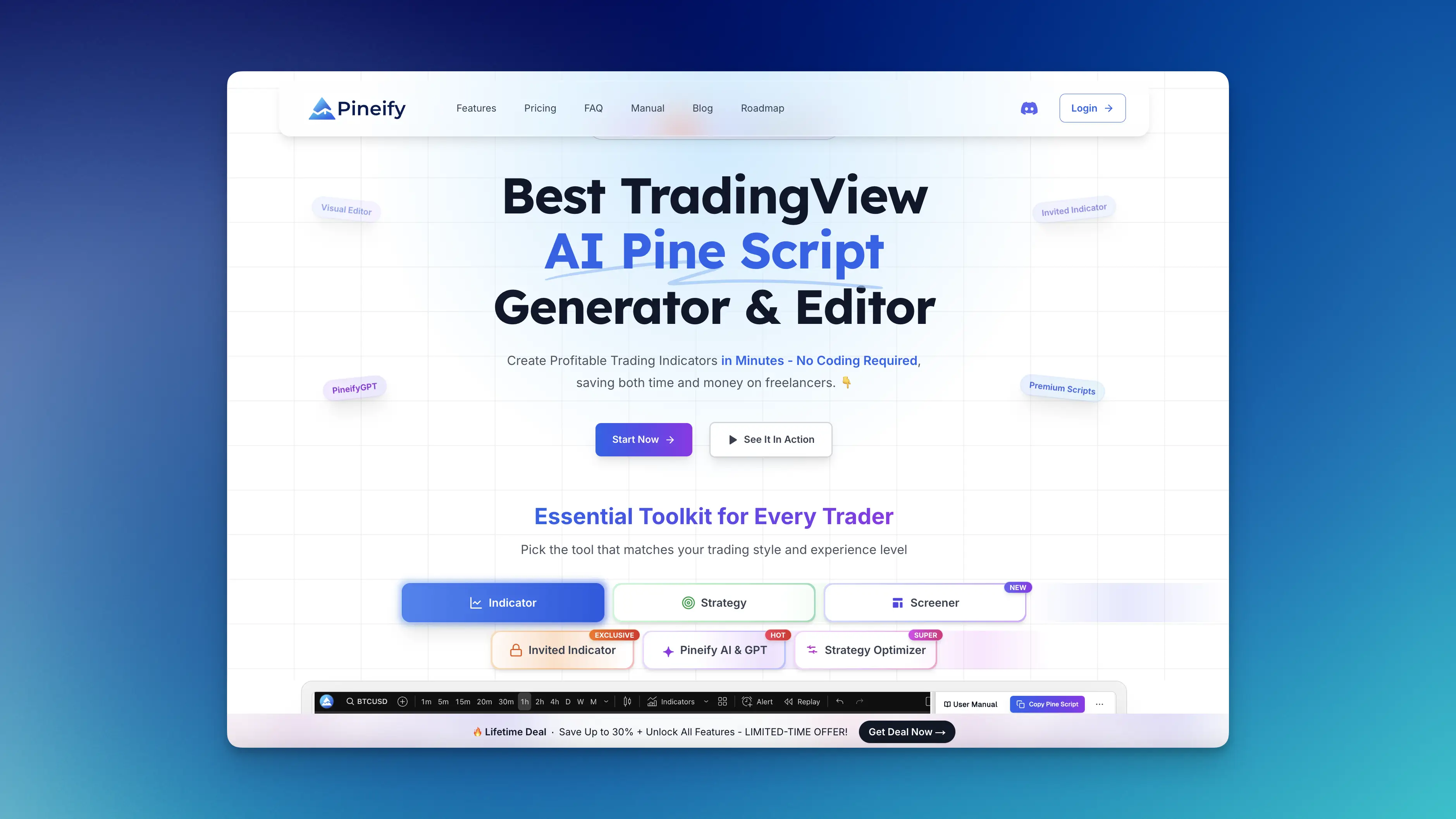
I prefer building strategies visually when I'm prototyping. Pineify's Visual Editor lets me drag RSI conditions onto a moving average filter, set stop-loss rules, pick timeframes — and it writes the Pine Script for me. Over 235 technical indicators are available. I don't touch a line of code until I'm ready to fine-tune edge cases.
AI That Knows Pine Script
The AI Coding Agent is specialized for TradingView's language, not a generic chatbot. I describe my strategy — "buy when RSI crosses below 30 on the 1-hour and price is above the 200 EMA" — and it generates production-ready Pine Script. It catches syntax errors before they hit the editor and remembers context from previous requests. I've used it to generate about 40 strategies this year alone.
Deep Report v2.0 Goes Beyond Basic Metrics
TradingView's Strategy Tester gives you profit, loss, and a win rate. Pineify's Deep Report adds Sharpe ratio, Sortino ratio, Monte Carlo simulations, rolling window analysis, and performance heatmaps by day of week and month. I exported my EUR/USD strategy's 2-year backtest into the report last month — it showed me the strategy had a profit cliff every December, which I never would have caught in the standard tester.
Automated Optimization
The Strategy Optimizer runs hundreds of parameter combinations automatically. I set a range for RSI period (10 to 30) and stop-loss (1% to 3%), and it finds the settings that maximize Sharpe ratio. Then I export the results to Excel and pick manually. It's not a magic button — you still need to check that the optimal parameters generalize to out-of-sample data.
One thing I haven't tested: Pineify's optimizer with very large parameter grids (10+ variables). The combinatorial explosion eats compute time, so I stick to 2-3 parameters per optimization run.
How to Backtest a Pine Script Strategy: My Step-by-Step
Here's my workflow when I'm testing a new strategy:
1. Open the Pine Editor. The tab is at the bottom of any TradingView chart. This is where the strategy code lives.
2. Get your strategy code. Write it yourself, use Pineify's visual builder, or describe it to the AI Coding Agent. Paste the final script into the editor.
3. Add to chart. Click "Add to Chart" to load the strategy and start processing historical data.
4. Open the Strategy Tester. The bar-graph tab on the right panel runs the simulation automatically.
5. Pick your test period intentionally. I tested a moving-average crossover on SPY from 2018 to 2023 to see how it handled both bull and bear regimes. Testing only 2020-2021 would have made any trend strategy look unstoppable.
6. Focus on these metrics first:
- Net Profit — Did the strategy make money overall?
- Max Drawdown — What's the worst peak-to-valley drop?
- Win Rate — Percentage of winning trades.
- Profit Factor — Gross profit divided by gross loss. Above 1.5 is decent.
- Sharpe Ratio — Risk-adjusted return. Higher is better.
7. Run a Deep Report. I upload the strategy's trade list to Pineify's Deep Report for the analytics TradingView's default screen doesn't show — rolling returns, Monte Carlo stress tests, monthly breakdowns.
8. Optimize, then verify out-of-sample. The Strategy Optimizer finds the best parameter combination on your training data. If the optimal settings are radically different from the default, that's a red flag. I always validate the optimized parameters on a separate time period before going live.
For more on exit logic, check the guide on Pine Script Strategy: Using Trailing Stops for Better Trading Results.
Common Backtesting Traps I've Hit
I've made most of these mistakes myself. Here's what to watch for:
- Over-optimization (curve fitting) — I once tuned a strategy's parameters until the backtest showed a 60% annual return. It lost money in the first month live. The parameters fit past noise, not future signal.
- Ignoring trading costs — Spreads, commissions, and slippage turn a 30% backtest into a break-even reality. TradingView lets you set these in the Strategy Tester — use them.
- Testing only one market regime — A strategy that crushes in bull markets can get destroyed in a sideways grind. Test across 2021 (bull), 2022 (bear), and 2023 (recovery).
- Survivorship bias — Testing only stocks that still trade today ignores all the delisted companies. The backtest looks better than reality because the failures are invisible.
- Neglecting exits and position sizing — Entry signals aren't a strategy. Without stop-losses and position sizing rules, you're testing a hunch, not a plan.
Pineify's Pricing
One payment, lifetime access. AI credits refresh monthly. No subscription treadmill.
| Plan | Price (One-Time) | AI Credits/Month | Highlights |
|---|---|---|---|
| Plus | $99 (was $129) | 500 | Visual editor, 235+ indicators, Coding Agent, 18 premium scripts pineify |
| Advanced | $149 (was $219) | 1,000 | Strategy Optimizer, Trading Journal, Backtest Deep Report, Signals & Overlays pineify |
| Expert | $259 (was $369) | 2,500 | Everything in Advanced + AI Stock Picker, 500 Advanced Model msgs/5h pineify |
All plans include future updates at no extra cost. And you only need a free TradingView account to use Pineify — no paid TradingView subscription required.
Frequently Asked Questions
Do I need to know Pine Script to use Pineify?
Not at all. You can build strategies by dragging blocks in the Visual Editor or describing your idea in plain English to the AI coding assistant. It writes the Pine Script for you.
Is Pine Script backtesting accurate enough for real trading decisions?
TradingView's backtester uses high-quality historical data, which is good for validating a strategy's core logic. Just make sure you enable slippage and add commission costs in the settings. And never go live based solely on a backtest.
What metrics should I prioritize in a backtest?
I look at Max Drawdown first — it tells you the worst pain you'd have endured. Then Profit Factor (above 1.5 is solid) and Sharpe Ratio for risk-adjusted returns. Pineify's Deep Report calculates all of these automatically.
How is Pineify different from just using TradingView's built-in strategy tester?
TradingView shows basic P&L. Pineify adds Monte Carlo simulations, rolling window analysis, performance heatmaps, and an optimizer. It turns the Strategy Tester into a full workshop rather than just a scoreboard.
Can I backtest crypto and forex strategies with Pine Script?
Yes. TradingView supports thousands of symbols across crypto, forex, stocks, indices, and futures. The backtesting process works the same across all markets.
Ready to put your strategy to the test?
- Sign up free at pineify.app. No paid TradingView subscription required.
- Build your strategy with the Visual Editor or AI agent. For more on displaying signals, see TradingView Plotchar: A Complete Guide to Visualizing Trading Signals on Your Charts.
- Backtest it in TradingView's Strategy Tester on the market and timeframe you trade.
- Analyze deeper by uploading results to Pineify's Deep Report for Monte Carlo, heatmaps, and rolling metrics.
- Optimize with the Strategy Optimizer, then verify the best parameters on out-of-sample data.
Got questions? Drop them below, share this with a trading partner, or browse Pineify's resource library for more strategy-building guides.