Best Paid Indicator TradingView: Pineify® - Signals & Overlays™ - The Ultimate All-in-One Trading Solution
Pineify® - Signals & Overlays™ is a standout tool on TradingView that simplifies the trading process. It brings everything together in one place, so you don’t have to deal with the common headache of using several different indicators that often give you mixed messages. This members-only tool combines key concepts like trend phases, momentum analysis, and risk management into a single, clear system. It only shows you a signal when everything—trend, momentum, and market volatility—lines up together.
Why This Tool Works for Focused Trading
Most traders start by adding lots of indicators to their charts. The trouble is, one might point to a buy while another suggests a sell, leaving you stuck trying to make sense of the noise. Pineify® - Signals & Overlays™ fixes this by working differently. It uses a built-in scoring system that checks each price bar across three separate areas: the trend direction, the strength of the momentum, and the current market volatility.
Think of it like getting a second opinion—but instead of asking three different experts, you have one system that checks all three factors at once. It only gives you a clear arrow or shades the chart when all parts of its analysis are in agreement, based on settings you control. This means fewer false alarms, less clutter on your screen, and more confidence when a signal does appear. It’s about getting a unified view that you can’t easily recreate by just stacking independent indicators on top of each other.
What Makes This Premium Indicator Tick
Reading Market Structure with Dow Theory
First, let’s talk about how it sees the market’s big picture. It uses the classic Dow Theory to spot two kinds of trends: the main direction (primary trend) and the smaller pullbacks or pauses within it (secondary trend). Think of it like watching the ocean—you see the powerful, underlying current (primary trend), but you also notice the waves rolling against it (secondary trends). This helps you tell the difference between a real shift in direction and just ordinary market noise, giving every trade important context.
The Dynamic EMA Cloud for Clear Trends
Instead of relying on one or two moving averages, this indicator uses a whole system of eight. It’s like having a team working together to paint a clearer picture. This approach can be particularly effective when combined with understanding various moving average types, such as those explored in the guide to the ALMA Indicator: How the Arnaud Legoux Moving Average Transforms Your Trading Strategy.
Four faster EMAs (5, 8, 20, 34) and four slower ones (9, 13, 21, 50) combine to create colored “clouds” on your chart. You don’t need to analyze crosses; you just look at the color:
- Blue or Green Clouds: The trend is likely bullish (up).
- Yellow or Red Clouds: The trend is likely bearish (down).
This setup creates smoother, more reliable trend visuals than a simple moving average crossover. Because it’s also weighted by trading volume, the clouds do a better job of reflecting what’s actually happening beneath the surface of the price action.
Timing Your Moves with QQE Momentum
Knowing the trend is one thing; knowing when to act is another. That’s where the QQE (Quantitative Qualitative Estimation) comes in. It’s a smart momentum tool built from RSI concepts but smoothed out to be much more stable. For traders looking to deepen their momentum analysis, exploring tools like the RSI Bands Indicator: How to Find Dynamic Support and Resistance That Actually Moves With the Market can provide additional layers of confirmation.
Using a specific, tuned setting (an RSI length of 14 and a 4.238 multiplier), it spots overbought and oversold conditions and potential reversals with less false chatter than a standard RSI. It gives clear “buy+” and “sell+” signals that are actually designed to be traded on.
To make it even sharper, it includes a counter that tracks how many candles have moved in one direction. After a long run (say, 8 candles in a row), it will only suggest a possible reversal if the QQE also shows a divergence—where price makes a new high or low but momentum doesn’t. This two-factor check helps filter out weaker signals.
Smart Stops That Adapt with Volatility (ATR-Based)
Your stop-loss shouldn’t be a fixed, arbitrary number. Markets breathe—they get volatile and then calm down. This indicator uses the Average True Range (ATR) to build a trailing stop that breathes with the market.
It uses a 21-period ATR with a dynamic multiplier. In simple terms:
- When the market gets jumpy and volatile, the stop-loss automatically widens to give your trade room to survive normal swings.
- When things are calm, the stop tightens up to better protect your profits.
This means you’re less likely to get knocked out of a good trade by a random spike, and your capital is guarded more closely when the market is quiet. It’s a practical way to manage risk based on what the market is actually doing, right now.
What Makes This Tool Stand Out: Premium Features Explained
Let's talk about what really sets this tool apart. These aren't just fancy extras; they're practical features designed to make your trading more precise and less stressful.
The Multi-Timeframe Confirmation Filter: Seeing the Bigger Picture
This feature is a real time-saver. Instead of you having to flip between different charts to check if the trend on your 15-minute chart also makes sense on the 1-hour chart, the tool does it for you—instantly.
It automatically looks at a higher timeframe (like checking the 1-hour trend when you're on a 15-minute chart) and only gives you a strong "Long ▲+" or "Short ▼+" signal if both timeframes agree. This helps you avoid getting tricked by small price moves that go against the main trend, so you're more likely to trade in the direction the market is actually headed.
Think of it as having a built-in second opinion that checks the broader context before you place a trade.
Stay Informed Without Staring at the Screen: The Alert System
You can't watch the charts all day, and you shouldn't have to. This tool comes with a full alert system that lets you know when something important happens, so you can step away with confidence. Understanding the full potential of your TradingView subscription is key; a detailed breakdown is available in our guide, How Much is TradingView Premium? A Complete Pricing Guide.
You can get notified for different types of market moves, including:
- New Trend Alerts: When a new uptrend or downtrend begins.
- Entry Signals: For standard and confirmed "Long ▲" or "Short ▼" opportunities.
- Reversal Warnings: For both major and minor potential trend reversals.
The best part? You can pick and choose exactly which alerts you want. If you only care about the strongest confirmed signals, you can set it up that way. It helps you filter out the noise and focus on your own strategy, which can seriously improve your daily routine.
Start Simple or Dive Deep: The Beginner Profile
Starting with a new indicator can be overwhelming. That’s why there's a simple "One-Click" profile that loads settings designed for safety and clarity, perfect if you're just getting familiar with it.
For traders who love to tweak and optimize, every single setting is still available. You can adjust:
- The sensitivity of the trend and momentum components.
- How many bars in a row define a trend.
- The multi-timeframe filter settings.
- You can even turn specific features on or off directly from the main menu.
This way, everyone gets what they need—a safe starting point for new users and complete control for experienced traders.
Why This Tool Can Be More Effective Than Free Options
No More Mixed Signals
Free indicators like RSI, MACD, and Bollinger Bands are great on their own. But when you try to use them together, they can often tell you different stories. One says buy, another says wait—it gets confusing. Pineify® - Signals & Overlays™ is built to handle that. It uses a built-in scoring system that only gives a signal when the trend, momentum, and volatility readings all agree.
This means you get fewer misleading hints and more reliable alerts. It's the difference between trying to interpret three separate, talking over each other, versus getting a single, clear message.
Get Hours of Your Day Back
Manually checking different timeframes and bouncing between multiple indicator windows eats up your day. It's tedious. This tool does that cross-referencing for you automatically. What used to take an hour of screen-scanning can now be summarized in seconds, letting you focus on your actual trading plan or looking for the next setup.
A Cleaner, Clearer Chart
A chart cluttered with dozens of lines, histograms, and squiggles is hard to read. It's visual noise. Pineify consolidates that information into a simpler system using color-coded areas and clear markers. You can understand what's happening in the market almost instantly, without the distraction. It helps you see the opportunity, not just the indicators.
One Method for All Your Trades
Whether you're looking at stocks, forex, crypto, or commodities, this tool works the same way. You don't have to learn one approach for forex and a totally different one for crypto. That consistency simplifies everything. It makes your analysis and decision-making process uniform, whether you're trading a tech stock or a currency pair.
Who Gets the Most Out of Pineify? A Look at Trader Styles
Pineify isn't a one-size-fits-all tool, but it naturally fits certain trading approaches like a glove. Here’s a breakdown of who tends to find the most immediate and lasting value.
For the Active Day Trader
If your world is measured in minutes and ticks, speed and a clear head are everything. Pineify is built for that pace. It generates signals quickly and uses multiple timeframes to help you avoid trades that go against the larger trend—a common pitfall. The charts are designed to be clean, and the alerts are instant, so you can make decisions confidently without having to untangle a messy screen.
For the Swing Trader
Your game is about catching those bigger moves over several days or weeks. The real trick is spotting a potential trend reversal early. Pineify’s strength is in bringing different pieces of analysis together to highlight those moments where the trend, momentum, and market volatility all hint at a coming change. Because it’s grounded in market structure, it gives you a solid framework to manage those longer-term positions.
If You're Just Starting Out
Beginning to trade can feel overwhelming. There’s too much information, and everyone seems to give different advice. This is where the One-Click Beginner Preset helps. It simplifies everything to cut through the noise. More importantly, it teaches you how to think by showing you how experienced traders look for setups—where multiple conditions line up to suggest a good opportunity. It’s less about giving you answers and more about building good habits from the start.
For Portfolio Managers
When you’re overseeing a diverse portfolio across stocks, forex, or other assets, you need a consistent way to evaluate everything. Pineify acts as that consistent lens. It lets you apply the same logical principles across all your different holdings. This uniformity is key—it allows for clearer strategic insights and helps in coordinating how you manage all your positions as a unified whole.
Getting Access and Understanding the Value
Pineify® - Signals & Overlays™ works on an invite-only basis. This means you’ll need to request permission from the creator to use it, which is usually granted once you’ve completed the purchase process. Think of it like getting a key to a specialized tool—it’s not publicly listed in the TradingView marketplace for just anyone to grab.
In terms of cost, it’s helpful to know that Pineify offers different tools. Their main platform for building indicators starts at $99. However, the Signals & Overlays indicator itself is separate and uses TradingView’s private model, so the exact price is set by the author.
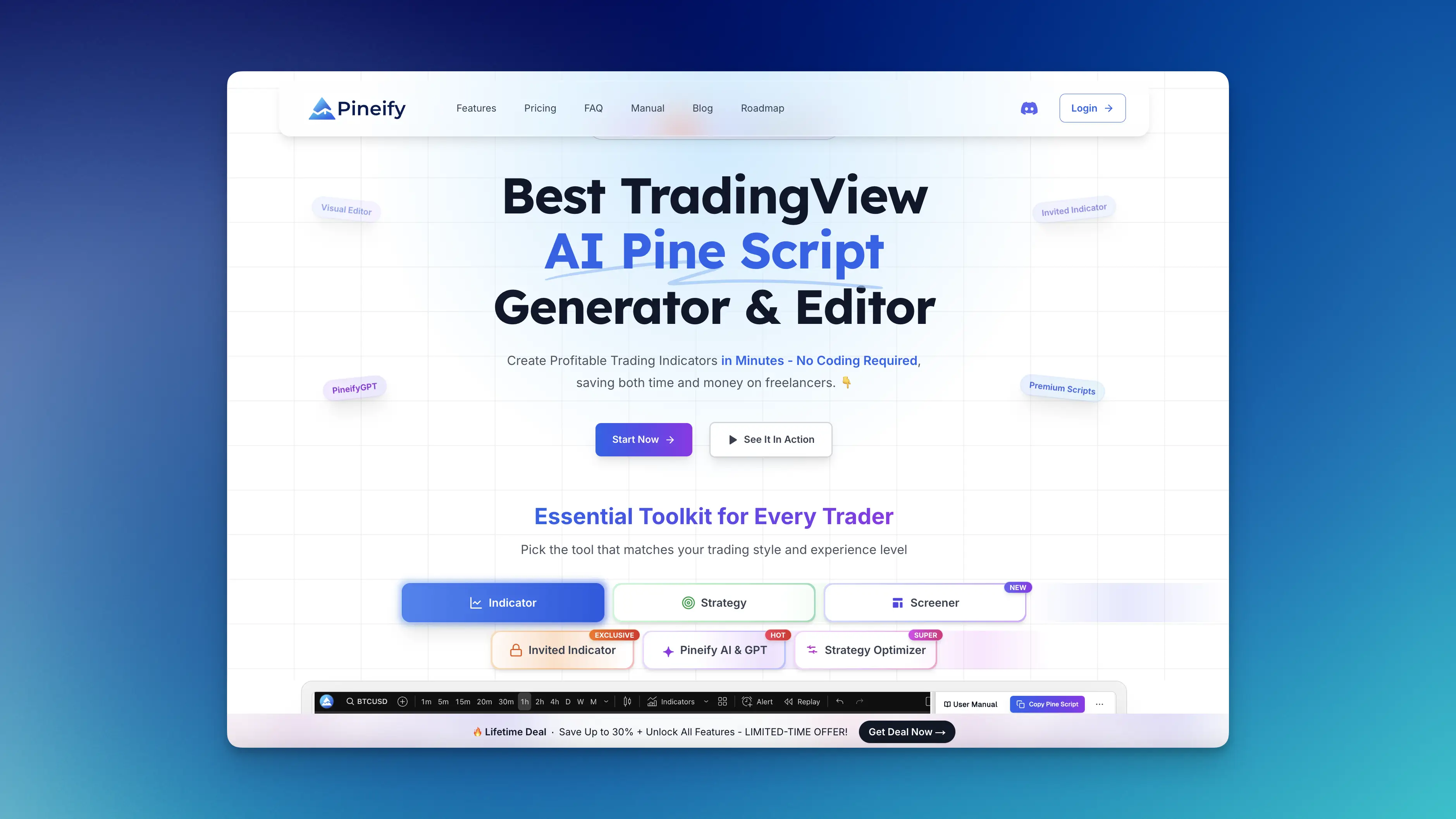
This main platform, accessible at pineify.app, is where the real magic happens for most traders. It's the all-in-one Pine Script generator and editor that lets you build custom indicators, strategies, and even screeners visually—no coding required. It's designed to save you the time and expense of hiring a freelancer, putting the power to create your own proprietary trading tools directly in your hands. For a practical example of this power, see our tutorial on How to Backtest a Trading Strategy in the Pineify Strategy Editor.
Here’s a quick breakdown for clarity:
| Product / Offering | Starting Price | Access Model |
|---|---|---|
| Pineify Indicator Platform | $99 | Direct Purchase |
| Signals & Overlays Indicator | Variable | Invite-Only (Author sets price) |
This approach reflects the careful work that goes into a tool that combines several strategies into one seamless system. If you’re interested, the best way to get current pricing and an invite is to reach out to Pineify directly. You can visit their website at pineify.app or join their Discord community—the details and instructions are all there. It’s the most straightforward way to start the conversation.
Questions & Answers
Do I need to know how to code to use Pineify® - Signals & Overlays™?
Not at all. Think of it like adding an app to your phone. It’s a ready-made tool you simply add to your TradingView chart. Everything is controlled through a straightforward settings panel you click through. It’s built for traders, not developers.
Will this work if I’m on TradingView’s free plan?
Yes, it works perfectly with a free TradingView account. One thing to know: the free plan limits you to adding 3 indicators to a single chart. Since Pineify® - Signals & Overlays™ combines several types of analysis into one tool, it actually helps you get more out of those limited slots.
How is this different from other popular tools like LuxAlgo or Zeiierman?
That’s a great question. It’s helpful to understand what makes each tool unique.
| Provider | Known For | Pineify's Key Difference |
|---|---|---|
| LuxAlgo | Huge community, various trend visuals, and AI analytics. | Focuses on a unified scoring system that blends trend, momentum, and volatility. |
| Zeiierman | Specialized tools for liquidity and "smart money" concepts. | Emphasizes synchronized verification—all its internal parts must agree before giving a signal. |
The main idea is that Pineify condenses multiple checks into one cohesive system, aiming for higher-confidence signals when everything lines up.
Can I change the settings, or am I stuck with the defaults?
You have full control. There’s a "One-Click" profile with safe, beginner-friendly defaults to get you started. But if you like to tweak things, you can adjust everything: the moving average lengths, volatility settings, signal thresholds, and more. You can even turn individual parts of the indicator on or off.
Should I try this on past market data before using it live?
100% yes. The creator strongly suggests you do this. Spending time backtesting on historical charts helps you see how the signals played out in different market conditions. It’s the best way to figure out if it fits with how you like to trade and how much risk you’re comfortable with before using real money.
Why is the multi-timeframe filter such a useful feature?
It acts like an automatic "sense-check." Before a signal is confirmed, this filter quickly looks at a bigger picture timeframe (like the 1-hour chart if you’re trading on 15 minutes) to see if the overall trend is in the same direction. This simple step can stop you from taking trades that look good on your chart but are actually going against the larger trend, helping to filter out misleading signals.
What to Do Next: Make Your Trading Clearer Starting Today
Feeling unsure when you trade, or hesitating at the moment you should act, often happens when your tools are fighting each other. If messy charts and mixed signals are making your decisions harder, making one change now can set you on a better path.
Here’s how to get started:
1. Request Your Access Head to the Pineify® - Signals & Overlays™ page on TradingView, or reach out directly through pineify.app to get on the invite list. You can also join the Discord community at discord.gg/ynke2deT2u to talk with other traders and find help.
2. Begin with the Simple Setup Once you’re in, turn on the One-Click beginner preset. This lets you see how a unified set of signals works, without the noise of a dozen separate indicators. It’s a safe, straightforward way to get a feel for how everything flows together.
3. Set Your Alerts Configure notifications for the symbols you watch most and the signal types you prefer. This way, you can step away from the screen and still get a nudge when a setup that matches your strategy appears.
4. Test It Thoroughly Spend some time backtesting the tool on your favorite charts and timeframes. See how it acts in different markets—when things are trending strongly versus when they’re choppy and range-bound. Tweak the settings until they fit your style and comfort level.
5. Always Manage Your Risk Remember, Pineify® - Signals & Overlays™ is a tool for information and learning. It’s not financial advice. No indicator replaces solid risk management. That means using stop-losses, being smart about your position sizes, and always protecting your capital first.
6. Learn with Others Jump into the Discord and other trading forums where Pineify users share ideas. Seeing how more experienced traders have things set up can shortcut your learning curve and show you clever uses you might not have thought of on your own.
Moving from confusion to clarity often starts by choosing tools that are built to work together, not apart. You’re not alone in wanting a cleaner approach—over 32,000 traders are already using Pineify to move away from guesswork and toward a more systematic way of trading. Your first step toward clearer charts and more confident decisions is right here.