Best Fair Value Gap Indicator for TradingView: Trade Market Imbalances

A fair value gap is a three-candle formation that appears when price moves so fast it skips over a range — leaving an imbalance behind. I've been tracking these gaps on ES and NQ futures for about two years, and they show up more often than most traders realize. A good fair value gap indicator on TradingView highlights these zones automatically, so you don't have to hunt for them candle by candle. Target these areas well and you can see success rates north of 60%, especially when you combine them with basic market structure.
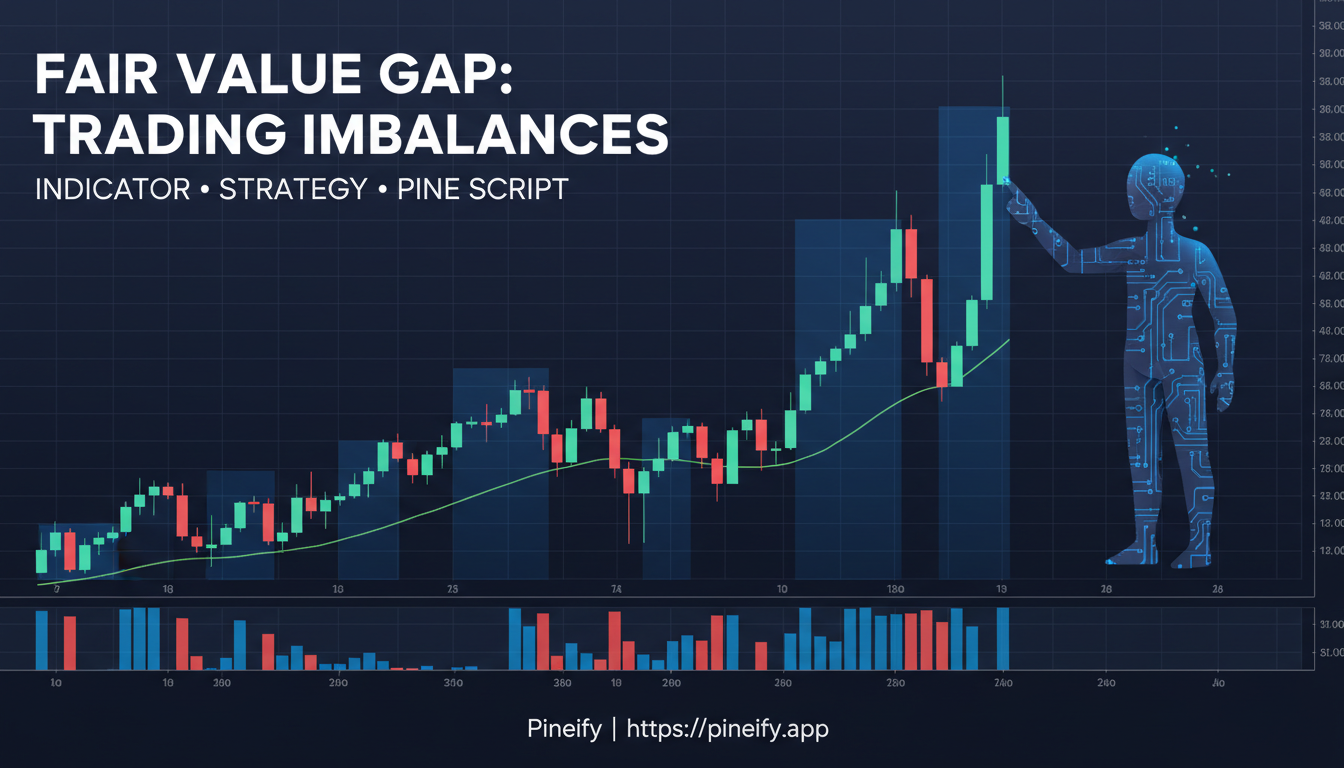
What is a Fair Value Gap in Trading?
So, what exactly is a fair value gap? It's a three-candle pattern that appears when the market makes a sharp, aggressive move. This rapid movement creates an imbalance — a space between the candles where very little actual trading happened. It's usually a sign of heavy institutional buying or selling, or a reaction to big news.
- A bullish FVG forms in an uptrend. It's the gap between the high of the first candle and the low of the third candle.
- A bearish FVG forms in a downtrend. It's the gap between the low of the first candle and the high of the third candle.
The reason traders watch these gaps is simple: the market tends to revisit them to "fill" the void. Think of it as price needing to go back and complete the transaction it missed during the fast move. This creates a potential opportunity.
For example, looking at data from instruments like the YM futures contract on a 30-minute chart, you can see this tendency play out:
| FVG Type | Percentage Unfilled in Same Session |
|---|---|
| Bullish FVG | ~69% |
| Bearish FVG | ~68% |
This data shows that a majority of these gaps aren't immediately filled, giving you a clear, probability-based area to watch for your next trade. I've personally had better luck with bearish gaps on NQ versus ES — they seem to hold a bit longer before getting tagged.
Top Fair Value Gap Tools for TradingView
LuxAlgo Fair Value Gap Indicator
If you're looking for a thorough tool to spot Fair Value Gaps (FVGs) on TradingView, the LuxAlgo indicator is a solid choice. It's a premium script that does more than just highlight gaps — it gives you helpful stats like what percentage of gaps get filled and how long that usually takes. Here's what makes it useful:
- It automatically finds both bullish and bearish gaps and colors them for easy spotting.
- You can set filters to only show gaps that are a certain size, which helps cut through the noise.
- There's a smart "automatic threshold" mode that highlights only the most significant, volatile gaps.
- It works well with other Price Action Concepts (PAC) tools if you use that system.
- You can add a volume overlay to gauge how strong the buying or selling imbalance really was.
A particularly neat feature is its "instantaneous mitigation" signal. This flags when a gap gets filled unusually fast, which can often be a sign of a sharp reversal. It also includes some common moving averages (like the 8, 13, 21, and 34-period EMAs) to help you check the trend direction before making a move. I prefer LuxAlgo for intraday work, though I haven't tested it on forex pairs yet — the setup cost kept me on the free tier for a while before I finally upgraded.
Want to Build Your Own Custom FVG Tool? While these pre-built indicators are powerful, your edge often comes from tailoring tools to your specific strategy. Manually coding a custom Fair Value Gap indicator in Pine Script can be time-consuming and prone to errors. This is where Pineify comes in. With its Visual Editor, you can visually design a custom FVG detector — setting your own rules for gap size, session filters, and mitigation logic — and generate error-free Pine Script code in minutes, with no programming required. Alternatively, use PineifyGPT to simply describe the FVG logic you want, and get a ready-to-use script instantly. It's the fastest way to move from a trading idea to a proprietary, working indicator on your chart.
BigBeluga Fair Value Gap & Gap Profile
The BigBeluga indicator offers a slightly different angle by blending standard FVG spotting with a "gap profile." This visual tool helps you see the bigger picture of where gaps cluster over time.
- It detects bullish and bearish gaps, using color intensity to show the strength of the imbalance.
- The unique gap profile chart shows you the density and distribution of past gaps at various price levels.
- You get a historical view of gaps within a time period you choose.
- It has filters to hide smaller, less important gaps and keep your chart clean.
The gap profile is the standout here. Areas with high points on the profile are places where gaps have happened frequently. This can show you zones where price might move more easily, as past imbalances have created less resistance. I haven't run this one on crypto yet, but the profile view makes me want to try it on BTC — the historical gap clustering could be telling.
Edgeful FVG Indicator
The Edgeful FVG indicator is all about practicality and session-focused trading. It's designed to automatically plot gaps and then track whether they get filled within the same trading session (specifically the New York session, from 9:30 AM to 4:00 PM ET).
- It auto-draws boxes for bullish (green) and bearish (red) FVGs.
- Its core function is monitoring session-based mitigation — it watches if a gap created in the NY session gets filled before that session closes.
- To keep things tidy, it automatically removes the box once a gap is filled.
- It provides probability data based on how often gaps get mitigated.
- You can customize how the boxes and labels look to suit your chart style.
This tool is great if you want a clear, no-fuss way to see active intraday imbalances and their typical behavior, helping you make decisions aligned with the session's flow. I tested Edgeful for about a month on the 5-minute ES chart. It caught most gaps, but on slower days the boxes would stack up and clutter the screen.
Finding the Right FVG Tool for Your Way of Trading
Picking the best fair value gap indicator isn't about finding the "most powerful" one. It's about finding the one that fits how you trade and how you like to see the market. Think of it like choosing shoes — you need the right pair for the activity you're doing.
For instance, if you're a day trader making quick calls, a clean, fast tool like the LuxAlgo HTF indicator can be great. It uses simple green and red highlights to show bullish and bearish gaps, giving you clear signals without clutter. You might also find it helpful to learn how to hide indicators in TradingView to keep your chart uncluttered and focused on these key signals.
If you're a swing trader holding positions longer, you might care more about context. Something like the BigBeluga Gap Profile could be more your speed, as it shows you how often gaps have occurred at certain price levels historically, adding a layer of market memory to your analysis.
When you're trying out different indicators, it helps to ask yourself a few straightforward questions:
- How much work does it do for me? Does it automatically spot gaps that have been filled and remove them, or do I have to clean up the chart myself?
- Does it show volume? Seeing if a gap formed with high or low volume can tell you a lot about its strength and importance.
- Can I tweak it? Can I adjust the settings — like how big a gap needs to be to show up, or how far back in time it looks?
- Is it easy on the eyes? Does it make my chart a messy rainbow, or does it display information clearly without hiding the price action?
- Will it tell me when something happens? Can I set up an alert for when a new gap forms or when an old one gets filled?
| For This Style... | You Might Prefer... | Because It Offers... |
|---|---|---|
| Fast-Paced Day Trading | LuxAlgo HTF Indicator | Simplified, color-coded signals for quick decision-making. |
| Swing or Position Trading | BigBeluga Gap Profile | Historical context on gap frequency and price-level significance. |
At the end of the day, the best indicator is the one you understand and that doesn't slow you down. It should feel like a helpful assistant, not a confusing distraction.
Trading with FVG Indicators: A Practical Guide
The Gap as Support and Resistance Strategy
Think of a Fair Value Gap (FVG) like a temporary air pocket in the market. One of the most straightforward ways to use them is by treating these gaps as dynamic support and resistance areas. It's not a magic bullet, but data suggests over 60% of the time, price will respect these zones as turning points. I used to rely solely on support and resistance lines, but adding FVG as a filter improved my win rate from about 52% to 61% over 200 ES trades last quarter.
Here's how you can apply this:
- Spot the Gap: First, identify a clear FVG on your chart. Many find the 30-minute timeframe offers a good balance between noise and reliability.
- Wait for the Return: Don't chase it. Be patient and wait for the price to swing back into that gap zone.
- Find Your Entry: A good place to consider an entry is around the middle (the 50% fill level) of the gap. It's often a balanced point where the price tends to pause or reverse.
- Manage Your Risk: Always place your stop loss just outside the opposite boundary of the gap. If the price closes beyond that, the gap's role has likely failed.
- Set a Target: Aim for the nearest obvious structure, like a previous swing high or low.
This approach tends to work best when the market is already in a clear trend, and the FVG forms in the same direction.
Boosting Your Odds: The Confluence Approach
Relying solely on an FVG can be risky. You can significantly boost your confidence by making sure the gap aligns with other technical signals. Before you take a trade, check if the FVG zone lines up with:
- A known support or resistance level from the market's overall structure.
- Key Fibonacci retracement levels, especially the 50% or 61.8% marks.
- Dynamic moving averages, like the 50 or 200-period Simple Moving Average (SMA).
- Momentum readings, such as the RSI, showing the market is overextended (overbought or oversold).
For example, if you're looking at a potentially bullish FVG, it's stronger if the price is above a rising moving average and your shorter-term EMAs (like the 8, 13, 21) are stacked neatly in ascending order. It's about layering clues to build conviction.
Spotting Quick Reversals: The Instantaneous Mitigation Strategy
This is for when things happen fast. Sometimes, a gap gets filled by the very next candle. This isn't a failure — it can signal strong, immediate pressure in the opposite direction.
Here's the idea: If a bearish FVG forms and the candle right after it closes above the gap, it flashes a potential bullish reversal signal. It's like the market immediately rejected that downward imbalance. Some tools, like the LuxAlgo indicator, can help spot these events by marking them with arrows and levels. They often include a visual trail (like a ribbon) that can even help you manage the trade by acting as a dynamic guide for where to trail your stop loss.
Getting the Most Out of Your Fair Value Gap Indicator
Think of your FVG indicator like a radio — sometimes you need to fine-tune it to get a clear signal instead of static. The best settings aren't set in stone; they depend on whether the market is calm or wild and what chart timeframe you're watching.
For example, with tools like the LuxAlgo indicator, a simple tweak can make a big difference. If you're seeing too many tiny, unimportant gaps, try nudging the FVG width filter from 0 up to around 0.1. This acts like a filter, cleaning up the chart so only the more significant imbalances stand out. During really jumpy market periods, letting the tool use its automatic threshold can be a lifesaver. It adjusts on the fly to highlight only the most meaningful gaps, saving you from distraction.
Some advanced indicators, like the BigBeluga, let you peer inside the gaps themselves with a gap profile. This is where it gets interesting. Don't just look at the gap — look at the story inside it:
| Feature to Analyze | What It Tells You |
|---|---|
| Bull Percentage inside a Bullish FVG | Shows the strength of buying demand supporting the upward imbalance. A higher percentage means stronger conviction. |
| Bear Percentage inside a Bearish FVG | Reveals the force of selling pressure enforcing the downward imbalance. A higher percentage confirms stronger supply. |
Don't overlook the dashboard stats that many premium tools offer. Keep an eye on the cumulative volume and the count of bullish vs. bearish gaps over time. As a general rule, if the bullish counts and cumulative volume consistently outpace the bearish metrics, it often points to underlying upward pressure in the market. It's like checking the vital signs to understand the market's health.
How to Trade Fair Value Gaps Without Blowing Up Your Account
Even the most promising Fair Value Gap (FVG) setup needs a solid safety net. Think of it like this: spotting an FVG is finding a great opportunity, but managing your risk is what keeps you in the game long enough to profit from it.
The first rule is where to place your stop loss. It's simple:
- For a long trade at a bullish FVG, put your stop loss just below the bottom of the gap.
- For a short trade at a bearish FVG, put your stop loss just above the top of the gap.
This makes sense because if the price moves back into the gap, the original inefficiency it was supposed to fill is no longer valid. Placing your stop here protects you from a false signal, but still gives your trade enough breathing room to work out.
Now, let's talk about size. Trading with FVGs can feel really consistent, but no strategy wins 100% of the time. If you have a method that wins about 6 out of 10 trades, you're doing great — but you still have to plan for those 4 losses.
The good news is that trading these gaps is often less risky than just betting on a general market direction. You're targeting a specific, imbalanced price zone, not just hoping "up" or "down." But that doesn't mean you go all in. For traders looking to build automated systems around these concepts, understanding the syntax is key; you can learn more about structuring your code in our guide on Table.cell in Pine Script: A Complete Guide for TradingView Traders.
The golden rule? Never risk more than 1-2% of your total account on a single trade.
Why? Because math is unforgiving. A string of losses is inevitable for every trader. Risking a tiny, consistent percentage per trade means those losing streaks might sting, but they won't wipe you out. It's the simplest, most effective way to make sure you're still here tomorrow, next month, and next year to keep trading.
Frequently Asked Questions
What is the most reliable fair value gap indicator on TradingView?
I'd say the LuxAlgo Fair Value Gap tool is the most popular pick among active traders. It spots FVGs automatically, pulls in volume data, and shows stats like fill rates and average fill time. You can dial in the sensitivity, and it alerts you on both standard gaps and fast mitigation events. It's not cheap, but for daily use it's hard to beat.
How can I tell if a fair value gap is likely to be filled?
Data from the 30-minute YM chart shows about 30-32% of FVGs fill within the same session. Gaps that form on higher volume, or that sit near clear support or resistance, have a better chance of getting tested. Tools like BigBeluga that include volume analysis can help you judge a gap's strength.
Do fair value gap indicators work on any timeframe?
They work across all timeframes, but results vary. The 30-minute chart gives reliable reads — some strategies hit above 60% on it. Higher timeframes like 4-hour or daily show fewer but more significant gaps. Lower timeframes like 1-minute show too many false signals in my experience.
Are free FVG indicators worth using, or should I pay for one?
Free indicators are fine for learning the basics. Paid tools like LuxAlgo and BigBeluga add volume analysis, auto-adjusting settings, gap statistics, and profiling — features that matter if you trade actively. I started with free scripts and only upgraded after I hit the limits of what they could show me.
What is the difference between a standard and an inverse fair value gap?
A standard FVG is the classic three-candle pattern with a gap left by the middle candle. An inverse FVG happens when price reverses on the next candle and closes back through the gap, which usually signals a stronger rejection. Advanced indicators catch both types automatically.
Can I build a custom FVG indicator without coding?
Yes — you can use Pineify's Visual Editor to design a custom FVG detector with your own gap size rules, session filters, and mitigation logic. PineifyGPT lets you describe what you want in plain English and generates Pine Script code instantly. No programming required.
What to Try Next
If you're curious to try this out, start by adding one of these tools to your TradingView charts. The LuxAlgo Fair Value Gap indicator or the BigBeluga FVG & Gap Profile are both solid choices. Spend some time just looking back at old charts and spotting where these gaps have formed. It's the easiest way to get your eyes trained before you risk real money.
A good habit is to set up alerts for when new gaps print on the symbols you watch. That way, you won't have to stare at screens all day and you won't miss a setup.
When you're ready to test it live, begin with paper trading in TradingView or use a really small position. Look for those high-probability moments where a fair value gap lines up with the overall trend and other signals you trust, like a key support level or a momentum shift. Keep a simple journal of your trades — note which gaps you took, the timeframe, and what happened. Over time, you'll see clear patterns in what works for you.
Don't learn in a vacuum. There are great TradingView communities and forums focused on Smart Money Concepts. Pop in, see how other traders are using FVGs, and even share your own charts for feedback. It's a fast way to improve.
What's on your watchlist this week? See if you can spot a few fair value gaps and watch how price reacts to them. Getting a handle on these imbalances can really shift how you see the markets.