Best Consolidation Indicator TradingView: Complete Guide to Identifying Price Compression Zones

· 17 min read

Finding the quiet moments in the market can be just as important as catching the big swings. Those times when the price seems to take a breather, coiling up in a tight range, are called consolidation periods. Spotting these phases can give you a huge edge, as they often lead to powerful breakout moves. This guide will walk you through some of the most effective tools on TradingView to help you identify these setups for yourself.

Best Consolidation Indicator TradingView: Complete Guide to Identifying Price Compression Zones

What Does Consolidation Look Like?

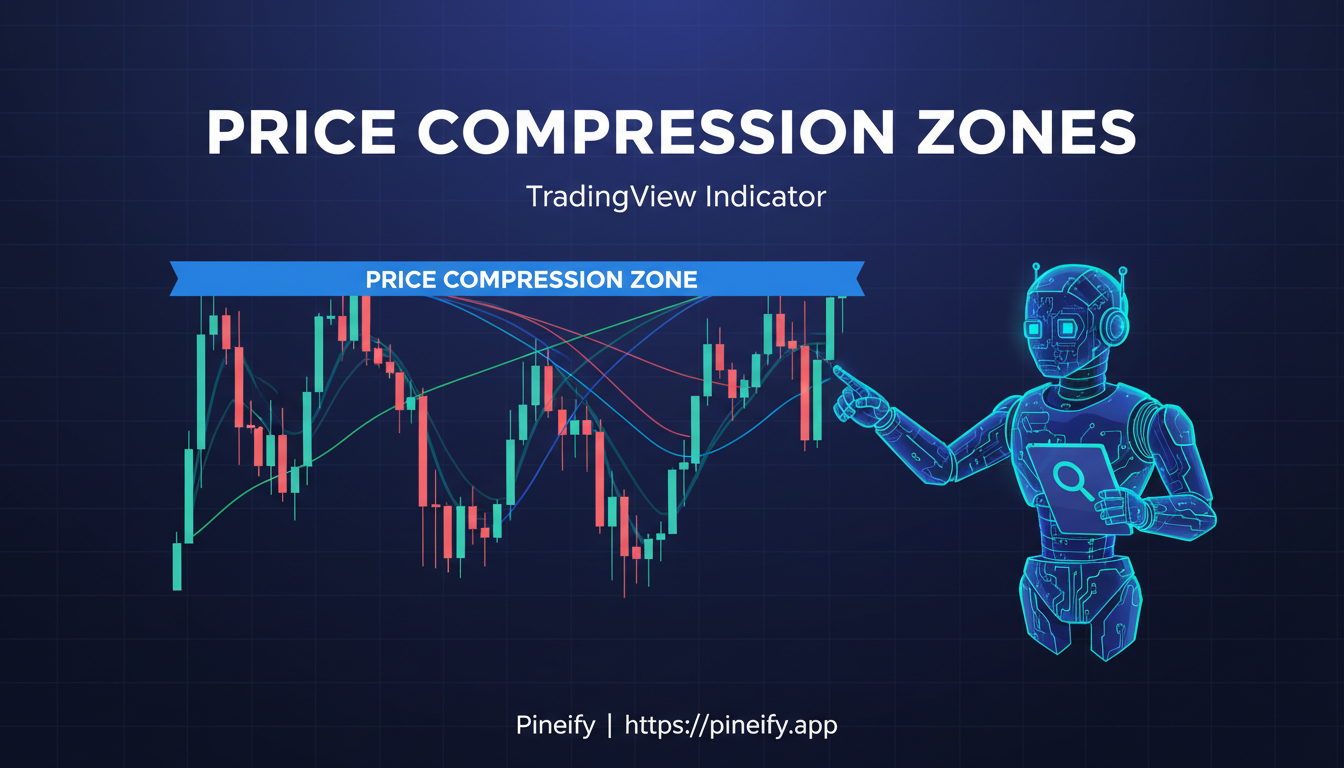
Think of consolidation as the market catching its breath. The asset's price starts moving sideways, the wild ups and downs calm down, and trading volume tends to drop off. It's a period of indecision, where the price gets stuck between a clear floor (support) and a ceiling (resistance), forming a horizontal channel.

These quiet zones are valuable because all that compressed energy often needs to go somewhere. When the price finally breaks out of its range, the move can be significant.

Here's what to keep an eye out for:

CharacteristicWhat It Means in Plain Terms
Horizontal ChannelsThe price keeps bouncing between two clear levels, creating a well-defined range.
Tight CompressionThe candlesticks get smaller and cluster together, showing a loss of momentum.
Decreased VolumeTrading activity quiets down noticeably, without any big, sudden spikes in volume.

By learning to recognize these signs, you can position yourself before the market makes its next decisive move.

Top TradingView Consolidation Indicators

Spotting those tight, sideways price ranges—what we call consolidation—can give you a huge heads-up before a big move happens. It's like the market is taking a deep breath before its next leap. Here are a few really smart tools on TradingView that help you spot these zones easily.

Consolidation Detector by LHAMA-Trading

Think of this as your all-in-one lookout for spotting when the price gets "stuck." The Top Consolidation Detector doesn't rely on just one method; it uses three different checks to make sure it's really seeing a consolidation zone.

Here's how it works:

  • Dollar Range Analysis: It watches to see if the price is moving within a specific, small price range.
  • ATR Comparison: It checks if the current market noise is much quieter than it has been recently.
  • Rate of Change Filter: This adds a final check on momentum to confirm things have truly slowed down.

You'll see these zones marked right on your chart. Purple boxes show you where past consolidations happened, and dashed boxes highlight ones that are still forming. To keep your chart from getting too cluttered, it only shows the 50 most recent boxes. Plus, you can set it to alert you the moment a new consolidation starts or when the price finally breaks out of one.

Consolidation & Head and Shoulders Scanner

This tool is like having a personal assistant that constantly scans the markets for you. It automatically hunts for not just consolidation patterns, but also the classic Head and Shoulders formation across many different charts at the same time.

What makes it powerful is its ability to:

  • Run completely on its own, monitoring up to 20 different symbols and timeframes simultaneously.
  • Find patterns based on swing points, which makes its detections very precise.
  • Let you adjust how big or how "perfect" a pattern needs to be before it gets flagged.
  • Send you an alert when a breakout is happening.

It even provides a handy table to see all your monitored symbols and their status at a glance. Since it works on your chosen timeframe, the patterns it finds are always relevant to how you trade.

Consolidation Range Detector

If you want a straightforward tool that clearly marks consolidation periods right on your chart, this is a fantastic choice. The Consolidation Range Detector uses smart math to find these quiet periods and then validates them using Average True Range (ATR) to ensure they're meaningful.

The best part is you can tweak it to your liking:

  • Set the minimum number of bars for a consolidation to be valid.
  • Control how "tight" the range needs to be by setting a maximum range as a multiple of the ATR.
  • Adjust the detection sensitivity to catch tighter or looser formations.

To make it easy on the eyes, it has a dynamic coloring system. You can let it pick random colors or set a fixed one that works best with your chart's background.

How to Spot When a Market is Taking a Breather: Key Technical Tools

Bollinger Bands Squeeze

Think of Bollinger Bands as a way to see the market's "vital signs." One of the clearest signals they give is called a "squeeze." This happens when the upper and lower bands move closer together, pinching the price action. It's a strong hint that the market is coiling up, taking a pause, and could be getting ready for its next big move.

The most telling squeezes are the ones that get progressively tighter over several days or weeks, showing that volatility has really died down. The key is to wait for this significant contraction before anticipating a breakout. A strong, decisive candle closing outside of the bands is often your confirmation that the move is starting.

Average True Range (ATR)

The Average True Range (ATR) is your go-to tool for measuring how jumpy a stock or currency pair is. When the ATR line starts to fall and tighten up, it's a direct sign that the price swings are getting smaller. This quiet period is what we call consolidation.

Many savvy traders use ATR as a reality check. It helps confirm that what you're seeing is a genuine period of rest in the market, and not just a random, quiet day. This extra validation step helps filter out false alarms and makes your consolidation spotting much more reliable.

Average Directional Index (ADX)

The ADX is all about measuring the strength of a trend. Its real power for our purposes, though, is in what it tells you when it's low. A falling ADX reading, especially when it dips below 20, is basically the indicator's way of saying, "There's no strong trend here right now."

When you see a weak ADX reading paired with price action that's just moving sideways, you have a compelling case for consolidation. It helps you tell the difference between a market that's truly stuck in a range and one that's just catching its breath before continuing its prior trend.

Donchian Channels

Donchian Channels simply draw a box around the price by marking the highest high and lowest low over a set period (like the last 20 days). The width of this channel tells you a story. It widens when things are volatile and contracts when the market is consolidating.

These periods of contraction are like a spring being compressed. The tighter the channel gets, the more potential energy is building up, often leading to a significant price move. Watching for this compression allows you to get ready for the breakout, helping you time your entry better and manage your risk.

Volume Profile

While most volume indicators look at when volume occurred, Volume Profile shows you where it happened—at which price levels. It identifies price zones where a huge amount of trading took place. These high-volume areas, often called "nodes," are like financial footprints.

These footprints mark important consolidation areas that the market remembers. In the future, these same levels often become major support (a floor) or resistance (a ceiling). By spotting these high-volume zones, you can make more informed decisions about where to enter a trade, place a stop-loss, or take profits.

How to Combine Indicators for Better Accuracy

If you really want to spot a market consolidation accurately, the trick is to never rely on just one signal. Think of it like getting multiple opinions before making a big decision—it just makes you more confident.

The most reliable confirmation happens when you see several things line up at once:

  • The Bollinger Bands squeeze together tightly.
  • The ADX indicator drops down below 20.
  • The moving averages on your chart flatten out and stop trending.

When all of these happen together, it's a much clearer sign that the market is taking a breather and a new breakout is likely brewing.

Using this multi-indicator approach helps you plan your next move with more conviction. You can set up your breakout trades knowing you've waited for clear signs, which makes managing your risk a whole lot simpler. When different technical tools all tell you the same story, it greatly increases your chances of successfully catching that next big move.

Getting Your Settings Just Right

Getting the Top Consolidation Detector on TradingView to work perfectly for you is all about tweaking a few key settings. Think of it like adjusting the seat and mirrors in a car before you drive—it just makes everything fit better for how you trade.

The main thing you'll play with is the consolidation size. This setting directly controls what kind of patterns you'll see:

  • A larger size setting will pick out bigger, broader consolidation patterns.
  • A smaller size setting will find tighter, more compact areas where the price is coiling up.

A great way to start is with the default settings, which are already a solid foundation for most stocks and timeframes. From there, the best approach is to enable the debug mode. This lets you peek behind the curtain and see exactly when and why the script detects a consolidation, which is incredibly helpful for fine-tuning.

Here's a quick guide on what to adjust:

Setting to AdjustWhat It Does & How to Think About It
Maximum RangeThis sets how wide the price range can be during the consolidation. Adjust this based on how volatile your chosen stock or crypto normally is. A calm stock needs a smaller range; a wild one needs a bigger one.
ATR ThresholdThis acts as a filter for noise. A higher ATR setting means it will ignore smaller, less significant moves, making the signals more reliable but potentially fewer. A lower setting makes it more sensitive.
Minimum BarsThis determines how long the price has to be stuck in a range before it counts. It's the balance between getting an early signal and waiting for a more established pattern to confirm.

It really comes down to finding your own personal sweet spot between sensitivity (catching more setups) and reliability (making sure the setups are high-quality). Don't be afraid to experiment a little on a chart you know well.

Trading Strategies Using Consolidation Indicators

The Breakout Trading Approach

Think of a consolidation zone like a coiled spring. The price is essentially gathering energy, which often leads to a significant move. A breakout strategy is all about catching that move right as it starts.

Here's how it often plays out: traders wait for the price to make a strong, decisive push above the top of the range or below the bottom. The key is confirmation. You want to see this happen with higher-than-usual trading volume and for the price to close strongly beyond the boundary, not just poke its head out and retreat.

An interesting thing to note is that the tighter and more compressed the range, the more powerful the eventual breakout tends to be. It's that built-up energy finally being released. To manage this, many traders set alerts for when a consolidation pattern is completing. This lets you keep an eye on multiple potential setups without having to stare at the screen all day.

The Range Trading Strategy

While some traders wait for a breakout, others thrive within the consolidation itself. This range trading strategy is about playing the bounce. The idea is straightforward: you look to buy when the price gets down to the established support (the bottom of the range) and sell when it approaches resistance (the top of the range).

This is where a tool like the Consolidation Range Detector becomes really helpful. It turns what might look like random market noise into a clear map of potential opportunities.

To help decide which ranges are worth your attention, some indicators assign a "strength score" to a consolidation. This score helps you gauge the potential of the range:

Strength ScoreWhat It Typically Suggests
70 - 100A strong, well-defined consolidation. These have higher potential for an explosive move when the price finally breaks out.
Below 70A weaker or choppier range. It might continue to drift sideways without a clear direction for a while.

The Upsides and Downsides of Consolidation Indicators

Let's talk about why these tools are so helpful, but also where they fall short. It's like having a super-powered assistant for your trading.

The biggest advantage is that they save you a ton of time. Instead of you manually scanning dozens of charts looking for those tight, coiled-up price ranges (consolidations), the indicator does it for you automatically. It applies objective rules to find these compression zones and can even send you real-time alerts the moment a pattern forms or finally breaks out.

Now, for the important reality check. Here's what you need to keep in mind:

AdvantageLimitation
Saves time with automated pattern detectionDoes not predict which way the price will break out
Provides objective, unbiased criteriaNot every consolidation leads to a successful, profitable move
Sends real-time alerts for setupsShould not be used as a lone, standalone signal

Think of a consolidation indicator as a fantastic lookout. It shouts, "Hey, something is about to happen over here!" But it can't tell you if that "something" will be a big rally or a sharp drop.

Because of this, the most successful traders use these indicators as one part of a bigger puzzle. You'll get the best results by combining them with other aspects of technical analysis, a solid plan for managing your risk, and an understanding of the overall market mood. It's about building a complete strategy, not just chasing a single alert.

QA Section

Q: What is the most reliable consolidation indicator on TradingView?

A: Honestly, you're better off using a team of indicators rather than looking for one single "magic" tool. It's like getting a second and third opinion. The most dependable method I've found is when the Bollinger Bands Squeeze, the ATR (Average True Range), and the ADX all tell a similar story. Together, they give you a much stronger signal that a market is truly consolidating. For a more automated approach, dedicated tools like the Top Consolidation Detector are great because they do the heavy lifting for you, drawing boxes on the chart and sending alerts in real-time.

Q: How do I know when a consolidation is about to break out?

A: You want to watch for a few key things happening at once. First, see if the Bollinger Bands, which were tight, start to expand again—that's the "squeeze" releasing. Second, keep an eye on trading volume; it should start to pick up. Finally, check if the ADX line begins to climb above 20. The real confirmation comes when you see a strong price candle close decisively outside the consolidation zone, and it should happen on good volume. The good news is, many TradingView indicators can be set to send you a notification the moment this is happening.

Q: What timeframe works best for consolidation indicators?

A: You can use them on any timeframe, but the "best" one really depends on how you like to trade. For instance, the Top Consolidation Detector is built for speed and works well on 1-minute charts, but you can tweak its settings for longer timeframes. As a general rule, if you're looking for more reliable, higher-quality signals, stick to longer timeframes like the 4-hour or daily charts—you'll get fewer false alarms. If you're a more active trader using shorter timeframes, you'll see more opportunities, but you'll also need to be more selective to avoid market noise.

Q: Can I scan multiple symbols for consolidation patterns simultaneously?

A: Absolutely! This is a huge time-saver. Tools like the Consolidation & Head and Shoulders Scanner let you watch up to 20 different symbols at the same time. It presents all the information in a simple table, showing you the status of each stock or crypto pair. This way, you can see in a single glance which ones are coiling up in a consolidation or are starting to break out, without having to flip through twenty different charts.

Q: What settings should I use for the ATR consolidation filter?

A: Here's a straightforward way to think about it. A good starting point is to set the maximum range to between 1.5 and 2.0 times the value of the ATR. This is a fairly conservative setting that catches solid consolidation periods. If you want to find only the very tightest, choppiest ranges, you would use a lower multiplier, like below 1.5. If the market you're watching is naturally more volatile and you want to catch wider ranges, try a higher value, between 2.5 and 3.0. It's all about adjusting to the personality of the asset you're trading.

Your Next Moves

Alright, you've got a handle on the main indicators that spot consolidation on TradingView. So, what's the real-world game plan?

A great first step is to pull the Top Consolidation Detector or the Consolidation & Head and Shoulders Scanner into your TradingView workspace. Play around with them on the charts you usually watch—see how they behave and tweak the settings to your liking.

To really boost your confidence in a signal, try combining methods. For instance, using Bollinger Bands together with the ADX indicator can help confirm if a consolidation is genuine, cutting down on those misleading false alarms. And don't forget to set up alerts for breakouts; that way, you won't miss a potential move, even when you're not staring at the screen.

Before risking real money, get some screen time in. Head over to your trading simulator and practice spotting these patterns. Aim for at least 20 practice trades to build that muscle memory.

Speaking of building and testing strategies, if you ever want to create your own custom consolidation detectors or combine multiple indicators into a single, powerful script without any coding, tools like Pineify make it incredibly straightforward. You can visually build, backtest, and even use AI to generate the Pine Script code for your unique trading ideas in minutes.

Pineify Website

If you're looking to take your TradingView skills to the next level, learning how to add strategies in TradingView can help you backtest your consolidation breakout ideas and see how they would have performed historically. This is especially useful for validating your approach before going live with real capital.

We'd love to hear how it goes! Drop a comment below about your experiences. Which TradingView indicator ended up being your favorite? If you want more deep dives like this into technical analysis and finding the right tools, you can sign up for our newsletter. It's all about giving you the know-how to sharpen your trading edge.