Pineify Editor: Build Custom TradingView Indicators Without Code

A custom TradingView indicator is any technical analysis tool you build yourself rather than relying on the platform's built-in options. Most traders assume this requires months of Pine Script study — but that's changing fast. I've been testing Pineify Editor for the past few weeks, and it lets you build indicators by dragging and dropping blocks on a canvas, no coding required.
How Pineify Editor works
You start with a blank canvas in the visual editor. On one side, there's a library of over 149 technical indicators — RSI, MACD, Bollinger Bands, and community-built tools like the Advance Decline Line. You drag indicators onto the canvas and set rules: "when RSI crosses below 30 AND price is above the 200-day moving average, trigger a buy signal."
The platform writes the Pine Script behind the scenes. I don't touch code for most of my tests. It catches common errors too — like placing a plot function inside a local scope, which kept tripping me up when I tried learning Pine Script directly.
I prefer this visual approach over writing raw Pine Script for quick experiments. I built a basic RSI divergence detector in about 4 minutes. It took Pineify maybe 30 seconds to compile and show me the generated script. I adjusted the overbought and oversold thresholds using dropdown menus right on the canvas. No syntax errors, no debugging.
That said, the visual editor has limits. I haven't tried building ultra-complex strategies with dozens of conditions in it — at some point, direct code editing is probably faster. But for the vast majority of indicator and strategy work, it's enough.
Features I actually use
Visual strategy builder
You set entry and exit rules by pointing and clicking — take-profit, stop-loss, trailing stops, all from the same interface. I set up a basic mean-reversion strategy on SPY in about 10 minutes: RSI(14) below 30 enters long, take profit at 1.5x ATR, stop loss at 2x ATR. Doing that in raw Pine Script would have taken me at least twice as long.
The tool also suggests signals across different timeframes. I wouldn't rely on those suggestions alone for serious trading decisions, but they work well as a starting point when testing a new idea.
Generate code from plain English
You describe what you want in natural language, and Pineify generates about 80% of the Pine Script for you. I've noticed it sometimes misses edge cases around barstate handling, so the output isn't production-ready without review. But it saves time compared to writing from an empty file. On the Premium plan, you get 500 AI credits per month — enough for roughly one script per day.
Real-time market screener
The screener runs TradingView's Pine Script indicators across dozens of symbols at once using over 149 indicators. It flags long and short setups in real time. I set up a screener for NASDAQ 100 stocks with a volume plus RSI filter, and it caught a setup on NVDA last week that I almost missed. You can customize the columns and signals to match your own approach. For more on building screeners, check the Pine Script screener guide.
Who benefits from Pineify
New traders: You don't need to learn Pine Script to test strategies. One swing trader I know built her first profitable strategy within two weeks of starting — she'd spent months stuck on other platforms.
Experienced traders: The speed gain is real. Instead of switching between charts and manual calculations, you combine everything into one strategy. The backtesting feature is especially useful here — I tested a momentum strategy on TSLA against five years of data, and the results showed a drawdown I hadn't anticipated.
Developers: Think of it as a rapid prototyping tool. It handles the boilerplate Pine Script work so you can focus on the logic that matters. You can import existing Pine Script files and the platform will suggest improvements — adding backtest logic, converting an indicator into a strategy, or optimizing parameters.
Pricing
| Plan | Price | Key Features & AI Credits |
|---|---|---|
| Free | $0 | Basic features to test the platform. |
| Pro | $99/year | Full access to all features. |
| Ultra | $149 (one-time) | Lifetime access, all future updates, and exclusive code. |
The Free plan lets you explore the editor and see whether the visual approach clicks with you. If you trade regularly, Pro at $99/year unlocks every feature.
Ultra at $149 one-time includes all future updates. That's less than what some developers charge for a single custom indicator.
Monthly AI credits:
- Pro: 500 credits
- Ultra: 2,000 credits
They refresh each month.
Optimizer and backtester
The Strategy Optimizer tests thousands of parameter combinations instead of making you guess. I set it loose on a dual moving average crossover for ETH and it tested 24 timeframe combinations in under 2 minutes. The results sorted by Sharpe ratio — the top setup used a 7-period and 21-period combination, which wasn't what I expected.
| What You Can Optimize | How It Helps |
|---|---|
| Timeframes | Check if your idea works better on 1-hour vs. 4-hour data. |
| Numerical Values | Test a range of moving average lengths to find the strongest one. |
| Switches & Dropdowns | See whether adding a filter helps or hurts results. |
Backtesting
The backtester applies entry and exit rules against historical data and generates a report with win rate, average trade, max drawdown, and other metrics. I ran a backtest on a simple breakout strategy for GOOGL using 3 years of daily data. The report showed 43 trades with a 58% win rate and a max drawdown of 12% — information I'd need hours to compute manually.
One thing to note: the backtester works well for single-instrument strategies, but I haven't tested it on portfolio-level or multi-symbol setups. If you run complex systems across many assets, you might need additional tooling.
Tips from my testing
Start simple. I made the mistake of combining RSI, MACD, Bollinger Bands, and volume in my first strategy — the optimizer found a combination that worked on historical data but failed in live trading. Classic overfitting. Now I start with one or two indicators and add complexity gradually.
Test across symbols. A strategy that works on AAPL might fail on gold or Bitcoin. I check every setup against at least three unrelated instruments.
Use user inputs for flexibility. Instead of hardcoding values, set adjustable parameters for period lengths and thresholds. When market conditions shift from trending to choppy, you can adapt without touching the core logic.
Here's a reference table I use for documenting strategy components:
| Component | Purpose & Interpretation | Suggested Parameters |
|---|---|---|
| RSI (Relative Strength Index) | Measures momentum to identify overbought (>70) or oversold (<30) conditions. A cross above 30 can be a buy signal, a cross below 70 a sell signal. | Period: 14 Oversold: 30 Overbought: 70 |
| Moving Average Convergence Divergence (MACD) | Shows the relationship between two price moving averages and momentum. A MACD line crossing above the signal line suggests upward momentum. | Fast Length: 12 Slow Length: 26 Signal Smoothing: 9 |
The AI assistant is great for generating an initial code structure. But always review the output — I've caught logic errors in the generated scripts, especially around position sizing. The AI handles the basics well, but you're still responsible for making sure the strategy makes sense.
Frequently Asked Questions
How is Pineify Editor different from TradingView's own Pine Script editor?
TradingView's editor is a blank text document where you need to know Pine Script to write anything. Pineify is a visual builder — drag-and-drop, plain English, and simple toggles that write the Pine Script for you in the background. It also includes an AI assistant, a library of ready-to-use components, and one-click backtesting. If you use alerts in your scripts, the TradingView alerts guide explains how to set them up.
Can I bring my old Pine Script code into Pineify?
Yes. You can import existing Pine Script indicators or strategies directly into Pineify. From there you can add a stop-loss, convert an indicator into a full strategy, or make other changes without rewriting everything from scratch.
I have never coded before. Can I actually use this?
That's the whole point. Pineify was built for traders who don't know how to code. You work with a visual editor, dragging logic blocks and describing what you want in plain terms. The platform translates your ideas into proper code. Many users start with zero experience and build their own strategies within a few weeks.
What can I actually build with Pineify Editor?
Trend strategies following momentum with moving averages. Reversion strategies looking for bounces from extremes. Multi-confirmation setups combining signals from several indicators before taking a trade. Multi-timeframe analysis — checking the daily trend for direction, then using a 1-hour chart for entry. Full risk management with take-profit, stop-loss, and trailing stops. Scanners that search hundreds of symbols for charts matching your criteria.
How does it work with TradingView? Do they connect directly?
Pineify generates the finished Pine Script code. There's no direct link to TradingView. You build and test in Pineify, copy the final code, and paste it into TradingView's own Pine Script editor. It runs exactly like any standard Pine Script because that's what it is.
What to Try Next
Sign up for the free plan and open the visual editor. Drag a few indicators onto the canvas and connect them with basic rules. See what happens when you combine RSI with a moving average or add volume confirmation. You might find a setup that clicks with your trading style.
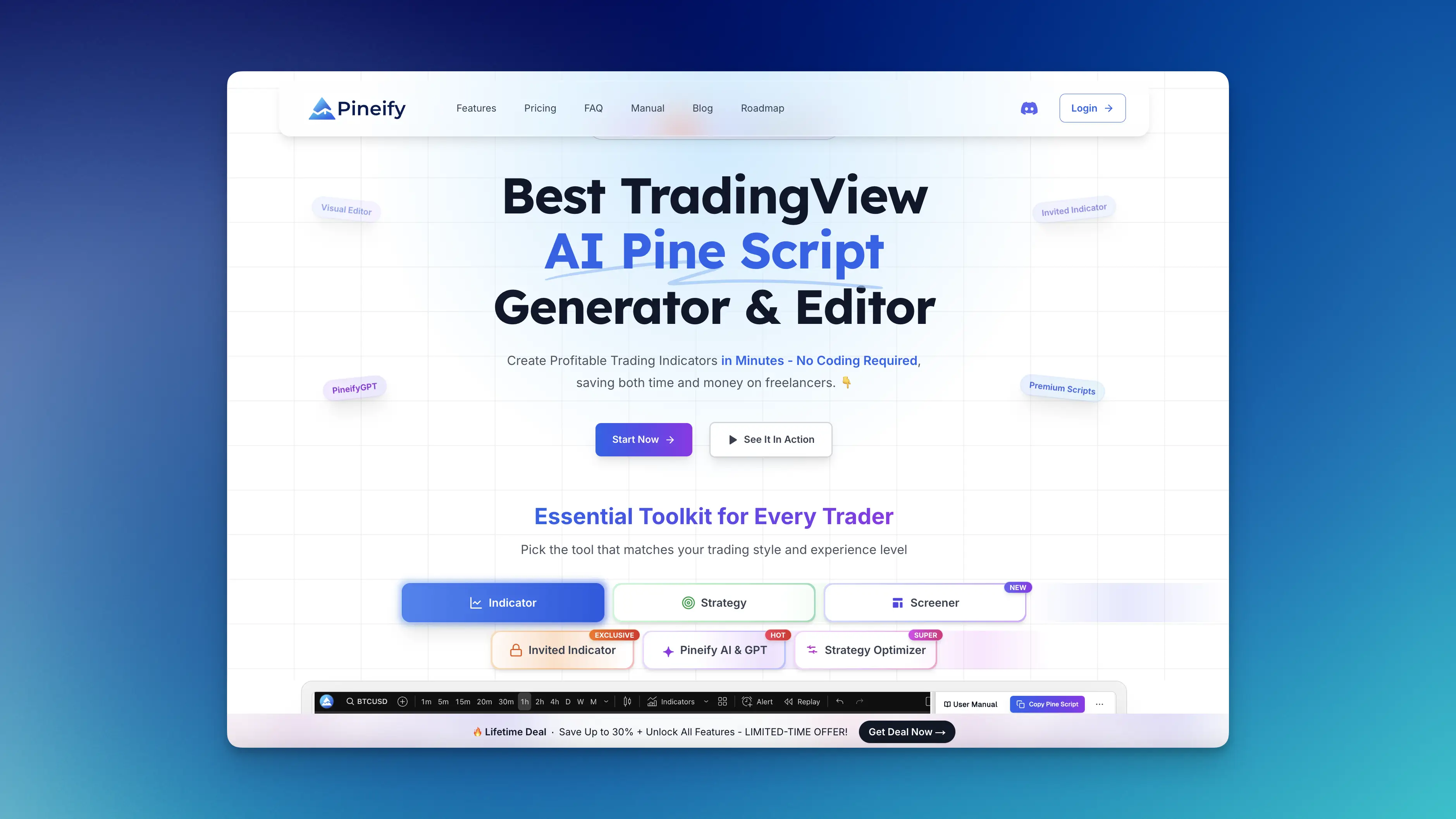
For regular use, the Ultra plan at $149 one-time gives you lifetime access with all future updates and monthly AI credits. That includes every feature and enough credits to test ideas consistently.
There's a growing community of traders using Pineify to build custom TradingView indicators. Give the visual editor a try and see how it compares to writing raw Pine Script.