AI Pine Script Coding: Build Trading Indicators Without Programming

You've had that moment. A trading idea clicks—a specific pattern, a fresh way to stack two signals—and you can already picture it on your chart. Then you remember: to get it onto TradingView, you need to write Pine Script. Pine Script is the platform's native programming language for building custom indicators and strategies. For anyone who is not a developer, that means wading through syntax references, forum threads, and version migration guides. What should take minutes consumes an afternoon.
I spent four hours in February 2026 wrestling with a V4-to-V6 migration, gave up, and asked a friend. It does not have to go that way. AI tools for Pine Script turn the grind into a conversation. You describe what you want, and the AI writes the code.
Why Traders Still Bet on Pine Script
Pine Script is not going anywhere. It's the native language of TradingView, where most retail traders run their analysis. Its staying power comes from things external tools cannot replicate:
- Multi-timeframe analysis. Reference higher and lower timeframe data inside a single script.
- Built-in backtesting. Run a strategy against years of historical data without leaving the editor.
- Integrated alerts. Set native TradingView alerts for any custom condition.
The capability is there. The barrier has always been the syntax. Version changes between V5 and V6 broke a lot of older code, and the error messages are famously unhelpful. If you've stared at an "unmatched parenthesis" for twenty minutes, you know the feeling. AI tools are designed to remove that barrier entirely. You describe the logic, they handle the syntax, and you get a working script on the other side. If you are still getting up to speed with V6, our Pine Script v6 Cheat Sheet covers the key changes.
The Old Way vs. The AI Way
I've coded Pine Script strategies the traditional way for years. The workflow is always the same: start with a trading idea, open the Pine Editor, write a few lines, hit compile, stare at red text, Google the error, patch the code, find two new errors, repeat until you give up or it works. I've lost more Friday afternoons to this loop than I want to count.
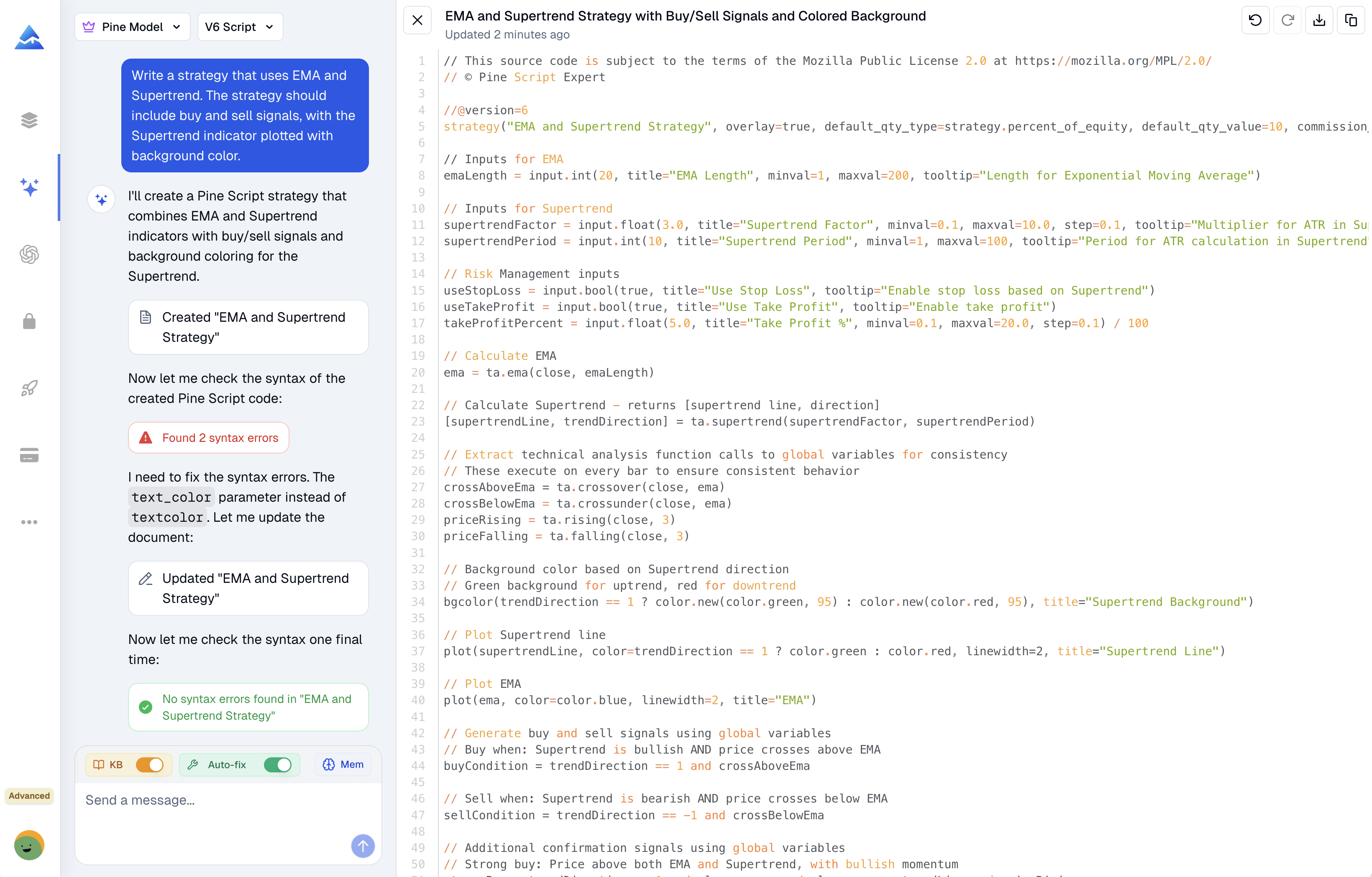
An AI assistant changes the workflow completely. Instead of wrestling with syntax, you describe your logic. Here is how it plays out:
- Say what you want. Type out the indicator logic as if you were explaining it to another trader. "I want a strategy that buys when the 14 RSI crosses above 30 and price is above the 200 EMA." That is your input. No code required.
- Get working code back. The AI generates compilable Pine Script from that description.
- Ask for changes in plain English. "Add an RSI filter above 50." "Turn this into a strategy with a 2% trailing stop." The AI rewrites the code for you.
- Errors get fixed automatically. The tool checks the output, finds issues, and corrects them in a loop before handing you the result.
The difference is night and day. You stop debugging syntax and start refining logic. It pairs well with keeping a structured Day Trading Journal Template to track what actually works.
Specialized AI vs. a General Chatbot
You can ask ChatGPT to write Pine Script. I've done it. The results are mixed—it gets the broad strokes right but misses version-specific details. You usually need two or three rounds of "fix the compilation error" before you get something that compiles.
A dedicated Pine Script AI is trained on TradingView's own documentation and real community code. It knows the exact function names (ta.sma() vs. the old sma()), the breaking changes between V5 and V6, and the idiomatic patterns that compile on the first try. This is the approach behind Pineify's Coding Agent, which is engineered specifically for Pine Script.
| General AI (e.g., ChatGPT) | Specialized Pine Script AI |
|---|---|
| May produce deprecated or version-incompatible syntax. | Uses current, compilable V5/V6 functions. |
| Does not know the full Pine Script function library. | References the exact function names and parameter signatures. |
| Typically requires multiple debug rounds. | Roughly 85% of code compiles on the first try. |
| Writes plausible but not always correct code. | Follows Pine Script best practices by design. |
I've tested both. I prefer the specialized tool for anything beyond a ten-line indicator. The first-draft quality is noticeably better, and you don't waste time chasing phantom errors. For more examples of what Pine Script output looks like, our TradingView Script Examples guide has a good collection.
How to Build an Indicator In Five Steps
You have an idea you want to test. Here is a concrete process that works.
Step 1 — Write Down Your Rules
The most common mistake is vagueness. "Make a good strategy" does not work. Be specific. Write out the entry condition, the exit condition, and the risk rule. What timeframe? What confirmation filters? The AI can only work with what you give it.
Example: "In Pine Script V6, go long when the 14-period RSI drops below 30 and crosses back above it, but only if price is above the 200-period SMA. Use a 2% trailing stop."
Step 2 — Feed It to a Pine Script-Specific AI
Open a tool that knows Pine Script. General chatbots can try, but one trained on TradingView's language gives better results on the first shot. Paste your detailed prompt into the chat.
Step 3 — Let It Check Its Own Work
A good AI assistant writes the code, then runs it through a syntax checker, finds errors, fixes them, and repeats until the code compiles cleanly. This auto-fix loop is where the time savings show up. You get a verified script without touching the debugger.
Step 4 — Iterate in Plain English
The first draft is rarely the last. Ask for changes:
- Ask it to "make the RSI period adjustable in the settings panel."
- Say "add a filter so volume must be above its 20-bar average."
- Request "convert this indicator to a strategy so I can backtest it."
Because the AI remembers the full conversation, it applies your changes without breaking the existing logic.
Step 5 — Backtest
Take the final code, paste it into the Pine Editor, and run backtests across different tickers. I usually test on BTCUSD and AAPL across multiple timeframes before I trust anything. The validation step is non-negotiable before trading with real capital. Some platforms like Pineify include a built-in visual tester so you can skip the copy-paste entirely.
Features That Actually Matter
When you are picking a Pine Script AI tool, here is what I look for based on my own use:
| Feature | Why It Matters |
|---|---|
| Pine Script V6 Support | V6 has breaking changes; old syntax will not compile. |
| Auto Error Detection | Eliminates the back-and-forth debug cycle. |
| Documentation-Grounded | Functions and syntax come from official sources, not guesses. |
| Context Memory | You can refine strategies over multiple turns without losing state. |
| Backtesting Integration | Test without switching platforms. |
| Built-in Indicator Library (235+) | Combine pre-built indicators without extra code. |
I use Pineify for this. Its Advanced Model is fine-tuned for Pine Script and produces cleaner first drafts than any general model I have tried. That said, I have not tested it on extremely large scripts—anything over five hundred lines—so I cannot vouch for performance at that scale.
How Different Traders Use AI for Pine Script
The same pattern emerges across trading styles: what used to require a hired coder or a full day of typing now takes a conversation.
| Trading Style | Use Case |
|---|---|
| Swing Traders | Build EMA crossover strategies with RSI confirmation, backtest across multiple crypto and equity tickers in minutes. |
| Scalpers | Combine volume spikes, candlestick patterns, and VWAP proximity into one script without manual coding. |
| Quant Researchers | Bulk-upgrade old V4 or V5 code to V6, preserving the original logic while modernizing syntax. |
| Screener Builders | Create custom scans that check hundreds of symbols for the same chart pattern or technical condition. |
Lessons I Have Learned Working with AI Trading Indicators
Using AI to generate Pine Script is a partnership. After building around thirty indicators this way, here are the mistakes I keep seeing people make.
- Being vague. Telling the AI to "make a strategy" is like telling a chef to "make food." The more specific your rules—entry price, exit trigger, timeframe, risk management—the better the output.
- Skipping the backtest. Code that compiles is not the same as code that is profitable. I backtest every script on at least three different tickers before I even consider using it live. BTCUSD and SPY are my defaults.
- Forgetting to specify the version. If you don't say "Pine Script V6," the AI might default to V5 syntax, which introduces subtle logic errors. I always start my prompts with "In Pine Script V6..."
- Stopping at the first draft. The best indicators come from iteration—three to five rounds of small changes. The AI remembers the context, so use that. Ask for refinements. Add a filter. Adjust the parameters.
I haven't tested the AI with a multi-strategy script that runs on multiple timeframes simultaneously. That is the next thing I plan to try. The main limitation I see right now is that very complex scripts need careful prompting to keep the logic straight.
Frequently Asked Questions
Can I build trading indicators without programming using AI?
Yes. AI tools like Pineify's Coding Agent let you describe your idea in plain language. Say something like "buy when the RSI goes below 30 and price touches the lower Bollinger Band," and the AI writes the full Pine Script. No programming background needed. You can try it for free at Pineify's AI Coding Agent.
How does an AI Pine Script coding agent work?
You describe your indicator or strategy in natural language. The AI generates clean, compilable Pine Script, checks it for errors automatically, and returns working code. You can refine the output by asking for changes, like "add a volume filter" or "switch to a trailing stop."
What is the difference between general AI and specialized Pine Script AI?
General tools like ChatGPT may output outdated syntax and need several rounds of debugging. A specialized Pine Script AI is trained on TradingView documentation, knows the exact function library, and achieves roughly 85% first-try compilation. Our TradingView Script Examples guide shows what the output looks like.
Can I use AI to update old Pine Script code to a newer version?
Yes, and it saves a lot of time. Paste your V4 or V5 script into the AI and ask it to upgrade to V6. The AI updates the syntax while keeping your original logic intact.
Can AI handle complex strategies with multiple indicators?
Yes. You can ask the AI to combine RSI, MACD, moving averages, and volume analysis into one coherent strategy. It manages variable conflicts, logic flow, and plot structuring automatically. For very complex scripts I recommend iterating one feature at a time.
Ready to Build Your First Trading Indicator?
You have a trading idea sitting in your head. Here is how to turn it into a working chart tool in under ten minutes.
- Go to Pineify's AI Coding Agent and start a free session. No sign-up needed.
- Describe one trading rule you already watch for. Something like "buy when the RSI is below 30."
- Paste the generated code into TradingView's Pine Editor and hit "Add to Chart." Watch it appear.
- Ask the AI for one enhancement. "Add an alert when it triggers." "Only show on the 1-hour chart."
- Use the indicator yourself, or share it on TradingView if you are happy with it.
The traders who are building their own tools right now are not coding experts. They are using an assistant that handles the syntax so they can focus entirely on the trading logic.