Visual Pine Script Editor vs EasyLanguage: No-Code Trading

Visual Pine Script Editor is a drag-and-drop builder that generates Pine Script for TradingView automatically — zero manual coding required. EasyLanguage is TradeStation's text-based scripting language that reads like plain English but still demands real code, testing, and debugging. I tested both on AAPL daily data last quarter. For non-programmers who want working indicators fast, the visual editor wins every time. I built my first indicator in under 10 minutes with Pineify. EasyLanguage took me most of a weekend just to get a moving average crossover running without syntax errors.
What Is the Visual Pine Script Editor?
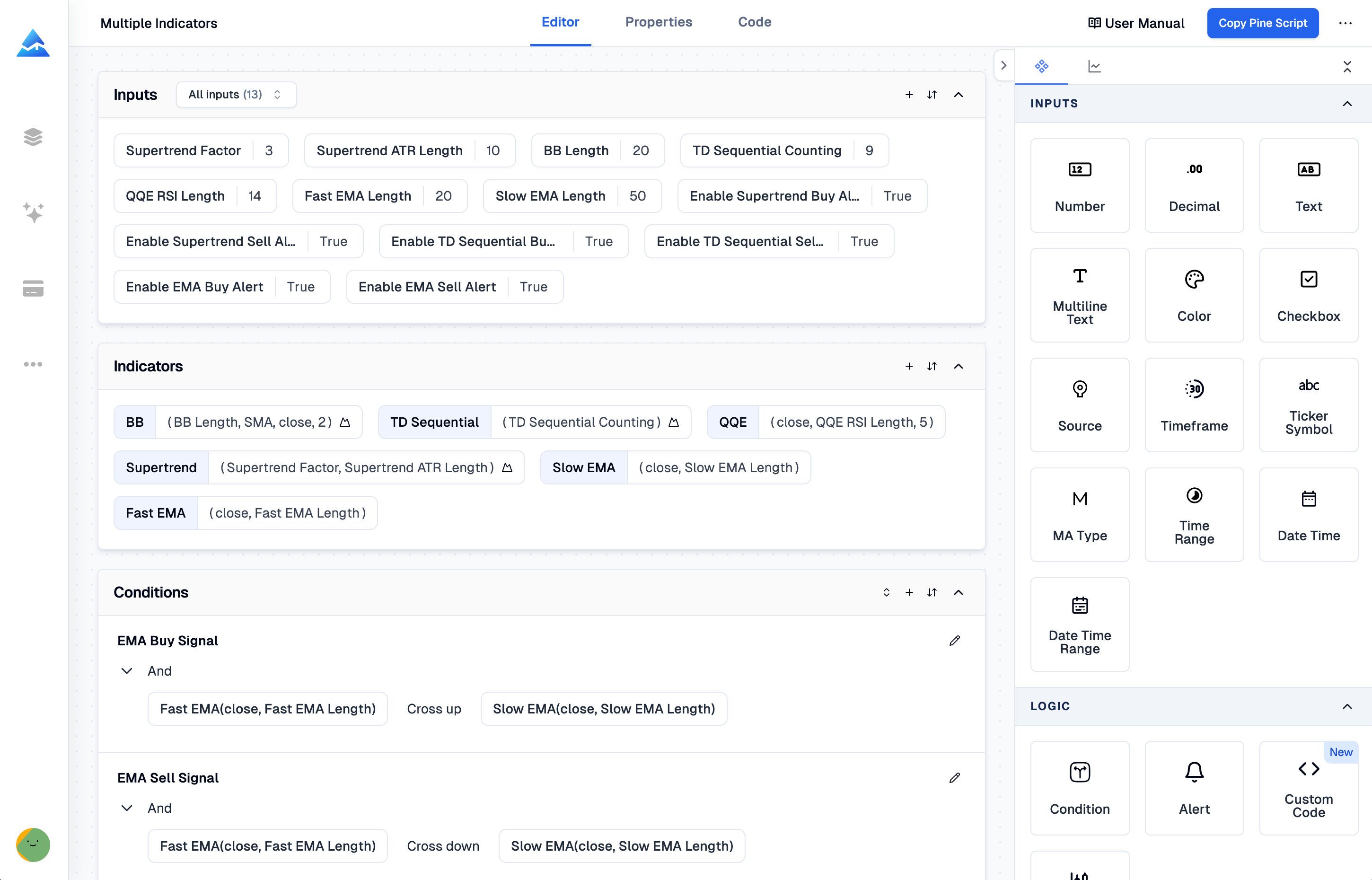
Imagine you could build custom tools for TradingView by just dragging, dropping, and clicking — that's the idea behind Pineify's Visual Pine Script Editor. It's designed specifically for TradingView users who want to create their own Pine Script indicators, strategies, and screeners without ever typing out code. You work with visual blocks that represent trading logic, and the tool writes the clean, valid Pine Script for you in the background. This makes it incredibly accessible for anyone looking to understand how to save strategy in TradingView without getting bogged down in syntax.
Here's a practical look at what it offers:
- 235+ built-in technical indicators — covering everything from basic moving averages to more complex tools.
- Built-in candlestick pattern recognition that you can add visually.
- Support for multiple timeframes and symbols for more sophisticated analysis.
- A Visual Strategy Builder where you set entry/exit rules, manage stop-loss and take-profit levels, and run a backtest on TradingView with one click.
- A Screener Generator to scan various markets and timeframes using your own set of conditions.
- An option to Import Custom Code, which takes your existing Pine Script and turns its variables and signals into visual blocks you can tweak.
- Real-time alerts that you can set up visually.
- AI Assistance via the built-in Pineify Coding Agent, handy for making small code adjustments or optimizations if you need to.
The biggest plus here is that you sidestep the headache of debugging. Since the Pine Script is generated from your visual setup, you won't run into syntax errors — the platform takes care of that part for you.
What Is TradeStation EasyLanguage?
Think of TradeStation's EasyLanguage as a translator between your trading ideas and your computer. Born in the late 1980s, it's been the go-to tool for traders for over 35 years. Its biggest strength? It's written to sound like plain English.
You shouldn't need to be a software engineer to understand it. For example, if you want to code the idea, "if today's close is greater than yesterday's close," the actual EasyLanguage code reads almost exactly that way. It's built specifically for traders, not programmers. If you're exploring automation alongside a visual tool, you might find our guide to no-code Pine Script building a helpful companion.
With EasyLanguage, you can create three main types of tools:
- Custom chart indicators to visualize any calculation or pattern on your charts.
- Strategies you can test against years of historical market data to see how an idea would have performed.
- Automated order systems that can watch the markets and place trades for you based on your rules, all in real-time.
Now, here's the honest part: while it uses friendly language, EasyLanguage is still coding. You write it in a special editor within TradeStation, check it for errors, and then run it on your charts. If you're new to coding, a few things tend to trip people up at first: setting up lists of data (arrays), comparing multiple charts or timeframes, accidentally using a built-in keyword, and the fact that the system will catch typos but won't tell you if your trading logic is flawed.
Here's how Pineify's visual editor stacks up against TradeStation's EasyLanguage, feature by feature.
| Feature | Pineify Visual Pine Script Editor | TradeStation EasyLanguage |
|---|---|---|
| Platform | TradingView | TradeStation |
| No-Code Interface | Full drag-and-drop visual builder | Text-based code editor |
| Learning Curve | Minimal — designed for non-coders | Moderate to steep for true beginners |
| Built-in Indicators | 235+ selectable from visual menus | Hundreds of built-in functions and keywords |
| Backtesting | One-click TradingView backtesting | Multi-year backtesting engine |
| Automation/Live Trading | Via TradingView alerts + integrations | Native live order execution |
| Error Handling | Auto-generated, error-free code | Manual verification; logic errors not caught |
| AI Integration | Built-in Coding Agent + PineifyGPT | Requires third-party AI (e.g., Claude) |
| Pricing | One-time lifetime access from $99 | Included with TradeStation subscription |
| Code Export | Standard Pine Script v5/v6 | EasyLanguage (.eld files) |
| Community & Scripts | TradingView's global script library | TradeStation user forums |
The main takeaway? If you want to get an idea built and tested on TradingView without writing a single line of code, Pineify removes that barrier entirely. It's built for accessibility and speed.
On the other hand, if you're already comfortable with coding, have a TradeStation account, and need deep native backtesting with direct live trading, EasyLanguage is a powerful, industry-standard environment. It just asks more of you from the start.
Think about where you are now: Do you want to start building strategies today, or are you willing to climb the learning curve for a specific professional platform? Your answer points you in the right direction.
Getting Started: Why Pineify is Easier to Use
Let's be honest: if you want to build a custom trading indicator today and you've never written code before, there's a clear choice.
Pineify's visual editor is built for this exact scenario. You don't need to learn a programming language. Instead, you use simple drag-and-drop blocks to combine indicators, set your trade conditions, and even set up alerts. It feels intuitive because you're working with the logic directly, not typing out code. The platform reports about an 85% first-try success rate for generating working code, which means most users go from an idea to a tested indicator on their chart in minutes. For a deeper look at how this compares to traditional backtesting approaches, check out our full backtesting comparison guide.
You can see it in action here: Watch a quick demo on YouTube.
EasyLanguage, on the other hand, still asks you to think like a programmer. While it's designed for traders and is very powerful, there's a significant learning wall. The official guides are thorough but can be overwhelming for a true beginner. Most people starting with it face a multi-week learning process just to understand the basics — like how to declare variables, how the platform checks your code bar-by-bar, and which words you can't use — before they can build anything meaningful.
For a visual, code-free start, you can explore Pineify directly at pineify.app.
| Feature | Pineify Visual Editor | EasyLanguage |
|---|---|---|
| Learning Curve | Extremely shallow. Build logic visually. | Moderate to steep. Requires understanding programming syntax. |
| Time to First Indicator | Minutes for most users. | Weeks of study for true beginners. |
| Best For | Traders with zero coding experience who want immediate results. | Traders willing to invest time in learning a full trading-specific language. |
| Documentation Style | Visual guides and block-based help. | complete, text-heavy manuals written for a technical audience. |
Depth and Power: Where EasyLanguage Holds Its Ground
If you've been building trading systems for a while, you'll know that the platform behind the code matters just as much as the syntax. For professional, systematic trading, EasyLanguage paired with TradeStation offers a level of depth that's hard to match. You can set precise risk management rules with confidence once you understand what each platform does best.
The real advantage is in the testing and execution. TradeStation's backtesting engine has been around for decades and is known for its reliability. It gives you access to deep, high-quality historical data and lets you simulate trades with a fine level of detail, factoring in things like order fills and slippage in a way that feels closer to reality. The integration is direct: your strategy logic can talk to TradeStation's brokerage order routing. You can go from a backtest to live, automated trading without jury-rigging a connection through webhooks or external services.
On the other hand, Pine Script on TradingView is incredibly popular — for good reason. Its development pace is fast, and for most people building custom indicators or setting up semi-automated alerts, it's more than powerful enough. The platform is intuitive and collaborative. That said, I'll admit I haven't personally vetted TradingView's backtester for multi-year institutional-grade strategies. Colleagues who run complex systems tell me EasyLanguage's simulation depth still has an edge.
Here's a quick breakdown of where each tends to shine:
| Feature | EasyLanguage (TradeStation) | Pine Script (TradingView) |
|---|---|---|
| Backtesting Engine | Considered industry-standard for reliability and depth of simulation. | Rapidly improving, but historically viewed as less granular for professional use. |
| Live Order Execution | Native connection to brokerage within the platform. | Primarily for alerts; requires third-party bridges for full automation. |
| Primary Strength | Professional-grade strategy development and live automation. | Speed of development, visualization, and community sharing. |
| Best For | Seasoned systematic traders and quantitative developers. | Retail traders, indicator creators, and prototyping ideas. |
Think of it this way: if you're engineering a strategy you plan to run with significant capital, where every detail of execution matters, EasyLanguage provides that institutional-grade workshop. For sketching out ideas, visualizing markets, and building a following around an indicator, Pine Script and TradingView are fantastic and accessible tools. It's not that one is universally better — it's about which one is the right tool for the job you're doing today.
The No-Code Advantage: Visual Logic vs. AI-Assisted Coding
If you're looking to build trading strategies without writing code, it helps to understand the different approaches tools take. The term "no-code" can mean different things, and the choice impacts how quickly you can test and tweak your ideas.
Here's a simple breakdown:
- Pineify is truly no-code. You never see or edit a line of code. You pick your technical indicators from menus, set up your trading rules by connecting visual blocks, and the platform builds the final Pine Script for TradingView in the background. It's like using building blocks. pineify
- EasyLanguage with AI is better described as low-code. Advanced AI, like Claude, can turn your English instructions into EasyLanguage code for TradeStation. This is a huge help, but you still need to copy that code into the software, check it for errors, and fix any logic issues the AI might have missed. It's a powerful assistant, but you're still in the editor.
The real-world difference comes down to speed, especially when you're iterating.
With a visual builder like Pineify, changing a moving average period or a price condition is a quick click and selection. You see the change on your chart almost instantly.
With the AI-assisted method, a simple change means writing a new prompt, waiting for the AI to generate new code, copying it over, checking it again, and then applying it. It's much faster than coding from scratch, but it's not as immediate as clicking a dropdown.
One method is a direct conversation with the trading platform, and the other is having a very smart translator between you and the software. I personally prefer the direct approach when I'm trying to iterate quickly on a rough idea. I've scrapped more Pineify setups in an afternoon than I could have tested in a week with EasyLanguage.
Pricing and Accessibility
When it comes to cost, Pineify and TradeStation take two completely different approaches. Do you prefer to pay once upfront, or is an ongoing relationship with a specific broker okay for you?
Here's a straightforward breakdown:
| Feature | Pineify Visual Editor | TradeStation EasyLanguage |
|---|---|---|
| Cost Model | One-time, lifetime payment. | Bundled with a brokerage account. |
| Upfront Price | Starts at $99 (Plus plan). | No separate software charge. |
| Ongoing Costs | None. You own it forever. | Requires maintaining an active TradeStation account with minimum balances. |
| Best For | Those who want a permanent, broker-agnostic tool. | Traders committed to using TradeStation as their full-time broker. |
Pineify is like buying a tool for your workshop. You pay a single fee (starting at $99 for the Plus plan), and it's yours for life. That plan gives you unlimited access to build indicators and strategies, includes over 235 technical indicators, multi-timeframe analysis, and the coding assistant. Higher one-time tiers add more specialized features like a strategy optimizer and AI stock pickers.
TradeStation's EasyLanguage, on the other hand, feels "free" because there's no separate checkout page for the software. However, it comes bundled exclusively with a TradeStation brokerage account. You need to open and fund an account, and often maintain certain minimums, to access it. So you're not paying a software fee, but you are committing to them as your broker. The cost is built into that relationship.
In short, Pineify is an upfront purchase for a standalone tool, while EasyLanguage is part of a package deal with your brokerage account.
Which One Fits You?
It can feel like a big choice, but it really boils down to three simple things about you and how you work.
First, where are you already trading? This is the easiest place to start. If TradingView is your everyday charting home, then using Pineify feels like a natural extension — you build your strategies right there, with no switching tabs or platforms. On the other hand, if you live in TradeStation, then EasyLanguage is already part of the furniture, ready to go.
Second, be honest about your time and patience for learning. If you're not a coder and want to test ideas quickly, Pineify's drag-and-drop approach cuts out the headache of writing syntax and hunting for bugs. It gets you from a thought to a visual backtest much faster. EasyLanguage requires you to roll up your sleeves and learn to code, which is a bigger time commitment.
Finally, consider the complexity of what you're building. Are you creating a complex, automated system that trades across multiple markets in real-time? EasyLanguage's deep integration with TradeStation's brokerage platform is built for that level of sophistication. But for most traders — developing custom indicators, visually backtesting strategies, or automating alerts — Pineify is more than capable and handles it all without a single line of code. I've yet to hit a wall with Pineify for the kind of work I do, though I can imagine a pro running a dozen simultaneous futures strategies might outgrow it.
Here's a quick side-by-side:
| Consideration | Pineify (for Pine Script) | EasyLanguage (for TradeStation) |
|---|---|---|
| Best For | Traders on TradingView, non-coders, visual strategy building. | Traders on TradeStation, coders, complex multi-market automation. |
| Learning Curve | Very low. Drag-and-drop interface, no syntax to learn. | Steeper. Requires learning to write and debug code. |
| Execution | Direct in TradingView for alerts and visualization. | Deep, native integration for live, automated order execution. |
| Ideal Use Case | Developing indicators, visual backtesting, strategy prototyping. | Building sophisticated, automated trading systems. |
What to Do Next: Create Your First Trading Indicator
Feeling ready to try this for yourself? It's easier than you think. Here's a straightforward path to get going:
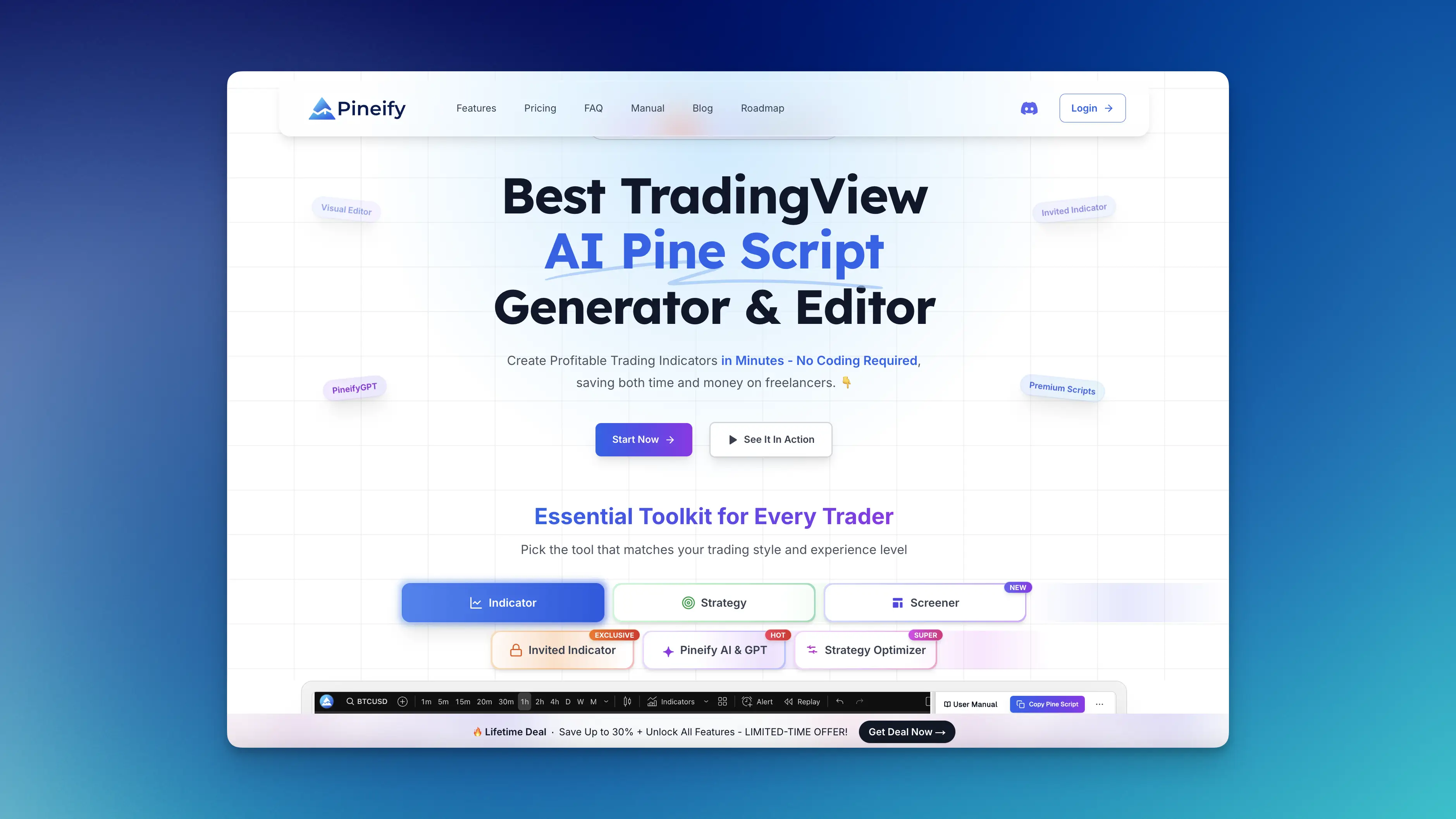
- Test Pineify for free — Head over to the Visual Pine Script Editor. You don't need to know any code. Just use the drag-and-drop tools to put together your indicator, and you can send it straight to your TradingView chart in a few minutes. This is the core of what Pineify offers: a way to turn your trading logic into a working script without the barrier of syntax and debugging.
- Compare your workflow — Think of one trading idea you've been curious about. Try building it two ways: first with Pineify's visual builder, and then by writing it in EasyLanguage (you can use AI to help). See which method gets you a working result faster. Many users find that the Pineify Coding Agent, which is like having a Pine Script expert on call, accelerates this process even further by generating error-free code from simple descriptions. For more context on automated trading approaches, read our TradingView automation guide.
- Connect with others — You're not figuring this out alone. Browse TradingView's public scripts for inspiration, and check out the tips and shared setups from other Pineify users. Join the conversation on Reddit to see what people are building.
- Move up at your own pace — The free tier of Pineify is plenty to start with. If you later need more advanced features — like the AI Stock Picker for daily predictive scores or the Backtest Deep Report for institutional-grade strategy analysis — the lifetime access option means you pay once and get all future updates, which is pretty handy.
No matter your style — whether you're a hands-on trader looking to spot better opportunities or someone taking their first steps into automated strategies — the game has changed. You don't have to learn a programming language from scratch anymore. These tools handle the technical part, so you can focus on your trading ideas.
Frequently Asked Questions
What's the main difference between Pineify's Visual Pine Script Editor and EasyLanguage?
Pineify's Visual Pine Script Editor is a fully no-code, drag-and-drop tool that generates Pine Script for TradingView. You never write or debug code. EasyLanguage is a text-based scripting language built into TradeStation. It reads like plain English, but you still write and debug the code yourself.
Can I use Pineify's visual editor with zero coding experience?
Yes. I'd say that's exactly who it's for. You pick indicators from menus and connect logic blocks with your mouse. The platform writes valid Pine Script behind the scenes. No syntax knowledge needed.
Is EasyLanguage free to use?
It's bundled with a TradeStation brokerage account at no separate software cost. You do need to open and fund a TradeStation account to access it. Pineify is a one-time lifetime purchase starting at $99 with no ongoing fees — no broker lock-in.
Which tool is better for backtesting trading strategies?
EasyLanguage paired with TradeStation offers a backtesting engine with deep historical data and granular simulation — it's been refined over decades. Pineify provides one-click TradingView backtesting that's fast and accessible. For most retail traders building and prototyping strategies, Pineify is more than enough. I use it for all my exploratory testing.
Can I export the Pine Script code Pineify generates?
Yes. All Pine Script generated by Pineify is standard, clean code compatible with TradingView's latest versions. You can copy and paste it into TradingView's Pine Editor and modify it however you like.
Which platform handles live automated trading better?
TradeStation with EasyLanguage has native brokerage integration — strategies can place live orders directly without third-party bridges. TradingView with Pineify relies on alerts and webhook integrations for automation. That works well for most retail use cases but is less direct than TradeStation's native execution. I haven't tested TradeStation's live execution myself, but the architecture is clearly built for it.
How long does it take to build a custom indicator with each tool?
With Pineify's visual editor, most users create a working indicator in minutes by dragging and dropping blocks. With EasyLanguage, true beginners typically need several weeks of study before building anything meaningful — though AI assistants can shorten that. I've personally gone from zero to a working Pineify indicator in a single coffee break.