Pineify vs Perplexity Finance: A Research Output Checklist

Pineify Finance Agent and Perplexity Finance both support financial research through connected information sources. A useful comparison tests the same question against the same evidence, then records missing data, calculation errors, and corrections. This Pineify-published article provides that checklist; it does not claim months of private testing or a proven winner.
Establish what each product currently offers
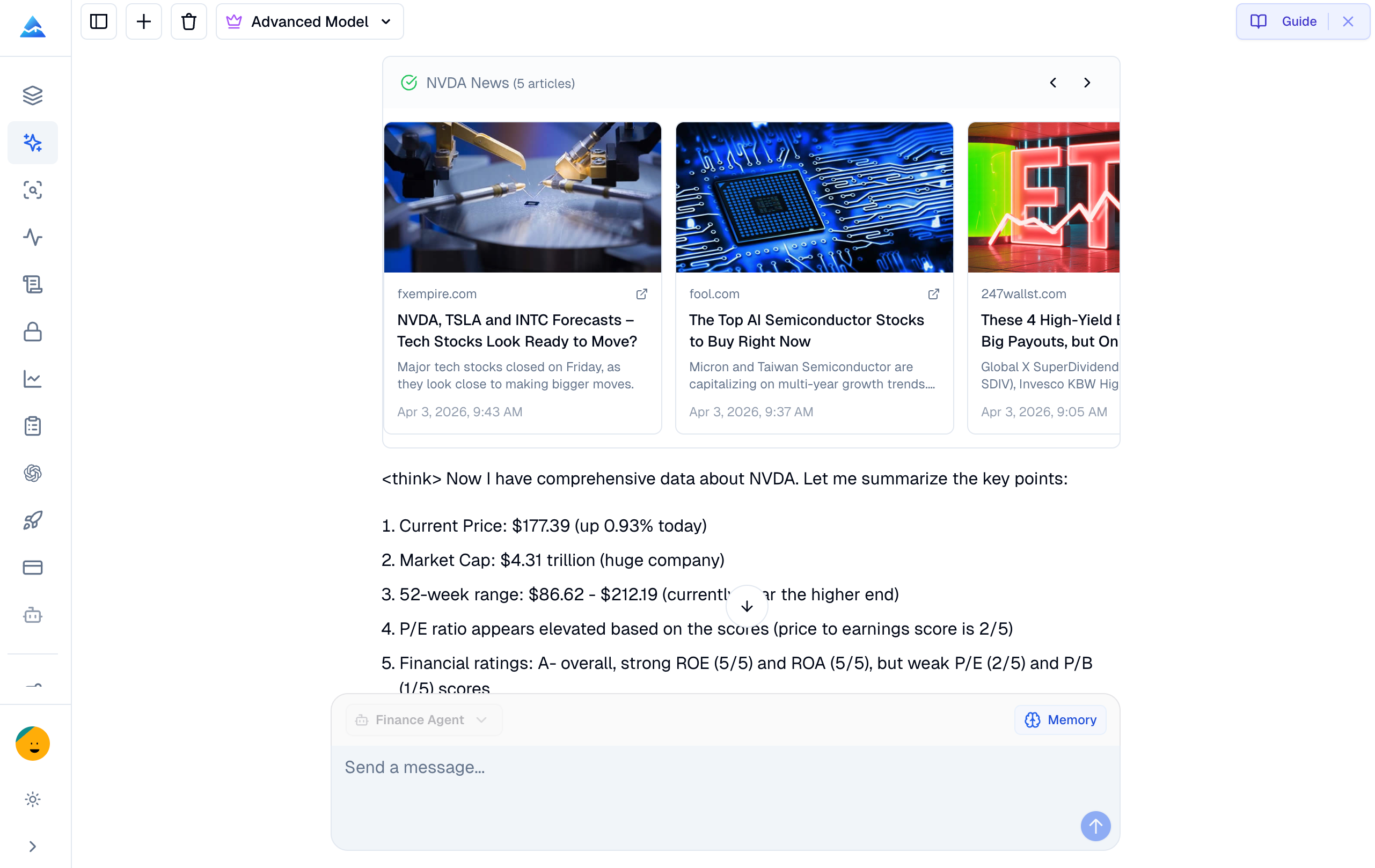
Pineify's Finance Agent exposes tools for quotes, financial statements, estimates, news, supported asset screening, options snapshots, and public-discussion searches. The tool result and the model's interpretation are separate parts of the answer and can fail in different ways.
Perplexity's official finance materials describe financial data connections and research outputs. Its financial-data release notes include financial statements and screening examples. It should not be characterized as a summary-only service that cannot analyze filings or retrieve financial data. Confirm current access for the product and plan you are comparing.
Test 1: A quote with an explicit clock
Ask each tool for one supported symbol's latest available quote, the observation timestamp, timezone, exchange, trading session, and source. Save the response and the time of the request.
Check the result against an appropriate source at the same time. A different price alone does not prove an error: one response may show a last trade, another a bid/ask midpoint, and another a prior close. Resolve those definitions before comparing accuracy. Neither product's ability to call an API establishes a universal real-time feed entitlement.
Test 2: A filing-based comparison
Choose two reported periods for one company. Request revenue, operating profit, operating cash flow, and a cited explanation of the largest change. Ask the assistant to distinguish reported figures from adjusted metrics and forecasts.
Check the numbers and definitions in the original filing. A citation should support the nearby claim. Record whether the model invents a reason for a change when management has not supplied one. Also check whether a quarterly value was compared with a year-to-date figure by mistake.
| Evaluation field | Record for each tool |
|---|---|
| Input | Exact question, company identifier, periods, and cutoff date |
| Retrieval | Sources returned, timestamps, missing fields, and available coverage |
| Calculation | Formula, units, signs, rounding, and denominator |
| Explanation | Claims supported by evidence and assumptions presented as such |
| Correction | Whether a follow-up fixes the issue without introducing another |
| Cost | Account allowance consumed and any required upgrade |
Test 3: An options snapshot with known boundaries
Specify the underlying, exact expiration, put or call, and a narrow strike range. Ask for contract identifiers, bid/ask quotes, quote times, open interest, implied volatility, and available Greeks. Require missing fields to remain missing.
Pineify's snapshot tool returns a limited list from the provider response. It does not follow every page into a guaranteed complete chain. A summary built from a partial list cannot safely be labeled a whole-market put/call ratio or a complete max-pain calculation. Confirm the covered contracts and aggregation method first.
For either product, compare matching contracts and observation times. Greeks are model-derived sensitivities, not guaranteed price changes. A trade print, open interest, or a large option position does not by itself identify the trader's complete position or intent.
This test concerns data quality and explanation. It does not claim that a snapshot predicts an entry or that one product produces better investment returns.
Assess discussions and disclosures separately
A social search can return selected posts and links. It is not a complete sentiment poll, and a retrospective story about noticing a post before a price move is not evidence of a repeatable trading advantage.
Insider and congressional datasets describe disclosed transactions. The transaction date and publication date can differ; they are not live mirrors of an individual's brokerage account. Require both dates where available and inspect the original disclosure before drawing conclusions.
Make the decision from observed results
Keep a short error log for the tasks you actually need. A product may fit one workflow better because of its sources, interface, export options, or adjacent tools. Do not turn a small test into a universal accuracy ranking.
Pineify's separate Coding Agent and Visual Editor may be useful if you also develop TradingView scripts. That is an additional workflow requirement, not evidence that its financial answers are more accurate. See the research-to-rule comparison for that handoff.
Review Pineify's current pricing and Perplexity's current plan details. Compare the actual research mode, dataset access, usage allowances, and additional charges. Historical lifetime prices and a free dashboard do not establish equivalent entitlements.
Common comparison questions
Which one gives better buy or sell advice? A confident label is not an accuracy measure. Evaluate the data, assumptions, risk discussion, and source support behind the conclusion.
Does this article show that Pineify has broader market coverage? No. Verify the specific symbols, data categories, and history you require in each product.
Can either replace a specialist data subscription? Only if its demonstrated coverage, update frequency, export rights, and operational requirements match your needs. Similar visible fields do not establish identical data licenses.