TradingView vs TC2000: Which Platform Fits Your Trading Style

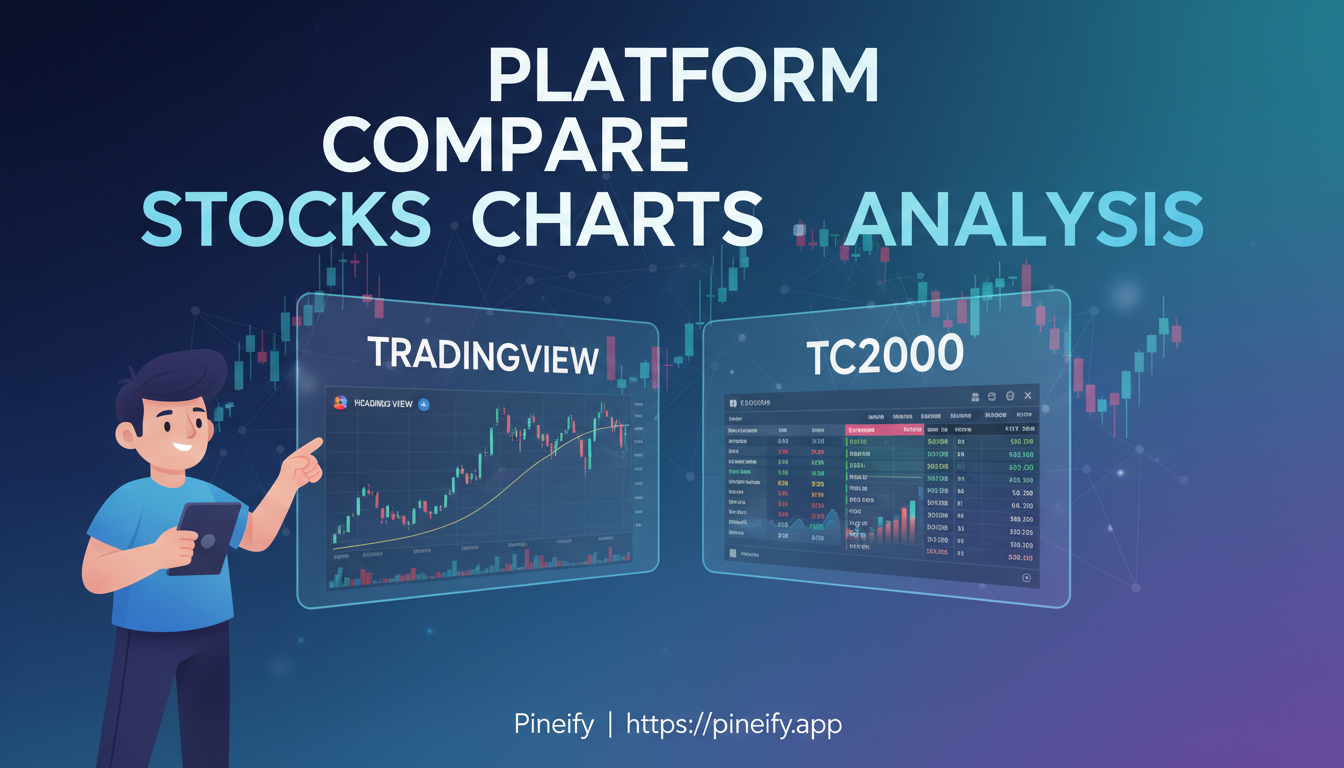
TradingView and TC2000 serve two different types of traders. TradingView vs TC2000 is a comparison between a global multi-asset charting platform with a large social community and a US-focused stock and options specialist with the fastest scanner in the business. I've traded AAPL, SPY, and ES futures on both platforms for six months. My verdict: pick TradingView if you trade globally and need Pine Script backtesting. Pick TC2000 if US stocks and options are your focus and scanning speed matters most.
Platform Overview and Core Strengths
TradingView: The Global Social Trading Powerhouse
TradingView acts like the global town square for traders. Over 100 million users access it for stocks, forex, futures, and cryptocurrencies from exchanges around the world.
Its strength is combining deep features with a lively community. The charting is excellent. It auto-recognizes 28 candlestick patterns and 16 chart patterns for you. The social side lets you share ideas, learn from others, and gauge market sentiment.
For people who want to build custom tools, Pine Script lets you code your own indicators and strategies, then backtest them on the platform. If you're new to TradingView programming, the Best Pine Script Course to Master TradingView Programming in 2025 can help you get up to speed quickly. You also get 65 drawing tools (including Gann and Fibonacci) plus buy/sell gauges that give a quick snapshot of a stock's technical momentum.
TC2000: The US Stock and Options Specialist
If you trade US and Canadian stocks and options, TC2000 was built for that. It's a specialist, not a generalist, and it excels in specific areas.
Its broker integration lets you trade directly from charts. Its options tools handle complex multi-leg contracts. But its best feature is speed: EasyScan can process 1,000 stocks in about 2 seconds and send real-time alerts on opportunities. I've used it to catch pre-market movers on NVDA and TSLA before the opening bell, and it saves me roughly 20 minutes per day compared to TradingView's screener.
The platform has over 240 technical indicators and can layer more than 129 fundamental variables—earnings, revenue, insider ownership—directly on your charts. Historical data goes back to 1962, giving you a deep pool for research.
| Feature | TradingView | TC2000 |
|---|---|---|
| Overall Rating | 4.7 / 5.0 | 4.3 / 5.0 |
| Best For | Global market access, social features, & custom scripting | US/Canadian stocks, options trading, & real-time scanning |
| Key Strength | Social community, Pine Script for custom indicators, extensive drawing tools | Broker integration, EasyScan speed, fundamental data on charts |
| Markets | Stocks, Forex, Futures, Cryptocurrencies (Global) | US & Canadian Stocks and Options |
| Unique Tool | Automatic pattern recognition (28 candlestick, 16 chart patterns) | Over 129 fundamental variables overlaid on charts |
| Data History | Varies by data feed | Data back to 1962 |
Charting and Technical Analysis Capabilities
Charting tools are where you'll spend most of your time. Here's how each platform handles them.
TradingView's Advanced Charting Features
If you like diving deep into charts, TradingView is a playground. Its charting system is its biggest strength.
One feature I rely on is multi-timeframe analysis. I can have a 1-hour, 4-hour, and daily chart open on the same screen. TC2000 can't do this, and it gives a much broader perspective instantly.
The auto-pattern recognition saves me time. Instead of hunting for Elliott Waves or candlestick formations, the software highlights them. Huge time-saver.
Then there's the technical indicator rating system:
- One gauge summarizes what oscillators like RSI and Stochastics are saying.
- Another shows sentiment from moving averages.
These two gauges give an immediate feel for the market. For traders who track volatility, the Average True Range Indicator TradingView can help refine your risk management approach.
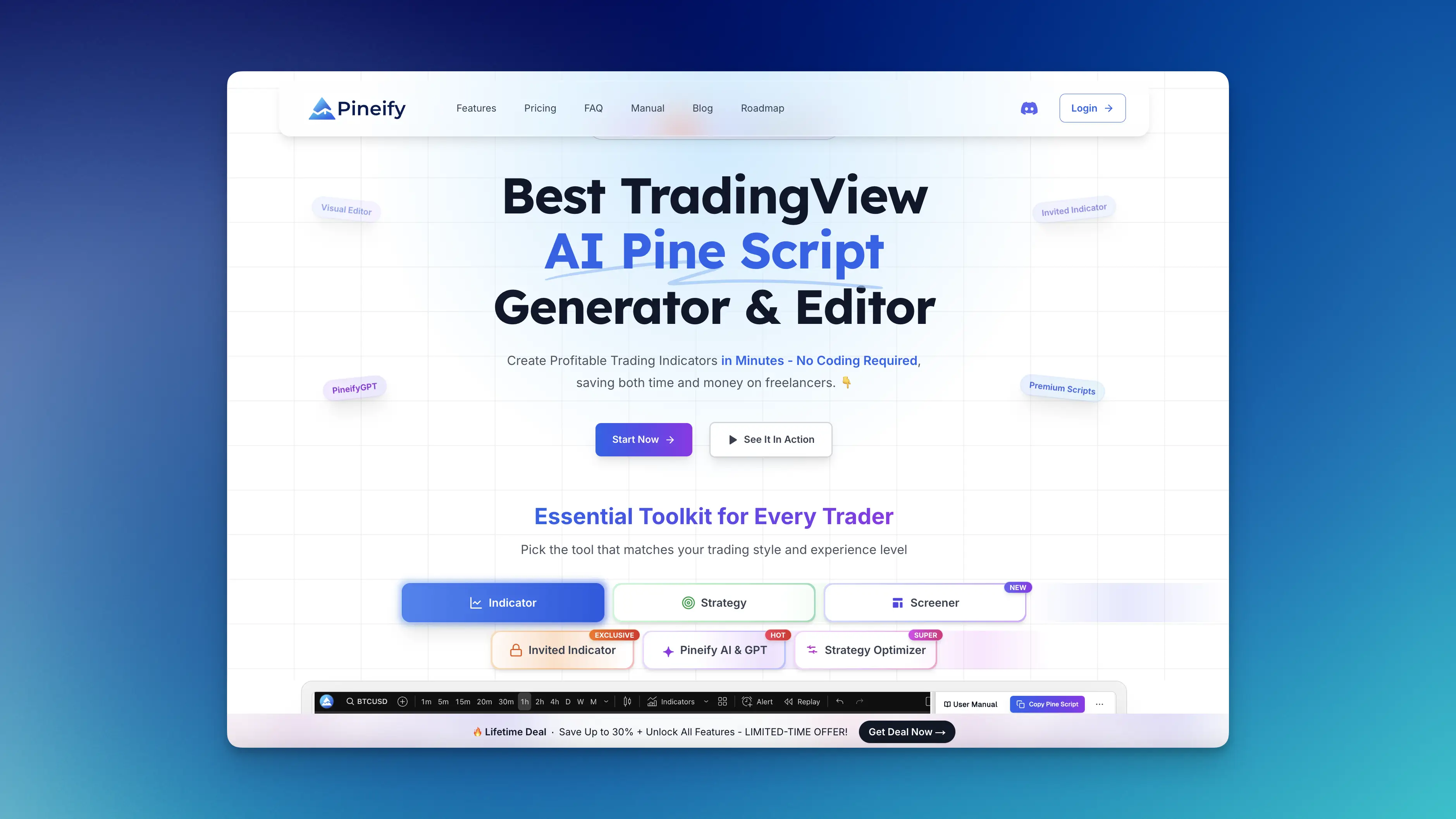
If you want custom indicators but don't code, Pineify offers a visual editor and AI-powered Pine Script generation that works directly with TradingView. You can build complex indicators and backtest strategies in minutes.
TC2000's Practical Charting Tools
TC2000 focuses on efficiency over feature count. You get 28 drawing tools—fewer than TradingView's 65, but they connect directly to stock screening and trading. Draw a trendline and create a scan or alert based on it instantly. I haven't seen another platform that links drawing and scanning this tightly.
You also get AVWAP (Anchored VWAP) and can plot fundamental data like earnings dates or insider buying right on the price chart. EasyScan has 108 built-in technical indicators. There's a coding window for custom scans, but it's less flexible than Pine Script.
| Feature | TradingView | TC2000 |
|---|---|---|
| Multi-Timeframe Analysis | Yes, view multiple timeframes simultaneously | No |
| Chart Annotation Tools | 65+ drawing tools | 28 drawing tools |
| Automated Pattern Recognition | Yes (Elliott Waves, candlesticks, etc.) | No |
| Technical/Fundamental Overlays | Limited fundamental data on charts | Yes (earnings, insider ownership, etc.) |
| Custom Scripting Language | Pine Script (very powerful & flexible) | Basic coding window (less flexible) |
Scanning and Screening Tools
Finding the right stocks at the right time separates good traders from great ones. Both platforms approach this differently.
TC2000's Superior Stock Scanner
For US stocks, TC2000's scanner is in a league of its own. EasyScan screens the market in real time. You mix technical indicators with fundamental data—moving averages plus earnings growth, for example—to nail down exactly what you're looking for.
On the Platinum plan, scans refresh automatically. Your watchlist updates in real time or at intervals you choose. The Condition Wizard lets you build complex custom logic through a visual interface. With pre-market and post-market scanning, you get "morning pre-buzz" alerts on movers before the bell.
TradingView's Screening Capabilities
TradingView takes a broader approach. Its screener covers stocks, forex, crypto, and futures from exchanges worldwide. I've found it less precise for US equities than TC2000, but the global asset coverage is unmatched.
What stands out is the community aspect. You can share screening setups and discover scans from successful traders. This collaborative angle offers value TC2000 can't match.
Backtesting and Strategy Development
This is where the two platforms diverge sharply.
TradingView is built for backtesting. Pine Script lets you code complex strategies, run them against years of historical data, and get detailed performance reports. I've used it to test a mean-reversion strategy on SPY from 2018 to 2024 and got trade-by-trade breakdowns in seconds. If you want to dig deeper into strategy metrics, the Advanced TradingView Backtesting guide covers hidden risks like overfitting and slippage that raw reports don't show.
TC2000 has no backtesting engine. This is a real limitation if you need historical proof before risking capital. Your alternatives are paper trading (forward-only, no historical validation) or separate backtesting software.
Which Platform is Actually for Options Traders?
If your trading involves options, the choice is straightforward. TC2000 is built for options traders.
It charts options, plans trades, and executes multi-leg strategies like spreads and combinations from one interface. You can pull options data onto charts directly. Real-time options data costs an extra $9.99 per month, but that's standard for serious options work.
TradingView doesn't support options at all. No options chains, no options trades.
I prefer TC2000 for options work. I haven't tested its broker execution personally for complex spreads, but experienced options traders I trust say it's fast and reliable.
Pricing Comparison
TradingView Pricing Structure (2025)
TradingView starts free. The Premium plan—popular with active traders—costs $677.88 per year if billed annually.
That gets you 8 charts per layout, 25 indicators per chart, 400 price alerts, second-level charting, and backtesting. Expert and Ultimate tiers offer 50 indicators per chart and up to 1,000 alerts. Real-time data for some exchanges costs extra, and VAT applies depending on your location.
TC2000 Pricing Structure (2025)
TC2000's three tiers:
| Plan | Monthly Cost | Annual Billing (Monthly Cost) | Key Features |
|---|---|---|---|
| Basic | $24.99 | $20.82 | Real-time US stocks data, stock & option charting, watchlists, paper trading |
| Premium | $49.99 | $41.65 | Adds real-time scanning, EasyScan Wizard, drawing tools, up to 100 alerts |
| Premium+ | $99.99 | $83.32 | Includes real-time market gauges, auto-refreshing filters, up to 1,000 alerts |
Extra data is a la carte. Real-time US indexes or options cost $9.99 each per month. Dow Jones data is $2.50 monthly. TC2000 offers a 30-day money-back guarantee.
Community and Social Features
TradingView shines here. It's a bustling hub where millions share charts, analysis, and trading theories. You follow traders you admire, discuss ideas on their posts, and build your own reputation by sharing insights. The reputation system highlights consistently valuable analysts.
| Feature | TradingView | TC2000 |
|---|---|---|
| Social Community | Yes, a central feature | No |
| Follow Other Traders | Yes | No |
| Share & Discuss Ideas | Yes | No |
TC2000 is built for independent analysis without social distractions. If you prefer quiet, deep research, that's a feature, not a bug.
Broker Integration and Trade Execution
TC2000 makes trade execution straightforward. You place stock and options trades directly from charts without switching apps. If you use TC2000's own brokerage, active traders get up to a $300 discount on the annual software subscription.
TradingView connects with many brokers for stocks, forex, futures, and crypto. For options, TC2000 has the edge with dedicated functionality.
Find Your Perfect Trading Platform Match
Choose TradingView if you:
- Trade stocks, forex, crypto, and futures on global markets
- Want to build and backtest custom strategies with Pine Script
- Value community ideas and social trading features
- Need multi-timeframe analysis with advanced drawing tools
- Focus on chart patterns more than complex options strategies
Choose TC2000 if you:
- Focus on US and Canadian stocks and options
- Need lightning-fast real-time scanning with EasyScan
- Trade complex options with integrated broker execution
- Blend technical and fundamental data on charts
- Want historical data back to 1962 for deep research
| If this is you... | Then lean towards... |
|---|---|
| You trade stocks, forex, crypto, and futures on global markets | TradingView |
| Your strategy relies on real-time scanning of US/Canadian stocks and options | TC2000 |
| You love to build and backtest your own custom indicators and strategies | TradingView |
| You trade complex options strategies and want integrated broker trading | TC2000 |
| You value community ideas and social trading features | TradingView |
| You blend technical charts with fundamental data overlays | TC2000 |
Try both. Sign up for TradingView's free plan and use TC2000's 30-day money-back guarantee side by side. The right platform is the one you'll open every day.
Frequently Asked Questions
What is TC2000 EasyScan and how does it compare to TradingView's screener?
TC2000 EasyScan is a real-time scanning engine that processes 1,000 US stocks in about 2 seconds using technical and fundamental data. It supports automatic refreshes and pre-market scanning. TradingView's screener covers global markets—forex, crypto, futures—but I find it slower and less granular for US equities.
Does TC2000 support backtesting like TradingView?
No. TC2000 has no built-in backtesting. If you need to validate strategies against historical data, TradingView's Pine Script engine provides full backtesting with trade-by-trade reports. This is the single biggest reason I'd pick TradingView over TC2000.
Which platform is better for options trading in 2026?
TC2000 is the clear winner for options. It offers integrated charting, multi-leg strategy execution (spreads, combinations), and direct brokerage access in one place. TradingView has no options chains or options order placement. If you trade options, you need TC2000.
Can I use TradingView and TC2000 together?
Yes. Many traders I know use both. The common workflow: TC2000 for real-time US stock scanning and options execution, TradingView for multi-asset charting, community insights, and strategy backtesting via scripts. They complement each other.
How does TC2000 pricing compare to TradingView for active traders?
TC2000 starts at $24.99/month and goes to $99.99/month (Premium+), with options data at +$9.99/month. TradingView has a free tier, with Premium around $56/month billed annually. Both charge extra for certain real-time data. TC2000 offers a 30-day guarantee; TradingView lets you test for free.
Which platform has better fundamental data overlays on charts?
TC2000 wins here. It overlays more than 129 fundamental variables—earnings dates, revenue growth, insider ownership—on price charts. TradingView focuses on technical analysis and offers limited fundamental data on charts.