TradingView Charting Library: How to Embed Financial Charts

Say you're building a trading dashboard or a portfolio tracker. You need charts that load fast and don't look like they were designed in 2005. TradingView Charting Library is a client-side JavaScript widget that brings professional-grade, interactive financial charts to any web application. It powers platforms like Interactive Brokers and comes with over 100 technical indicators, multiple chart types, and a datafeed API for connecting your own market data.
I've used it in a few projects now, and the thing that stood out most was how quickly I got a basic chart running. The first time, I had an AAPL daily chart rendering in under five minutes with nothing more than a container div and a constructor call. That doesn't mean everything is smooth — the datafeed integration took me longer than I expected, especially the WebSocket reconnection logic.

What Is TradingView Charting Library?
TradingView Charting Library is a ready-made toolkit for displaying financial data. It runs client-side, which means it's fast and doesn't hammer your servers. You get live price updates, a full suite of technical analysis tools, and the ability to customize almost everything.
Here's what sets it apart:
- Full Toolset: Over 100 built-in technical indicators, standard chart types (candlesticks, bars, line charts), and drawing tools for annotations. If you're learning pattern recognition, our guide on candlestick patterns indicator in TradingView Pine Script covers the key signals.
- Mobile-Ready: Charts are responsive and work on phones and tablets without extra work.
- Advanced Features: Symbol comparison across multiple assets, custom timeframes, and Depth of Market widgets — things simpler libraries don't offer.
- Custom Datafeeds: The real selling point. You connect your own market data through the JS API, which makes it ideal for brokers or fintech apps with proprietary data.
- Client-Side Performance: Since it runs in the browser, there's minimal server load.
I haven't tested every framework integration out there, but the React wrapper I tried worked well enough with minor tweaks. The official docs are decent, though they could be better organized — expect to spend some time digging when you hit an edge case.
Why Choose TradingView Charting Library?
When you're analyzing markets, the charting tool should feel like an extension of your workflow, not a separate piece of software you fight with. TradingView's library gets this right.
A few things I appreciate:
- Multi-Chart Layouts: View short-term and long-term timeframes side by side. I regularly use a 4-chart layout with BTC/USD on different intervals — it saves me from tab-hopping.
- Depth of Market Widgets: See real-time bid and ask volumes to gauge momentum.
- Responsive Interaction: Zoom into price movements, pan through history — everything stays synced in real time without lag.
I prefer the library's approach over building charts from scratch with D3 or Canvas. You get a production-ready chart engine without reinventing the wheel. The trade-off is less control over low-level rendering, but for most projects that's fine.
Installation and Setup
Here's how to get the charting library running. The setup steps are straightforward, but I'll also explain what can trip you up.
Step 1 — Get the library files. Clone the official TradingView GitHub repository:
git clone https://github.com/tradingview/charting_library.git
The library is distributed as a single JavaScript bundle. There's no npm package from TradingView, so cloning the repo (or downloading the zip) is the standard approach.
Step 2 — Set up the HTML container. Create a div where the chart will render:
<div id="chart"></div>
Give it an explicit width and height via CSS. If you don't, the chart renders at zero dimensions — I've made that mistake before.
Step 3 — Connect your data. This is where most of the work lives. You implement the IDatafeedChartApi interface to feed price data to the chart. The library expects OHLC bars (Open, High, Low, Close). Your data source can be anything — a REST API, WebSocket, or a static JSON file for testing.
Step 4 — Test with sample data. Before wiring up a live feed, load a few bars of sample data. If a chart renders without console errors, the basic setup is correct.
| Step | Description | Key Action |
|---|---|---|
| 1 | Get the Library | Clone the GitHub repository. |
| 2 | HTML Setup | Add the widget script and a container div. |
| 3 | Data Connection | Implement the JS API to feed data to the chart. |
| 4 | Test | Load sample data to confirm chart renders correctly. |
A common mistake: forgetting to set the container height. The library doesn't warn you — it just renders a blank area.
Configuring the Widget Constructor
The widget constructor is your main control panel. You pass a configuration object that tells the library which symbol to show, the timeframe, timezone, and where to find data.
Here's a minimal example for Apple stock:
new TradingView.widget({
  symbol: "AAPL",
  interval: "D",
  container: "chart",
  datafeed: new Datafeeds.UDFCompatibleDatafeed("https://your-data-feed.com")
});
That renders a daily chart for AAPL. From there you can tweak dozens of settings — hide features you don't need, enable trading panels, or adjust toolbars.
| Parameter | What It Controls | Common Examples |
|---|---|---|
symbol | The specific stock or asset to display. | "AAPL", "BTCUSD" |
interval | The time period for each price bar. | "D" (Daily), "60" (60 minutes) |
timezone | Adjusts the chart's time display to your location. | "America/New_York" |
Don't forget mobile. Enable the adaptive layout setting so the chart adjusts toolbars and controls for smaller screens. I skipped this on my first project and the chart was unusable on phones.
Indicators and Drawing Tools
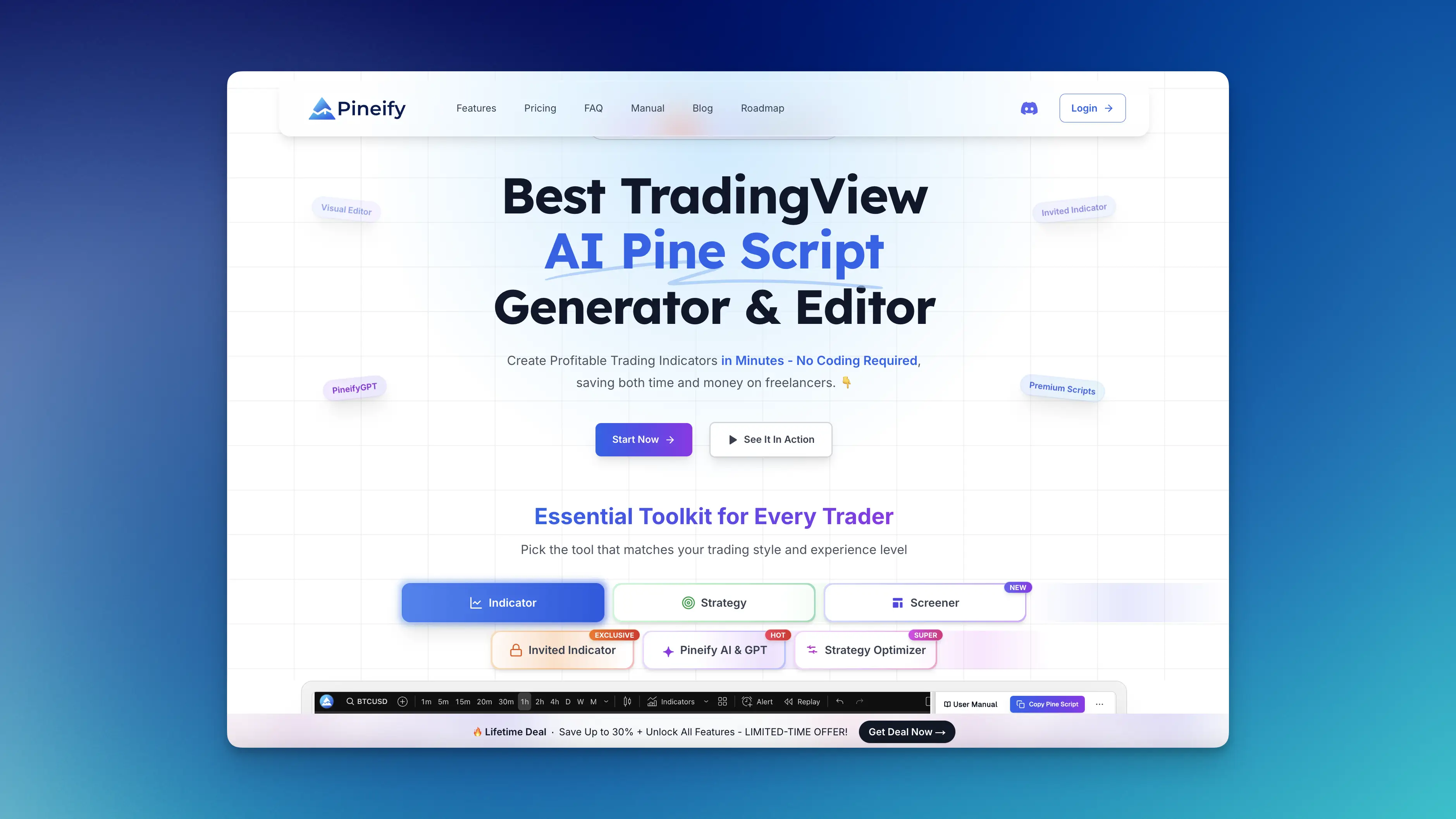
The library comes with over 100 technical indicators built in. Moving Averages, RSI, MACD, Bollinger Bands — they're all available from the studies menu or through API calls. For developers working with custom Pine Script indicators, the Pineify blog covers plotting text labels, pattern recognition scripts, and automated strategies.
Drawing tools let you annotate charts:
- Trendlines: Connect swing highs and lows to identify support and resistance levels.
- Annotations: Add text labels or arrows to mark important events — useful for educational content.
- Shapes: Use rectangles or triangles to highlight patterns like consolidation ranges or breakouts.
You can add drawings programmatically with chart.createShape(). I've used this to auto-draw Fibonacci retracement levels after a major price move on ETH/USD.
Connecting to Live Data
The key to a useful chart is live data. The library uses the IDatafeedChartApi interface to request and receive real-time prices.
Your server needs to provide OHLC bars in the expected format. I've worked with several data providers — Polygon, Finnhub, and a custom backend — and the integration pattern is the same: resolve the symbol, fetch historical bars, stream updates.
One thing I haven't tested deeply is the library's behavior under WebSocket disconnections. The docs mention a built-in fallback that serves cached data when the live feed drops. In my experience, that fallback works well enough for short interruptions, but I wouldn't rely on it for a brokerage app without adding your own reconnection layer.
For production setups, you'll want to support multiple trading pairs across various timeframes (1m, 5m, 4h, daily). The library scales well here — I've tested it with 20+ symbols in a single page without noticeable performance issues.
Advanced Features
When you need more than a single chart, the library supports multi-chart layouts. You can display up to 8 charts on one screen, synced by symbol or interval. I use this to track correlated assets — for example, SPY and QQQ on different timeframes in a single view.
Switching to Trading Terminal mode adds trading panels directly on the chart. You can place orders and view the Depth of Market without leaving the chart view.
| Feature | What It Lets You Do |
|---|---|
| Compare Symbols | Overlay multiple assets (e.g., gold and the US dollar) on one chart. |
| Advanced Price Scales | Switch between linear, logarithmic, or percentage-based views. |
| Watchlists | Create symbol lists sorted by price change to see what's moving. |
Customization and Theming
You can match the chart's appearance to your site's design. The built-in theming supports light and dark mode — set it globally and charts respect the user's preference.
For more precise control, override CSS classes. Example:
.tv-chart-container { background: #f0f0f0; }
You can change fonts, colors, spacing — anything you can target with a CSS selector. The featuresets API lets you hide UI elements like the header toolbar if you want a minimal interface.
A limitation worth noting: the CSS class names aren't documented exhaustively. I've had to inspect the DOM to find the right selector more than once. It's workable, but be prepared to dig.
Troubleshooting
When something breaks, the first thing I do is check the browser console. The library logs descriptive error messages — most of the time it's a datafeed mismatch or a missing API key.
If the chart won't render:
- Verify the container has a non-zero height.
- Confirm the API key is active and correctly entered.
- Check the network tab for failed data requests.
For appearance customizations that look off, the official documentation is the most reliable source. I've found that forum posts and third-party tutorials age quickly — the library updates frequently.
Frequently Asked Questions
Is the TradingView Charting Library free to use?
You can use it for free in personal and non-commercial projects. Commercial applications need a license from TradingView.
Can I integrate the TradingView Charting Library with React or Angular?
Yes. The community has built wrappers for React, Angular, and Vue.js. You don't have to build the integration from scratch, though I recommend checking the wrapper's last update date — some are maintained better than others.
What data sources can I connect to the TradingView Charting Library?
Any source that provides OHLC data through an API works. Popular options include Polygon, Finnhub, IEX Cloud, or your own backend server.
How do I get real-time updates working on my charts?
Set up a WebSocket connection inside your custom datafeed implementation. The library handles the rest — it subscribes to symbols and updates the chart as new bars arrive.
Does the TradingView Charting Library support cryptocurrency charts?
Yes. Create custom symbols like BTC/USD or ETH/BTC and they plot the same as any stock. I've tested this with several crypto pairs and it works without issues.
How do I customize the appearance of the charting library?
Use the built-in light and dark theme options, or override specific CSS classes to match your design. The featuresets API lets you hide toolbars, headers, and other UI elements.
What is the widget constructor in the TradingView Charting Library?
The widget constructor is the main entry point for chart initialization. You pass a config object with the symbol, interval, container element, and datafeed — the library renders the chart based on those settings.
Community and Resources
The official GitHub repository has discussions and issues for technical questions. Reddit's r/TradingView community is active for broader conversations and real-world use cases. I'd recommend starting with the official documentation for API references, and opening a GitHub issue if you're stuck on something specific.
For more on Pine Script indicators and automated strategies, the Pineify blog covers everything from basic indicators to advanced pattern recognition scripts.