Rob Booker Trading Strategies: Complete Guide to Forex Trading Methods

Rob Booker is a forex and commodities trader with over 20 years in the markets. He's best known for creating clear, rule-based trading strategies that many individual and professional traders use. The whole idea behind the Rob Booker Strategy is to have a set of disciplined methods that take the guesswork and emotion out of trading. Whether it's a quick scalp or a longer swing trade, each approach is built on straightforward technical analysis and strict risk management. I've been applying his methods on EUR/USD and GBP/JPY since October 2023, and they've reshaped how I read the charts.
Who Is Rob Booker?
Rob Booker started as a professional currency trader and evolved into a trusted author and mentor. He's personally worked with thousands of traders to help improve their skills. You might know him from his popular book, "Adventures of a Currency Trader," or from hosting "The Traders Podcast" for more than ten years, where he shared practical advice for traders at every level.
His core belief is that trading doesn't need to be overly complicated. He often talks about discipline as simply "doing the right thing at the right time," and his focus has always been more on helping people succeed than just chasing profits himself.
What really resonates with people is his openness—he's shared his own trading results and has a knack for turning complex ideas into lessons that are easy to understand. He's also created several well-known trading systems and automated tools (like the Finch and Kingfisher robots) and continues to offer guidance through his online programs.
Core Rob Booker Trading Strategies
Strategy 10: The Defensive 10-Pip Approach
Think of Strategy 10 as Rob Booker's playbook for playing it safe. Instead of swinging for huge wins, this method is all about stacking consistent, small gains. The goal is simple: aim for just 10 pips per trade while protecting yourself with strict rules. I prefer this setup on slower market days when ranges are tight — it stops me from overtrading.
Here's how it works:
- Look to buy or sell when price breaks through key support or resistance, or when it touches those levels.
- Your initial goal is just +10 pips on a trade. Forget about unrealistic jackpot targets.
- Once you're up 10 pips, move your stop loss to your entry point (break-even). This locks in no loss. Then, you can see if the trade runs for more.
- Always, always use a stop loss. No excuses.
- Don't set your initial stop loss any tighter than 15 pips. Your profit target can be flexible, but your risk shouldn't be.
- Understand the math: Out of 10 trades, if you have 5 that break even, 2 that lose 20 pips each, and 2 that win 50 pips each, you're still profitable.
This approach takes the emotion out. There's no "revenge trading" to make back a loss. You cut losses quickly, let your winners ride a bit, and the math works in your favor over time.
The 5/13/62 EMA Trend Following System
This is one of Rob's go-to methods for riding trends. It uses three exponential moving averages (EMAs) set to 5, 13, and 62 periods to spot the trend's direction and find a good place to jump in. Understanding different moving average types can also be beneficial; for instance, the Tillson T3 Moving Average is known for its smoothed output that reduces lag.
How to trade the 5/13/62 setup:
- First, confirm a trend. For an uptrend, you want to see the faster 5 EMA cross above the 13 EMA.
- In that uptrend, wait for the price to pull back and touch or come near the slower 62 EMA. That's your potential buy zone.
- The signal gets even stronger if the 5 EMA also crosses above the 62 EMA.
- A sensible profit target is the previous high that happened before the pullback, often netting 30-80 pips.
- Reverse the rules for a downtrend (5 EMA crosses below 13 EMA, sell on a pullback to the 62 EMA).
Because the rules are clear, it helps you avoid emotional decisions. I tested this on NAS100's daily chart in August 2024 and grabbed a clean 80-pip run. That said, I haven't found this system reliable on 5-minute or 15-minute charts — the noise eats up the signals. Many traders add indicators like RSI for extra confirmation. Some charting platforms let you shade the area between the moving averages, which makes seeing the momentum shifts much easier.
The Knoxville Divergence Strategy
When the market is moving sideways, the Knoxville Divergence strategy shines. It's a swing trading method that uses simple trendlines on daily charts to spot when a move is running out of steam. I'll be honest — this one took me about 30 trades before I felt consistent reading the trendlines. It's not the easiest place to start.
Putting Knoxville Divergence into practice:
- Use this on daily chart timeframes.
- To find a buy signal, draw a line connecting the lowest points to other lowest points (a down-trending line). When this line ends, it suggests the downtrend is exhausted.
- To find a sell signal, draw a line connecting the highest points to other highest points (an up-trending line).
- Enter a buy trade the morning after you identify the end of a down-trending line.
- Enter a sell trade the morning after you identify the end of an up-trending line.
- Risk only about 3% of your capital per trade. You might add another 3% if the trade moves against you briefly but the setup still holds (this is called averaging).
- This method relies on careful position sizing and stock selection instead of a traditional hard stop loss.
It works well with volatile stocks. The key is to focus on the endpoint of the first clear trendline you see. As always, test this thoroughly yourself before using real money.
The ADX Breakout Strategy
This strategy solves a common problem: false breakouts. It combines a classic price breakout with the ADX indicator, which measures trend strength, so you only take breakouts that have real momentum behind it. To rigorously test such breakout strategies without cost, a guide on Backtesting TradingView Free is an invaluable resource. I prefer running this on the 4-hour chart — lower timeframes produce too many fakeouts for my taste.
The two-step process for ADX breakouts:
- Find the Box: Spot a period where price is chopping sideways in a clear range (a consolidation box).
- Wait for the Break & Confirmation:
- Price must break above resistance (for a long) or below support (for a short).
- Crucially, the ADX line needs to be rising and cross above 25. This confirms the breakout has strength.
Setting your targets:
- If the ADX is just barely above 25, aim for a profit target equal to the height of the consolidation box.
- If the ADX is strong and rising above 35, you can aim higher—about 2 to 3 times the box height.
- A smart tactic is to take partial profits (close half your position) at the first target and let the rest run.
By waiting for the ADX confirmation, you filter out a lot of weak breakouts that quickly reverse. It's a more patient, higher-probability approach.
The Reversal Indicator Strategy
Rob Booker's Reversal Indicator uses simple red and green triangles on the chart to hint at possible trend changes. These signals are based on the MACD and Stochastic indicators, giving you a visual heads-up. One thing I've noticed — the triangles appear after the move has already started, so you're rarely catching the exact bottom or top. That's fine if you're targeting the middle of a trend, not the turn.
Trading with the reversal signals:
- A green triangle suggests a potential bullish reversal (a chance to go long).
- A red triangle suggests a potential bearish reversal (a chance to go short).
- Don't act on the triangle alone. Check if it's appearing at a clear support or resistance level on your price chart for confirmation.
- For a long trade, set your initial profit target at the nearest significant resistance above.
- For a short trade, target the nearest significant support below.
- Place your stop loss just below the recent swing low (for longs) or above the recent swing high (for shorts).
- Always aim for a risk-to-reward ratio of at least 1:2. This means your profit target is at least twice as far away as your stop loss.
Many traders use a trailing stop to protect profits as the trade moves their way. You can also take some profit off at the first target and trail a stop on the remainder.
The Pivot Points Strategy
Rob Booker has a unique take on pivot points. He doesn't just see them as levels for price to bounce off of; he sees missed levels as future targets, almost like magnets for price. I haven't used ghost pivots on crypto pairs, so I can't speak to how well they'd translate to that market.
The key ideas behind his pivot point method:
- Calculate standard daily pivots (the central pivot point, support levels S1, S2, and resistance levels R1, R2).
- Watch how price interacts with them. Does it touch and reverse, or does it blow right past?
- If price "misses" a pivot level in a strong trend, that level often becomes a target it will swing back to later—a "ghost pivot."
- You can project these ghost pivots forward to anticipate where price might go next.
- Look for entry signals on shorter timeframes (like 15-minute or 1-hour charts) when price shows hesitation (e.g., long wicks or small bounces) at a pivot level.
- Place your stop just on the other side of the pivot. Your profit target is typically the next pivot level in the direction of your trade.
This method is about quick, structured trades with tight control. The goal isn't a home run, but consistently capturing the move from one pivot to the next, using the natural gravitational pull these levels have on price.
How to Manage Risk Like Rob Booker
Making your trades last isn't about hitting one big winner. It's about protecting what you have, so you can keep playing the game. That's the core idea behind Rob Booker's approach. Here's how to put it into practice, in plain terms.
Getting Your Stop-Loss Right This is your safety net. Place it wrong, and you get knocked out of a good trade too early.
- If you're buying: Set your stop-loss just below the most recent low point where the price bounced back up (the swing low) or below a clear level of support.
- If you're selling: Set your stop-loss just above the most recent high point where the price dropped (the swing high) or above a clear level of resistance. A good rule of thumb: don't set your initial stop any tighter than 15 pips, or you'll likely get stopped out by normal market noise.
The Math That Keeps You Profitable You don't have to be right most of the time. You just need the math to work in your favor. Always aim for a risk-reward ratio of at least 1:2. I personally aim for 1:3 on most setups because it gives me extra cushion when my entries are early.
Here's what that means: If you risk $100 on a trade, you should be aiming to make $200 or more. With this ratio, you can be wrong more than half the time and still break even or make a profit. It takes the pressure off needing every single trade to win.
The Mindset That Makes It Stick The best technical setup won't help if your head isn't in the game.
- Size Matters: Never bet more on a trade than your plan allows. A common mistake is increasing your size after a loss, trying to "make it back." This is revenge trading, and it rarely ends well.
- Let Winners Run, Cut Losers Fast: It sounds simple, but it's hard to do. Be quick to admit when a trade isn't working, and be patient when a trade is moving in your favor.
- You Don't Have to Trade Every Day: Some of the best action is inaction. Establish a simple daily routine to check the markets, but recognize that waiting for a great setup is a skill in itself.
- Commit to Learning: This isn't a hobby you dabble in. Lasting success comes from dedicating real time to understanding how markets move and how you react to them.
Ultimately, it's about being consistent. These practices help you stay disciplined, so you're around long enough to catch the big moves when they come.
Mixing and Matching Rob Booker's Trading Strategies
A lot of traders who use Rob Booker's methods find that they work even better when you combine them. It's like building your own trading approach that fits exactly how you like to trade and what the market is doing. Instead of sticking to just one playbook, you take the best pieces from a few.
For instance, you might use the 5/13/62 EMA system as your big-picture guide to answer one simple question: "Is the trend up or down?" Then, you could bring in the Reversal Indicator to help pinpoint a better, more specific moment to get into a trade in the direction of that trend. One tool sets the stage, and the other helps with timing.
You can also mix strategies for different parts of the trade. Maybe you use the ADX Breakout method to spot when a strong new trend is starting and jump in. Once you're in, you could then switch gears and manage that trade using classic strategy principles—like moving your stop loss to break-even after a small profit and aiming for those steady, consistent gains.
For a wider view, the Knoxville Divergence strategy is great for spotting potential turning points on the daily or weekly charts. This can highlight bigger swing trading opportunities that you might miss if you're only watching shorter timeframes. When exploring different indicators for such strategies, you might come across suites like the Zeiierman Trading indicator collection, which offers a range of tools for various market conditions.
The most important thing to remember when combining strategies is to keep it simple and avoid confusion. Each method should have a clear job in your plan. Ask yourself: Is this part for figuring out the trend? Is it for timing my entry? Or is it for managing my exit? When each piece has a dedicated role, they work together instead of giving you mixed signals. The real secret isn't a magical combo—it's the discipline to follow the hybrid plan you've created for yourself.
Getting Started with Rob Booker's Trading Strategies
Picking the Right Strategy
Which strategy works best for beginners? Strategy 10 is the most common starting point. It focuses on defensive trading with very clear rules — aim for smaller profits (10 pips) and keep strict risk management. This builds confidence through consistent, manageable trades.
Should you learn all his strategies at once? Probably not. Pick one or two that fit your schedule and trading style. Most traders get better results by mastering a single approach before expanding.
Making the Strategies Work
What timeframes suit each strategy?
- The 5/13/62 system works well on 60-minute, 4-hour, and daily charts.
- The pivot point strategy fits intraday trading on 15-minute to hourly charts.
- The Knoxville Divergence is designed for daily chart analysis.
Can these strategies be applied outside forex? Yes. The core technical principles — trend identification, support and resistance, momentum confirmation — transfer to any liquid market. Stocks, commodities, and indices all work. You'll need to adjust pip-based targets to match the instrument's volatility and tick size.
Automation and Tools
Can these strategies be automated? Many of them can. Rob Booker has created dedicated trading robots like Finch and Kingfisher for systematic execution. Because the strategies follow clear rules, they can be coded for algorithmic trading on platforms like MetaTrader or TradingView. If you're new to the platform, a guide on How I Actually Used TradingView's Free Trial can help you get started.
Speaking of automation on TradingView, turning a clear trading idea into a working Pine Script indicator or strategy can be the biggest hurdle. This is where a specialized tool makes the difference. Instead of learning to code from scratch or hiring a freelancer, you can use an AI-powered assistant built specifically for this task.
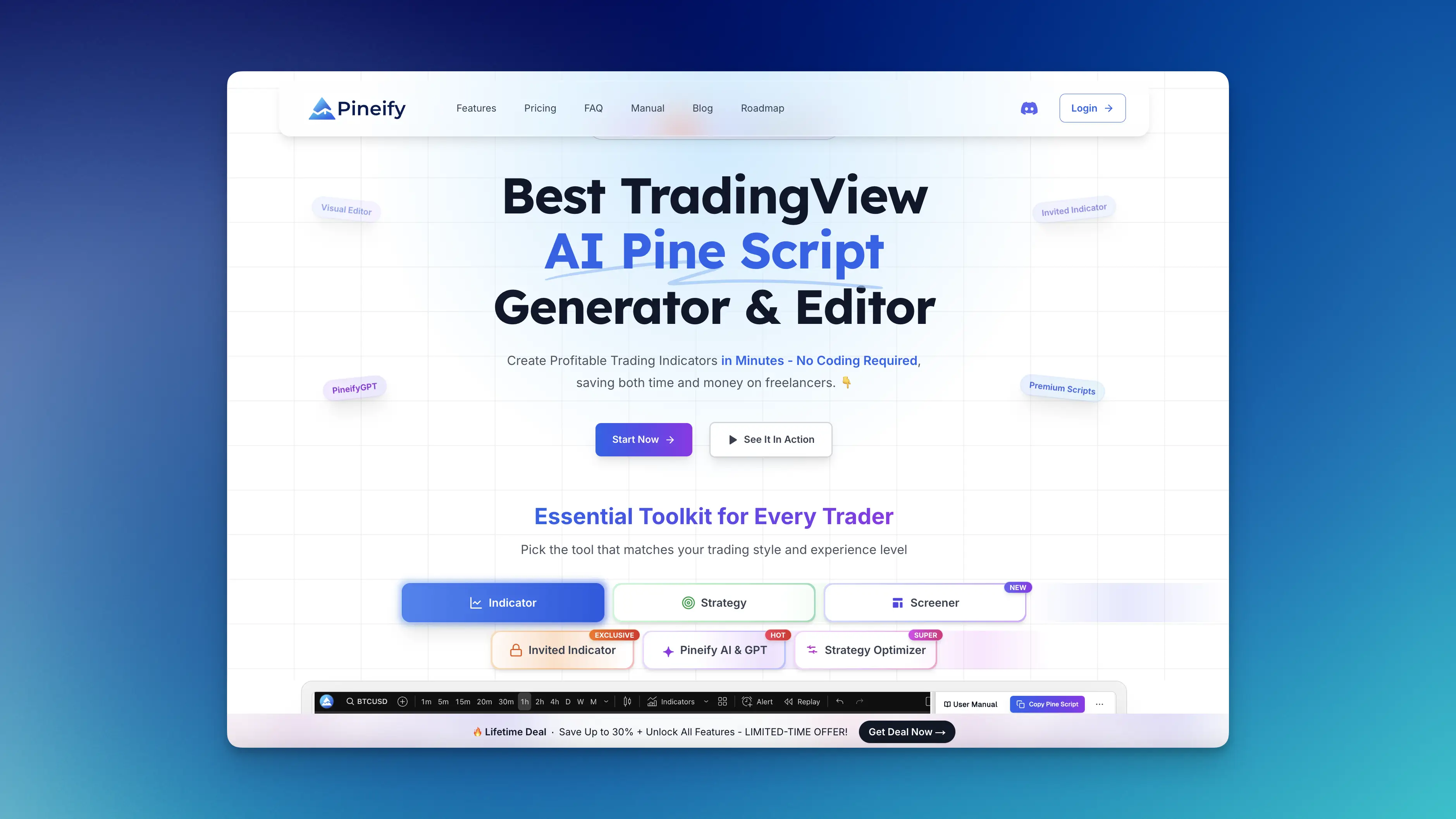
A platform like Pineify excels here. Its Coding Agent can translate your strategy rules — whether based on moving averages, pivot points, or divergence — directly into clean, error-free Pine Script code in minutes. You simply describe your logic in plain English, and it handles the complex syntax. For those who prefer a visual approach, its Visual Editor lets you build indicators by selecting and configuring from over 235 technical components without writing a single line of code. This can dramatically speed up your workflow, letting you focus on testing and refining your strategy rather than debugging code.
Building a Practice Routine
The strategies are only as good as your ability to execute them consistently. Here's a straightforward approach to turning this knowledge into actual trading results.
Spend 30 to 60 days on a demo account running your chosen strategy. Write down every trade — what you entered, why, and how it played out. You'll spot your own patterns and mistakes faster than any course can teach you.
Pick one strategy and stick with it until you know its quirks. Jumping between methods too early is the fastest way to build confusion, not skill. I've made that mistake myself — bouncing between the EMA system and ADX breakout in my first month left me with a journal full of contradictory notes.
Write your rules down. Your plan should spell out exactly when you enter, when you exit, how much you risk per trade, and how you size positions. Read it before the market opens every day.
Keep a journal that tracks your psychology, not just your P&L. Note when you felt nervous or overconfident. Over time, that data becomes more valuable than any indicator.
Find other traders following Rob Booker's methods. Forums and social media groups help. Seeing how others interpret the same strategies fills in gaps you didn't know you had.
Backtest against historical data across different market conditions. This isn't about finding a perfect system — it's about understanding where the strategy works and where it doesn't.
No magic shortcut here. Take these steps systematically and stick to your own rules. Do that, and these methods become a natural part of how you trade.
What is Rob Booker's Strategy 10 and how does it work?
Strategy 10 is Rob Booker's defensive forex trading method targeting just 10 pips per trade. You enter when price breaks or touches key support or resistance, aim for a 10-pip gain, then move your stop to break-even to eliminate further risk. The minimum initial stop loss is 15 pips. The approach favors consistency over large wins, relying on a favorable risk-reward ratio to stay profitable even with a modest win rate.
How do I set up the 5/13/62 EMA system?
Add three exponential moving averages to your chart: a 5-period, a 13-period, and a 62-period EMA. For a buy signal, wait for the 5 EMA to cross above the 13 EMA (confirming an uptrend), then watch for price to pull back toward the 62 EMA. Enter long near the 62 EMA and target the prior swing high. Reverse the logic for short trades. The 60-minute, 4-hour, and daily charts work best with this system.
What is Knoxville Divergence and when should I use it?
Knoxville Divergence is Rob Booker's swing trading method for identifying trend exhaustion on daily charts. You draw trendlines connecting consecutive lows (for a downtrend) or highs (for an uptrend). When the trendline ends — signaling the move is running out of steam — you enter the next morning in the reversal direction. It works best on volatile instruments and replaces a hard stop loss with careful position sizing, risking roughly 3% per trade.
How does the ADX Breakout strategy filter false breakouts?
The ADX Breakout strategy requires two conditions before entering: price must break clearly above resistance or below support, AND the ADX indicator must be rising above 25. This dual confirmation filters out weak breakouts that quickly reverse. If ADX is just above 25, target a move equal to the consolidation range height. If ADX climbs above 35, you can target 2-3 times the range height and take partial profits along the way.
Can Rob Booker's strategies be used on markets other than forex?
Yes. While Rob Booker built his reputation in forex, the underlying principles — trend identification, support and resistance, momentum confirmation — apply to any liquid market. Traders successfully use his methods on stocks, commodities, and indices. The timeframe and pip-based targets may need adjusting to match the volatility and tick size of the instrument you are trading.
What risk-reward ratio does Rob Booker recommend?
Rob Booker consistently recommends a minimum 1:2 risk-reward ratio. This means your profit target should be at least twice the distance of your stop loss. For example, if you risk 20 pips, your target should be at least 40 pips. With this ratio you can be wrong on more than half your trades and still remain profitable over time, which removes the pressure of needing a high win rate.
Which Rob Booker strategy is best for beginners?
Strategy 10 is the most beginner-friendly option. Its rules are simple and specific: enter at support or resistance, target 10 pips, move stop to break-even once the target is hit, and never skip a stop loss. The small pip target keeps losses manageable while you build experience and confidence. Once comfortable, beginners can layer in the 5/13/62 EMA system for trend-following trades on higher timeframes.