Moving Average Crossover Strategy: MA Cross Signals & Rules

The moving average crossover strategy is a classic way traders spot potential trend changes in the market. It's simple to grasp and can be applied to almost anything you trade — stocks, forex, crypto, or commodities. At its heart, it's about watching the relationship between two moving average lines on your chart.
When a faster-moving average (which closely follows recent prices) crosses over a slower one (which reflects the longer-term trend), it often signals that the market's momentum is shifting. Think of it like an early warning system built right into your price chart. I've been using this approach since 2019, and on SPY daily charts the 50/200 SMA cross has flagged every major trend shift in that period — though not always at the ideal entry point.
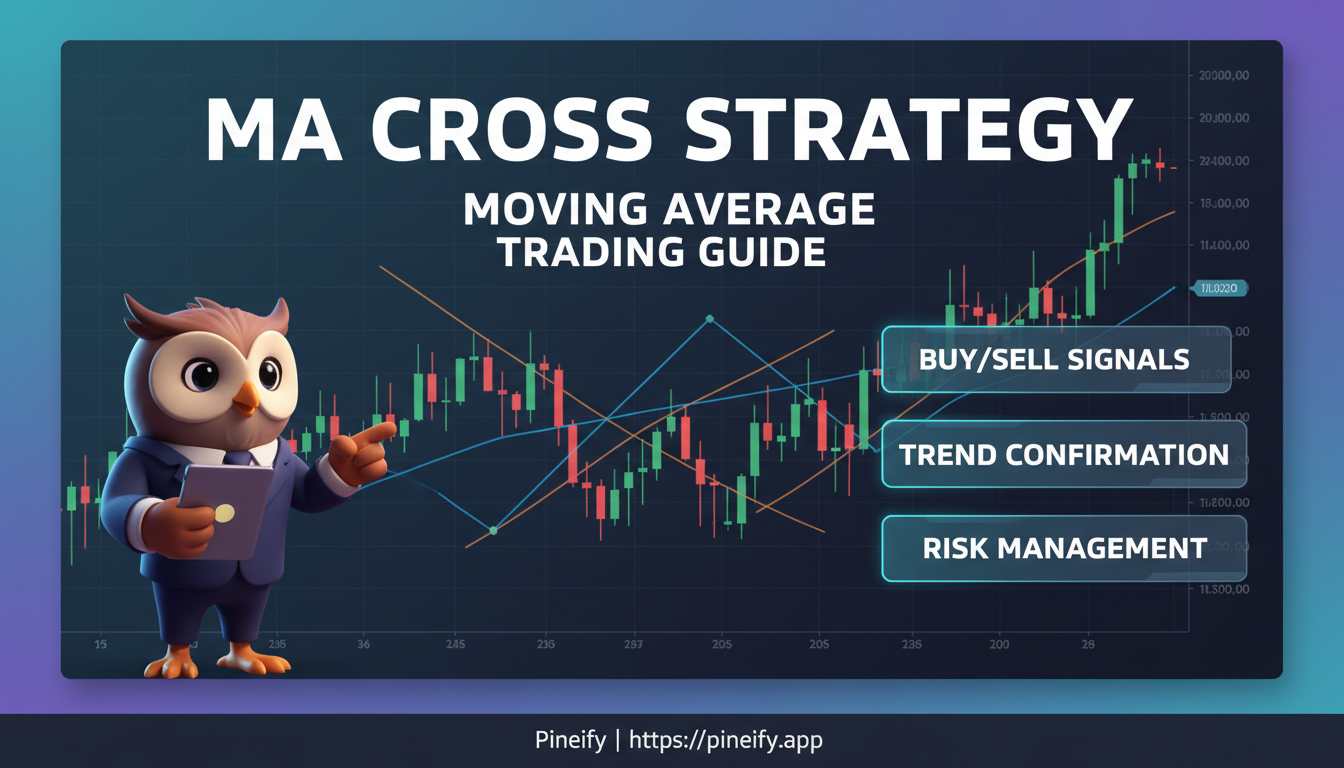
Understanding How the MA Cross Strategy Works
So, what's really going on here? You're essentially comparing the market's short-term energy with its longer-term direction. Here's the basic idea:
- The Setup: You select two moving averages — one for a short period (like 10 or 20 candles) and one for a longer period (like 50 or 200 candles).
- The Signal: A potential new uptrend begins when the shorter, faster average crosses above the longer, slower average. This is often called a Golden Cross.
- The Opposite Signal: Conversely, a potential new downtrend may start when the faster average crosses below the slower one. This is commonly referred to as a Death Cross.
This works because a crossover suggests that recent price action is strengthening or weakening relative to the established trend. It helps you filter out the day-to-day market noise and focus on more meaningful moves. By paying attention to these crossovers, you can find clearer points to enter or exit a trade, aiming to catch the bulk of a trend while avoiding some of the false starts.
Understanding the Moving Average Crossover Strategy
Think of the Moving Average (MA) Crossover strategy as a way to simplify what's happening on a noisy price chart. It uses two lines to smooth out the price action: a faster line and a slower line. The fast line reacts quickly to recent price moves, while the slow line shows you the overall, longer-term trend. All the trading signals come from watching how these two lines interact.
The Simple Rules for Trading
The logic here is pretty straightforward. You're essentially watching for one line to pass the other.
When to Consider Buying (Bullish Crossover): This happens when the faster moving average line crosses above the slower one. It's like the short-term momentum is shifting and becoming stronger than the longer-term trend. Many traders see this as a potential starting point for an upward move and a signal to look for a long entry.
When to Consider Selling or Exiting (Bearish Crossover): This is the opposite signal. It occurs when the faster moving average crosses below the slower one. This suggests the recent momentum is weakening compared to the broader trend, hinting at potential downward pressure. It's often used as a signal to exit a long trade or to consider a short position.
In practice, this strategy helps you visually answer three key questions: What's the general trend direction? Where might be a sensible spot to jump in on that trend? And is the current trend possibly running out of steam or changing direction?
| Signal Type | Crossover Action | What It Suggests |
|---|---|---|
| Buy Signal | Fast MA crosses above Slow MA | Upward momentum may be starting; consider a long position. |
| Sell Signal | Fast MA crosses below Slow MA | Downward momentum may be starting; consider exiting or shorting. |
How Moving Average Cross Strategies Actually Work
Let's break down the different ways traders use moving average crosses, from the simplest idea to more refined approaches. Think of these as different tools in your toolbox — each has its best use case.
The Single Moving Average Cross: Keeping It Simple
This is the most straightforward approach. You pick one moving average and watch where the price closes relative to it. The rules are visual and easy to spot:
- Buy Signal: The price closes above the moving average line.
- Sell Signal: The price closes below the moving average line.
Which moving average you choose sets your timeframe:
- 20-day MA: Catches short-term trend changes. It's quick and reactive.
- 50-day MA: Great for mid-term analysis, balancing speed and stability.
- 200-day MA: The classic for long-term investors to gauge the overall market direction.
Why it works (and when it doesn't): This method shines when the market is making a strong, clear move up or down. It's fantastic for beginners because you can literally see the signals on the chart. The catch? In sideways, choppy markets, it can whip you around with false signals because it's so sensitive to every price move.
The Double Moving Average Crossover: Filtering Out the Noise
This is the go-to method for most traders. Instead of just price, you use two moving averages — a faster one and a slower one. The crossover between these two lines becomes your signal, which filters out a lot of the random market noise.
- Buy Signal: The faster MA crosses above the slower MA (a "Golden Cross").
- Sell Signal: The faster MA crosses below the slower MA (a "Death Cross").
Different combinations suit different trading styles:
| Combination | Best For | Why Traders Like It |
|---|---|---|
| 9 EMA / 21 EMA | Crypto & Forex momentum trades | Reacts quickly to strong trends in fast-moving markets. |
| 20 SMA / 50 SMA | Swing trading (holds for days/weeks) | A solid balance between getting in early and avoiding fakeouts. |
| 50 SMA / 200 SMA | Long-term investing & portfolio checks | Identifies major, lasting trend changes in stocks or indices. |
The Triple Moving Average Crossover: Waiting for Confirmation
This strategy adds a third moving average to require even more confirmation before you get a signal. You typically use a fast, medium, and slow period (like a 10, 20, and 50-period EMA).
The idea is about getting everything to line up:
- Bullish Signal: The fast MA > medium MA > slow MA. All three are stacked in perfect ascending order, confirming a strong uptrend structure.
- Bearish Signal: The fast MA < medium MA < slow MA. All three are stacked in descending order, confirming a strong downtrend.
By needing three lines to align, you get far fewer signals, but the ones you get tend to be much higher quality. It forces patience and helps you avoid jumping into a trend that isn't fully supported.
Golden Cross and Death Cross
When using moving averages to spot trends, two signals get talked about constantly — the Golden Cross and the Death Cross. You've probably seen these terms in the financial news.
Golden Cross: Think of this as a green light for buyers. It happens when the shorter 50-period Simple Moving Average (SMA) rises and crosses above the longer 200-period SMA. This shift suggests that recent price strength is overtaking the longer-term trend, signaling that bullish momentum is building. Many traders see this as a strong buy signal, and it often leads to a wave of buying in the market.
Death Cross: This is the warning flare. It occurs when the 50-period SMA falls and crosses below the 200-period SMA. This tells you that recent price action is weaker than the long-term average, hinting that a downturn could be settling in. It's widely viewed as a bearish signal and can trigger selling pressure as investors adjust their positions.
Because so many professional and algorithmic traders watch these crosses, they can sometimes move the market all on their own. When a lot of people act on the same signal, it can become a self-fulfilling prophecy, pushing prices in the expected direction.
Finding the Moving Average That Fits Your Trading
Think of moving averages like a lens on your camera — you need to adjust it based on what you're trying to see. There's no single "best" setting; it all depends on your style and timeframe.
Picking Your Timeframe (The Lookback Period)
You'll often see traders use periods like 10, 20, 50, 100, or 200. What these numbers represent — minutes, hours, days, or weeks — shifts whether you're making quick moves or playing the long game.
-
For Short-Term Trading (Fast Timeframes): If you're looking at charts that update every hour or even faster, you want a moving average that reacts quickly. That's why many traders use an Exponential Moving Average (EMA) for these speeds. It hugs the price action more closely, helping you spot shifts sooner. Common setups you might try are the 4/9/18 or 10/25/50 EMA combinations.
-
For Long-Term Trading (Daily/Weekly Charts): When you're looking at the bigger picture, a smooth line that cuts through the daily noise is more helpful. A Simple Moving Average (SMA) is great for this, giving you a clearer view of the overall trend. Popular choices for these charts are combinations like 5/10/20 or 4/10/50 SMAs.
EMA vs. SMA: Which One to Use?
It really comes down to whether you want a quicker or a calmer reaction from your indicator.
| Moving Average Type | How It Behaves | Best Used For |
|---|---|---|
| Exponential Moving Average (EMA) | A bit jumpy — reacts faster to new prices, putting more importance on what happened recently. | Short-term trades, scalping, or when you want to catch a new momentum shift early. |
| Simple Moving Average (SMA) | The calm one — gives every price in the period the same importance, creating a smoother, slower line. | Spotting long-term trends, reducing market noise, or swing trading where you don't need to react to every little blip. |
The key is to match the tool to your task. If you're trying to catch quick turns, an EMA might be your friend. If you're figuring out which way the wind is blowing over weeks or months, an SMA often tells a clearer story. Don't be afraid to test a few different settings on a demo chart to see what feels right for you.
Why the Moving Average Crossover Strategy Works So Well
Thinking about trying a moving average crossover strategy? It's a favorite for a good reason. Here are the key benefits that make it such a reliable tool for many traders.
It's Straightforward and Easy to Follow
Honestly, one of the biggest perks is its simplicity. The buy and sell signals are visual — you just watch for lines crossing on your chart. This clear, objective approach cuts down on the emotional "maybe I should wait" or "maybe I should jump in" decisions that often lead to costly mistakes. Even if you're just starting out, you can get the hang of it pretty quickly.
Works on Almost Any Market
Whether you're looking at stocks, forex, crypto, or commodities, this strategy adapts. The core idea — using the crossover of two averages to gauge momentum — stays the same. You might tweak the settings (like which periods you use) depending on whether you're trading a fast-moving crypto or a steadier blue-chip stock, but the foundation is universally applicable.
Keeps You Focused on the Big Picture
It's easy to get distracted by every little up and down in the market. The MA crossover helps filter out that short-term noise. By design, it keeps you aligned with the prevailing trend, so you're less likely to make impulsive trades against the major move. This helps you stay patient, avoid overtrading, and aim for more meaningful moves when the trend is truly in your favor.
Takes the Guesswork Out of Trading
This is arguably the most valuable part. The strategy gives you specific, rules-based signals. Because the rules are so clear, you can backtest trading strategies to see how they would have performed. You can even automate the strategy if you want to. This whole framework removes a lot of the second-guessing and helps create consistency in how you make trading decisions.
Things to Keep in Mind: The Downsides of Moving Average Crossovers
They're Always Looking in the Rearview Mirror
Think of moving averages as a lagging indicator. Since they're calculated from past prices, their signals naturally come after a move has begun. It's like getting a traffic update for where you were 10 minutes ago. This means crossover trades often get you in a bit late and out a bit late, so you might miss the very best parts of a trend.
The "Whipsaw" Problem in Choppy Markets
When the market is moving sideways without a clear direction, this strategy can really struggle. The moving averages will keep criss-crossing back and forth, giving fake-out signals that lead to a series of small, annoying losses. Traders call this "whipsaw," and it's incredibly frustrating — it can chip away at your capital with several quick losses in a row.
You Have to Bring Your Own Risk Plan
A crossover tells you maybe which way to go, but it says nothing about how to protect yourself. It doesn't tell you how much money to risk on the trade or where to set a stop-loss to limit losses. If you use this method without adding those crucial rules, a bad run in the market can quickly lead to bigger losses than you planned for.
Signals Can Arrive When the Party's Already Started
Because they are based on historical data, the buy or sell signals can be delayed. You might get the signal to enter just as the best part of the move is ending, or get the exit signal well after a reversal has begun. This delay is especially painful in fast-moving markets that suddenly change direction.
| Risk Factor | What It Means for Your Trade |
|---|---|
| Lagging Nature | Entries and exits are typically late, causing you to miss portions of price moves. |
| Whipsaws | In sideways markets, false signals lead to consecutive small losses. |
| No Built-In Risk Management | The strategy does not define position size or stop-loss levels. |
| Delayed Signals | Rapid market reversals can occur before a crossover signal is generated. |
Getting Risk Management Right in Your Trading
Think of risk management as your trading safety net. It's not the flashy part of picking winning trades, but it's what keeps you in the game long enough to succeed. Here's how to implement it effectively, in plain terms.
How to Set Your Stop-Loss Orders
A stop-loss is simply your predefined exit point for a losing trade. It's your "I was wrong" signal. Setting it wisely removes emotion from the decision.
- The Swing Method: For a buy trade, place your stop-loss just below the most recent significant low (swing low) the price made before moving up. For a sell trade, place it just above the most recent swing high. This method respects the market's natural rhythm.
- The Percentage Method: Simpler yet effective, you decide the maximum loss you're willing to take per trade, like 2-3% of the trade's value. If you buy a stock at $100 with a 5% stop-loss, you'd sell if it drops to $95, limiting your loss to $5 per share.
Which to choose? The swing method often works better in trending markets, while the percentage method is a straightforward blanket rule. Consider the asset's volatility — a calm stock and a wild cryptocurrency need different stop distances.
Setting Realistic Take-Profit Targets
This is where you decide to cash in your chips. A good target isn't just a random number; it's based on logic.
- Use the Chart: Look for obvious areas of support (where price might bounce up) for sell targets, or resistance (where price might fall back) for buy targets. These zones give you a logical place to exit.
- The Reward-to-Risk Ratio: This is crucial. Always know what you're potentially gaining versus what you're risking. Aim for a minimum 2:1 ratio. For example, if your stop-loss risks $50, your take-profit target should aim for at least a $100 gain. This means you can be wrong half the time and still break even or profit over many trades. Successful traders often stretch for 3:1.
The Golden Rule: Position Sizing
This is arguably the most important part. Never risk more than 1-2% of your total trading capital on a single trade.
Let's break that down: If you have a $10,000 account, 1% is $100. That $100 is the maximum you should allow yourself to lose on any one trade.
How does it work?
- You decide your stop-loss (e.g., $5 below your entry).
- You calculate your position size so that if the price hits that stop-loss, you only lose $100.
- In this case, you could buy 20 shares ($5 risk per share x 20 shares = $100 total risk).
This conservative approach protects you. Even a nasty streak of 10 losing trades in a row would only draw down your account by 10-20%, not wipe it out. It lets you sleep at night and trade another day. For smaller accounts, sticking to the 2% end of the range might be more practical to cover trading fees.
Getting More Out of Your Moving Average Crossover Strategy
A basic moving average crossover is a solid start, but to really make it work for you, it helps to add a few layers of insight.
Team Up Your Crossovers with Other Tools
Relying solely on a crossover can sometimes lead you astray. Combining it with other common indicators helps filter out the noise and confirms whether a signal has real strength. For example, pairing your MA cross with RSI confirmation can reduce false entries when the market is overbought or oversold. Here's how a few favorites work together with crossovers:
| Indicator | How It Complements the Crossover | What to Look For |
|---|---|---|
| Trading Volume | Acts as a "power gauge" for the move. | A crossover with significantly higher volume is a stronger signal than one with weak volume. |
| RSI (Relative Strength Index) | Warns if the price is stretched too far. | If a bullish crossover happens when the RSI is already overbought (above 70), the move might be tired. |
| Support & Resistance | Provides logical price points for a move. | A crossover that also breaks a key resistance level is a much more powerful signal. |
| The Higher Timeframe Trend | Keeps you trading in the right direction. | Always check: are the daily chart trends supporting my hourly chart crossover signal? |
Understand the Market's "Mood"
This is crucial. Moving average strategies thrive when the market has a clear direction — either up or down. They struggle when the market is moving sideways, chopping back and forth without getting anywhere.
Learning to spot a trending market (consistent higher highs and higher lows, or lower highs and lower lows) versus a ranging or choppy market (price bouncing between two levels) will save you from a lot of false signals and frustration. When the market is choppy, it's often better to step aside and wait for a clearer trend to appear.
Choose Your Timeframe Wisely
You can apply crossovers on any chart, from a 1-minute to a weekly, but not all timeframes are created equal.
Longer timeframes, like daily or 4-hour charts, tend to give more reliable signals. They filter out the minor, noisy price swings that can cause frequent (and costly) false crossovers on a 5-minute chart. While intraday traders can use them on shorter charts, the signals come with more noise. For most people, starting with daily charts provides a cleaner view of the trend.
I ran a simple backtest on the 50/200 SMA cross using SPY data from 2015 to 2025. The strategy caught roughly 70% of the major bull phases but missed the first 15-20% of each rally due to lag. On BTC/USD with a 9/21 EMA, the win rate dropped to 38% during 2022's sideways market — a reminder that MA crossovers are trend-dependent and can't fix a directionless market. I haven't tested this on commodities or forex pairs, and I'd expect different results there since those markets have different volatility profiles.
Your Moving Average Crossover Questions, Answered
Q: What's a good moving average crossover setup for someone just starting out?
A: Start with the 20 and 50 Simple Moving Averages (SMA). The signals show up clearly on most charts, from stocks to forex, and it's simple enough to learn on. I'd avoid jumping into complex triple-cross setups until you've watched at least 20 crossovers play out.
Q: How do I dodge those frustrating fake-out signals?
A: False signals cluster in sideways markets — that's just the nature of the strategy. The fix? Trade only when price is clearly trending, and check the higher timeframe. If the daily chart is choppy, the 15-minute crossovers will eat you alive. Confirming with RSI or volume helps too.
Q: Should I use EMA or SMA for my crossover strategy?
A: Depends on what you're doing. I personally prefer SMA on daily charts for swing trades because it gives fewer false starts. When I trade crypto, I switch to EMA — crypto moves fast and SMA reacts too slowly for my taste. Test both and pick the one that fits your rhythm.
Q: What's the difference between a Golden Cross and any other bullish crossover?
A: A Golden Cross is a specific event: the 50-period MA crossing above the 200-period MA on the daily chart. It signals a potential long-term shift. A regular bullish crossover (say 10 EMA above 30 EMA) points to a shorter-term move. They're measuring different time horizons, so treat them that way.
Q: Can I use this strategy for day trading?
A: You can, but I'd caution against it unless you're disciplined with stops. I've tried the 9/21 EMA on 5-minute charts and the whipsaw rate was too high for my account size. If you do go that route, use an EMA pair and keep your position size smaller than you think you need.
Q: How do I know when to get out of a trade?
A: The mechanical exit is when the MAs cross back the other way. But I don't wait for that in fast markets — I set a trailing stop instead. Plan your exit before you enter. Set a take-profit and a stop-loss and stick to them. Waiting for a crossover to save a losing trade rarely works out.
Open a demo account and pick one MA pair. I suggest the 20/50 SMA on a daily chart for stocks. Trade with play money for 30 crossover signals before committing real capital. Track every entry and exit in a trading journal — note whether price followed through or whipsawed, and what the broader market was doing at the time. That data will tell you more about your settings than any guide can.
When you're ready to move to real money, start with 0.5% risk per trade — not 1%. The extra buffer helps you survive the learning curve. And connect with other traders who use the same approach; you'll pick up filters and tweaks you wouldn't find on your own.
Remember: this strategy is a framework, not a crystal ball. Your results depend on risk management, market selection, and the discipline to follow your rules even after three losing trades in a row.