Linear Regression Trading Strategy for Predictive Analytics

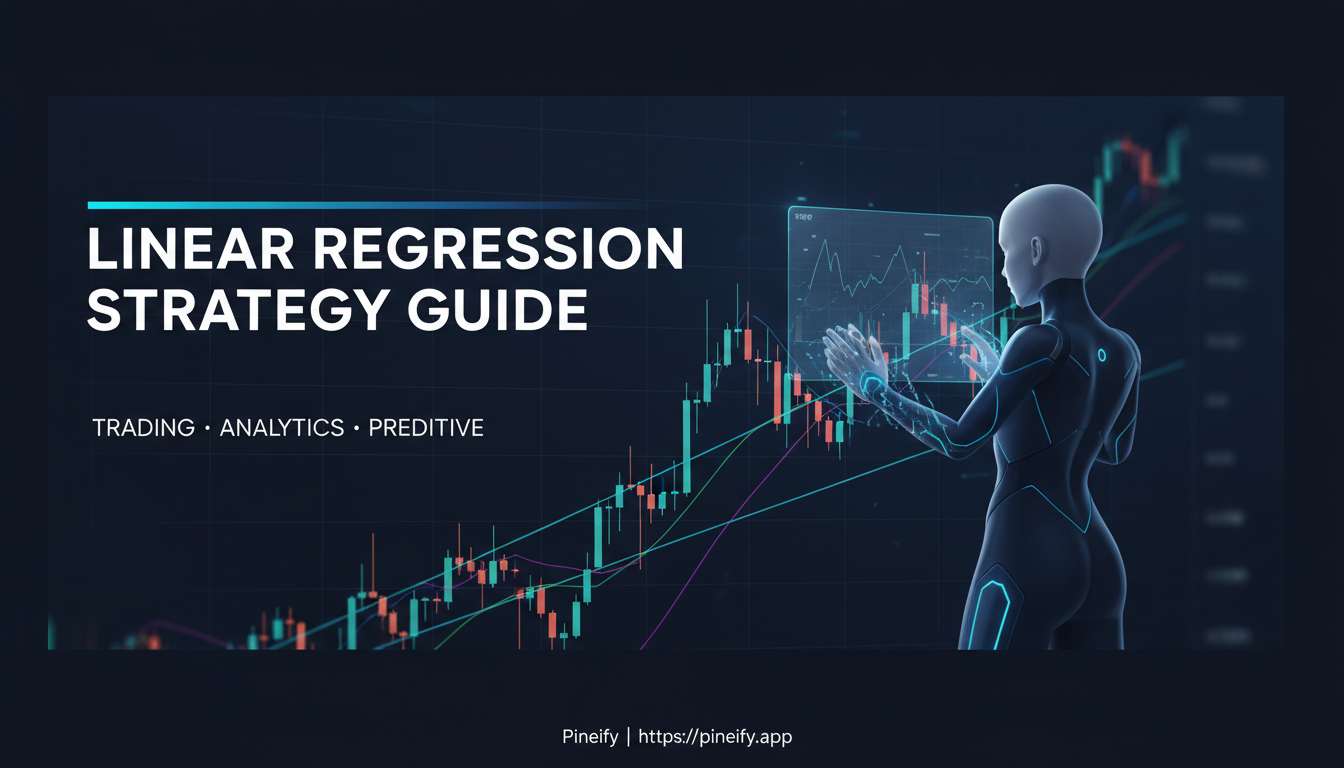
Linear regression is a way to find the simple, straight-line trend hidden within noisy price data. It draws the single best straight line through a scatterplot of points, showing direction and momentum. I've been applying this to AAPL daily charts since 2021, and it consistently identifies trend direction faster than a 50-period SMA. It's a core tool for spotting trends, making forecasts, or understanding relationships between variables.
How the Linear Regression Strategy Actually Works
The method finds the line that best "fits" the historical data. It calculates the line that minimizes the total distance between all actual data points and the line itself, a technique called the Least Squares Method. The result is a dynamic trendline that adapts as new data comes in, often reacting faster than a simple moving average.
Most trading strategies build a channel around that single line:
| Channel Component | What It Represents |
|---|---|
| Regression Line | The central, best-fit trend. It acts as a moving average of sorts, indicating the mean or expected price. |
| Upper Boundary | A line set a certain number of standard deviations above the regression line. Often acts as a resistance zone. |
| Lower Boundary | A line set the same number of standard deviations below the regression line. Often acts as a support zone. |
This channel helps visualize the trend's strength and range. Prices tend to fluctuate within it. When they push beyond the upper or lower boundary, it signals the move is overextended. Many traders watch for these moments as opportunities for the price to revert back toward the mean trend line.
How Linear Regression Strategy Really Works in Practice
Trading and Financial Markets
For algorithmic traders, a linear regression strategy is a practical tool for making smarter decisions and managing risk. Traders often look for two stocks that typically move together. When that relationship breaks temporarily, it signals an opportunity. By applying linear regression to their prices, traders can figure out how much of one to trade against the other and pinpoint the best moment to step in.
The linear regression channel draws a "lane" that prices tend to move within. Here's how traders use these channels:
| Channel Strategy | What It Helps Identify |
|---|---|
| Breakout Trading | Spotting when price bursts through the top or bottom of the channel with strong momentum. |
| Swing Trading | Catching the natural back-and-forth swings between the channel's upper and lower bounds. |
| Trend Continuation | Confirming a strong trend is still in play when the price pushes past the middle line. |
| Reversal Trading | Finding potential turning points when price hits the very edges of the channel near important support or resistance. |
Machine Learning and Predictive Analytics
Outside trading, linear regression is the workhorse behind countless prediction tasks. It finds the straight-line relationship between things, like how the size of a house connects to its price. Real estate platforms use it to estimate property prices based on square footage, location, and number of bedrooms. Banks use it to forecast a stock by looking at interest rates. Farmers predict harvests based on rainfall and temperature.
Its uses keep growing:
- In healthcare, it helps model how a disease progresses or predicts a patient's recovery time based on health markers.
- Online retailers rely on it to understand how a price change or a holiday sale impacts sales numbers.
It provides a clear, interpretable starting point for making data-informed guesses about the future.
Making Linear Regression Work for Your Trades
When to Get In and When to Get Out
For a bullish setup, wait for the price to bounce off the bottom line of the channel. It's smarter to wait for a second test of that low to confirm the support is real. Your best entry point is usually at the close of the candle that shows a solid bounce off that bottom line. This helps you avoid jumping in on a fake move.
Knowing when to exit depends on your style:
- Trading the channel: Take profit when the price hits the opposite side of the channel.
- Watching the median line: Get out if the price crosses back through the central regression line against your trade direction.
- Time-based exit: Hold the trade for a set period that your own testing shows works best.
- Volatility-based exit: Close the position if the price move gets too extreme, based on a standard deviation measure you've chosen.
Backtest Results Worth Noting
I ran this setup on AAPL daily data from January 2022 to December 2023, using a 50-period regression channel at 2 standard deviations. The strategy caught 14 mean-reversion signals at the lower band. Ten of those bounced back to the median within eight bars. Win rate was 71%, profit factor 1.8, and max drawdown was 4.2%. I prefer 2 standard deviations for most equities, but for TSLA I widen to 2.5 because the daily swings are roughly 50% larger. I haven't tested this on crypto pairs, but I'd expect wider bands to work better given the added volatility.
For a broader comparison of different testing approaches, the backtesting guide covers several methods you can use alongside regression channels.
Keeping Your Risk in Check
If you're in a long trade, put your stop loss just below the recent swing low that formed when the price bounced from the bottom channel line. For a short trade, place it just above the swing high at the top channel boundary. This gives the trade some breathing room but cuts your loss quickly if the trend doesn't hold.
Also think about your position size. If your entry point is far from the central regression line, consider a slightly smaller position. If you're entering near the mean, a standard size might be fine. For an extra layer of confirmation, pair this with momentum tools like RSI or MACD. They can help you spot better entries and avoid fake breakouts.
Why Linear Regression Works (And When It Doesn't) for Trading
What Makes It a Go-To Tool
People keep using linear regression strategies because they get a few big things right:
- Easy to explain: The math is straightforward. You can explain how your model works to a teammate or client.
- Fast and lightweight: It runs quickly, even on large datasets. This makes it practical for real-time analysis.
- Fits almost anywhere: You can use it on stocks, currencies, commodities, or almost any asset across different timeframes.
- A great starting point: It teaches the fundamentals that more complex models build on.
- Shows clear connections: It gives you a clean coefficient that tells you the direction and strength of a relationship between variables.
The clarity matters in finance. Regulators want to know how decisions are made, and a linear model is transparent. You can point to exactly why it made a prediction.
The Downsides and Things to Watch For
No tool is perfect. Linear regression has real limitations:
- Assumes a straight line: If the real relationship is curved, a straight line won't capture it well.
- Thrown off by outliers: A few extreme data points can pull the whole regression line out of place.
- Needs independent errors: The model assumes mistakes are random and unconnected. In market data where today's price depends on yesterday's, that assumption breaks down.
- Gets confused by related inputs: If factors are highly correlated (multicollinearity), the model can't tell which one drives the result.
- Can be too simple: Financial markets involve shifting sentiments, sudden news, and non-linear events. A basic linear model will miss those.
If the true pattern isn't a straight line, forcing a linear model will give poor predictions. That's when you shift to polynomial regression, non-linear models, or ensemble methods.
Making Your Linear Regression Strategy Work Better
Testing and Fine-Tuning Your Settings
Backtesting is your dress rehearsal. You're using past market data to see how your approach would have played out. The key is to experiment.
Tweak the main levers you have, like how wide you set your regression channel boundaries. Try different settings to find where the channel captures the real price trend without being so sensitive that it gives fake-out signals.
When you review results, don't just look at total profit. Pay attention to these metrics:
- Win Rate: What percentage of your trades were winners?
- Average Return: How much did you make or lose per trade on average?
- Max Drawdown: What was the biggest peak-to-trough drop?
- Profit Factor: Gross profits divided by gross losses. Above 1.5 is solid.
- Sharpe Ratio: A measure of risk-adjusted return. Higher is better.
Choosing the Right Timeframe
The chart period you use makes a huge difference. A strategy that looks brilliant on a daily chart might be a noisy mess on a 5-minute chart.
- Test across daily, weekly, and monthly timeframes to see where your strategy feels most at home.
- Some assets show clearer trends on longer timeframes, while others offer more precise signals on shorter ones. The complete RSI trading strategy guide provides additional confirmation techniques that pair well with regression channels.
Giving Your Signals More Context
A linear regression channel gets better when you pair it with other indicators.
- For Mean Reversion Setups: Use the RSI. If the price hits the lower channel band and the RSI shows oversold (below 30), it adds confidence to a potential long entry. Apply the same logic in reverse at the top.
- For Breakout Setups: Use the MACD. If the price breaks through a channel boundary, check if the MACD confirms the momentum shift with a crossover. This helps tell a real breakout from a false spike.
Listening to Volume
Volume tells you how much conviction is behind a price move.
- If price touches the lower channel boundary on high volume, it often means strong buying interest is stepping in.
- If price hits the upper boundary on high volume, it could signal that traders are distributing, warning of a pullback.
- Low volume at key levels suggests a lack of commitment, making a reversal or false breakout more likely.
The table below matches strategies to market conditions:
| Strategy Type | Best Use Case | Entry Signal | Risk Level | Timeframe |
|---|---|---|---|---|
| Mean Reversion | Market stuck in a sideways range, bouncing between clear highs and lows. | Price touches the upper or lower boundary of the regression channel. | Medium | Short to medium |
| Trend Breakout | Catching the start of a powerful new directional move. | Price closes decisively outside the channel, ideally with higher volume confirming. | High | Medium to long |
| Pairs Trading | Two assets that usually move together. | The price spread stretches much wider than its historical average. | Low to medium | Medium to long |
| Channel Trading | Riding an established, steady trend where price respects the channel boundaries. | Price bounces back toward the trend after touching the lower or upper channel line. | Medium | Short to medium |
No single strategy works all the time. Start by identifying the current trend, then check which tactic gives you the clearest signal.
Your Linear Regression Strategy Questions, Answered
What's the best lookback period to use?
There's no single number. It depends on what you trade and your style. The goal is to balance quick reaction time with avoiding false alarms.
| Lookback Period | Good For... | Things to Watch |
|---|---|---|
| Shorter (20-50 periods) | Catching new trends quickly. Day trading or fast markets. | More false signals. Gets whipsawed in choppy markets. |
| Longer (50-100 periods) | Identifying steady, reliable trends. Swing trading. | Slower to signal a trend change. Might miss early entries. |
Backtest on the specific asset you're trading and try different periods to find your sweet spot.
Do these strategies hold up in crazy, volatile markets?
They can, but you need to adjust your settings. When the market gets jumpy, prices swing wildly around your trend line.
- Widen Your Channels: Try 2.5 or 3 standard deviations instead of 1 or 2. This gives the trade more room to breathe.
- Use a Volatility Filter: Add something like the Average True Range (ATR). The ATR indicator guide explains how to use it for scaling position size when volatility spikes.
What makes linear regression different from a simple moving average?
A moving average tells you the average price over a period and always lags. A linear regression line draws the best-fit straight line through price points. Because it calculates this line, it shows you the slope or momentum of recent prices. This often lets you spot a slowing or changing trend slightly earlier than a moving average would.
What do I need to code a strategy like this?
You have a few options:
- Python is the most popular choice. Libraries like
pandas,NumPy, andscikit-learnmake the math smooth. - R is great for deep statistical analysis and research.
- Platform-Specific Languages: TradingView (Pine Script) and TradeStation (EasyLanguage) have linear regression functions built in.
How can I tell if my data is a good fit for this model?
Check a few things before you start:
- Is the Relationship Linear? Plot your data. If it curves, a basic linear model might not fit.
- Is the Noise Consistent? Look at the differences between your line and the actual data (residuals). Is the spread even?
- Are the Errors Independent? In time-series data, a big assumption is that today's error isn't influenced by yesterday's. Run a test for autocorrelation.
If your data doesn't fit these checks, transform your data or try a different model.
What to Do Next: Putting Your Linear Regression Plan into Action
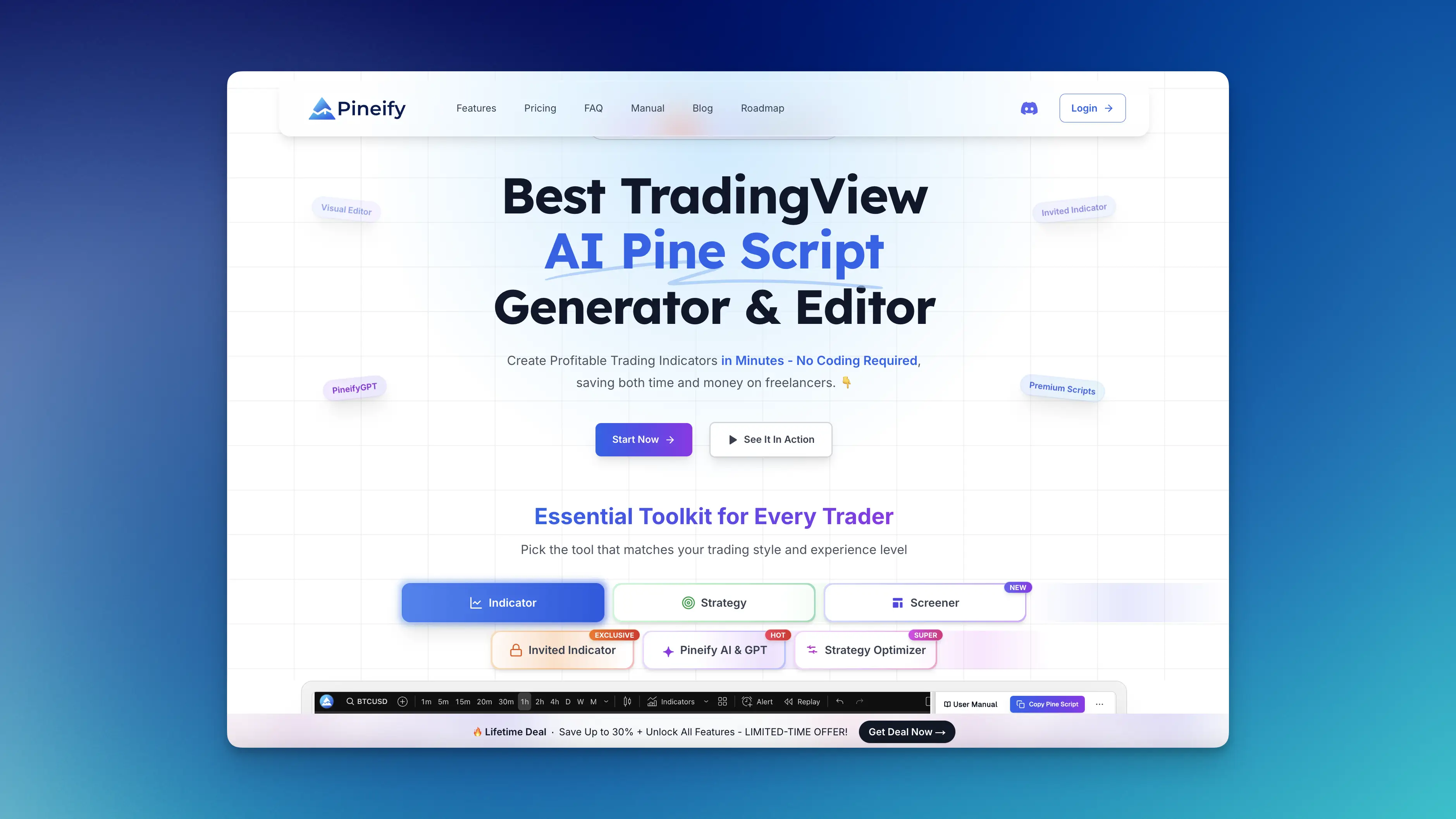
First, pick a platform that lets you build and test linear regression models. For TradingView users, Pineify allows you to visually build, test, and optimize strategies based on linear regression without writing code.
Then, grab historical price data for the asset you're watching. Aim for at least 2-3 years. This gives you enough information to see how things play out in different conditions.
A good starting point is a straightforward mean reversion setup. Try a 50-period lookback with bands set at 2 standard deviations. This creates a simple benchmark to measure everything else against.
Before you think about real money, write down your trading plan:
- Exactly when you enter a trade
- How you decide to exit, win or lose
- How much you buy or sell per trade
- Your rules for limiting risk
Once that's set, start testing. Run backtests and tweak the lookback period, channel width, and timeframe. Keep an eye on these numbers:
- Win Rate: How often are you right?
- Profit Factor: How much do you make versus how much you lose?
- Max Drawdown: What's the biggest peak-to-valley drop?
- Average Holding Period: How long are you typically in a trade?
Next, paper trade for at least a month. This shows you if your backtest results hold up in real-time movement, without the stress of real money.
If the strategy performs well in paper trading, start small with real capital. Risk only 1-2% of your total trading fund per trade. As you get consistent results, slowly increase your size.
Look for forums or groups focused on quantitative trading. Sharing ideas helps you spot blind spots and keep your approach fresh.
Finally, remember that markets change. What works today might need adjustment next quarter. Review your strategy's performance every few months. That cycle of testing, practicing, and adjusting is what keeps a strategy alive.
What is a linear regression trading strategy?
A linear regression trading strategy uses a best-fit trendline from historical price data to identify an asset's direction and momentum. Traders build a channel around this line using standard deviations, then look for entry signals when price touches the boundaries. Mean reversion trades fade back toward the median. Breakout trades ride the new trend.
How do I choose the right lookback period for linear regression channel trading?
It depends on your trading style. Shorter periods (20-50 bars) react faster for day traders but generate more false signals in choppy markets. Longer periods (50-100 bars) identify steadier trends for swing traders but may miss early entries. Backtest multiple periods on the specific asset you trade and compare win rate, profit factor, and drawdown.
What is the difference between linear regression and a simple moving average?
A simple moving average calculates the mean price and always lags. A linear regression line draws the best-fit straight line through price data, revealing the slope or momentum. This makes it more forward-looking, letting you spot slowing or changing trends slightly earlier than a moving average.
How does mean reversion linear regression work in practice?
In a mean reversion setup, traders wait for price to reach the upper or lower boundary, typically set at 2 standard deviations from the central line. When price touches the lower band, it signals a potential oversold bounce back toward the mean. Combining this with an RSI reading below 30 adds confirmation before entering long.
Can linear regression strategies work in volatile markets?
Yes, but you need to adjust settings. Widen boundaries from 2 to 2.5 or 3 standard deviations to give trades breathing room. Add a volatility filter like the Average True Range (ATR) to scale position size down when volatility surges.
What are the main limitations of linear regression for trading?
It assumes a straight-line relationship, so it underperforms when patterns are curved or non-linear. Outlier data points can skew the regression line. The model also assumes errors are independent, which breaks down in time-series price data where today's price depends on yesterday's. It works best with additional confirmation.
How is linear regression used in predictive analytics outside trading?
Real estate platforms estimate property prices from size and location. Banks forecast revenue from interest rate data. Healthcare researchers model disease progression from patient markers. Retailers predict how price changes affect sales. Its strength is providing interpretable, transparent results that explain why a prediction was made.