How to Use TradingView for Beginners: A Step-by-Step Walkthrough

TradingView is a web-based charting platform for stocks, forex, crypto, and other financial markets. It pulls live data into interactive charts that anyone can read. Two years ago I opened my first TradingView chart — the screen was a mess of buttons and panels. Within a week I was setting price alerts on AAPL and tracing trendlines on BTCUSD without opening a single tutorial. This walkthrough covers what I wish someone had shown me on day one.
What Is TradingView and Why Is It Good for Beginners?
TradingView brings together live market data, charting tools, and a large community of traders in one browser tab. You can spot trends by looking at dynamic, interactive charts that cut through the noise.
For a beginner, the interface stays clean and intuitive. You don't need a finance degree to start using it. I've tested it on a laptop, tablet, and phone, and the experience holds up on each one.
If you ever want to go further, you can write your own indicators and strategies using Pine Script, TradingView's built-in programming language. But for now, the free tools are enough to get you moving.
Getting Started: Setting Up Your TradingView Account
Setting up a TradingView account takes about a minute. Go to their website, click sign-up, enter your email, and pick an account level. The free option works fine for getting started. What can go wrong: if you skip the email verification step, some features won't activate until you confirm.
Understanding TradingView Account Types
You don't need a paid plan right away, but it helps to know what each tier gives you:
| Account Tier | Key Features |
|---|---|
| Basic (Free) | Access to charts with occasional ads, one chart per tab, three indicators per chart, and one saved chart layout. |
| Essential/Pro | An ad-free experience, four charts per tab, ten indicators per chart, and ten saved chart layouts. |
| Premium | No ads, eight charts per tab, 25 indicators per chart, and unlimited saved chart layouts. |
Once you're signed up, personalize your profile and set up your alerts. I'd recommend enabling two-factor authentication — it's a simple security layer that costs nothing. I've had friends lose access to their accounts because they skipped this step.
Getting Around the TradingView Interface
Getting comfortable with the TradingView layout is like learning your way around a new kitchen — once you know where things are, you work faster. The interface puts your tools within easy reach.
On the left side of your screen is the drawing toolbox. You can draw trendlines, measure distances, and add labels with a single click.
The main chart window sits in the center. Above it you'll see the current trading period. The bottom left shows your selected timeframe — 1-hour, 4-hour, or daily. Click the value to change it.
When you hover over different panels, tooltips explain what's available. TradingView also shows keyboard shortcuts next to common tools. For example, pressing Alt + H draws a horizontal line immediately.
Chart Types and Timeframes
The different chart views in TradingView are like different lenses on the same market. Each one highlights something different.
In the top left corner of the chart you'll find the chart type icon. Click it to switch between these styles:
| Chart Type | What It's Good For |
|---|---|
| Candlestick | The most popular choice. Great for seeing the open, high, low, and close all at once. |
| Heikin-Ashi | Smoothes out price noise, making trends easier to spot. |
| Bar Chart | Similar to candlesticks but displayed as vertical bars. |
| Line Chart | A simple, clean view that connects the closing prices. |
| Area Chart | A filled-in version of the line chart, easy on the eyes. |
| Point & Figure | Filters out minor price movements to focus purely on significant trends. |
Working with Timeframes
Jumping between timeframes is essential. Are you scanning for a quick scalp or planning a long-term position? TradingView gives you two ways to adjust:
- Fixed Periods: Click buttons for one-month (1M) or three-month (3M) to see specific date ranges.
- Candle Periods: Click the current timeframe label (like '1D') in the top left. This sets how much data each candle represents — from 1 minute to 1 month.
I use both together: check the weekly trend first, then drop to an hourly chart to find an entry. It's a habit I picked up after missing a few moves by only watching the 5-minute chart.
A Few Navigation Tips
- Zooming: Scroll up and down with your mouse wheel.
- Right-Click Menu: Click any empty space on the chart for extra options.
- Reset View: Use "Reset Chart" if you zoom in too far. It returns to the default zoom but keeps all your drawings intact.
Essential Technical Analysis Tools for Beginners
If you're starting with technical analysis, TradingView has tools that help you read what the market is doing. You get Moving Averages, Bollinger Bands, the RSI (Relative Strength Index), and the MACD built in. These are your starter kit for spotting trends and choosing entry points based on live data.
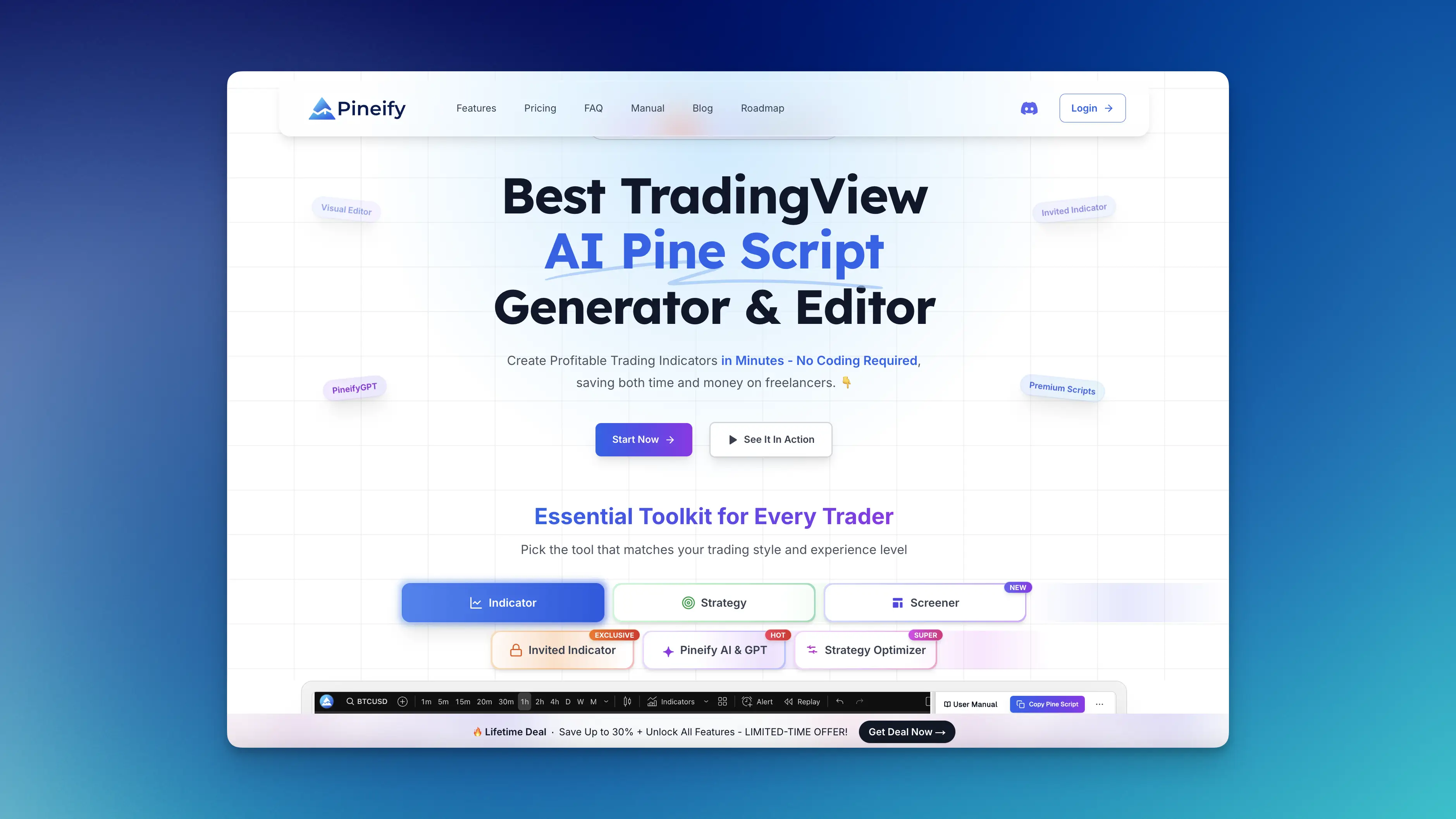
For traders who want custom indicators without learning to code, platforms like Pineify offer visual editors. You can combine indicators, set conditions, and backtest strategies — all without hitting the three-indicator limit on free TradingView accounts.
Adding Indicators to Your Chart
These tools are straightforward. Click the 'Indicators' button at the top of your chart to open the library. You can layer several indicators on the same chart to get a fuller picture.
A good starting set includes:
| Indicator | What It's Great For |
|---|---|
| Moving Averages | Seeing the general direction of a trend. |
| RSI | Identifying if an asset is potentially overbought or oversold. |
| MACD | Spotting shifts in momentum. |
| Bollinger Bands | Gauging how volatile the market is. |
On a free Basic account you can use up to three indicators per chart. If you need more, paid plans increase the limit. Tools like Pineify can combine unlimited indicators into a single script and bypass the restriction entirely.
The real value comes from combining tools. I've noticed that when the RSI and MACD both signal the same direction, the trades tend to hold up better. But I haven't tested this systematically — it's just an observation from my own charts.
Drawing Tools for Market Analysis
The drawing tools sit on the left side of your chart. If the toolbar is hidden, click the arrow labeled "Hide/Show Drawing Toolbar." Hover over any icon to see what it does.
Focus on these three tools first:
- Trendlines to follow the market's direction.
- Horizontal Lines to mark important price levels.
- Fibonacci Retracement to spot potential pullback areas.
Why mark up your chart? It turns a flat price history into a story. You can highlight where you'd enter a trade and where you'd exit. I draw a trendline on nearly every chart I open — it makes support and resistance levels pop out immediately.
These annotations serve as notes for your future self. They help you build an organized trading plan and make patterns visible over time. A messy price chart becomes a structured game plan.
Keeping Tabs on Your Favorite Stocks and Setting Alerts
A watchlist on TradingView keeps all the stocks, currencies, or cryptocurrencies you care about in one panel. No jumping from chart to chart.
Open the "Watchlist" panel on the right side of your screen. Click "Add Symbol," type the name, and you're done.
Never Miss a Move with Alerts
Pair your watchlist with alerts and you won't miss important moves. Here are the alert types:
| Alert Type | What It Does |
|---|---|
| Price Alerts | Pings you when an asset hits a specific price you care about. |
| Technical Alerts | Fires off based on an indicator or a condition you define (like an RSI crossing a certain level). |
| Watchlist Alerts | Lets you monitor an entire group of assets in your watchlist for a specific event. |
| Drawing Tool Alerts | Get a notification when the price touches a trendline or other shape you've drawn on the chart. |
To set an alert on a watchlist item, right-click it, choose "Create Alert," and pick your condition. For drawing tools, right-click the line or shape itself and select "Add Alert." TradingView auto-suggests the right settings based on what you drew.
I can't watch the screen all day, so I keep price alerts on NVDA and TSLA for levels I'm watching. It saves me from staring at the monitor.
For more complex alerts, check out our guide to creating custom TradingView alerts with Pine Script for advanced alertcondition techniques.
Getting Started with Paper Trading
Paper trading lets you test your trading ideas without real money. It's a risk-free practice ground where you can buy and sell, see how markets move, and build confidence before using your own capital.
The paper trading interface mimics a real exchange — realistic order types, spreads, and execution. It's the best way to check whether your strategies actually work.
Both free and paid TradingView users get access to paper trading:
| Account Type | Paper Trading Access |
|---|---|
| Free | Yes |
| Paid (Pro, Pro+, Premium) | Yes |
A useful feature is Market Replay. It lets you go back in time on daily or weekly charts and "replay" past market action. You can test how your strategy would have performed during a big rally or a sudden drop. I ran through the August 2024 volatility spike on SPY using Market Replay — it showed me exactly where my stops were too tight.
Learning from the TradingView Community
The TradingView community is one of the platform's strongest features. Traders share scripts, strategies, and chart analyses publicly. You can browse a library of community-built tools instead of starting from scratch.
| Community Feature | What You Can Do |
|---|---|
| Public Scripts | Find and use indicators or strategies built by others. |
| Published Ideas | Read detailed analysis and charts from thousands of traders. |
| Social Features | Comment on, and rate, public analyses to join the conversation. |
Browse over 100,000 publications to find a strategy, indicator, or library that fits your style. Seeing how others analyze the market helps you learn faster than going it alone.
For premium tools, check out our guide to getting invite-only scripts on TradingView — it covers how to find and access exclusive indicators.
Frequently Asked Questions
Is TradingView completely free to use?
Yes, the free Basic plan gives you full chart access and essential tools. The trade-off is you'll see ads roughly every 15 minutes. Paid plans remove ads and open more features.
Can a complete beginner use TradingView?
Absolutely. The interface is built to be beginner-friendly. You don't need chart experience to start — the tooltips and community guides will walk you through everything.
What is the difference between paper trading and live trading on TradingView?
Paper trading uses fake money in a simulated market. Live trading uses real money in actual markets. I always recommend paper trading first — it's how I tested my strategies before putting capital at risk.
How many indicators can I use on a single chart?
Basic: 3 indicators. Essential/Pro: 10. Premium: 25. You can also use Pineify to combine multiple indicators into one script, which bypasses this limit entirely.
Can I use TradingView on my phone or tablet?
Yes. Your charts, watchlists, and alerts sync across all your devices. I'll often start analysis on my desktop and check positions on my phone later.
What are the best indicators for beginners on TradingView?
Start with Moving Averages (trend direction), RSI (overbought/oversold), MACD (momentum shifts), and Bollinger Bands (volatility). These four give you a solid foundation.
How do I set a price alert on TradingView?
Right-click a symbol in your watchlist, choose "Create Alert," and set your price condition. Or right-click a trendline or horizontal line you've drawn and select "Add Alert" — the platform sets the correct options automatically.
Next Steps: Your TradingView Journey Begins Now
You've covered the basics. Now the real work starts.
Here's a path to keep you moving without getting stuck:
| Phase | Action | Why It Helps | What Can Go Wrong |
|---|---|---|---|
| 1. Get Settled | Create your free account and click around. Don't worry about doing it "right." | You'll get comfortable with the interface. | Skip the email verification — some features won't work until you confirm. |
| 2. Keep It Simple | Start with one or two tools, like Moving Averages or RSI. | Prevents information overload. | Adding too many indicators early leads to confusion, not insight. |
| 3. Practice the Basics | Draw trendlines and identify support/resistance levels. | Builds your chart-reading intuition. | Overcomplicate it. A simple trendline is often better than a dozen layers. |
| 4. Set Up Your Environment | Build a watchlist of a few assets and set simple price alerts. | Makes the market feel manageable. | Adding too many symbols makes your watchlist useless. Keep it to 5-10. |
| 5. Trade Risk-Free | Use paper trading extensively. | Builds confidence without real losses. | Jumping to live trading too early — I've seen beginners lose money they didn't need to lose. |
Don't do this alone. The TradingView community publishes scripts and analysis daily. Reading how others approach the same charts will teach you faster than trial and error.
Once the basics feel natural, take a look at our guide on how to backtest on TradingView to validate strategies before risking real capital.
Most importantly, be patient. Getting good with TradingView takes time. Start small, stay consistent, and your skills will grow.