How to Find Contract Size on TradingView

Contract size is the fixed multiplier that determines how much a single price move is worth in dollar terms. On TradingView, you find it through Symbol Info, Point Value, and Tick Value — but the platform rarely labels it directly. I've traded ES and NQ for years, and missing this number once caused me to grossly misjudge my risk on a 10-lot position. Here's how to track it down, whether you trade futures, forex, or crypto perpetuals.
The fastest method on any chart
Click the symbol name in the top-left corner of your chart — you'll see something like /ES or CL. A window pops up. Select "Symbol Info" and you get the contract's technical specs.
The Symbol Info panel won't always show a line titled "Contract Size." Instead, you'll see:
- Point Value or Tick Value — the dollar value of a full point (or minimum tick) move. For futures, this is effectively your contract multiplier.
- Tick Size — the smallest price increment the instrument can trade.
Here's why this matters: if you only watch the price chart, you have no idea what a 10-point move means in your account. The Point Value turns that abstract number into real P&L. What can go wrong? Some brokers or data feeds report slightly different Tick Values for the same instrument. Always cross-check against the exchange's official specs.
If neither field directly says "Contract Size," divide Tick Value by Tick Size. For most futures, the result is the cash value of a $1 price move — your multiplier.
Examples at a glance
| If you see this... | It means this... |
|---|---|
| Point Value: 50 | A 1-point price move equals a $50 change in the contract's value. |
| Tick Value: 12.50 & Tick Size: 0.25 | A 0.25 move is worth $12.50. A full $1.00 move is worth $50 ($12.50 x 4). |
A backup script when the panel falls short
If the Symbol Info panel is missing data, or you just want the raw numbers on screen, a few lines of Pine Script do the trick. Open the Pine Editor at the bottom of the chart, paste this, and click "Add to Chart."
//@version=5
indicator("Contract Size Helper", overlay=true)
plot(na, title="Check the Data Window") // This just creates a dummy plot
// The real info will appear in the 'Data Window' panel.
Once the script runs, open the Data Window tab on the right (the spreadsheet icon). Hover over any bar, and it shows syminfo.pointvalue and syminfo.mintick. Use these two numbers for the same Tick Value divided by Tick Size calculation. I prefer this method when I'm switching between multiple instruments quickly — no clicking around, just hover and read.
Why you need this number
Contract size is the engine behind every P&L calculation. It directly converts price movement into dollars. If you don't know it, you're guessing your risk.
With the correct multiplier:
- You can calculate the exact dollar cost of a stop-loss before you enter a trade.
- You know the real value of a take-profit target.
- You size your position based on account equity, not hope.
It also clears up a common confusion: leverage and contract multiplier are not the same thing. The multiplier is fixed; leverage is chosen. Mistaking one for the other is how traders overstay their welcome on a losing trade.
Where to find it across TradingView
The details are tucked away in a few places. Here's where I check:
- Symbol Info Panel: Click the symbol name at the top-left of any chart. For futures and derivatives, you'll see Point Value, Tick Size, and Tick Value. This is my go-to.
- Full Symbol Description: From that same panel, open the full description. It often includes complete contract specs or a direct link to the exchange's product page.
- Order Panel or DOM: If your broker account is linked, the order panel or Depth of Market view may show "Contracts" in the quantity field — a visual cue that you're dealing with a contract-based instrument.
- Mobile App: Tap the symbol at the top of the chart, then look for "Details" or "Symbol Info." Same fields appear. I've used this while checking setups on my phone, and it works the same as desktop.
Step-by-step on desktop
Here's the exact routine I follow when setting up a new futures chart:
- Pull up the chart. This could be CME:ES1! for E-mini S&P, NYMEX:CL1! for crude oil, or COMEX:GC1! for gold.
- Click the symbol name at the top-left. The Symbol Info panel opens.
- Find three numbers:
- Point Value — cash value of a full 1.00 move.
- Tick Size — smallest possible price increment.
- Tick Value — cash value of that single minimum move.
- If "Contract Size" is missing, calculate: Multiplier = Tick Value divided by Tick Size. The result equals the Point Value — confirming your math is correct. Why do this instead of just trusting Point Value? Because some data feeds display Point Value for the continuous contract, which can use a blended multiplier from multiple expiries.
- Still unsure? Click "Full Symbol Description" for a link to the exchange's official product page. This is your source of truth.
What the numbers actually mean per asset class
TradingView rarely shows "contract multiplier." You see Point Value and Tick Value instead. Here's how to interpret them for the asset you're trading.
- Index Futures (ES, NQ, DAX): Point Value equals the contract multiplier. ES is $50 per point; Micro ES is $5. A single tick on ES (0.25 points) is worth $12.50.
- Commodity Futures (CL, GC, SI): Price represents one unit (one barrel of oil, one troy ounce of gold). Point Value equals the number of units per contract. CL crude: a $1 move is $1,000 because one contract holds 1,000 barrels.
- Currency Futures (6E Euro, 6J Yen): These have a fixed notional amount. One 6E contract represents 125,000 euros. A 1.00 move in the quoted price would equal that notional value in USD.
- Equity Options and Stocks: Standard options use a 100-share multiplier. Stocks may show "Lot size" — the minimum trade unit on that exchange. Verify whether "Lot size" means a board lot or a derivative multiplier; they're different.
- Crypto Perpetuals: Contract value varies by exchange. One exchange might use $1 per contract, another $10, or even 1 full coin. Check Symbol Info, then confirm on the exchange's official product page. I haven't tested every exchange, so I always double-check on Binance or Bybit before sizing.
| Asset Class | Key Concept | Value of a $1 Move |
|---|---|---|
| Index Futures | Point Value = Multiplier | 1.00 point = Point Value (e.g., ES: $50) |
| Commodities | Contract Size = Units | Point Value = cash value of $1 move (e.g., CL: $1,000) |
| Currencies | Notional Amount | 1.00 move = notional in quote currency (e.g., 6E: 125,000 USD) |
| Equity Options | 100-share multiplier | Check "Lot Size" and verify the meaning |
| Crypto Perpetuals | Set by exchange | Use Symbol Info, confirm on exchange site |
The formula you'll reach for most
You don't need complicated math. Here's the calculation for each scenario:
| Where to Look | Calculation |
|---|---|
| Tick fields available | Multiplier = Tick Value divided by Tick Size |
| Point fields available | Point Value is already the multiplier |
| Need single tick value? | Tick Value = Point Value x Tick Size |
With the multiplier, you can size a stop-loss in dollars and decide how many contracts fit your risk budget. It turns a head-scratcher into mental math you can do in seconds.
Using the Position Tool as a shortcut
If you want to skip the arithmetic, TradingView's Long/Short Position tool handles it. It won't label "contract size" anywhere, but the result is baked into its calculation.
Here's the workflow:
- Select the "Long Position" or "Short Position" tool from the left toolbar.
- Set your account currency and the dollar amount you're willing to risk.
- Drag the entry and stop-loss lines to your desired levels.
- The tool outputs the number of contracts to trade. This number ensures your max loss matches the dollar risk you entered.
| Goal | Method |
|---|---|
| Manual formula calculation | Use the Tick Value divided by Tick Size approach above |
| Quick visual risk check | Position Tool (covers the math for you) |
What can go wrong? The Position Tool assumes your broker uses the same multiplier TradingView knows. If you're trading CFDs or spread bets, the broker's multiplier may differ. Confirm on the trade ticket before clicking submit.
Pine Script backup plan
When Symbol Info is uncooperative, here's a script I keep saved for quick access:
//@version=5
indicator("Contract Size Helper", overlay=true)
float tickSize   = syminfo.mintick
float pointValue = syminfo.pointvalue
float tickValue  = pointValue * tickSize

// For many futures, pointValue equals the per-1.00 multiplier.
// For commodities quoted per unit, pointValue equals units per contract when price moves by 1.00.

label.new(bar_index, high,
     str.format("Tick Size: {0}\nPoint Value: {1}\nTick Value: {2}\n(Contracts per $1 move ≈ {1})",
     tickSize, pointValue, tickValue),
     style=label.style_label_down, textcolor=color.white, color=color.new(color.blue, 0))
Copy the code into Pine Editor, click "Add to Chart." The Point Value tells you the per-contract dollar impact of a $1 move. The script also calculates Tick Value automatically. For commodities priced per unit, Point Value is the number of units in a single contract.
If Pine Script is new to you, the Pine Script tutorial for beginners covers the editor basics. This helper script is a practical way to see syminfo.pointvalue and syminfo.mintick in action without writing code from scratch.
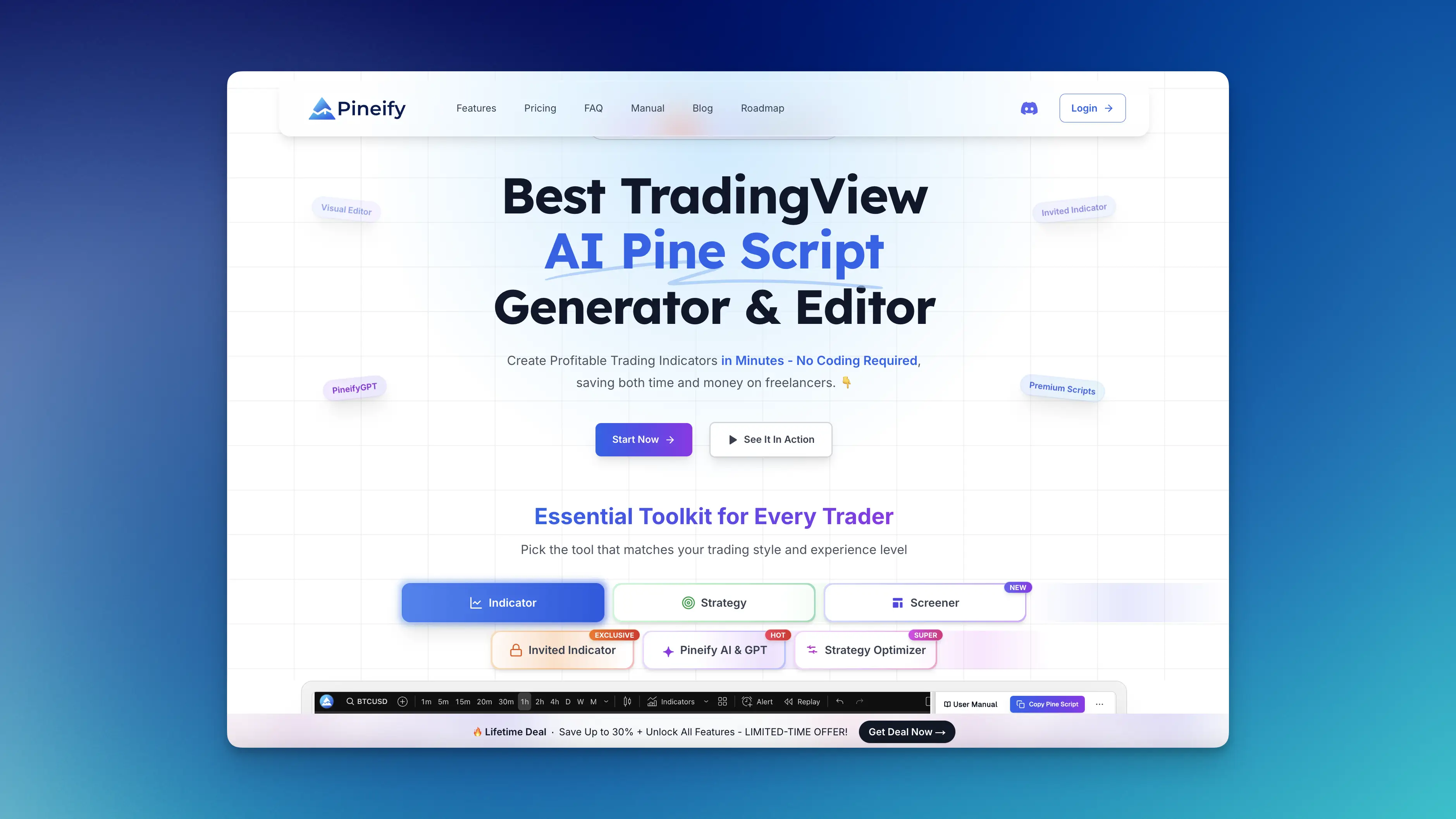
If you regularly build scripts like this, Pineify's visual editor removes the manual typing — you set the logic visually, and it generates error-free Pine Script. It's not a replacement for understanding contract specs, but it saves time when you're iterating on indicator ideas quickly.
Worked examples with real tickers
Here's how the numbers look for the contracts I trade most:
| Contract | Tick Size | Tick Value | Multiplier |
|---|---|---|---|
| E-mini S&P 500 (ES) | 0.25 | $12.50 | 50 |
| Micro E-mini S&P (MES) | 0.25 | $1.25 | 5 |
| WTI Crude Oil (CL) | 0.01 | $10.00 | 1000 |
| Gold (GC) | 0.10 | $10.00 | 100 |
Applying these:
- ES: A 10-point move equals 10 x 50 = $500 per contract. I use this to size my stops — if I'm willing to lose $500, I set my stop 10 points away on one contract.
- MES: Each point is $5. Easier to micro-adjust position size. When my risk budget is tight, I use MES instead of ES.
- CL: Multiplier of 1000 means a $1.00 move equals $1,000 per contract. High risk per tick, so I keep position counts low.
- GC: Multiplier of 100, so a $1.00 move in gold equals $100 per contract. Reflects 100 troy ounces per contract.
Euro FX (6E): Notional size is 125,000 euros. A 1.00 move (say from 1.0800 to 1.0801) changes the contract value by 125,000 in the quote currency (USD). I haven't traded 6E live yet, but the math is straightforward — just less granular than ES.
Points to watch
Some situations trip up even experienced traders. Here's what I look for:
- Continuous symbols (ES1!, CL1!): These charts stitch multiple expiries together. The Symbol Info may show blended data. Switch to the front-month contract for the exact multiplier.
- Broker vs. exchange specs: Your broker or CFD provider might use a different multiplier than the official exchange. Always confirm on the trade ticket before entering.
- Options are not futures: Standard equity options use 100-share multipliers, but index options and options on futures follow their own rules. Check the option chain or instrument description.
- Crypto variability: USD-margined linear contracts and coin-margined inverse contracts work differently. Double-check on the exchange's site.
- Board lots are different: A 100-share board lot is a trading convention for equities, not a contract multiplier. Don't confuse the two.
Risk management using contract size
I calculate my risk with three formulas. They've kept me consistent across multiple accounts and instruments:
- Dollar risk for a stop-loss: Risk = Stop Distance (points) x Multiplier x Contracts
- Contracts for fixed risk: Contracts = Dollar Risk divided by (Stop Distance x Multiplier)
- Notional value of a position: Notional = Entry Price x Multiplier x Contracts
I prefer working backward from my dollar risk. Pick the amount you're willing to lose, set your stop-loss in points, and the formula tells you how many contracts to trade. It keeps position sizing consistent whether I'm on ES, CL, or GC.
For more on keeping risk under control, see the guide to automated stop-loss and take-profit setups in TradingView. Once you know the multiplier, you can also validate your strategy with proper testing — how to backtest on TradingView walks through that process.
Common issues with contract details
Here's how I handle the problems that come up most:
- No "Contract Size" field? Calculate it: Multiplier = Tick Value divided by Tick Size. That result is your multiplier.
- Commodity confusion? Price is per unit. Point Value equals the number of units in one contract for a 1.00 move.
- Still not sure? Add the Pine Script helper above to your chart. Check
syminfo.pointvalueandsyminfo.minticklive. - Data mismatch? If you're on a continuous contract (ending in
!or_CONT), switch to a specific expiry month. Re-check the details. - Broker shows different numbers? CFDs and spread bets often use proprietary multipliers. Check the broker's product specification sheet, not TradingView's Symbol Info.
FAQ
How do I find the contract size on TradingView if it isn't shown?
Open the Symbol Info panel and find Tick Size and Tick Value. Use this formula: Multiplier = Tick Value divided by Tick Size. For most futures, the result is the value of a 1.00 price move.
What's the difference between contract size and lot size?
Contract size is a fixed amount for a futures or options contract (like 5,000 bushels of corn). Lot size applies to stocks — the minimum shares you can trade in one go, often 100. They're not interchangeable.
Is Point Value the same as contract size?
Close but not identical. Point Value is the cash gain or loss for a 1.00 point move. For commodities it equals the number of units in the contract. For index futures it's the dollar value per point used in your position sizing.
Can I find this on the TradingView mobile app?
Yes. Tap the ticker at the top of the chart, then open Details or Symbol Info. Look for Point Value, Tick Size, and Tick Value. Calculate the multiplier from those.
How do I confirm the size for a crypto perpetual contract?
Read the Symbol Info on TradingView first. Then verify on the exchange's own product page (Binance, Bybit, etc.) because linear contracts and inverse contracts use different conventions.
Will the Long/Short Position tool tell me the contract size?
It doesn't show a "contract size" label, but it uses the multiplier internally. Set your risk in dollars and your stop distance — the tool tells you how many contracts to trade.
Why do continuous futures charts look different?
A continuous chart strings together multiple contract months. To see the exact specs for the current market, switch to the front-month contract.
Can Pine Script show these values automatically?
Yes. Use syminfo.pointvalue and syminfo.mintick in a Pine Script. These built-in variables let you calculate the tick value and multiplier on your chart without leaving TradingView.