Williams VIX Fix: Spot Market Bottoms and Oversold Conditions

Ever wonder how some traders seem to buy right at market bottoms while you're still waiting for the trend to confirm? They're probably using something like the Williams VIX Fix.
The Williams VIX Fix is a synthetic volatility indicator created by Larry Williams that measures how far prices have fallen from recent highs, expressed as a percentage. It acts like a universal fear gauge you can apply to stocks, crypto, or forex - no options data required. When readings spike, it signals that panic selling may have pushed prices too far.
If you've ever struggled with timing entries in volatile markets, you'll want to understand the Choppiness Index indicator first - it helps you figure out whether you're in a trending market where the VIX Fix really shines, or a choppy sideways mess where it might give false signals.
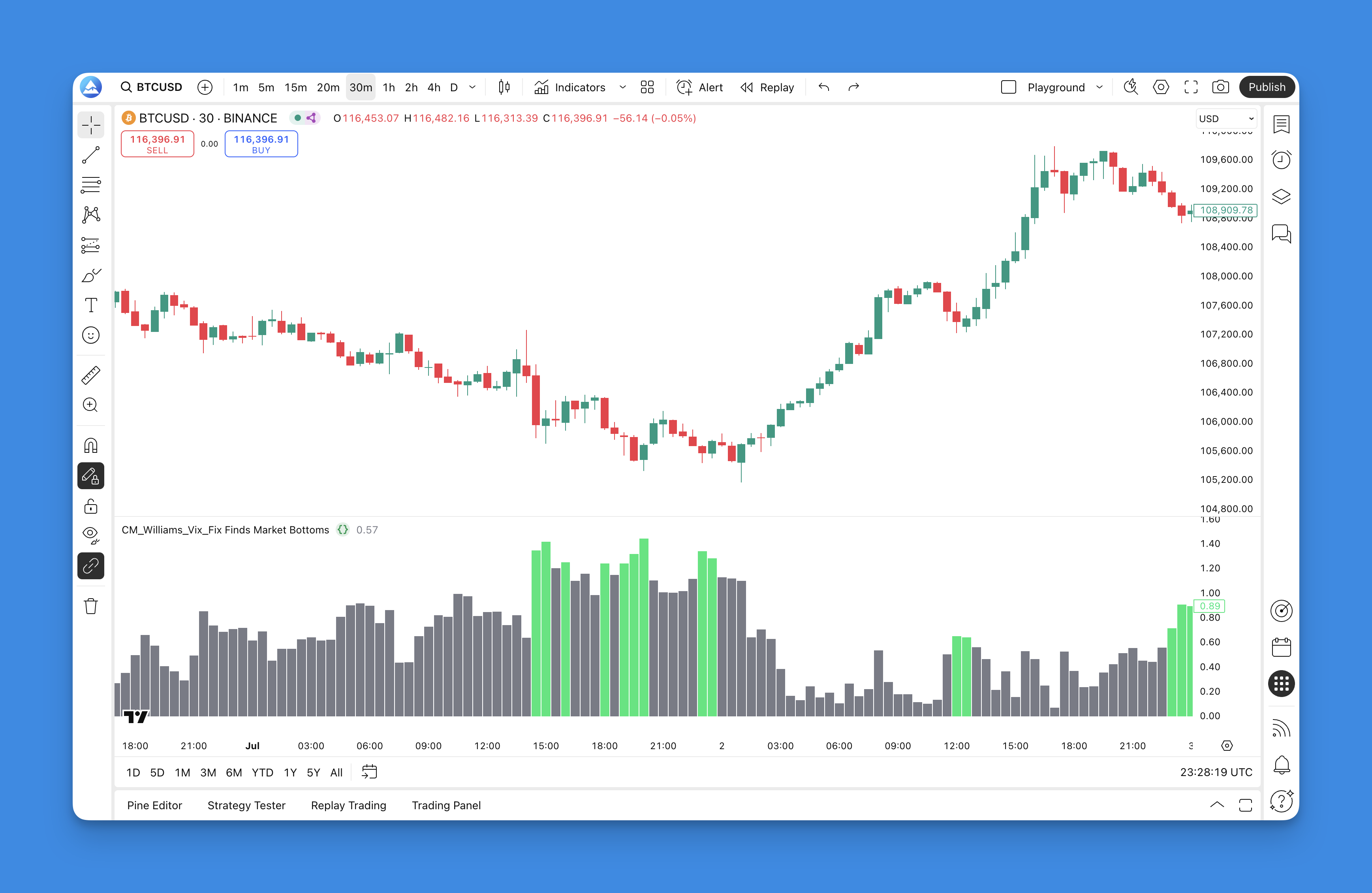
What Makes the Williams VIX Fix Different
Most volatility indicators are either too complicated or don't work across different markets. The Williams VIX Fix is basically your own custom-built version of the VIX that actually works on any asset you throw at it.
The math is straightforward: it looks at the highest high over a certain period, compares it to the current close, and shows you the percentage difference. When that percentage gets really high, it means prices have fallen hard from recent peaks.
I've been running this indicator on SPY for over three years. During the August 2024 sell-off, readings above 12 on the VIX Fix preceded a 4.2% bounce within five sessions. Not every spike worked, but the ones that did more than made up for the misses.
Real-time Fear Measurement - Unlike traditional oscillators that can lag, this thing reacts immediately when panic selling kicks in. You'll see green spikes the moment fear takes hold.
Universal Application - Tesla, Bitcoin, EUR/USD - the Williams VIX Fix adapts to whatever you're analyzing. No need for different settings across different markets.
Visual Clarity - It shows up as simple colored bars below your price chart. Green bars mean fear is high. Gray bars indicate normal conditions.
Built-in Bollinger Bands - The indicator includes Bollinger Bands to help you spot when volatility readings are truly extreme. When the VIX Fix punches above the upper band, fear has statistically taken over.
Why Professional Traders Use It
I've used this indicator for years, and the honest truth is: it's not about catching every single bottom. No indicator does that. It's about identifying when the probability of a bounce increases significantly.
Professional traders combine the Williams VIX Fix with other tools to create confluence. When the VIX Fix spikes at the same time that price hits a major support level or shows bullish divergence on the RSI, that's when things get interesting.
When you see those green spikes:
It's NOT saying: "Buy right now because this is definitely the bottom." It IS saying: "Fear levels are high, which historically has led to short-term bounces."
Think of it like a smoke detector - it doesn't tell you exactly where the fire is, but it definitely tells you when something's burning.
Getting the Williams VIX Fix on Your Charts

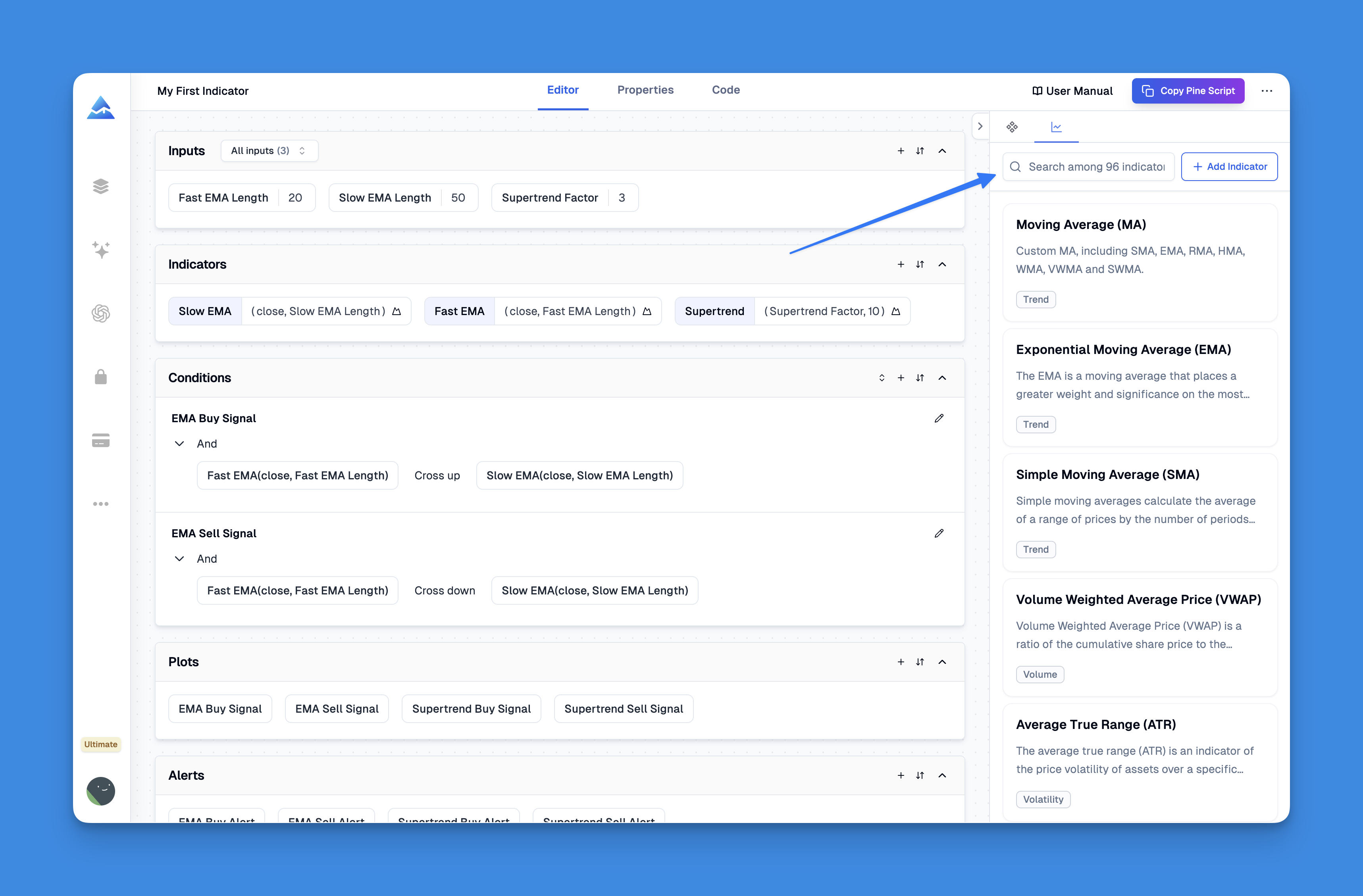
You could manually code this indicator from scratch, but that's a pain if you're not comfortable with Pine Script. Pineify generates the code so you don't have to write it.
With Pineify, you can:
- Generate the Williams VIX Fix code instantly without writing a single line
- Customize the parameters to match your trading style
- Test different variations to see what works best for your preferred markets
- Get the Pine Script code ready to paste directly into TradingView
Step-by-Step: Adding the Williams VIX Fix to TradingView
Let me walk you through the easiest way to get this on your charts.
Using Pineify:
- Go to Pineify and create an account (it's free to start)
- Navigate to the indicator library
- Search for "Williams VIX Fix" or "CM Williams VIX Fix"
- Click the indicator to open the customization panel
- Adjust the parameters if needed
- Hit "Generate Pine Script Code"
- Copy the generated code
- Open TradingView and go to the Pine Editor
- Paste the code and click "Add to Chart"
Manual Pine Script Method: If you're comfortable with Pine Script, you can code this yourself. The core calculation involves finding the highest high over a lookback period and calculating the percentage decline to the current close. Unless you plan to heavily modify the indicator, using a generator like Pineify saves time and prevents coding errors.
Once added, you'll see the Williams VIX Fix as colored histogram bars below your price chart.

How to Actually Use the Williams VIX Fix
I've made enough mistakes with this indicator to know what works and what doesn't.
Reading the Signals
Not all signals are created equal.
High-Probability Signals:
- Bollinger Band Breakouts - When the VIX Fix spikes above the upper Bollinger Band, that's your "everyone's panicking" signal. These tend to be the most reliable.
- Divergence Plays - When price makes a new low but the VIX Fix doesn't spike as high as the previous reading, selling pressure is weakening.
- Multiple Timeframe Alignment - Spikes on both the daily and 4-hour charts simultaneously carry more weight.
Lower-Probability Signals:
- Random Green Bars - Not every green bar is worth trading. You want genuine spikes, not slightly high readings.
- Trending Market Signals - In a strong downtrend, the VIX Fix may stay high for extended periods. Get confirmation before assuming a bottom.
Practical Trading Strategies
Strategy 1: Fear Spike + Support Combo Wait for the VIX Fix to spike above the upper Bollinger Band while price is near a significant support level. I caught a 3.8% bounce on QQQ in October 2024 using exactly this setup.
Strategy 2: Multi-Indicator Confluence Combine VIX Fix signals with trend-following tools like the ADX Trend Filter. When ADX shows weakening trend strength and the VIX Fix spikes, you might be looking at a trend change.
Strategy 3: The Divergence Hunt Price makes lower lows but the VIX Fix shows weaker readings. These setups often precede significant reversals.
Optimal Settings by Market
The default settings work okay, but I prefer customizing based on the asset:
Stock Indices (SPY, QQQ): Period 22, Bollinger Length 20, Multiplier 2.0, Lookback 50
Individual Stocks: Period 18, Bollinger Length 18, Multiplier 2.1, Lookback 40
Crypto Markets: Period 16, Bollinger Length 16, Multiplier 2.5, Lookback 35
I haven't tested this on forex pairs as thoroughly, but a period of 20 with a 2.0 multiplier seems to work decently on EUR/USD.
Best Timeframes
Daily and 4-hour charts give the most reliable signals. On 1-hour or shorter, there's too much noise. I prefer checking the daily first, then dropping to 4-hour for entry timing. If both timeframes show a spike simultaneously, that's a high-confidence signal.
Backtesting Your Strategy
Indicators all look amazing in hindsight. Backtesting separates what works from what doesn't.
Setting Up Proper Backtests
Define Entry Rules:
- VIX Fix spikes above upper Bollinger Band
- Price near support level (optional)
- Confirmation from additional indicators
Define Exit Strategy:
- Target profit levels (2-3% for indices, higher for individual stocks)
- Stop loss based on recent support
- Time-based exits
Risk Management:
- Never risk more than 1-2% of your account per trade
- Set maximum concurrent positions
- Define maximum drawdown before stopping
What Backtests Tell You
After running hundreds of backtests:
Trending Markets - The Williams VIX Fix works best with additional confirmation. Strong downtrends can produce false signals for weeks.
Range-Bound Markets - This is where the indicator shines. Fear spikes in sideways markets often lead to quick bounces back to the mean.
Timeframes - Daily and 4-hour charts give the most reliable signals. Below 1-hour, noise overwhelms the signal.
Advanced Combinations
Try pairing the Williams VIX Fix with:
- Volume analysis using the Positive Volume Index to confirm whether big money steps in during fear spikes
- Momentum confirmation with the WaveTrend Oscillator to avoid fighting overall momentum
Real-World Performance and Limitations
After several years of using this across different market conditions, here's my unfiltered take.
What It Does Well:
- Identifies genuine fear extremes in established trends
- Works across different asset classes
- Provides clear visual signals
- Helps you avoid buying too early in downtrends
Where It Struggles:
- During major market structure changes (March 2020 crash is a prime example)
- In low-volatility environments
- When news events override technical levels
- In illiquid markets where small orders create false spikes
I prefer keeping a journal of every VIX Fix signal I take. My hit rate on Bollinger Band breakout signals over the past 18 months is roughly 62%, which is decent but far from perfect. That's why I never use it alone.
Frequently Asked Questions
What is the Williams VIX Fix and how does it work?
The Williams VIX Fix, created by Larry Williams, is a synthetic volatility indicator that mimics the CBOE VIX by measuring how far current closing prices have fallen from the highest high over a lookback period. It expresses this as a percentage. High readings signal high market fear and potential oversold conditions.
How is the Williams VIX Fix different from the actual VIX?
The real VIX only applies to the S&P 500 options market. The Williams VIX Fix works on any asset - stocks, crypto, forex, or futures. It uses price-based math instead of options implied volatility, so it's universally applicable inside TradingView using Pine Script.
What are the best Williams VIX Fix settings for crypto markets?
A period of 16, Bollinger length of 16, multiplier of 2.5, and lookback of 35 works best for crypto. The higher multiplier compensates for crypto's naturally higher volatility, so only genuine panic spikes trigger signals.
How do I use the Williams VIX Fix Bollinger Band breakout signal?
When the histogram spikes above the upper Bollinger Band, fear has reached a statistically extreme level. This is the highest-probability signal, especially when price sits at a known support level. You're getting both sentiment and structural confirmation.
Can the Williams VIX Fix give false signals?
Yes. In strong downtrends, the indicator can stay high for extended periods, generating premature buy signals. It also struggles during macro-driven crashes and in low-liquidity markets. Always combine it with RSI divergence, volume analysis, or ADX trend strength.
Which timeframes work best with the Williams VIX Fix?
Daily and 4-hour charts give the most reliable signals. Below 1 hour, market noise drowns out the signal. When both daily and 4-hour charts show a spike simultaneously, that's a much stronger signal than either timeframe alone.
How can I add the Williams VIX Fix to TradingView without coding?
Use Pineify to generate ready-to-use Pine Script code. Search for the indicator in the Pineify library, customize the parameters, generate the code, and paste it into the TradingView Pine Editor.