Best Support Resistance Indicator TradingView: Complete Guide to Top Tools
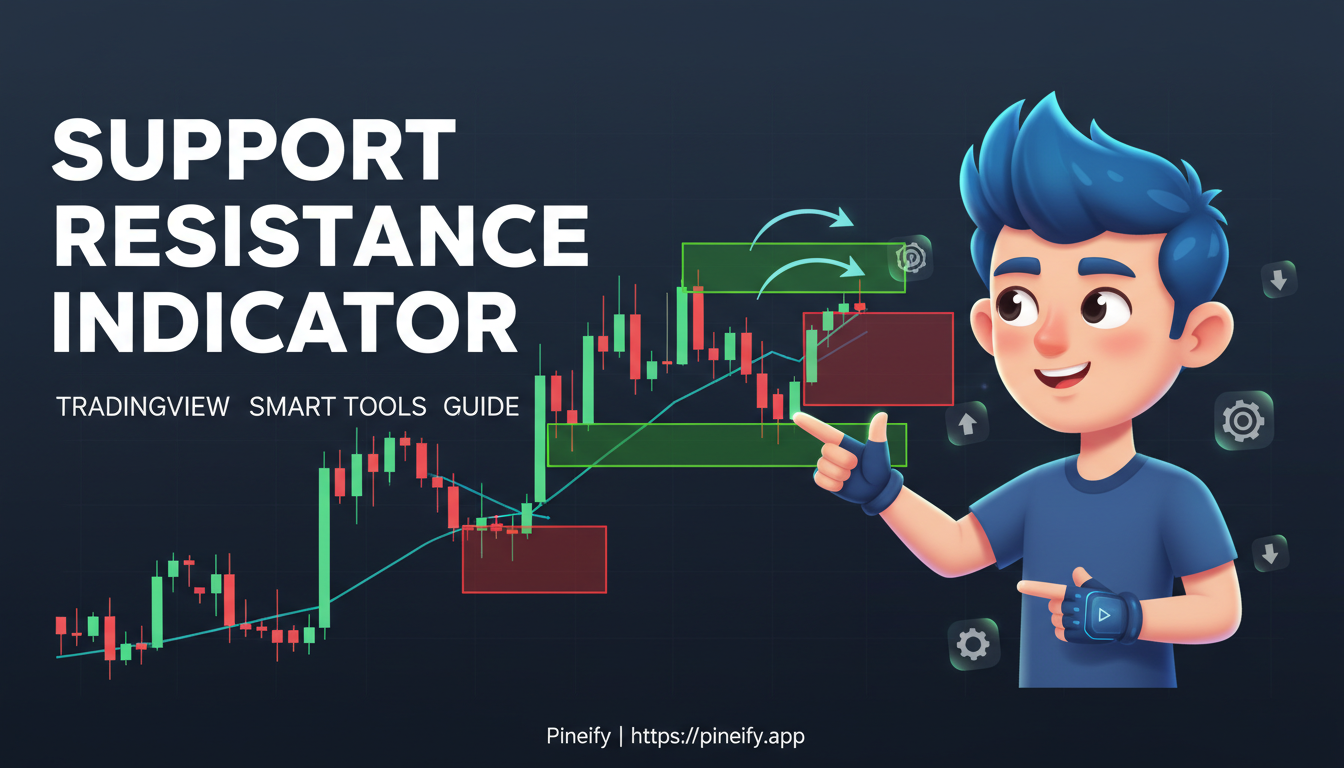
Support and resistance levels are like the fingerprints of a market—they show you where prices have historically paused or reversed, giving you clues about where they might do it again. If you're using TradingView, you've got a whole toolbox of indicators that can automatically find these key zones for you. This saves you from drawing lines by hand and helps you spot levels you might have missed. The trick is, there's no single "best" indicator for everyone. The right one for you comes down to how you trade, the charts you watch, and whether you need levels that move with the market or stay fixed.
Finding Key Price Levels on TradingView: A Simpler Approach
Think of these indicators as your automated scouts. They scan the charts for you, looking for those important peaks (resistance) and valleys (support) where the price has repeatedly turned around. Instead of you guessing where to draw a line, they use the market's own data—like how many times price touches a level—to decide what's important. They keep working in the background, updating as new price action comes in, so you're always looking at the most relevant picture.
The most useful ones don't rely on just one method. They might blend a few smart techniques—like finding pivot points, noting where high volume trades happened, or using Fibonacci ratios—to paint a fuller picture. The good news is, TradingView has you covered whether you're just starting out or have been trading for years. There are simple free tools built right in, plus more advanced ones created by other traders in the community, so you can find something that fits whether you're making quick trades or planning for the longer term. For instance, understanding the right Pine Script plot styles can be crucial for making these automatically drawn levels clear and visually distinct on your chart.
Finding Key Price Levels: The Best TradingView Indicators for Support & Resistance
Trying to figure out where a stock or currency might bounce or stall? These are your support and resistance levels, and they're crucial for making smarter trading decisions. TradingView has a ton of tools to spot them, from fully automatic indicators to simple drawing tools. Let's break down the most helpful ones, so you can find what works for your style.
The Built-In Workhorse: Pivot Points High Low Indicator
Think of this as your reliable starting point. It's already built into TradingView, so no need to search for scripts. This indicator automatically finds significant highs and lows (the "pivots") on your chart by scanning a set number of bars back and forth.
Here’s the simple way it works: you set a "length" (the default is 10). For a high pivot to be marked, it looks for a high that has 10 lower bars on either side of it. For a low pivot, it needs 10 higher bars on each side.
- Shorter length (like 5): Finds more levels, faster. Great for catching quick moves, but you might get some false signals.
- Longer length (like 20): Finds only the most major, important levels. It’s slower to update but often points to stronger areas.
The real magic happens when the indicator marks several pivots clustered around the same price. That creates a thick, obvious zone on your chart that price is very likely to react to. For a deeper dive into this concept, check out our guide on the Envelope Indicator in TradingView, which uses a similar principle of creating dynamic zones around price.
The Smart Auto-Detector: Auto Support/Resistance Levels
Forget manually drawing a hundred lines. This indicator does the heavy lifting for you. It scans price action and automatically draws clean horizontal lines where it detects potential support or resistance.
What makes it really handy is the flexibility. It offers different modes for different trading timeframes:
- Scalping Levels: For very short-term trades.
- Trading Levels: Perfect for day trading.
- Swing Trading Levels: Best for holding positions over days or weeks.
It’s also smart about keeping your chart clean. It removes old levels as new, more relevant ones form, so you’re never overwhelmed. The lines even change color depending on whether the current price is above or below them, giving you an instant visual cue.
The Math-Based Approach: Fibonacci Tools
Fibonacci tools blend automatic detection with ancient math ratios. They first find a clear swing high and a swing low (or vice-versa), then draw horizontal lines at key percentage levels between them.
These levels—like 38.2%, 50%, and the famous 61.8%—often act as potential support during a pullback or resistance during a rally. Think of the 50-61.8% zone as a common "decision point" where the trend often decides to continue.
They come in two main flavors:
- Retracement: Answers "How far might the price pull back?" Best used in ranging or corrective markets.
- Extension: Answers "How far could the price go after the pullback?" Most useful in strong trending markets.
The Volume Reality Check: VWAP & Volume Profile
Price is one thing, but volume tells you how much conviction is behind a move. That's where these tools shine.
VWAP (Volume Weighted Average Price) is like the "fair price" for the day, weighted by how much volume traded at each level. It acts as a dynamic magnet for price. Many institutional algorithms watch it, so seeing price react at the VWAP is a big deal.
Volume Profile shows you a sideways histogram of where most trading activity actually happened. The tallest part of the histogram is the Point of Control (POC)—the price where the most volume traded. These high-volume nodes become incredibly strong support or resistance areas because that's where the most business was done.
Your Personal Touch: Manual Drawing Tools
Sometimes, the best tool is you. TradingView's classic drawing tools let you mark up the chart exactly how you see it.
- Horizontal Lines: Perfect for marking a specific price where you've seen multiple bounces or rejections. They stay on your chart forever, so you can track long-term levels.
- Trend Lines: Connect at least two swing highs or lows to create a diagonal line of support or resistance. The key is patience—wait for that third touch to confirm the line is valid. More touches = a stronger level.
Pro Tip: Instead of a super precise line, consider drawing a rectangle to mark a zone. Price often respects a general area, not a single pixel-perfect value. This helps avoid getting stopped out by tiny wicks that just barely touch your line.
Choosing the right support and resistance tools can feel overwhelming with so many options. It's not about finding a single "best" one, but about picking the right tool for your style and what you're trying to see in the market.
Think of it like choosing lenses for a camera. Each indicator gives you a different focus, highlighting certain levels where price might bounce or break. The table below breaks down some popular choices to help you decide where to start.
| Indicator Type | Best For | Key Advantage | Customization Level |
|---|---|---|---|
| Pivot Points High Low | All trading styles | Automatic pivot detection with adjustable sensitivity | Medium |
| Auto S/R Levels | Multi-timeframe analysis | Separate scalping, day trading, and swing levels | High |
| Fibonacci Tools | Trend trading | Mathematical precision with extension targets | Medium |
| VWAP/Volume Profile | Institutional levels | Volume-based validation of price levels | High |
| Horizontal Lines | Custom analysis | Complete manual control and precision | Maximum |
Here’s a simpler way to think about it:
- If you want a solid, automated starting point, Pivot Points are a great all-rounder.
- For seeing different timeframes at a glance, Auto S/R Levels can organize the chart for you.
- When trading a strong trend, Fibonacci tools help pinpoint where pullbacks might end or where the trend could extend.
- To see where big players might be active, tools based on Volume (VWAP/Volume Profile) add a powerful layer of confirmation.
- And if you trust your own eye above all else, good old Horizontal Lines give you total freedom to mark exactly what you see.
Many traders end up combining a couple of these. For example, you might use automatic pivots as a baseline and then draw your own horizontal lines at key volume clusters. The goal is to build a clearer picture of where the market has paused before, because those are the areas where it’s likely to pay attention again.
Finding the Support and Resistance Tools That Work for You
Picking the right indicator is less about finding the "best" one and more about matching the tool to your own trading style. Think of it like choosing a tool from a workshop—you need the right one for the job.
If you’re a scalper, catching tiny price movements throughout the day, you’ll want tools that are highly sensitive and update often. Things like very short-term pivot points or indicators built specifically for scalping can give you those frequent, fine-tuned levels.
For day traders, who hold positions a bit longer but still within a single day, a middle-ground approach usually fits best. Standard daily pivot points or auto support/resistance indicators set to a daily timeframe offer a good balance. They give enough signals to act on without being so jumpy that they become unreliable.
If you’re a swing trader, holding trades for several days or weeks, you need to see the bigger picture. Tools that use longer timeframes, like weekly pivot points or levels designed for swing trading, are key. These help you spot the major zones where price tends to pause or reverse, which hold up over multiple trading sessions.
Some traders want to see where the big money is at work. For that, volume-based tools like VWAP and volume profile are incredibly useful. They don’t just draw a line on a chart; they show you where most of the trading activity happened, highlighting levels that institutions and major players are watching.
A really practical way to use these tools is to layer them. Here’s a common approach:
| Step | Tool Type | Purpose |
|---|---|---|
| 1 | Automated Pivot/S&R Detection | To quickly find potential levels on your chart. |
| 2 | Volume Profile or VWAP | To check if those levels align with high-volume areas (making them stronger). |
| 3 | Fibonacci Tools | To project where price might go next after reacting at a confirmed level. |
Starting with an automated tool helps you quickly identify possible support and resistance. Confirming those spots with volume tells you if they’re actually important. Finally, adding Fibonacci levels can help you plan where to take profits. This layered method helps filter out bad signals and gives you a clearer view of both where to enter and where to exit. Before you trust any setup, make sure you know How to Test Your Strategy on TradingView to validate its performance.
Getting the Most Out of TradingView's Support and Resistance Tools
Let’s talk about how to actually use these tools without overcomplicating things. It all starts with setting things up in a way that makes sense for your trading.
When using the built-in Pivot Points High Low indicator, the default setting of 10 bars is a fine starting point. Don't be afraid to play with that number, though. Try adjusting it between 5 and 20 to see what feels right for the chart you're looking at—whether it's a fast-moving 5-minute chart or a slower daily view. When you see several of these pivot points stacked close together, that area becomes much more significant. Think of it as a stronger zone the market has noticed more than once.
For drawing your own lines by hand, here's a simple rule of thumb:
- Connect the bodies of the candlesticks when you're trying to filter out false breakouts and find where the price actually closed.
- Connect the wicks when you want to mark where the price made an extreme swing and got pushed back.
Before you trust any level you've drawn, make sure the price has clearly touched it at least two or three times. One touch is just a coincidence. When price finally approaches one of your trusted levels, don't jump in immediately. Wait for a little confirmation, like a clear reversal candlestick pattern, a spike in trading volume, or another indicator like the RSI also showing the market is overbought or oversold.
Here's the most important mindset shift: think in zones, not perfect lines. The market rarely bounces off an exact, pixel-perfect price. It respects general areas. Focusing on a zone accounts for the bid/ask spread, a little bit of slippage, and just the normal back-and-forth noise of the market. Don't get hung up on a single number.
Finally, keep your chart clean. As new price action comes in, you need to update your lines. If the price slices through a level with strong momentum and doesn't look back, that level is done. Erase it. Your job is to mark where the market is reacting now, not where it reacted three weeks ago. Remove the levels that just aren't working anymore.
Common Pitfalls and How to Steer Clear
It’s easy to fall into a few common traps when you’re setting up your charts. Let’s go through the big ones, so you can avoid the headaches they cause.
1. Too Many Indicators, Not Enough Clarity
A cluttered chart is a confusing chart. When you add every indicator under the sun, you often end up with conflicting signals and so much noise that you can't see the actual price action. It's better to keep it simple.
Pick two or three tools that work well together. For example, you might choose:
- One tool to spot key pivot points automatically.
- One volume-based indicator to check if a move has real momentum.
- One projection tool, like Fibonacci retracements, to spot potential reversal areas.
This combo gives you a clearer, more focused view without the paralysis.
2. Sloppy Trend Lines
Drawing a trend line isn't about connecting any two dots you like. A forced or sloppy line will give you false signals. The goal is to find the real slope of the market's momentum.
A solid trend line should connect clear swing highs or swing lows, and it's best confirmed with at least three touches. If you’re bending the line to make it fit a random price point, it’s time to redraw it.
3. Treating Every Level as Equally Important
Not all support or resistance levels are created equal. Some are like sticky notes on a wall, and others are like brick.
A level becomes significant—or "strong"—based on a few key things:
- Multiple Touches: The more times price has reacted to a level, the more market participants remember it.
- High Volume: If a lot of trades happened at that price, it’s a more important zone.
- Confluence: When a trend line, a moving average, or a Fibonacci level lines up with your horizontal level, it adds extra weight.
- Clear History: You should see obvious bounces or breaks in the past.
A level that’s been tested once on low volume is a suggestion. A level tested five times, with volume increasing each time, is a much louder message from the market.
4. Using the Wrong Settings for Your Timeframe
This is a huge source of frustration. The tools that work for a weekly investor won’t work for a 5-minute scalper.
- Levels: A support zone on a daily chart might be completely invisible on a 5-minute chart. Always zoom out to see if a level matters on a higher timeframe.
- Indicator Settings: Match your settings to your trading style.
- For intraday or short-term trading, use shorter "lookback" periods so your indicators react to recent action.
- For swing or position trading, use longer periods to filter out the short-term noise and see the broader trend.
The key is consistency. Use a setup that's tailored to the pace at which you actually trade.
Frequently Asked Questions
What is the most accurate support and resistance indicator on TradingView?
For most people, the Pivot Points High Low indicator tends to be the most reliable because it uses a clear, math-based method to spot real swing highs and lows. But here’s the trick: you can make it even more trustworthy. Pair it with something like VWAP or volume profile, which shows where most of the trading volume happened. When the pivot points line up with these high-volume areas, you have much stronger confirmation that a level is significant.
How do I set up automatic support and resistance on TradingView?
It’s pretty straightforward. Just go to the ‘Indicators’ button on your chart, and in the search bar, type something like “Pivot Points High Low” or “Auto Support Resistance.” Click to add it. Once it’s on your chart, click the little settings icon to tweak it. You’ll see a sensitivity setting—lower numbers will give you more potential levels, while higher numbers will only show you the strongest, most notable ones. After that, it does the work for you, drawing the lines automatically.
Can I use multiple support and resistance indicators at the same time?
Absolutely, and it’s often a great idea—but only if they show you different things. Think of it like building a case with multiple pieces of evidence. A solid combo is using an auto-pivot indicator alongside a volume profile and maybe some Fibonacci retracement levels. What you want to avoid is stacking two or three indicators that all do the exact same job. That just makes your chart messy and doesn’t give you any new useful information. For a different kind of multi-layered analysis, you might explore concepts like the Moving Average Envelopes Indicator, which creates dynamic bands around price.
What's the difference between static and dynamic support and resistance indicators?
This is a key concept. Static indicators, like classic horizontal lines or daily pivot points, mark specific prices that stay put on your chart until you change them. Dynamic indicators, like the VWAP or a moving average, are constantly on the move. They recalculate and shift as new prices come in, creating levels that “flow” with the trend. If you’re trading within a range, static levels are super helpful. If you’re riding a trend, you’ll likely find dynamic tools more useful.
How often should I update my support and resistance levels?
If you’re using an automatic indicator, you don’t have to worry about this—it updates itself with every new candle. For manually drawn lines, it depends on your style. As a general rule: give them a fresh look every day if you’re day trading, and at least once a week if you’re a swing trader. Most importantly, update them anytime price makes a big move that clearly breaks through an old level. Don’t be afraid to clean up old lines that are no longer relevant and draw new ones where price has recently stalled or reversed.
Do support and resistance indicators work for all markets?
Yes, the core idea works everywhere—stocks, forex, crypto, commodities—because it’s based on how traders collectively react to price levels. The psychology is the same. The catch is that you might need to adjust your settings. For example, a highly volatile market like cryptocurrency often needs indicators with shorter lookback periods to keep up with the action, while a slower-moving blue-chip stock might work fine with the default settings.
Your Action Plan
First, add the Pivot Points High Low indicator to your TradingView chart. Just watch it for a few days on your favorite market. See where it draws the lines and how price reacts to them.
Then, try paper trading with only those levels for one week. Don’t use any other tools. This helps you see how reliable they are for your specific trading style before you use real money.
Once you’re comfortable, add just one more tool that works well with it—maybe volume profile or Fibonacci retracements. The goal is to build clarity, not clutter your screen. Add things slowly so you can actually understand what each one is telling you.
Make this process your own. Create a simple checklist that includes your chosen indicators and your personal rules for when to enter or exit a trade. Write down every trade you take using these levels. Note which setups worked and which didn’t. This log will show you what truly improves your trading, so you can keep what works and stop using what doesn’t.
Don’t forget to explore the TradingView community. Other traders share fantastic custom scripts. When you find a new one, test it on old data first. See if its levels match up with or improve upon what you already use. Does it actually give you better insight? If not, you can move on.
The truth is, the best indicator for you is the one that fits how you trade. It should feel right, match the time you can commit, and help you manage risk without stress. What’s perfect for someone else might not be right for you, and that’s okay. Your toolkit should be personal.
This philosophy of building a personalized, clutter-free toolkit is exactly why many traders are turning to Pineify. Instead of endlessly searching for the perfect pre-made script, you can build it yourself in minutes. Pineify’s visual editor lets you combine Pivot Points with other indicators like volume or Fibonacci, set your exact entry/exit rules, and backtest the entire strategy—all without writing a single line of code. It turns the process of testing and refining your personal edge into a simple, visual checklist.