Best Scripts on TradingView: Ultimate Guide to Top Indicators and Trading Tools

· 16 min read

TradingView is where millions of traders, from brand new to seasoned pros, go to chart the markets. A big part of its power comes from the community—traders who build and share their own custom tools, called scripts. Finding the right scripts can be a game-changer, giving you clearer insights, spotting opportunities you might miss, and helping you make more informed decisions.

This isn't about flashy promises. It's about practical tools. Whether you're just starting with technical indicators or you're refining a complex strategy, knowing which community-built scripts are worth your time is a huge advantage. For a broader look at the platform's capabilities, you might find our guide on TradingView 中文:完整指南、功能解析與中文使用技巧 particularly useful.

Best Scripts on TradingView: Ultimate Guide to Top Indicators and Trading Tools

What Are TradingView Scripts? A Look at Pine Script

So, what are these scripts? Think of them as custom tools or assistants built directly into TradingView. They are created using Pine Script, which is simply TradingView's own coding language made for financial analysis.

These tools range from super simple (like a special type of moving average) to incredibly sophisticated strategies that check multiple conditions across different timeframes. You'll find thousands of them on the platform, sorted into helpful lists like the team's "Editor's Picks," the community's top-rated "Most Popular," and the latest "New Scripts."

The beauty of Pine Script is that you don't need to be a coding expert to benefit from it. It lets people:

  • Build custom indicators and chart drawings.
  • Backtest trading ideas to see how they would have performed historically.
  • Set up automated alerts for specific market conditions.

Best of all, most scripts are open-source. This means you can click "View Source" to see exactly how they work, learn from the logic, and even tweak them to fit your personal trading style perfectly. It's like being able to peek under the hood of a useful tool and adjust it yourself.

Top 10 Best TradingView Scripts for 2025

Looking for tools to sharpen your trading edge? These are some of the most relied-upon TradingView scripts that traders are using to analyze the markets. Think of them as your chart's co-pilot, helping to spot opportunities you might otherwise miss.

1. CM_Ultimate RSI Multi Time Frame

Created by ChrisMoody, this is a powerhouse version of the classic RSI. Instead of just looking at one chart timeframe, it lets you see momentum across several timeframes all at once. This helps confirm whether a stock or crypto is truly overbought or oversold, cutting down on those frustrating false signals by seeing the bigger picture.

2. Supertrend Indicator

KivancOzbilgic's version of this indicator is a favorite for a reason. It’s fantastic at helping you ride a trend. Based on market volatility, it paints a clear line on your chart that flips color to signal "buy" or "sell." Newer versions add buffer zones to prevent whipsaws, making it a solid, straightforward tool for just about any market. For even more pattern recognition power, check out our guide on How to Automatically Spot 16 Candlestick Patterns on TradingView (Without Missing a Single One).

3. Volume Profile

This tool answers a critical question: At which prices did most of the trading happen? Instead of just looking at volume by time, it stacks volume by price level. This reveals strong areas of support and resistance that regular horizontal lines might not show. The most important level is the Point of Control (POC)—the price where the most volume traded. Advanced versions even show you if the volume was mostly from buyers or sellers.

4. WaveTrend Oscillator by LazyBear

If you love oscillators, you need to check out LazyBear's creation. It’s designed to spot overbought and oversold conditions with a slick, smoothed calculation that reacts quickly without being jumpy. It gives signals when its lines cross or when they diverge from the price, which is great for pinpointing entry and exit points.

5. Moving Average Convergence Divergence (MACD)

The MACD is a timeless classic for a reason. It shows the relationship between two moving averages and helps identify shifts in momentum. Enhanced scripts on TradingView often blend it with other indicators (like the RSI) and color-code the price bars for you. This creates a full picture at a glance, helping you gauge both trend direction and its potential strength.

6. Death Cross and Golden Cross Checker

Manually watching for a "Death Cross" or "Golden Cross" is a chore. This script by MexPayne does it for you. A Death Cross (50-day average crossing below the 200-day) often hints at a longer-term downtrend starting, while a Golden Cross suggests the opposite. This tool automatically highlights these major events, so you don't have to stare at your screen waiting.

7. Stochastic RSI

This is like a turbocharged momentum gauge. By applying the Stochastic formula to the RSI, it creates a super-responsive oscillator perfect for spotting short-term reversals. When it pushes above 80, the asset might be overextended to the upside; below 20, it could be oversold. It’s especially handy in markets that are bouncing between a high and low price.

8. Pi Cycle Bottom Indicator

Popularized by Doncic in the crypto world, this script uses a specific mix of moving averages to try and spot major market cycle lows. It’s built to signal potential long-term buying opportunities when an asset might be hitting a cyclical bottom, helping traders think about accumulation.

9. Traders Dynamic Index (TDI)

Why use three separate indicators when one can do the job? The TDI by JuanManuelOrtiz packs RSI, Bollinger Bands, and moving averages into a single window. This gives you a layered view of trend, momentum, and volatility all in one place, helping you wait for those high-confidence moments when everything aligns.

10. True Strength Index (TSI)

The TSI is a smooth operator. This momentum oscillator uses a double-smoothed calculation to filter out everyday market noise while still catching meaningful trends. It generates signals when it crosses above or below its center line or when its direction diverges from the price, offering a clean read on both trend direction and its underlying strength.

How to Add and Use Scripts on TradingView

Adding scripts to your TradingView charts is super straightforward. Think of it like adding a new tool to your workshop. Here’s how it works.

Up at the top of your chart, you’ll see a button that says "Indicators". Give that a click. It opens up a search window with a few different tabs: 'Technicals', 'Financials', and importantly, 'Community Scripts'.

For the real treasure trove, head to the 'Community' tab. This is where thousands of scripts built by other traders live. You can search for something specific by name, or just browse around. If you're not sure where to start, check out 'Editor’s Picks' for high-quality scripts the TradingView team has highlighted, or look at 'Top Scripts' to see what’s popular with the community.

Found one you like? Just click on it. It’ll pop right onto your chart. If you’re on a free account, you can have up to three indicators running at the same time. If you find yourself needing more, that’s where a paid subscription comes in handy. To get the most out of your subscription, explore our TradingView Plus Plan Discount Code: Ultimate Guide to Saving Money on Your Subscription.

Once a script is on your chart, you can tweak it to fit your style. See the little settings gear icon next to the indicator's name? Click that. Most scripts let you adjust things like the timeframe it looks at, how sensitive it is, or its colors and line styles. Play with the settings until it feels right for you.

Getting the Most Out of Your TradingView Scripts

Using scripts and indicators on TradingView can give you a real edge, but it’s easy to get lost in all the flashing signals. Here are some practical, tried-and-true ways to use them effectively, so they help you make clearer decisions instead of adding more noise.

PracticeDescriptionBenefit
Multi-Timeframe ConfirmationUse indicators across multiple timeframes before making trading decisionsReduces false signals and improves trade accuracy
Combine Complementary IndicatorsPair trend-following tools with momentum oscillatorsProvides comprehensive market analysis from different perspectives
Backtest StrategiesUse TradingView's Strategy Tester to evaluate performanceValidates effectiveness before risking real capital
Customize ParametersAdjust indicator settings to match your trading style and asset classOptimizes performance for specific market conditions
Consider Market ContextEvaluate volume, support/resistance, and broader market trendsPrevents reliance on indicators in isolation

When you're starting with a new script, it's smart to stick with the default settings first. Get a feel for how it behaves. Once you're comfortable, that's when you can start tweaking things. Use the Strategy Tester to see how your adjustments would have played out in the past, and then watch how they perform in real-time with a small position. To ensure your backtesting is reliable, read our analysis on Is TradingView Strategy Tester Accurate? A Comprehensive Guide to Backtesting Reliability.

One big thing to remember is that no indicator works perfectly all the time. Some, like moving averages, are great when the market is making a strong move in one direction. Others, like the RSI, are more useful when the market is bouncing around in a range. Always take a second to ask yourself what kind of market you're in—check the volume, look for obvious price floors and ceilings (support/resistance), and see what the overall trend is doing. This context stops you from blindly following a signal that might be out of sync with the bigger picture.

Unlocking Your Own Trading Tools with Pine Script

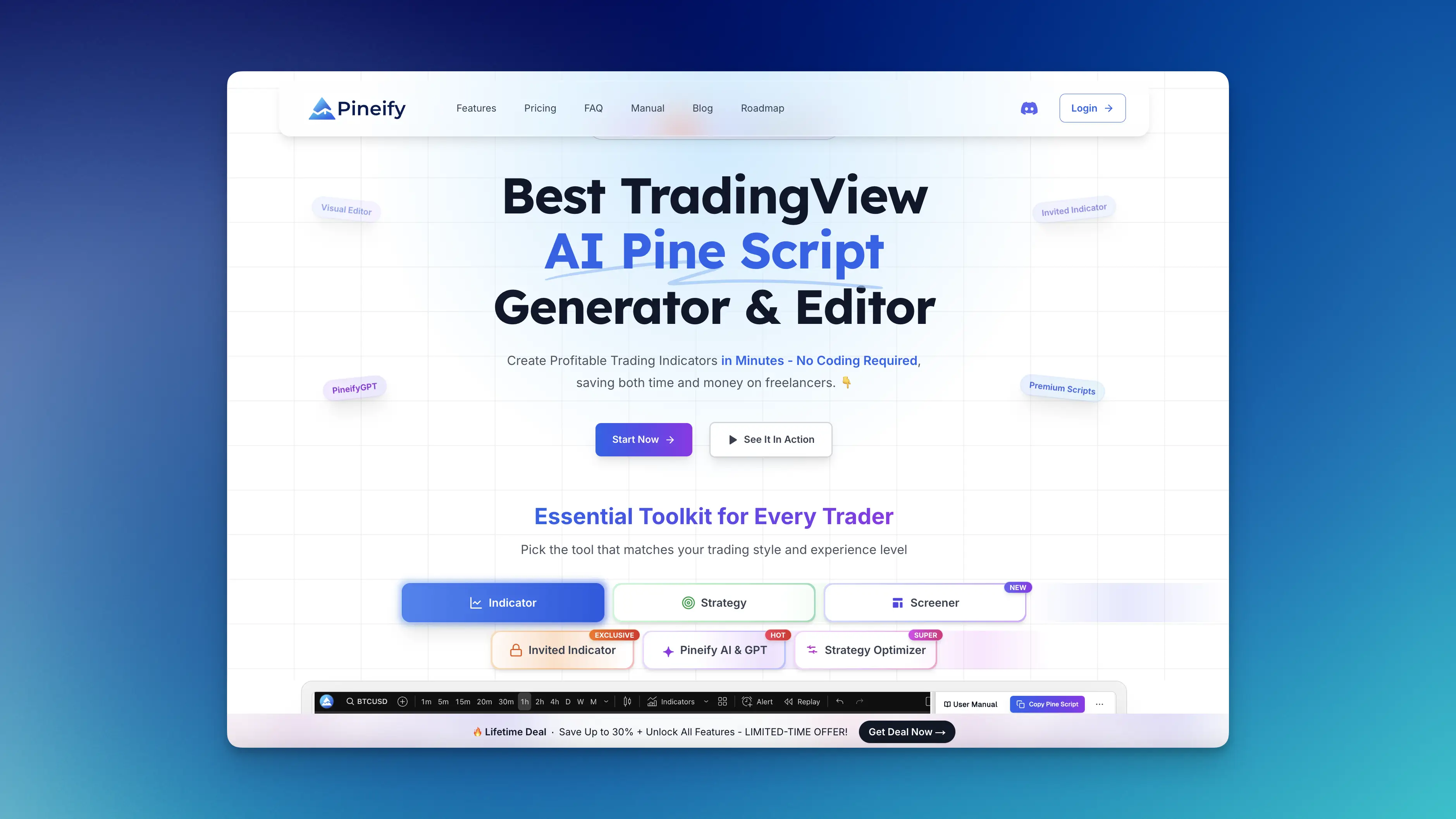
Ever wished you could tweak an indicator just a little bit, or build a strategy from the ground up? That's where Pine Script comes in. It's TradingView's own programming language, and it's how you go from using tools to creating them. Think of it as giving you the keys to the workshop. For those who prefer a visual, no-code approach to unlock this power, platforms like Pineify provide a seamless bridge, offering a visual editor and AI to generate error-free Pine Script without needing to master the syntax first.

Pineify Website

Getting started is straightforward. At the bottom of any TradingView chart, you'll find the "Pine Editor" tab. Click it, and you're in. The editor is your new best friend—it comes with ready-to-use templates for both indicators and full trading strategies, so you're never staring at a completely blank page.

How a Simple Script Comes Together

Pine Script is built to be readable, even if you're new to coding. Most scripts follow a clear path:

  1. Set the Stage: You start by declaring what you're building. indicator("My Cool Indicator", overlay=true) puts your creation right on the price chart. Use strategy() if you're coding rules for backtesting trades.
  2. Do the Math: This is where you use Pine's built-in functions to build your logic. Want to spot when a fast line crosses above a slow one? That's ta.crossover(). Need a moving average? ta.sma() or ta.ema() has you covered. You're essentially piecing together your trading idea with code blocks.
  3. Show the Results: Finally, you plot it. The plot() function draws your calculated lines or shapes on the chart. If you're writing a strategy, commands like strategy.entry and strategy.close tell the system when to simulate buying and selling.

Here’s a tiny taste of what that looks like for a simple indicator:

//@version=5
indicator("Basic MA Crossover", overlay=true)

fastMA = ta.sma(close, 10)
slowMA = ta.sma(close, 20)

plot(fastMA, color=color.blue)
plot(slowMA, color=color.red)

Learning in the Open: The Power of Community

The best part about Pine Script might not be the language itself, but the community around it. TradingView is built on open-source sharing. You can find a script for almost any idea, open it up, and see exactly how it works.

This "open kitchen" approach is a game-changer for learning. You can:

  • Study how experienced coders solve problems.
  • Borrow snippets of logic for your own projects.
  • Adapt a public script to fit your specific needs.

It turns a solo coding task into a collaborative learning experience, which means everyone gets better, faster. New and clever tools are constantly being built, shared, and improved by traders just like you. It’s less about secret formulas and more about building on what works, together. This collaborative spirit is amplified by tools that lower the barrier to entry, allowing more traders to contribute their unique logic and strategies to the ecosystem.

Your TradingView Script Questions, Answered

Q: Are TradingView scripts free to use? Most are! The vast library of indicators and strategies on TradingView is built by the community and is completely free to use. You can view, copy, and add them to your charts. The catch is that with a free TradingView account, you can only have three indicators running on a chart at once. If you want to use more simultaneously, or access premium scripts from the marketplace, you’ll need a paid subscription. So you can do a ton for free, but paying unlocks more power and convenience.

Q: Can I tweak or change a script I found? Absolutely, and that’s one of the best parts. If a script is labeled as “open-source,” you can look under the hood, copy the code (written in Pine Script), and save it as your own. From there, you can adjust its settings, change its colors, or even add new logic to it. It’s like finding a recipe online and then adding your own special spice. This lets you build tools that fit your trading style perfectly.

Q: I'm just starting out. Which scripts should I use first? Keep it simple. Focus on the classics that everyone talks about because they’re easier to learn and understand. Start with:

  • Moving Averages: Great for seeing the trend direction.
  • RSI (Relative Strength Index): Helps spot when an asset might be overbought or oversold.
  • MACD: Useful for spotting changes in momentum.

Another fantastic starter is the Supertrend indicator. It paints clear arrows or lines on your chart for potential buy and sell points, making it very visual and straightforward. Get comfortable with these before diving into complex multi-indicator systems.

Q: How can I tell if a script is any good? Don't just add the first script you see. Do a quick check first:

  1. Look at its popularity: How many people are using it? What’s its star rating? Read the comments section—the community is great at pointing out strengths and flaws.
  2. Seek out “Editor’s Picks”: These are scripts manually selected by TradingView’s team for being well-made and useful.
  3. Understand the logic: If you’re feeling adventurous, peek at the source code. Does it make sense? Does it base its signals on established analysis ideas?
  4. Always test it yourself: Use TradingView’s backtesting feature to see how the script would have performed on past data. This is the most important step before trusting it with real decisions.

Q: Can these scripts place trades for me automatically? Not directly on TradingView, no. Think of Pine Script as a super-smart assistant that watches the charts for you. It can highlight opportunities, draw lines, and most importantly, send you alerts when its conditions are met.

To fully automate, you’d need to connect those TradingView alerts to your brokerage account using a third-party service or a broker that offers an API. Many traders find a happy middle ground: they let the scripts generate the signals and send alerts, but they still click the button to place the trade themselves. This keeps you in control while making sure you don’t miss a setup.

Your Next Moves: Getting the Most from TradingView

You've got a handle on some of the best scripts and how they work. Now, let’s turn that knowledge into a real part of your trading day. Think of it like setting up a new workspace—you want your tools within reach and arranged just right.

A great way to start is by picking two or three indicators that work well together and adding them to your chart. For instance, you might use something like the Supertrend to see which way the wind is blowing, and then pair it with the Stochastic RSI to help spot a good moment to step in. The real trick is to watch them quietly for a while. See how they act on different charts—during a calm market, a volatile spike, or with different assets. You’ll learn more from that observation than anything else.

If you don’t have an account yet, just create a free one on TradingView. Head straight to the Community Scripts library; it’s like a treasure trove where you can search for tools that fit how you like to trade. Once you find a few you like, play around with the Strategy Tester. This lets you look back in time to see how a combo of indicators would have performed. Take notes on what settings and timeframes feel right for you.

Feeling adventurous? You might enjoy dipping your toes into Pine Script. It’s TradingView's own coding language, and you can start by tweaking an existing script to better suit your needs. It’s not as scary as it sounds, and it lets you build something that’s perfectly tailored to your approach.

Don’t forget the social side of TradingView. Follow a few traders whose analysis you respect, read their published ideas, and don’t be shy to join a conversation. Learning from others and even sharing your own chart observations makes the whole experience richer. The best indicators in the world are the ones that support your own understanding and risk rules—they’re here to give you confidence in your decisions, not to make those decisions for you. Always keep your own market analysis and trading discipline front and center.