Backtrader vs Zipline vs Pineify: Choosing Your Backtesting Tool

Algorithmic trading backtesting is running your strategy against historical price data to see how it would've performed. I've spent the better part of a year testing strategies on Backtrader, Zipline, and Pineify across tickers like AAPL and TSLA. The short answer: there's no universal winner. Backtrader gives you maximum control over every detail. Zipline offers rigorous academic-grade analysis. Pineify optimizes TradingView strategies faster than anything else I've used. You choose based on how you trade, not which has the longest spec sheet.
Backtrader: Flexible Python Backtesting
Backtrader is an open-source Python library that handles backtesting, visualization, and live trading. It reads data from CSV files, Pandas DataFrames, or sources like Yahoo Finance. I prefer Backtrader when I'm prototyping a new idea and need full control over every component of the simulation.
It ships with over 122 built-in indicators — SMA, EMA, MACD, RSI, you name it. You can also plug in TA-Lib for more. Its hybrid architecture is what sets it apart: it runs indicator math with fast vectorized operations while keeping an event-driven core for realistic order execution. That means it's quick enough for rough prototyping, yet detailed enough when you're tuning fills and slippage.
When you're ready to go live, Backtrader connects to Interactive Brokers, Oanda, Alpaca, and others. To be fair, I haven't tested the live broker integration myself — the setup isn't trivial, and if you're not comfortable tracing Python exceptions, you'll hit friction fast. For a deeper look at different backtesting software options, check out our complete guide.
Zipline: Research-Focused Framework
Zipline comes from the Quantopian team. It's a strict event-driven Python framework that processes data one bar at a time through functions like initialize() and handle_data(). It was built for one thing: rigorous, academic-grade backtesting.
Its strength is depth. Zipline models trading costs, risk factors, and performance attribution out of the box. It pairs directly with Pyfolio to generate tear sheets full of Sharpe ratios, drawdown analysis, and factor exposures. If you're publishing research or applying for a quant role, this setup mirrors professional workflows.
The catch: since Quantopian shut down, Zipline's community has shrunk. Documentation and updates are sparse. I've found myself digging through GitHub issues from 2019 to answer basic questions. It still works for its core purpose, but don't expect active support or modern Python compatibility without effort.
Pineify: TradingView Optimization Platform
Pineify is different from the Python libraries above. It's not a general-purpose backtester — it's a TradingView extension and platform built specifically for optimizing Pine Script strategies.
Here's what it does: you take any strategy you've written in Pine Script, set parameter ranges (min, max, step), and Pineify automatically tests thousands of combinations in minutes. It generates institutional-grade reports with Sharpe ratio, Monte Carlo simulations, and drawdown heatmaps. If you're wondering about the practical limits of TradingView automation, you might be interested in our guide that answers the question: Can Pine Script Execute Trades?
It also includes a trading journal for tracking manual trades, analyzing win rate, profit factor, and execution quality. The browser extension plugs directly into TradingView, so you don't leave the platform to optimize.
Pineify has one clear limitation: it won't execute trades for you. It optimizes and tracks. To go live, you still need TradingView alerts or a broker API. I've found Pineify most useful during the research and optimization phase, not execution.
Speed and Performance
When you're testing trading ideas, speed determines how many strategies you can explore. Here's how these three handle performance.
How Each Engine Handles Speed
The biggest factor in backtesting speed is the engine's architecture: does it process all data at once (vectorized) or step through bar by bar (event-driven)?
| Tool | Primary Architecture | Speed Profile | Best For |
|---|---|---|---|
| Backtrader | Hybrid (Event-driven with vectorized options) | Fast for prototyping; highly configurable for detail. | Traders who want a balance of speed and realistic trade simulation. |
| Zipline | Event-driven | Slower with large datasets, but accurate. | Research and academic work where precision is more important than raw speed. |
| Pineify | Optimization-focused | Extremely fast at finding optimal strategy parameters. | TradingView users who want to quickly tune and improve their existing strategies. |
Zipline's event-driven loop is slower — especially with years of multi-asset data — but it's built to mirror live market sequencing. Backtrader's hybrid model lets you pick speed or realism per use case. Pineify doesn't compete in the general backtesting speed race. Its specialty is parameter optimization inside TradingView — Pineify fires through thousands of combinations in minutes, directly in your chart, with no data exports or API connections needed.
Feature Comparison Table
| Feature | Backtrader | Zipline | Pineify |
|---|---|---|---|
| Programming Language | Python | Python | TradingView/Browser-based |
| Architecture | Hybrid (Event + Vectorized) | Event-driven | Optimization Engine |
| Built-in Indicators | 122+ indicators | Standard library | TradingView indicators |
| Live Trading Support | Multiple brokers (IB, Oanda, Alpaca) | Limited, requires custom development | Manual tracking via journal |
| Data Format Support | CSV, Pandas, Online sources | Pandas DataFrames | TradingView data |
| Community Support | Active, extensive documentation | Declining, historical resources | Growing, TradingView-focused |
| Primary Use Case | Flexible backtesting & live trading | Academic research & validation | Strategy optimization & journaling |
| Learning Curve | Moderate to High | High | Low to Moderate |
| Cost | Free, open-source | Free, open-source | Subscription-based (advanced features) |
When to Choose Each Platform
Choose Backtrader if...
You want complete control over every part of the process. Backtrader works best when you need to connect to live brokers, build custom indicators from scratch, or run multiple strategies simultaneously to see how they interact.
The learning curve is real — you need Python experience — but the documentation and community forums are excellent compensation. Features like automatic indicator warm-up and look-ahead bias prevention make it a reliable foundation for strategies you intend to trade live.
Choose Zipline if...
Your priority is deep, academic-style analysis. Zipline simulates trading costs, slippage, and risk factors more thoroughly than most alternatives. Its Pyfolio integration produces professional tear sheets with Sharpe ratios, max drawdowns, and factor exposure breakdowns.
Just know what you're signing up for: the community is quiet since Quantopian shut down, and you might need to patch things yourself for modern Python. But if analytical rigor is non-negotiable, Zipline still delivers.
Choose Pineify if...
You live in TradingView and write Pine Script, but manual parameter testing is eating your time. Pineify automates that grunt work — testing thousands of combinations across markets and timeframes. Its Strategy Optimizer Extension turns a single backtest into a full grid search, and its Professional Backtest Deep Report converts raw TradingView output into Monte Carlo simulations and advanced metrics.
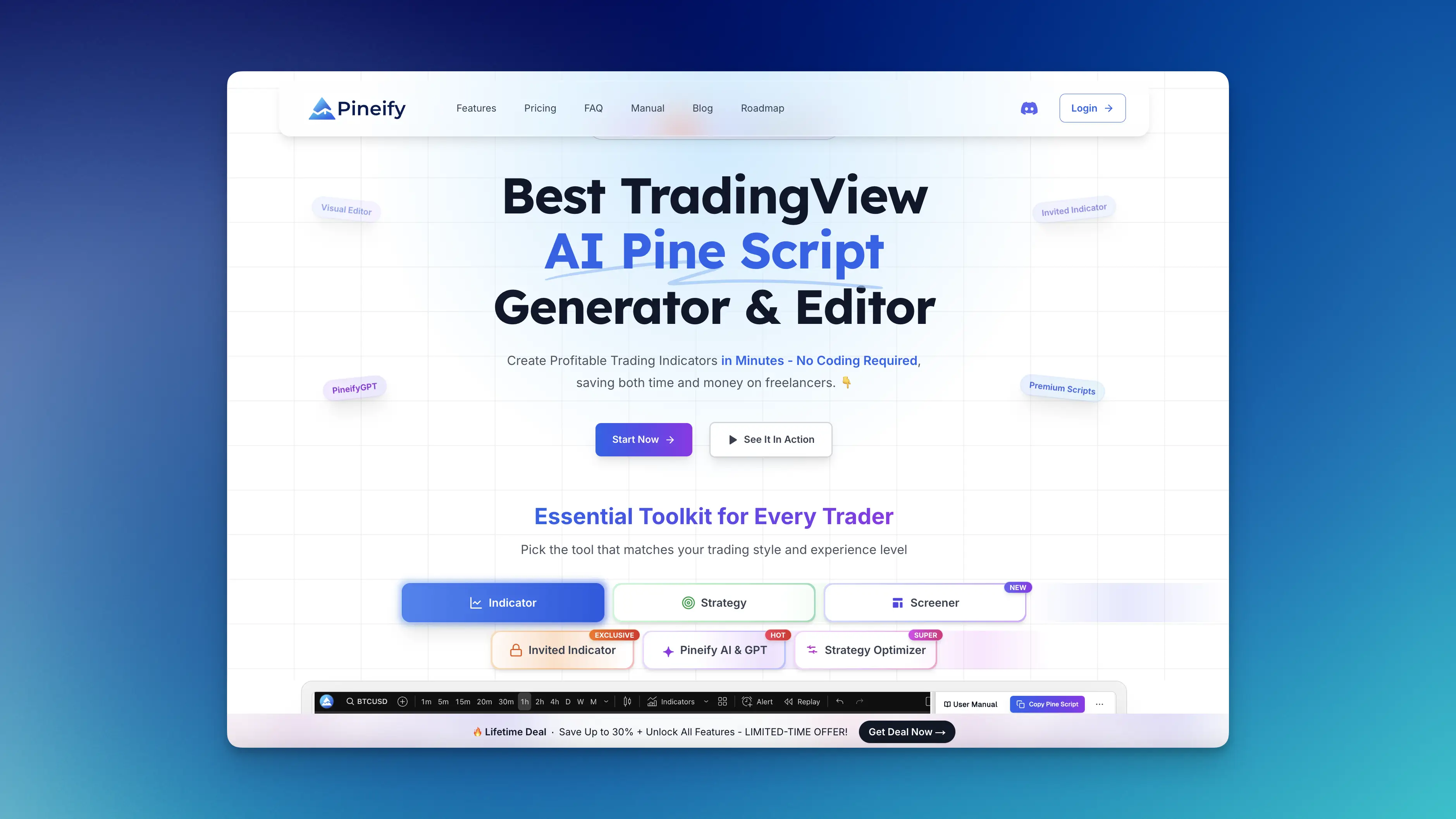
It also includes a serious automated trading journal without you building one yourself. The catch is that the TradingView extension requires a paid plan. For traders deep in the TradingView ecosystem, the connection and tools — like the AI Coding Agent for error-free Pine Script generation and the Visual Editor for building without code — can save significant time. To understand Pine Script logic better, including loops and conditionals, our guide on For Loops and else if in Pine Script is a solid resource.
Setting Up Each Platform
Backtrader Setup
You need Python 3.6 or newer. Install Backtrader with pip. Then create a Cerebro engine instance — this is the core of every backtest — configure your starting capital and commission, add your data feed, and run the test. Backtrader handles strategy processing and generates performance charts automatically. Custom indicators are created by extending bt.Indicator and defining your logic in the next() function.
Zipline Setup
Zipline structures backtests around two functions. initialize(context) runs once at the start to set cash, schedule recurring actions, and declare tracked variables. handle_data(context, data) fires on every new bar — you check signals, place orders, and log metrics here. Results export to CSV for deeper work with Pyfolio.
Pineify Setup
Add the Pineify extension to your browser and log into your account. Inside TradingView, add your Pine Script strategy to a chart and open the Strategy Tester tab. For any parameter you want to optimize, set a start value, end value, and step size. Pineify calculates the total combinations and runs them automatically, showing real-time progress. Results display which parameter sets performed best and can be exported for review.
Frequently Asked Questions
What is the main difference between Backtrader, Zipline, and Pineify?
Backtrader is a flexible Python library for building and testing custom strategies with live trading support. Zipline is a research-focused, event-driven framework originally from Quantopian, built for academic rigor. Pineify is a TradingView optimization platform that automates parameter testing and generates institutional-grade reports for Pine Script. Each serves a different workflow: Backtrader for Python control, Zipline for deep research, and Pineify for TradingView users who want to optimize without coding from scratch.
Which traders benefit most from Pineify?
Traders already using TradingView and Pine Script. Instead of manually testing parameter combinations, Pineify runs thousands in minutes. It delivers professional backtest reports with Monte Carlo simulations, Sharpe ratios, and drawdown heatmaps. If you also want an automated trading journal that plugs directly into TradingView, Pineify handles that too.
How do I set up Backtrader for backtesting?
Pretty straightforward. Install Python 3.6 or later, install Backtrader with pip, create a Cerebro engine, set your starting capital and commission, add your data feed, and run. Backtrader processes your strategy and generates performance charts. Custom indicators extend the bt.Indicator class.
Which platform offers the best backtesting speed?
Depends on what you need. Backtrader's hybrid design gives fast prototyping with realistic simulation. Zipline's event-driven model is slower but more accurate. Pineify isn't a general backtester — it's an optimization engine that rapidly tests thousands of parameter combos for TradingView strategies. For its specific job, it's extremely fast.
Is Zipline still actively maintained?
The code is open-source and available, but since Quantopian shut down, official updates and community activity have dropped significantly. You'll rely on existing documentation and may need to patch things for modern Python. It still works for event-driven backtesting, but for active support, Backtrader or Pineify are safer bets.
Can I use Pineify for live automated trading?
Not directly. Pineify is built for optimization and tracking, not live execution. It finds the best parameters for your strategy and provides a journal for manual trade tracking. To automate execution, you'd route through TradingView alerts, a broker API, or a third-party service. Pineify handles the optimization and analysis phases.