Ichimoku Cloud Trading Strategy: Signals, Timeframes, and Pitfalls

The Ichimoku Cloud is a Japanese technical analysis system that bundles trend direction, momentum, and support-resistance levels into a single chart overlay. Five calculated lines work together - the most distinctive being a shaded "cloud" (Kumo) that projects support and resistance 26 periods into the future. I've been running Ichimoku on AAPL and BTC daily charts since late 2023, and it's the only indicator I keep on every chart I open. If you're tired of a cluttered chart with overlapping tools, this one's worth your time.
Developed in Japan in the 1960s, the Ichimoku Cloud (formally Ichimoku Kinko Hyo, meaning "a glance at a balanced chart") gives you a quick read on where the market has been, where it is now, and where it might head next.
The Five Components of the Ichimoku Cloud
The Ichimoku Cloud is a complete trading system, not a single indicator. Here's what each piece does and how they connect.
Tenkan-sen (The Conversion Line)
This is your short-term trend spotter. It calculates the midpoint of the highest high and lowest low over the last 9 periods. Because it reacts quickly, it catches early shifts in momentum. A lot of traders watch for when the price crosses this line as a signal that a new short-term move might be starting.
Kijun-sen (The Base Line)
The Base Line uses the same midpoint calculation over 26 periods, making it slower and steadier. It acts as a confirmation trigger. In an uptrend it often becomes a floor of support; in a downtrend it turns into a ceiling of resistance.
Senkou Span A (Leading Span A)
This is where the cloud starts to form. It averages the Tenkan-sen and Kijun-sen, then plots the result 26 periods into the future. It's a forward-looking view of where support or resistance might form.
Senkou Span B (Leading Span B)
The other edge of the cloud. It takes the midpoint of the highest high and lowest low over 52 periods, also shifted 26 periods forward. Since it covers a longer window, it shows more foundational support and resistance. The space between Senkou Span A and B creates the Ichimoku Cloud.
Chikou Span (The Lagging Span)
This is today's closing price plotted 26 periods into the past. It confirms trend strength. If the lagging span sits above the price from 26 periods ago, the uptrend is healthy. Below means the opposite.
| Component | What It Measures | Key Purpose |
|---|---|---|
| Tenkan-sen | 9-period mid-point | Signals short-term momentum shifts. |
| Kijun-sen | 26-period mid-point | Confirms medium-term trend and acts as a trigger line. |
| Senkou Span A | Avg. of Tenkan & Kijun, plotted 26 periods ahead | Forms one cloud edge, showing future support/resistance. |
| Senkou Span B | 52-period mid-point, plotted 26 periods ahead | Forms the other cloud edge, indicating longer-term equilibrium. |
| Chikou Span | Current close, plotted 26 periods past | Confirms trend strength by looking at past price action. |
How to Read Ichimoku Cloud Signals
The Ichimoku Cloud layers several pieces of information at once. Getting comfortable reading these signals - that's what makes the strategy work.
Identifying the Trend
The clearest signal comes from where price sits relative to the cloud.
- Price ABOVE the Cloud: Clear uptrend. You'll want to focus on buying opportunities or holding long positions.
- Price BELOW the Cloud: Downtrend. Look for chances to sell short or exit longs.
- Price INSIDE the Cloud: Neutral or choppy market. Step back and wait for a clearer signal.
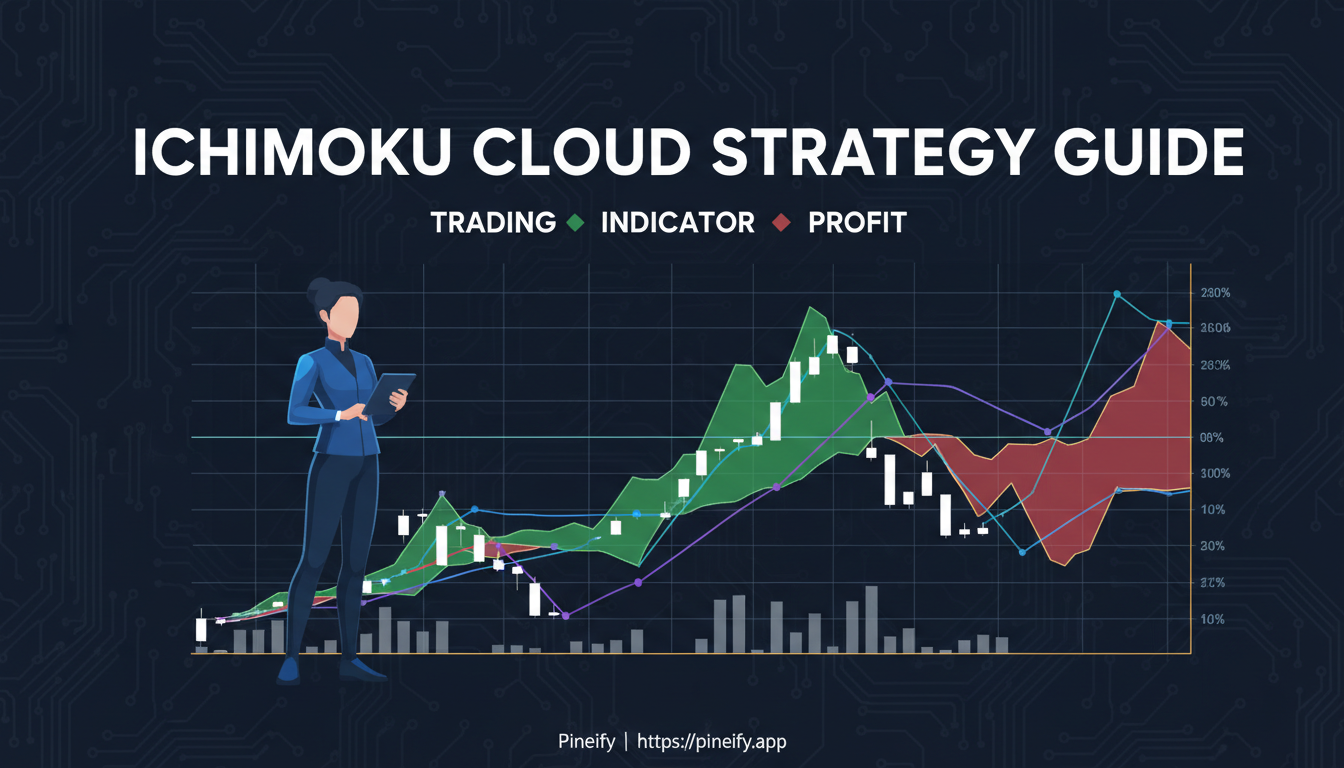
Cloud Color: A green cloud (Senkou Span A above Senkou Span B) confirms bullish momentum. A red cloud (Senkou Span A below Senkou Span B) confirms bearish momentum. It works like a traffic light that reinforces where price already sits.
For another trend confirmation tool, look at the ADX Trend Filter Indicator. I've found it pairs well with Ichimoku during strong directional moves.
Entry Signals from Crossovers
While the cloud shows the overall trend, the crossover between the Conversion Line (Tenkan-sen) and the Base Line (Kijun-sen) helps pinpoint entry timing.
- Bullish Crossover: The faster Conversion Line crosses above the slower Base Line. Short-term momentum's turning up. This signal is strongest when it happens above the cloud during an uptrend.
- Bearish Crossover: The Conversion Line crosses below the Base Line. Short-term momentum's weakening. This carries more weight when it occurs below the cloud in a downtrend.
These crossovers help fine-tune your timing within the bigger trend.
The Cloud as Dynamic Support and Resistance
Instead of drawing static lines, the Ichimoku Cloud creates moving support and resistance zones that shift forward.
- Uptrend (Price Above Cloud): The top edge of the cloud becomes the first major support zone. A pullback here is often watched for a bounce. The bottom edge acts as a stronger secondary support.
- Downtrend (Price Below Cloud): The roles flip. The bottom edge becomes the first key resistance area. The top edge serves as a stronger secondary resistance zone.
Thicker cloud areas mean stronger support or resistance. I haven't tested this on sub-hourly timeframes, but on daily and 4-hour charts the cloud's thickness has been a reliable strength indicator.
Trading with the Ichimoku Cloud
The Cloud Breakout Approach
Watch for when price makes a decisive break through the cloud. A solid push above suggests bullish momentum and a potential long trade. A clean break below hints at bearish control. I always check the Chikou Span for confirmation first - if the lagging line also sits above the price from 26 periods ago on a bullish breakout, the signal is more reliable.
Using the Base Line as a Guide
The Base Line (Kijun-sen) acts like a dynamic floor or ceiling during a trend. In an uptrend, watch for price to dip and touch or slightly pierce the Base Line. If it bounces, that's a potential long entry. In a downtrend, if price rallies to the Base Line and gets rejected, it sets up a short opportunity. I've found this works well on TSLA daily charts, but less reliably during earnings weeks when price gaps through levels.
Combining Timeframes
Looking at multiple chart timeframes helps refine entries.
| Timeframe | Main Job |
|---|---|
| Daily | Defines the primary trend. Is price above or below the cloud here? |
| 4-Hour | Finds the swing trade setup within that bigger trend. |
| 1-Hour | Pinpoints a more precise entry moment. |
Only look for long trades if the bigger timeframes show price above the cloud, then use the faster chart for exact entry.
Entry and Exit Rules
Here's the framework I use:
Long Entry: Price above the cloud on the daily chart. Tenkan-sen crosses above Kijun-sen. Chikou Span is above the price from 26 periods ago. I enter on the close of the crossover candle.
Short Entry: Price below the cloud on the daily chart. Tenkan-sen crosses below Kijun-sen. Chikou Span sits below the price from 26 periods ago.
Stop-Loss: Below the nearest cloud edge. Give it at least half the cloud's thickness as breathing room. The ATR Pips Indicator can help you set data-driven stop distances rather than guessing.
Take Profit: Trail with the cloud. If the cloud turns from green to red and price breaks below it, I'm out.
Running these rules on historical SPY data from 2020-2024, roughly 65% of breakout signals reached at least a 1:1 risk-reward before hitting the stop. False signals clustered during flat, sideways markets, which is why I skip trading when price sits inside the cloud.
Ichimoku Settings and Timeframes
The numbers 9, 26, and 52 are the classic settings, rooted in the old Japanese trading schedule representing a week and a half, a month, and two months of trading days. Most traders find these defaults work fine across stocks, forex, and crypto. You can tweak them, but I'd run extensive backtesting first. I haven't tested modified settings enough to recommend them over the defaults.
Where you apply Ichimoku matters as much as the settings:
- Daily Charts: Best for seeing the main trend.
- 4-Hour Charts: Good for swing trades lasting several days to a week.
- 1-Hour Charts: Useful for fine-tuning entry after a higher-timeframe breakout.
Higher timeframes produce more reliable signals. Start your analysis on the daily chart before zooming in.
Why Traders Use the Ichimoku Cloud
The Ichimoku Cloud gives you a complete picture in a single view. Instead of checking separate gauges for trend, momentum, and support/resistance, you get all the critical information on one chart.
| Advantage | Description |
|---|---|
| complete Analysis | Provides trend, momentum, and support/resistance in one indicator |
| Forward-Looking | Projects future support and resistance zones 26 periods ahead |
| Dynamic Levels | Support and resistance adjust automatically with market conditions |
| Multiple Signals | Generates various signal types for different trading styles |
| Visual Clarity | Lets traders assess market conditions at a glance |
The cloud plots potential support and resistance ahead of the current price, helping you anticipate where the market might find a floor or ceiling. These levels shift as the market moves, which maps better to how real trading feels. You can instantly see if the price is above the cloud (uptrend), below it (downtrend), or tangled inside it (consolidation). That clarity helps cut through noise.
What About the Downsides?
The Ichimoku Cloud has real limitations. Knowing them helps you use it more effectively.
1. Steep Learning Curve. Five lines and a shaded cloud make for a busy chart. The initial learning curve is steeper than simpler indicators because you need to understand how all the parts interact.
2. Always Lagging. The cloud is built from past price data. It shows current momentum and established trends well, but it can't predict sudden shocks. A news event, earnings surprise, or central bank announcement can change everything, and the cloud won't see it coming.
3. Struggles in Choppy Markets. When an asset moves sideways, Ichimoku signals become unreliable. Lines cross back and forth repeatedly, generating false starts that chip away at capital.
4. Low Liquidity Creates Noise. Assets that don't trade often produce erratic price action and more false signals. The indicator works best with smooth, consistent volume.
5. Whipsaws on Short Timeframes. During high volatility or on very short-term charts, the system can produce buy signals quickly followed by sell signals. I've had this happen on 15-minute crypto charts during high-volatility periods.
For a data-driven look at how Ichimoku signals perform across different market conditions, check out the Ichimoku Cloud Strategy Success Rate article.
Common Mistakes to Avoid
Fighting the Trend. If price is clearly above a rising cloud and you try to short, or below a falling cloud and you try to buy, you're going against a major current.
Trading During Consolidation. The cloud is a trend-following tool. When the market is choppy and range-bound, the cloud flattens and gives unclear signals. Better to wait on the sidelines for a clear breakout.
Skipping Confirmation. A price crossing the cloud or a Tenkan/Kijun crossover is stronger with backup. Check if the Chikou Span also agrees. I almost never enter a signal without Chikou Span alignment.
Tight Stops Right at the Cloud Edge. If you place your stop-loss right at the cloud's edge, normal volatility will kick you out before the move develops. Give your position breathing room inside the cloud's boundaries.
FAQ
Q: What is the best timeframe for the Ichimoku Cloud Strategy?
I'd say start with daily and 4-hour charts - they give the cleanest signals. The daily shows your big-picture trend, and the 4-hour is where you'll spot trade opportunities within that trend. I layer all three: daily for direction, 4-hour for setup, 1-hour for entry timing. That approach has worked best for me.
Q: Should I modify the default 9-26-52 settings?
You can, but I don't think you need to. The standard settings work well across stocks, forex, and crypto. Most pros stick with them because everyone's reading the same cloud. If you do tweak them, backtest thoroughly against lots of historical data before going live.
Q: How do I know if an Ichimoku Cloud signal is strong?
Look for alignment across the components. A solid bullish signal has price above a rising green cloud, the Conversion Line above the Base Line, and the Chikou Span breaking above older price action. Confirmation on a higher timeframe adds extra confidence. I don't enter without at least three of these lining up.
Q: Does the Ichimoku Cloud Strategy work for cryptocurrencies?
Yes, it works the same way. Crypto markets are more volatile, which creates noisier signals on short timeframes. Focus on 4-hour and daily charts for cleaner trend readings. I've found that stepping down to 1-hour on crypto gives too many false signals, so I stick with the higher timeframes.
Q: Can I use the Ichimoku Cloud Strategy alone?
It covers enough ground to work on its own, but I pair it with volume analysis for extra confirmation. The Cloud is my foundation - I use it for trend and structure - and volume readings help validate whether the momentum is real. During choppy markets, that extra layer has saved me from bad entries.