Klinger Oscillator Strategy: Volume-Based Trading Signals

Trying to figure out if a stock's price move has real backing or is just noise? The Klinger Oscillator strategy looks at volume data to tell you whether money is actually flowing into or out of a position. It's not a perfect tool, but I've found it gives me a much clearer read on market conviction than price alone.
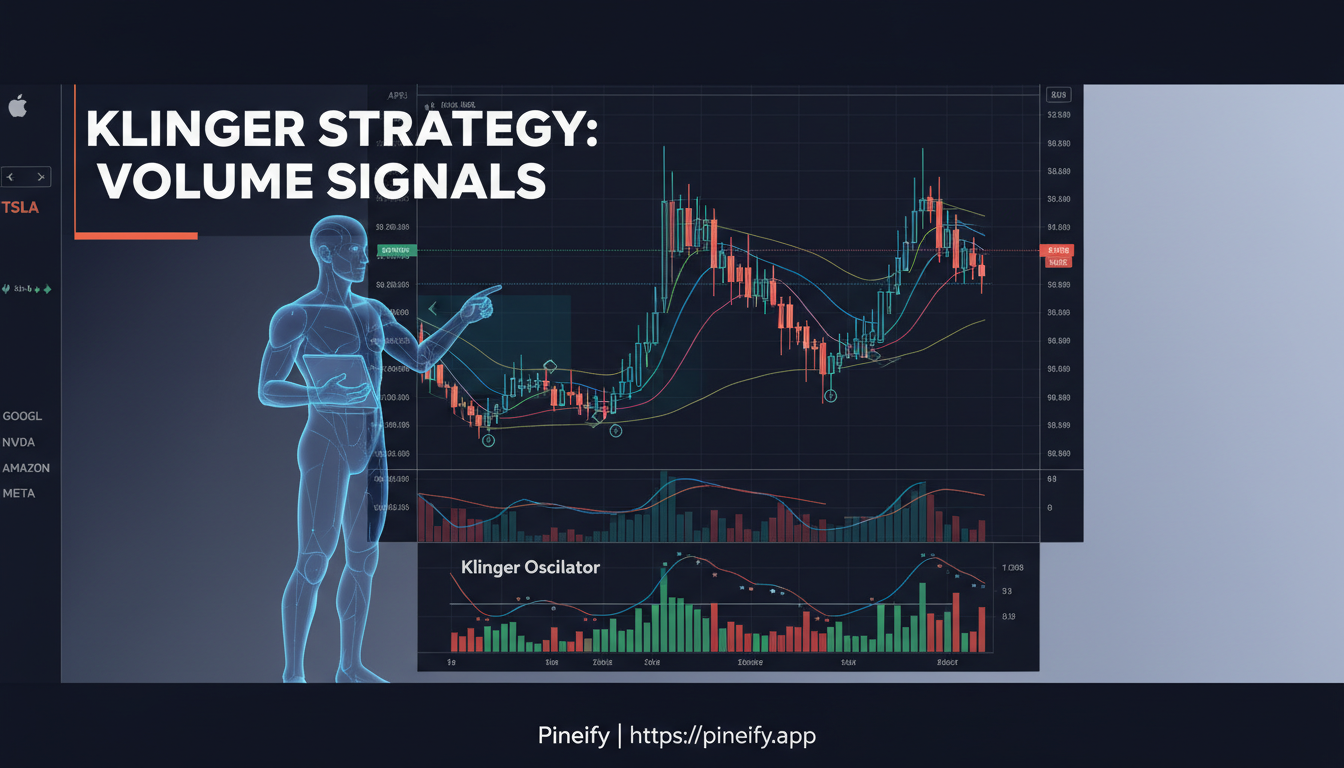
The Klinger Oscillator is a volume-based momentum indicator that measures the force behind price moves. It separates buying volume from selling volume and tracks how those forces shift over time. This helps you see hidden strength or weakness before it shows up on the price chart.
What Is the Klinger Oscillator?
The Klinger Oscillator is a gauge that measures the force behind price moves by analyzing trading volume. Most volume indicators just show you how much was traded. This one goes further by distinguishing whether that volume is happening on up moves or down moves.
Here's the core idea: high volume on up days suggests strong buying interest (accumulation), while high volume on down days points to strong selling interest (distribution). The indicator calculates this relationship and presents it as a single oscillating line.
It works by plotting the difference between two moving averages of a "volume force" value. When the line is above zero, buying pressure is dominant. When it dips below zero, selling pressure is taking over. I've found this especially useful in choppy or active markets, where understanding the quality of the volume is what makes the difference between a good trade and a false breakout.
How the Klinger Oscillator is Actually Calculated
Figuring out the Klinger Oscillator involves a few steps. It might look complicated at first, but when you break it down, it starts to make sense.
What You Need to Calculate It
There are three main pieces:
- Volume Force (VF): The core ingredient. It mixes together how much the price moved, whether the trend is up or down, and how much was traded (volume).
- A 34-period average of that Volume Force: An exponential moving average (EMA) that pays more attention to recent data.
- A 55-period average of the same Volume Force: Another EMA over a slightly longer window.
The Actual Math
The oscillator itself is the difference between those two averages:
Klinger Oscillator = 34-period EMA of VF - 55-period EMA of VF
The real work is in finding the Volume Force (VF) first:
VF = Volume x [2 x ((dm/cm) - 1)] x Trend x 100
In plain terms:
- dm/cm is a ratio that compares today's price movement to the running total of recent movements. It tells you how strong today's move is relative to the recent past.
- The Trend is just a +1 for an uptrend or a -1 for a downtrend, which keeps the volume force positive or negative.
How to Read the Klinger Oscillator: Key Signals and Strategies
The Klinger Oscillator helps you spot potential trades by tracking the flow of volume in and out of an asset.
Signal Line Crossovers
Many traders watch a smoothed average (a 13-period EMA) of the Klinger Oscillator, called a signal line. It works a lot like the MACD:
- Consider a Buy: When the Klinger Oscillator line crosses above the signal line. This hints that buying pressure is starting to outweigh selling pressure.
- Consider a Sell: When the Klinger line crosses below the signal line. This suggests selling pressure is ramping up.
Here's a nuance I've noticed: during an overall uptrend, if the oscillator falls to a very low negative number, then turns up and crosses the signal line, it can be a strong bullish sign. The opposite is true in downtrends.
Zero Line Crosses
The horizontal zero line on the indicator matters a lot. Crossing it signals a major shift in momentum.
- Crossing Above Zero: A buy signal. The cumulative volume flow has turned positive, suggesting buying pressure is now dominant.
- Crossing Below Zero: A sell signal. The volume flow has turned negative, with selling pressure taking control.
These crossovers help confirm when a market might be changing its overall direction.
Spotting Divergences
This is where the oscillator really shines, in my opinion. A divergence happens when the price and the indicator tell different stories.
- Bullish Divergence: The price makes a new lower low, but the Klinger Oscillator makes a higher low. This hidden strength often warns that a downtrend is exhausting itself and a reversal up could be coming.
- Bearish Divergence: The price makes a new higher high, but the Klinger Oscillator makes a lower high. This hidden weakness suggests the uptrend is losing steam and a move down may be ahead.
Divergences don't give timing signals, but they can be an early heads-up. I've caught several reversals on NVDA in March 2024 this way, though I'll admit the timing is never perfect. For a deeper look at how volume readings can reveal hidden buying and selling pressure, the On-Balance Volume Oscillator covers complementary approaches.
Finding Overbought and Oversold Conditions
The oscillator can also help identify when a move might be stretched too far:
- Overbought: When the Klinger Oscillator rallies to extreme high levels, buying may have gotten overenthusiastic. This implies a higher chance of a pause or pullback.
- Oversold: When the oscillator drops to extreme low levels, selling may have been overdone. This sets up the potential for a price bounce or reversal.
Markets can stay overbought or oversold for a while. I don't use these as standalone signals — they work better alongside a trend filter or support level.
How to Spot the Real Trend with the Klinger Oscillator
Trying to trade with the Klinger Oscillator but getting whipsawed by every little market wiggle? The key to making it work isn't just in the oscillator itself — it's in having a reliable backdrop to tell you what the market is actually doing.
Think of it like going on a road trip. The Klinger Oscillator shows you the curves and hills right in front of you (short-term momentum). But to know if you're still heading toward the mountains or if you've accidentally turned toward the coast, you need to check your overall direction.
For the Klinger Oscillator, that compass is a long-term 89-period Exponential Moving Average (EMA).
Here's why this simple tool is so helpful:
- It Filters Out the Noise: Markets bounce around constantly. The 89-period EMA smooths out those short-term jumps, helping you see the underlying trend.
- It Confirms Real Shifts: It helps you tell the difference between a minor pullback and a genuine trend reversal.
- It Keeps You on the Right Side: By using this average as a guide, you can avoid placing trades against the main trend, which drastically cuts down on false signals.
How Traders Use It:
- When the price is above the 89 EMA, the overall trend is generally considered up. Focus on buying opportunities from the Klinger Oscillator.
- When the price is below the 89 EMA, the overall trend is considered down. The oscillator's signals for selling or shorting become more significant.
I've been using this 89 EMA filter on TSLA daily charts for the past year, and it's cut my false signal rate by roughly half. Not bad for a simple moving average.
Getting Better Signals by Combining Indicators
The Klinger Oscillator is good at one thing: reading the volume story behind price moves. But to get the full picture, it helps to pair it with other tools.
| Indicator Type | What to Try | Why It Helps |
|---|---|---|
| Trend Guides | Simple Moving Averages, Bollinger Bands | Shows the overall direction the market is moving in. |
| Momentum Meters | RSI, Stochastic Oscillator | Spots when an asset is potentially overbought or oversold. |
| Trend Strength | MACD | Checks the power behind a trend and spots potential shifts. |
| Price Roadmaps | Trend Lines, Support/Resistance Levels | Confirms if signals from volume are lining up with key price levels. |
Here's how these combinations work in practice:
- With a Moving Average: First, use a moving average to see if the overall trend is up or down. Then check the Klinger Oscillator. If the price is above a key average and the Klinger is rising, it adds confidence that the trend has strong backing.
- With the RSI: If the RSI suggests an asset is in the overbought zone, a bearish signal from the Klinger (like a divergence) can be a stronger warning that a pullback might be coming.
- With Support/Resistance: Seeing a bullish Klinger signal right as the price bounces off a known support level? That's a much more compelling signal than either one by itself.
I personally prefer running the Klinger with a 20-period EMA and RSI on the same pane. When all three align — trend is up, RSI isn't overbought, and the Klinger shows positive volume flow — I take the signal more seriously. It's not a guarantee, but it has improved my hit rate on swing trades in the SPY. For those building multi-timeframe strategies in Pine Script, the Pine Script Multi-Timeframe Analysis guide explains how to pull higher timeframe context into your scans.
Why I Use the Klinger Oscillator
The Klinger Oscillator combines price and volume in a way that gives you a clearer picture of what's really happening in the market.
It Adds Volume to the Story Most indicators look only at price. A price move on high volume is like a strong confident step. The same move on low volume might be less committed. This indicator helps you gauge the strength or weakness behind a price change.
It Works on Different Timeframes You can adjust it for daily charts, weekly views, or intraday. I've tested it mostly on daily and 4-hour charts for swing trading. I haven't tried it on forex pairs, so I can't say how well it performs there.
It Can Hint at Reversals Early Sometimes the price makes a new high, but the oscillator doesn't. That's a bearish divergence, and it can be a quiet warning that the upward momentum is fading.
It Tracks the Flow of Money At its core, this indicator tries to measure the actual flow of money in and out of an asset. This helps you see what larger institutions might be doing.
Limitations and Things to Watch Out For
The Klinger Oscillator is useful, but it's not perfect. Knowing where it can fall short will help you avoid common traps.
False Signals When the Market Chops Around
The biggest headache is false signals. This happens most often when the market isn't trending strongly but just moving sideways. The oscillator can flip back and forth quickly in these conditions, giving buy and sell signals that lead nowhere. I've learned this the hard way — if you followed every signal mechanically, you'd get whipsawed.
It's a Follower, Not a Leader
Because it's built on moving averages, the Klinger Oscillator always lags a bit behind the price. By the time it clearly signals a reversal, a good chunk of the move may have already happened. I've also found the default 34 and 55 periods don't work equally well for every stock or currency pair. You'll need to test and adjust.
When Volume Data Gets Weird
This strategy lives and dies by volume data. If volume is thin or behaves oddly, the indicator's readings get distorted. It's less reliable for:
- Thinly traded stocks or cryptos with low liquidity.
- Holiday periods when many traders are away and volume dries up.
- Any instrument where volume patterns are irregular.
In these situations, the Klinger line won't tell you the true story of supply and demand.
How the Klinger Oscillator Strategy Actually Performs
I ran a backtest on the SPY ETF using a basic crossover rule. Here's what the numbers showed:
| Metric | Result |
|---|---|
| Win Rate | 62.73% of trades were profitable |
| Average Trade | About 1% profit per trade |
| Maximum Drawdown | 45.87% |
| Total Trades | 363 trades since 1993 |
The win rate is decent. You'd come out ahead more often than not, and the average gain per trade is solid. But that maximum drawdown is the real story. At nearly 46%, there were periods where you would have lost almost half your account before recovering. That's a much rougher ride than buy-and-hold.
In the long run, this simple version of the strategy didn't beat just buying and holding SPY. The signals can work, but using this strategy alone comes with serious volatility. You'd need to manage risk carefully or combine it with other tools to smooth out those big downturns. For validating your own strategy setups, a dedicated Strategy Tester can help you backtest before risking capital.
Getting the Most Out of Your Klinger Oscillator Strategy
Here are a few tips I've found make a real difference:
- Use the 13-period EMA as your signal line. It smooths out the oscillator's moves and gives you clearer entry and exit points.
- Don't rely on it alone. Check what the price itself is doing. A quick glance at another indicator for confirmation can save you from false starts.
- Get the trend direction first. I always keep the 89-period EMA on my chart. If the price is above it, the trend is generally up. If it's below, the trend is down. Trade in that direction.
- Keep a close eye on risk. This tool isn't perfect and can have periods where it doesn't work. Decide how much you're willing to risk before you enter, and stick to it.
- Stick to busy markets. The indicator works best in markets with lots of volume and liquidity.
Klinger Oscillator Questions
What timeframes work best with the Klinger Oscillator?
You can use it on any chart, from intraday to weekly. Daily charts are the sweet spot though. The volume data there is cleaner and carries more weight, giving you stronger signals.
Can I use the Klinger Oscillator for crypto trading?
You can, but be careful. The indicator works in any market where you have volume data. The catch with crypto is that trading happens 24/7 across many different exchanges, which can make the volume data messy. This affects signal quality, so double-check with other analysis.
How do I avoid false signals?
Don't use it alone. Pair it with another tool you trust, like the RSI or a simple moving average, to confirm what it's telling you. Also try to avoid trading when the market is really quiet or chopping sideways in a tight range.
What's the difference between the Klinger Oscillator and other volume indicators?
Most basic volume tools just show how much is trading. The Klinger Oscillator goes further by separating whether the volume is mostly buying or selling, and it factors in the price trend. That makes it more nuanced for following money flow.
Should I use the default 34 and 55 period settings?
The defaults are a great starting point and work well for many traders. You might tweak them for a specific stock or timeframe, but don't get carried away. Over-optimizing for past data can create a strategy that looks perfect on paper but falls apart in real trading.
Next Steps
If you want to try the Klinger Oscillator in your own trading, here's a practical path:
First, just watch it. Add the indicator to your charting platform. Don't trade yet. Spend time seeing how it moves in different markets — trending days, quiet ranges, volatile news events. Look back at historical charts and practice spotting the key signals: signal line crossovers, zero line moves, and divergences.
Practice without pressure. Switch to paper trading or a simulator. This lets you test your interpretations in real-time without any risk. Try combining the Klinger Oscillator with a moving average for trend context and the RSI to confirm momentum.
Keep notes. Start a simple trading journal. When you take a signal, note the signal type, market condition, and outcome. Over time, you'll see patterns. You might find certain signals work brilliantly in trending markets but give false reads in choppy ones. Tracking your results tells you honestly if the strategy is working for you.
Dig deeper into the "why". The Klinger Oscillator is more than just lines on a chart. It's a window into buying and selling pressure. Understanding how institutional money moves and what volume spikes really mean will transform how you see the oscillator's signals.
The journey is about building understanding, not just following signals. Start slow, focus on learning, and let your skill develop.