Automated Trading in TradingView: Strategy Automation for Real Traders

Automated trading in TradingView is the practice of using Pine Script strategies and webhook alerts to execute trades without manual intervention. You define entry and exit rules, backtest them against historical data, then let the system watch the markets and send orders on your behalf around the clock. The real work is connecting TradingView's charting engine with third-party services that handle actual trade execution.
Think of TradingView as your strategy design studio. It's where you build, test, and fine-tune ideas. It doesn't place trades directly, but it gives you all the tools—Pine Script, the alert system, webhooks—to generate signals and send them out into the world.
I've been automating trades on TradingView for a little over two years, and I still start every new strategy with something basic—like a 50/200 EMA crossover—before adding complexity. That habit has saved me from over-engineering more times than I can count.
How Automated Trading Works on TradingView
The whole process boils down to three pieces working together:
-
Build Your Strategy: Use Pine Script to write the rules. You're teaching the platform what to look for, like "buy when an indicator crosses above a level."
-
Set Up Alerts: Once your strategy is ready, configure an alert to send a message via webhook to another service rather than just making a sound.
-
Connect and Execute: That message is received by an external platform or your broker, which then places the trade for you.
Here's a breakdown of each component's role:
| Component | What It Does | Where It Lives |
|---|---|---|
| TradingView | Generates the trading signal based on your rules. | TradingView's cloud servers |
| Webhook Alert | Carries the signal (e.g., "Buy 0.1 BTC") to your broker. | An HTTP message sent over the internet |
| Broker/Automation Service | Receives the signal and executes the trade. | The service that places the actual order |
This setup lets you focus on perfecting your strategy using TradingView's tools while leaving execution to specialists. You're not locked into one broker either—you can connect your strategies to almost any account you have.
I personally keep my strategies to two indicators max. I've tested three-indicator systems on NAS100 and ES, and the extra accuracy never justified the added maintenance. Your mileage may vary, but that rule has worked for me since 2024.
How TradingView Automation Actually Works
So, what's the deal with Pine Script?
Pine Script is TradingView's own coding language that lets you build custom trading tools and full strategies. It's straightforward once you get the hang of it.
The language has built-in functions that do the heavy lifting. crossover() and crossunder() spot when a fast moving average crosses a slow one. When your conditions are met, strategy.entry() tells the system to go long or short.
You can code anything from simple moving average systems to momentum or breakout strategies. The real value is backtesting. You test your idea against years of historical data on different timeframes and assets before risking real money. The report shows win rate, profit factor, and maximum drawdown. For a detailed walkthrough of coding specific indicators, check out our guide on the ADX Trend Filter indicator.
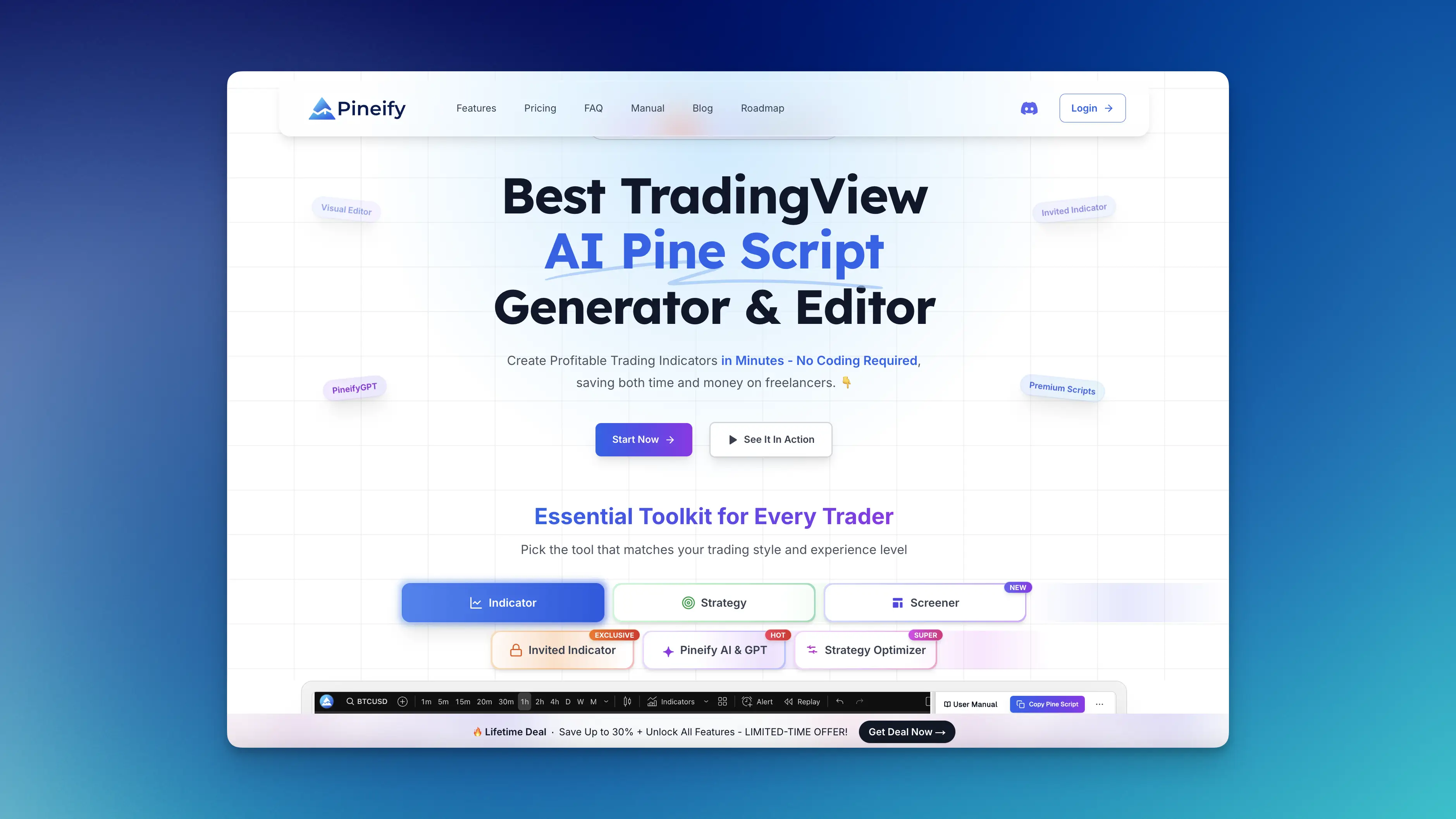
If you want to skip the coding learning curve, tools like Pineify make this process more accessible. The visual editor lets you build indicators and strategies using drag-and-drop components, and the AI Pine Script generator translates your ideas into error-free code in minutes. For common patterns like moving average crosses, RSI divergences, and volume breakouts, it works well. I haven't tested it against hand-written scripts for every edge case, but for most traders it gets the job done.
Getting Your Alerts to Actually Place Trades
TradingView's alert system has become quite capable. You can set an alert to trigger on complex conditions from your custom script, not just simple price moves.
The critical piece is the webhook. When your alert fires, it sends an HTTP message to a third-party automation service. That service places the trade with your broker in real time.
Services like TradersPost act as the middleman, connecting to brokers like Alpaca, TradeStation, and Interactive Brokers. I use TradersPost with my Alpaca account—the JSON payload mapping gives me full control over order parameters. Setup took about 20 minutes, and I've had zero missed signals in six months. The trade-off is their monthly fee, around $40 for the basic plan.
The Helpers That Connect the Dots
Since TradingView doesn't talk directly to most brokers, you need a bridge service. Here are the common ones:
| Service | How It Works |
|---|---|
| TradersPost | A dedicated webhook service that works with many brokers (Alpaca, TradeStation, Interactive Brokers, etc.). |
| AutoView | A browser extension that reads your TradingView alerts. Your TradingView tab needs to stay open and active. |
| TV-Hub | A feature-rich tool that lets you combine signals and offers advanced webhook customization. |
| SpeedBot | Focuses on fast execution of signals and includes monitoring tools for tweaking strategy parameters. |
If you want to see how pattern recognition feeds into automated signals, take a look at the All Chart Pattern indicator guide.
What Automated Trading Really Does for Your Workflow
Speed and Efficiency
Your trading idea hits, and instead of fumbling with your phone, the trade executes automatically. The system acts the instant your conditions are met. In fast markets, this can mean the difference between catching a breakout and watching it fly past.
No More Emotional Trading
We've all held a losing trade hoping it would turn around. Automated trading removes that impulse. The system follows the rules you gave it, regardless of market chaos or your last trade's result.
When I first automated a mean-reversion strategy on ETH/USDT last September, I kept wanting to override the signals during a volatile news event. The bot didn't hesitate. It took the losses it was supposed to take and profited on the ones that fit the model. I couldn't have done that manually.
Backtest Before You Risk Capital
TradingView lets you backtest your ideas against years of past market data. You can see how a strategy performs across different cycles, find its weak spots, and adjust before committing real money.
One thing I've learned the hard way: a backtest showing 80% win rate on EUR/USD might look very different on GBP/JPY. I test every strategy on at least three uncorrelated pairs before trusting the results. For more on this topic, see our backtesting best practices guide.
Run Your Trades 24/7
An automated system doesn't sleep or take breaks. It watches dozens of charts and places trades around the clock. This is especially useful for crypto markets that never close.
Risks and Challenges to Consider
Before you jump in, here are the roadblocks I've encountered.
The Trap of Over-Optimizing
You can make a strategy look perfect on paper by fitting it too tightly to past data. That's over-optimization. It backtests beautifully then fails in live trading.
I made this mistake with a volatility breakout script last year. The backtest showed a 2.3 profit factor on BTC/USD over 2023 data. In live trading, it lost 12% in the first month. The strategy was tuned to a volatility regime that didn't repeat.
Markets change. A strategy built during a calm low-volatility period can get destroyed by a surprise economic report or a sudden sentiment shift.
Relying on the Tech Stack
Automated trading depends on multiple systems cooperating. You need a stable internet connection, your broker's API needs to be available, and the exchange servers must be operational.
If any piece hiccups—say your broker's API goes down for five minutes—you could miss a trade or end up with an unintended open position. There's also latency between when TradingView sends an alert and when your broker acts. For high-frequency strategies, even 500 milliseconds matter.
I haven't tested SpeedBot or TV-Hub personally, so I can't vouch for their reliability. TradersPost has been solid for me, but I keep a manual fallback process for critical positions.
Subscription Tiers Matter
TradingView's free plan is fine for learning, but automation requires paid tiers. The Basic account only allows two active price alerts and doesn't support custom indicator alerts.
The paid plans give you the full automation toolset. Higher tiers like Premium offer hundreds of alerts and watchlist features for monitoring many symbols at once.
| Plan | Active Alerts | Indicator-Based Alerts | Watchlist Alerts |
|---|---|---|---|
| Basic | 2 | No | No |
| Premium | 400 | Yes | Yes |
Your Step-by-Step Guide to Automating Your Trading Strategy
Step 1: Define Your Trading Plan
Get your plan on paper. Be specific enough that there's no room for interpretation. Instead of "wait for a good entry," define exact conditions, stop-loss placement, and profit targets. Use hard numbers and measurable indicators.
Step 2: Code Your Pine Script Strategy
Open the Pine Script Editor in TradingView and translate your plan into code. Define variables, lay out entry and exit logic, and use strategy() to set starting capital and position sizing.
Step 3: Backtest and Optimize
Run your strategy on different timeframes and market conditions. Check the performance report for weaknesses. Tweak settings, but don't chase perfection. If you see 90%+ win rate in backtesting, your strategy is probably overfitted.
Step 4: Create Alert Conditions
Add alertcondition() functions in your Pine Script to define when TradingView notifies you. In the alert settings, choose your notification method and paste the webhook URL.
Step 5: Connect Your Broker
Sign up for a service that connects TradingView to your broker. They'll provide a unique webhook URL. Paste that URL into the alert you created.
Step 6: Monitor and Maintain
Your work isn't done once it's live. Check if real-time performance matches your backtest results. Never risk more than 1-2% of your account on a single trade. That rule has kept me in the game through some rough patches.
How to Set Up Your TradingView Automation for Success
Building an automated strategy is like learning to drive. You don't start on a racetrack—you start in a parking lot. Begin with simple strategies before attempting complex systems.
In my experience, simpler approaches hold up better when the market shifts. A single MA crossover with a volume filter has outperformed every multi-indicator system I've tested over the past two years.
Once you have a solid base, filter out weak signals. Set a minimum signal strength or require volume confirmation. This habit saves you from low-quality whipsaw trades.
Speed matters too. The bridge service connecting your TradingView script to your broker should be physically close to your exchange. Shorter distance means less network delay.
Finally, "set and forget" doesn't work here. Markets evolve constantly. Review your automation's performance monthly. And always keep the ability to step in manually. When news drops or a technical glitch hits, that manual override is your safety net.
Frequently Asked Questions
Can TradingView automatically place trades for me?
Not directly. TradingView acts as your strategy designer and alert system. It sends a webhook alert to a third-party service or compatible broker that places the actual trade.
Do I need a paid subscription to use automation features?
You can design strategies on the free plan, but running alerts for automation requires at least a Pro plan. For serious automation, the Premium plans give you up to 400 active alerts and watchlist features for tracking many symbols.
Can I set up automated trading without programming experience?
Yes. TradingView offers drag-and-drop strategy builders. For custom strategies, tools like Pineify generate Pine Script from your trading ideas without programming knowledge.
Which brokers can I connect to for automated trading?
You connect through an intermediary service. Popular brokers include Alpaca, TradeStation, Tradier, and Interactive Brokers. The exact options depend on which third-party connector you choose.
What risks should I watch out for with automated trading?
Over-optimization is the biggest risk—strategies tuned to past data often fail in live markets. Technical glitches cause missed trades. Poor risk management can blow up an account. Build stop-losses and position sizing into every strategy.
What is the difference between backtesting and forward testing?
Backtesting runs your strategy against historical data to estimate past performance. Forward testing (paper trading) runs it in real time with no real money. Both are essential before committing capital.
How do I choose the right automation service for TradingView?
Check broker compatibility first. Then compare pricing, supported order types, and execution speed. For volatile markets where latency matters, prioritize services with servers near your broker.
Your Next Steps
Ready to start automating? Here's a path that works.
Upgrade your TradingView account to at least a Pro subscription. This gives you the full alert system and indicator-based triggers.
Open the Pine Script Editor and start with something simple—a moving average crossover or an RSI-based strategy. The goal is to understand how alerts and webhooks connect, not to build a masterpiece on day one.
Pick a third-party automation service that works with your broker. Your choice depends on:
| Consideration | Why It Matters |
|---|---|
| Your Broker | The service must connect with your specific brokerage account. |
| Your Budget | Costs vary, so find one that fits your trading volume. |
| Technical Needs | Make sure it supports your alert types and order requirements. |
Always start with the service's demo account. Run through the entire workflow—create a strategy in TradingView, trigger the webhook, see the mock trade execute—without risking real money.
Browse the TradingView community forums. Other traders share Pine Script code, discuss what works, and highlight common pitfalls. Learning from those threads saved me weeks of trial and error.
When you go live, start small. Use conservative position sizes. Your first goal isn't profit—it's confirming the automation pipeline works reliably. Scale up gradually once you see consistent results.