

Trade and execution errors
These codes cover request prices, stops, volume, account state, quotes, order limits, permissions, and broker policy. Use the page for the returned number because the correct fix and retry rule differ.
MQL4 error diagnosis
MQL4 error codes identify runtime and trade failures recorded in _LastError. First check whether the API returned its documented failure value, then capture GetLastError immediately. Use the code to choose a specific diagnostic path instead of applying one generic retry.
#property strict

bool SelectTicket(const int ticket)
  {
   ResetLastError();
   bool selected = OrderSelect(ticket, SELECT_BY_TICKET);
   if(selected)
      return(true);

   int error_code = GetLastError();
   Print("OrderSelect failed. error=", error_code,
         " ticket=", ticket);
   return(false);
  }

void OnStart()
  {
   int ticket = -1;
   if(!SelectTicket(ticket))
      return;

   Print("Selected order ", OrderTicket());
}These codes cover request prices, stops, volume, account state, quotes, order limits, permissions, and broker policy. Use the page for the returned number because the correct fix and retry rule differ.
Runtime failures can stop calculations or indicate an invalid call. Preserve the failed API and arguments because the number alone may not identify the offending value.
These errors often depend on terminal settings, server policy, object lifecycle, the MT4 file sandbox, allowed URLs, or current connectivity. Source changes cannot override every external restriction.
Official MQL4 compilation error 112 means a double quotation mark was omitted. The official runtime table assigns internal error to 4024, so do not interpret “internal error 112” without first identifying whether the message came from MetaEditor or runtime logging.
The helper resets stale state, tests the OrderSelect return value, captures the error once on failure, and logs the ticket with the code.
An error number is not enough to validate a fix. Keep the failed API, arguments, terminal build, broker state, and exact timestamp with the diagnosis.
#property strict

bool SelectTicket(const int ticket)
  {
   ResetLastError();
   bool selected = OrderSelect(ticket, SELECT_BY_TICKET);
   if(selected)
      return(true);

   int error_code = GetLastError();
   Print("OrderSelect failed. error=", error_code,
         " ticket=", ticket);
   return(false);
  }

void OnStart()
  {
   int ticket = -1;
   if(!SelectTicket(ticket))
      return;

   Print("Selected order ", OrderTicket());
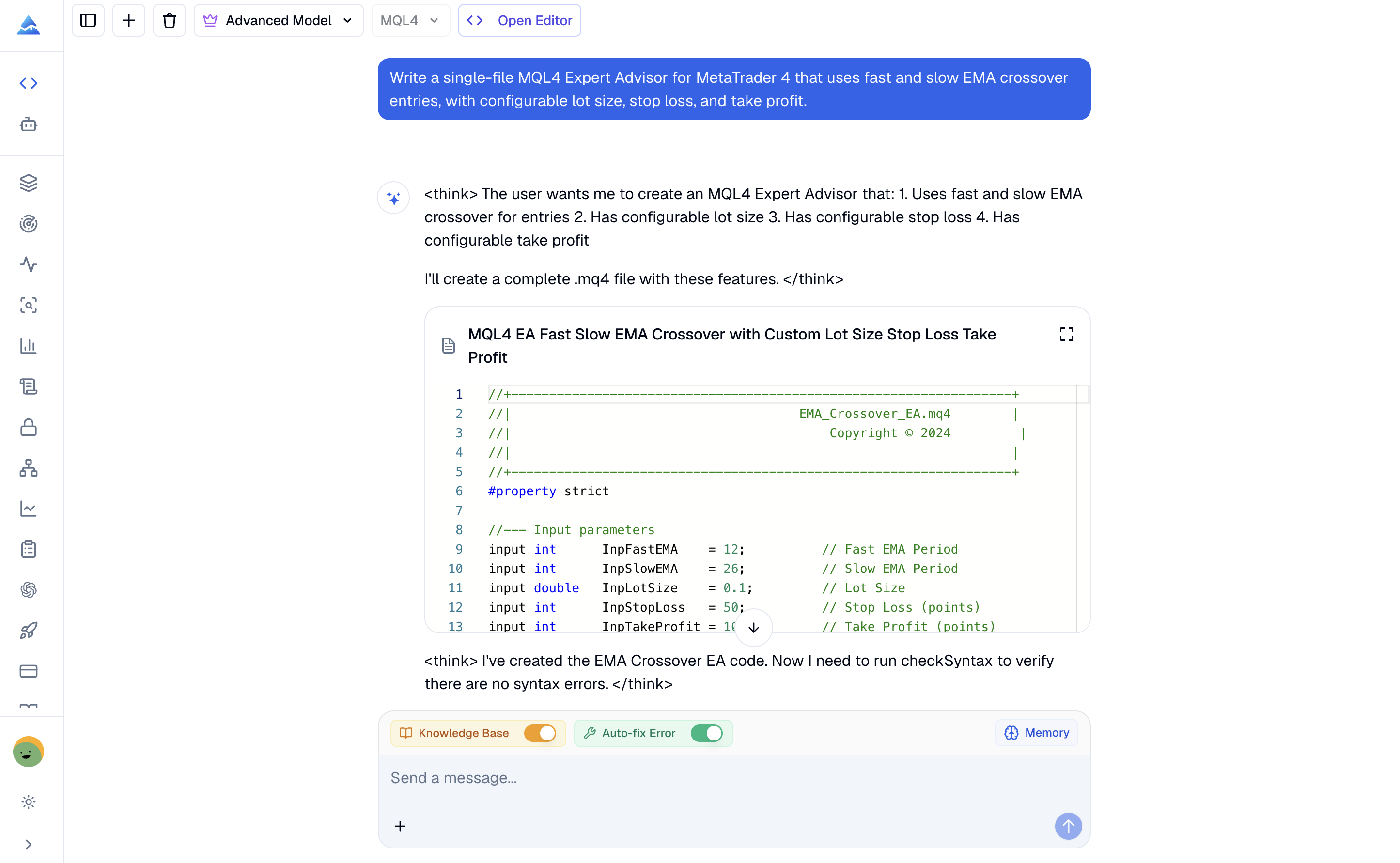
}Pineify can generate or revise one self-contained .mq4 file with MQL4-specific reference context. Its independent static checker returns MetaEditor diagnostics so you can repair source issues before testing in your own MT4 environment.
Open MQL4 Coding AgentStatic diagnostics do not prove runtime behavior, backtest results, broker compatibility, or live-trading safety.
Confirm its documented failure return value before using an error code.
Call GetLastError once at the failure point and keep the relevant arguments.
Use the official meaning to separate input, market, account, permission, runtime, and environment failures.
Compile and reproduce in the same terminal, broker, symbol, account, and market state.
Check the failed API result, call GetLastError immediately, then map the number through the official runtime error table.
Yes. It returns the current _LastError value and resets that stored value, so capture it once and keep it in a local variable.
No. MQL4 publishes separate compiler and runtime tables. Always identify where the message came from.
No. Invalid parameters need correction, permissions need a state change, and only some transient quote or busy-context failures justify bounded retries.
Pineify can revise a self-contained .mq4 file using the error, failed call, and relevant code. Runtime and broker evidence still comes from your MT4 environment.
Last verified against the linked official references on . Compile and test the final source in the MetaTrader 4 build, broker, symbol, and account environment you plan to use.
Define the requirement, inspect the generated source, repair diagnostics, and test the behavior in your own MT4 environment.
Open Coding Agent