MQL4 ERR_NO_ERROR

MQL4 error 0 means no error, not automatic success

MQL4 error 0 maps to ERR_NO_ERROR: no error returned. A zero error state does not replace the documented return value of the API you called. Capture GetLastError immediately after the failed call, correct the cause, and retry only when the condition can change.

ErrorStateDiagnostic.mq4.mq4
#property strict

void OnStart()
  {
   ResetLastError();
   bool selected = OrderSelect(-1, SELECT_BY_TICKET);
   if(!selected)
     {
      int error_code = GetLastError();
      Print("OrderSelect failed. error=", error_code);
      return;
     }

   Print("The call succeeded; no error should be inferred from stale state.");
  }
  • Official meaning: no error returned
  • Read the failed API return value first
  • Capture GetLastError immediately
  • Retry only when the condition can change

What MQL4 error 0 means

The official MQL4 runtime table names error 0 ERR_NO_ERROR and defines it as “no error returned.” A zero error state does not replace the documented return value of the API you called.

The error number is evidence about one failed call, not a diagnosis of the whole EA. Read the API sentinel first, then call GetLastError immediately because that function returns the current _LastError value and resets it.
Check these conditions before editing the strategy

Start with the inputs and external state that existed at the failure point. A later log entry or a successful call can overwrite the useful context.

  • The code calls GetLastError even though the API succeeded
  • The error was already reset or consumed by an earlier GetLastError call
  • The failing function does not report its result through _LastError alone
  • Logging occurs too late and loses the state from the failed operation

Fix the cause, then choose a retry policy

Error 0 alone gives no reason to retry. Use the actual API result and current state to decide the next action.

Keep the original trading and risk rules intact. A workaround that widens stops, increases volume, changes an account setting, or ignores a failed return value can hide the symptom while changing the system.

CheckAction
The code calls GetLastError even though the API succeededBranch on the function return value before checking the error state.
The error was already reset or consumed by an earlier GetLastError callCapture GetLastError once, immediately after a documented failure sentinel.
The failing function does not report its result through _LastError aloneRead the API contract to identify its success and failure values.
Logging occurs too late and loses the state from the failed operationLog the call, result, inputs, and error together at the failure point.

Review the complete example

The script checks OrderSelect first and reads the error only on failure. It does not treat a stale or zero error value as the operation result.

The example improves validation and logging. It does not prove the operation will be accepted by a broker or behave safely in live trading.

ErrorStateDiagnostic.mq4.mq4
#property strict

void OnStart()
  {
   ResetLastError();
   bool selected = OrderSelect(-1, SELECT_BY_TICKET);
   if(!selected)
     {
      int error_code = GetLastError();
      Print("OrderSelect failed. error=", error_code);
      return;
     }

   Print("The call succeeded; no error should be inferred from stale state.");
  }
Where Pineify fits

Move from the rule to editable MQL4 source

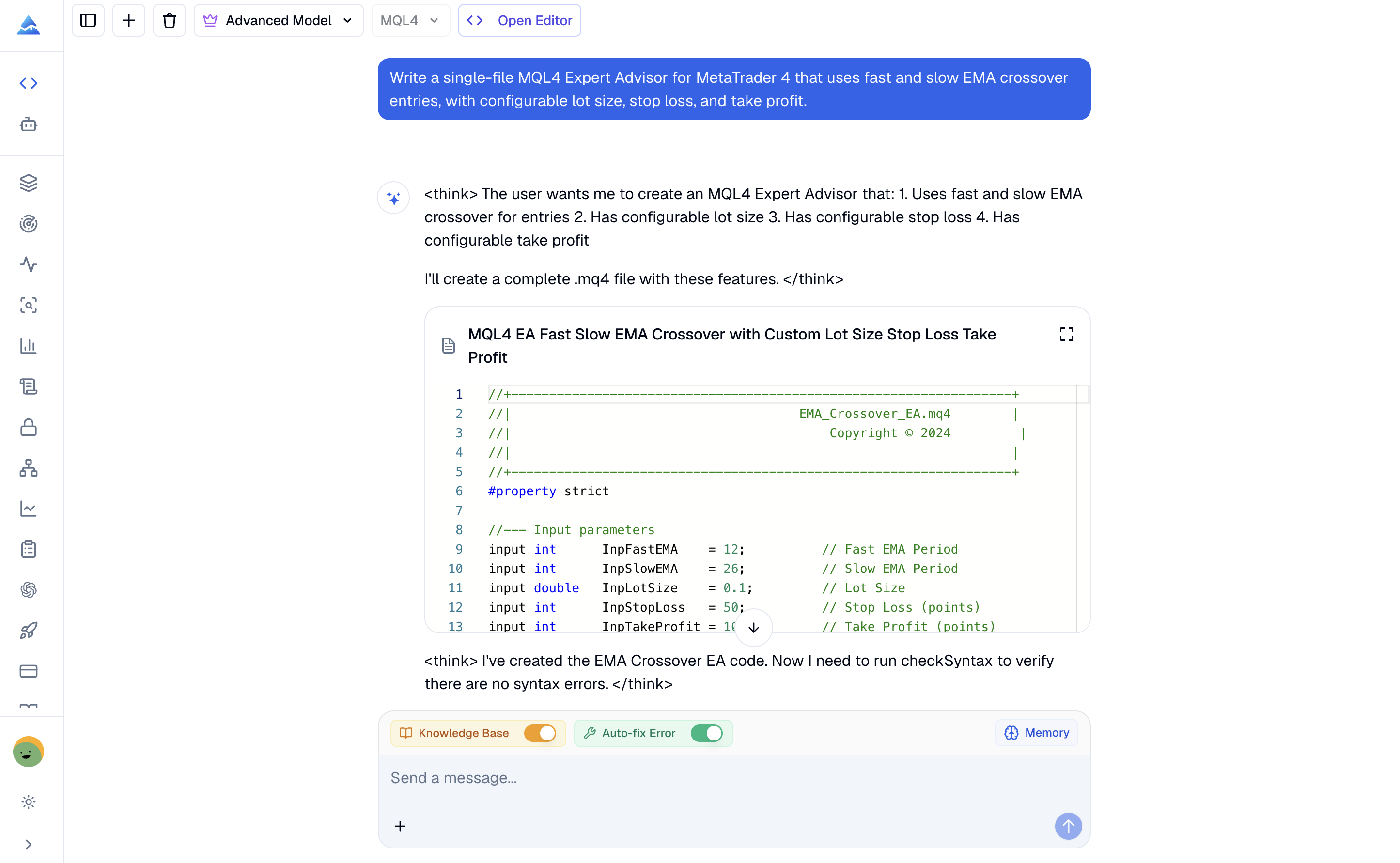
Pineify can generate or revise one self-contained .mq4 file with MQL4-specific reference context. Its independent static checker returns MetaEditor diagnostics so you can repair source issues before testing in your own MT4 environment.

Open MQL4 Coding Agent

Static diagnostics do not prove runtime behavior, backtest results, broker compatibility, or live-trading safety.

Pineify MQL4 Coding Agent with MQL4 selected and an editable MetaTrader 4 code artifact

A practical workflow

  1. 1

    Confirm the failed call

    Check the API return value before interpreting an error number from the log.

  2. 2

    Capture the error once

    Call GetLastError immediately and record error 0, symbol, prices, volume, ticket, and terminal state relevant to the operation.

  3. 3

    Correct the triggering condition

    Branch on the function return value before checking the error state.

  4. 4

    Retest in the target environment

    Compile the revised source, then test with the same MT4 build, broker, symbol, account permissions, and market state.

Frequently asked questions

What does MQL4 error 0 mean?

ERR_NO_ERROR means no error returned. The code should still identify which API returned failure and log the inputs used for that call.

What usually causes MQL4 error 0?

The code calls GetLastError even though the API succeeded The error was already reset or consumed by an earlier GetLastError call The failing function does not report its result through _LastError alone Logging occurs too late and loses the state from the failed operation

Should an EA retry after error 0?

Error 0 alone gives no reason to retry. Use the actual API result and current state to decide the next action.

Why should GetLastError be called immediately?

It reports the current _LastError value and resets it. Other operations can change the error state, so a delayed read may describe the wrong call.

Can Pineify fix MQL4 error 0?

Pineify can revise a self-contained .mq4 file, add validation and error logging, and return static MetaEditor diagnostics. It cannot prove broker acceptance, account permissions, market availability, or live execution.

Last verified against the linked official references on . Compile and test the final source in the MetaTrader 4 build, broker, symbol, and account environment you plan to use.

Continue with one reviewable MQL4 file

Define the requirement, inspect the generated source, repair diagnostics, and test the behavior in your own MT4 environment.

Open Coding Agent