MQL4 error diagnosis

Error handling in MQL4: preserve the failed call

Reliable error handling in MQL4 starts with the function contract: test the return value, capture GetLastError immediately on failure, log the inputs and external state, then choose a code-specific action. Resetting errors blindly or retrying every failure produces misleading logs and unsafe loops.

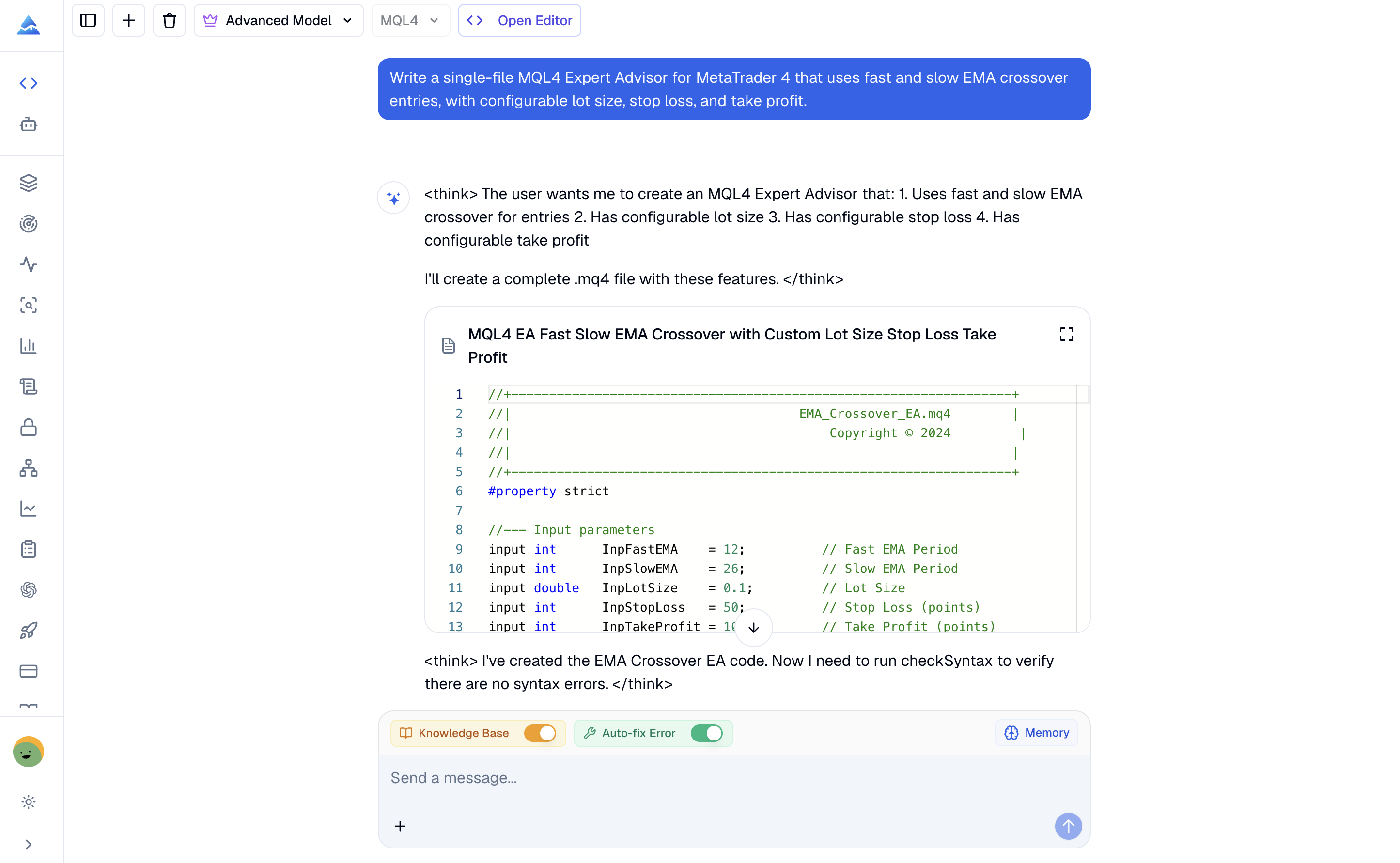
Open the Coding Agent, then choose MQL4 from the language menu.

ErrorHandlingPattern.mq4.mq4
#property strict

bool SelectTicket(const int ticket)
  {
   ResetLastError();
   bool selected = OrderSelect(ticket, SELECT_BY_TICKET);
   if(selected)
      return(true);

   int error_code = GetLastError();
   Print("OrderSelect failed. error=", error_code,
         " ticket=", ticket);
   return(false);
  }

void OnStart()
  {
   int ticket = -1;
   if(!SelectTicket(ticket))
      return;

   Print("Selected order ", OrderTicket());
  }
  • Test the API result first
  • Capture one error immediately
  • Log inputs with external state
  • Fail closed after bounded retries

Return values are the primary result

MQL4 APIs use different failure sentinels: OrderSend returns -1, FileOpen returns INVALID_HANDLE, and many operations return false. _LastError is supporting context after a failure, not a substitute for the return value.

A stale error can survive from an earlier operation. ResetLastError is useful immediately before a call when zero is also a possible successful value, but it should not replace a result check.
Build one diagnostic record at the failure point

Record the function, result, error, important arguments, symbol, ticket, terminal build, server time, and relevant external state in one message. Keep secrets and personal data out of logs.

  • Capture GetLastError before another API changes it
  • Store the code in a local variable before formatting logs
  • Use a stable event or correlation id for multi-step work
  • Throttle repeated messages so the first failure stays visible

Map failure classes to explicit actions

Invalid inputs should fail fast. A closed market or disabled permission should stop until state changes. Requotes, off quotes, and a busy trade context may receive a small retry budget with refreshed state and delay.

Cleanup belongs in the owning lifecycle. Close valid file handles, delete only owned objects, and do not start new trading work during deinitialization.

Review the complete example

The wrapper checks the documented boolean return, stores GetLastError once, and logs the ticket that caused the failure. Other API wrappers should follow their own return contracts.

Logging and retries can create their own faults. Avoid credentials in logs, cap repeated messages, and never use an unbounded trade retry loop.

ErrorHandlingPattern.mq4.mq4
#property strict

bool SelectTicket(const int ticket)
  {
   ResetLastError();
   bool selected = OrderSelect(ticket, SELECT_BY_TICKET);
   if(selected)
      return(true);

   int error_code = GetLastError();
   Print("OrderSelect failed. error=", error_code,
         " ticket=", ticket);
   return(false);
  }

void OnStart()
  {
   int ticket = -1;
   if(!SelectTicket(ticket))
      return;

   Print("Selected order ", OrderTicket());
  }
Where Pineify fits

Move from the rule to editable MQL4 source

Pineify can generate or revise one self-contained .mq4 file with MQL4-specific reference context. Its independent static checker returns MetaEditor diagnostics so you can repair source issues before testing in your own MT4 environment.

Open MQL4 Coding Agent

Static diagnostics do not prove runtime behavior, backtest results, broker compatibility, or live-trading safety.

Pineify MQL4 Coding Agent with MQL4 selected and an editable MetaTrader 4 code artifact

A practical workflow

  1. 1

    Read the API contract

    Identify success, failure sentinel, error-state behavior, and resource ownership.

  2. 2

    Wrap one operation

    Test the return and capture the immediate error with the call arguments.

  3. 3

    Choose an action table

    Define correct, wait, retry, stop, alert, or clean-up behavior for each expected class.

  4. 4

    Test failure paths

    Reproduce invalid inputs and unavailable external states without risking a live account.

Frequently asked questions

What is the correct GetLastError pattern in MQL4?

Test the API result, call GetLastError immediately on failure, store the number once, and log it with the relevant arguments.

Should I call ResetLastError before every function?

No. Use it when the API contract and diagnosis need a clean error state, especially when a successful result can be zero. Always check the return value.

Why is my MQL4 error log always zero?

The error may be read after another call, already consumed, or unrelated because the primary return value was not checked.

How should MQL4 retry a failed trade?

Use an error-specific attempt and time limit, refresh state, recheck the signal, and stop when the failure is not transient.

Can a static checker test error handling?

It can catch source diagnostics and help review control flow. It cannot reproduce broker, network, market, file, or account failures.

Last verified against the linked official references on . Compile and test the final source in the MetaTrader 4 build, broker, symbol, and account environment you plan to use.

Continue with one reviewable MQL4 file

Define the requirement, inspect the generated source, repair diagnostics, and test the behavior in your own MT4 environment.

Open Coding Agent