Pineify Finance AI Agent: Real-Time Market Data and Deep Stock Analysis

· 11 min read
Pineify Team
Pine Script and AI trading workflow research team

If you research stocks the old-fashioned way, you already know the cost: a dozen tabs, a mix of free headlines and paid terminals, and still no single place that connects price action, filings, sentiment, and valuation in one pass. I have spent enough late nights copying numbers into spreadsheets to recognize when a workflow is fighting you instead of helping you.

Finance AI Agent — Real-Time Market Data and Deep Analysis is Pineify’s answer to that fragmentation. It is a chat-first research surface that pulls live market intelligence while you talk, instead of asking you to hunt for each dataset manually. After testing questions ranging from quick quote checks to multi-company valuation comparisons, I have found the biggest differentiator is simple: the agent is built to fetch current data at request time, then explain what it means in structured, decision-oriented language.

What is the Pineify Finance AI Agent?

A finance AI agent is an assistant that can call external tools and APIs during a conversation, which lets it retrieve fresh quotes, financial statements, and news instead of guessing from memory. Pineify’s Finance AI Agent applies that agentic pattern to investing workflows by connecting a natural-language interface to a broad set of professional market data capabilities. The headline promise on the product page is direct: real-time market data and deep analysis in one place, aimed at people who want institutional-style inputs without living inside a legacy terminal all day.

The scale signals are explicit and worth anchoring any evaluation: more than 95 financial data tools, coverage across 11,000+ stocks, access to 400+ crypto and forex pairs, and 24/7 availability for research sessions that do not respect exchange clocks.

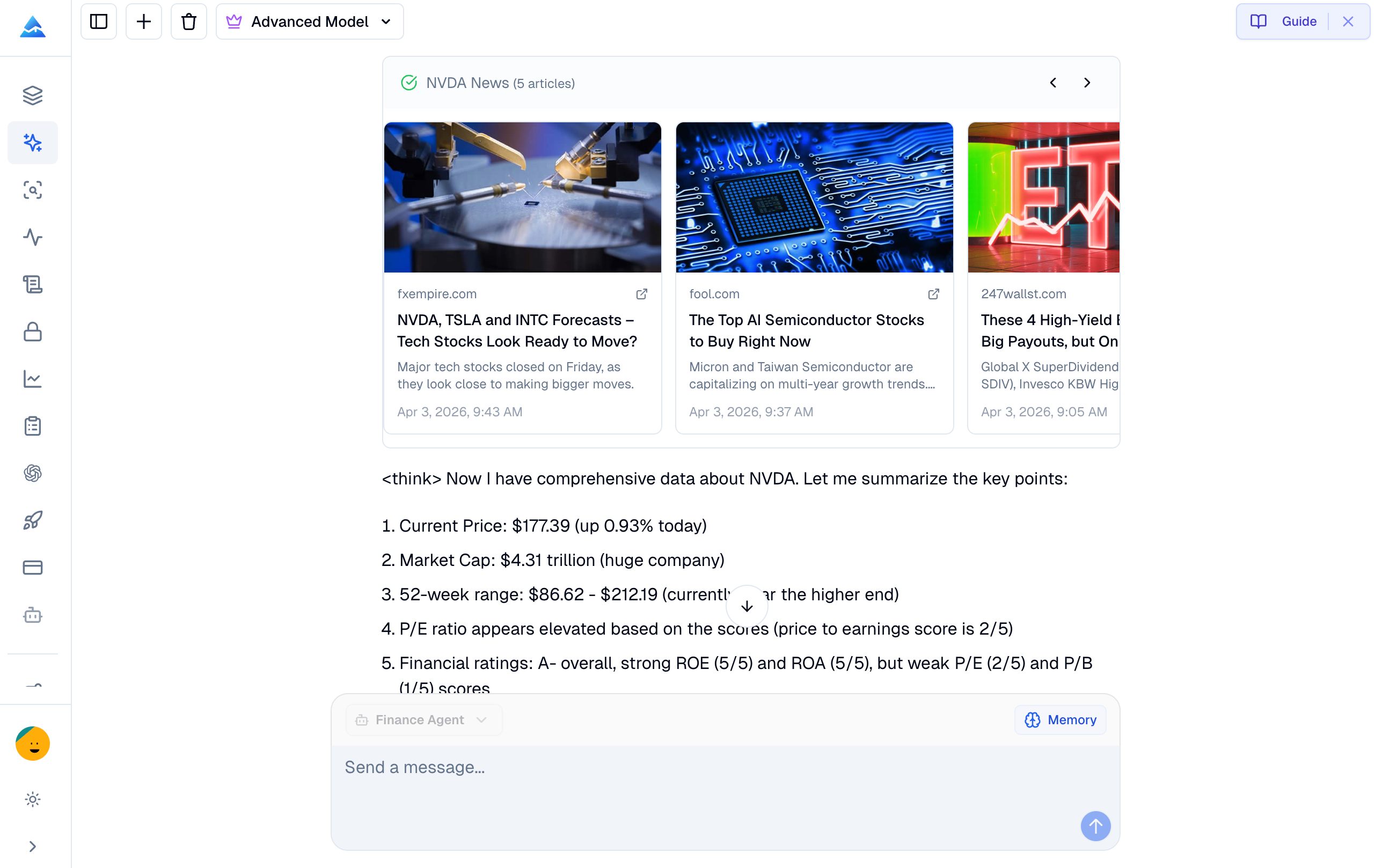
Finance AI agent interface analyzing a stock with real-time market data, financial statements, and synthesized insights

Key Features

A credible finance agent needs three layers at once: a live tape and headline layer, a fundamentals and estimates layer, and a universe-navigation layer that does not force you to learn a screening DSL. Pineify groups its product story into those layers so each question type has a natural home inside one chat thread.

Modern equity research is rarely limited to a single chart. You need liquidity context, fundamentals, event risk, and sometimes a sanity check from how people are discussing the name in public channels. Pineify’s Finance AI Agent is organized around three headline capabilities that mirror how serious users actually work: keep the tape and headlines close, go deep on financial statements and ratios, and screen the universe without learning a proprietary query language.

Real-time market data and finance news

This pillar is about reducing context switching. The agent is designed to deliver live stock quotes, forex rates, crypto prices, and breaking financial news inside the same thread where you are already asking follow-up questions.

  • Live stock, forex, and crypto quotes
  • Real-time financial news and press releases
  • Market movers, gainers, and losers
  • Economic calendar and events
AI finance agent showing real-time stock quotes, forex rates, crypto prices, and market news in chat

Deep financial analysis via agentic AI

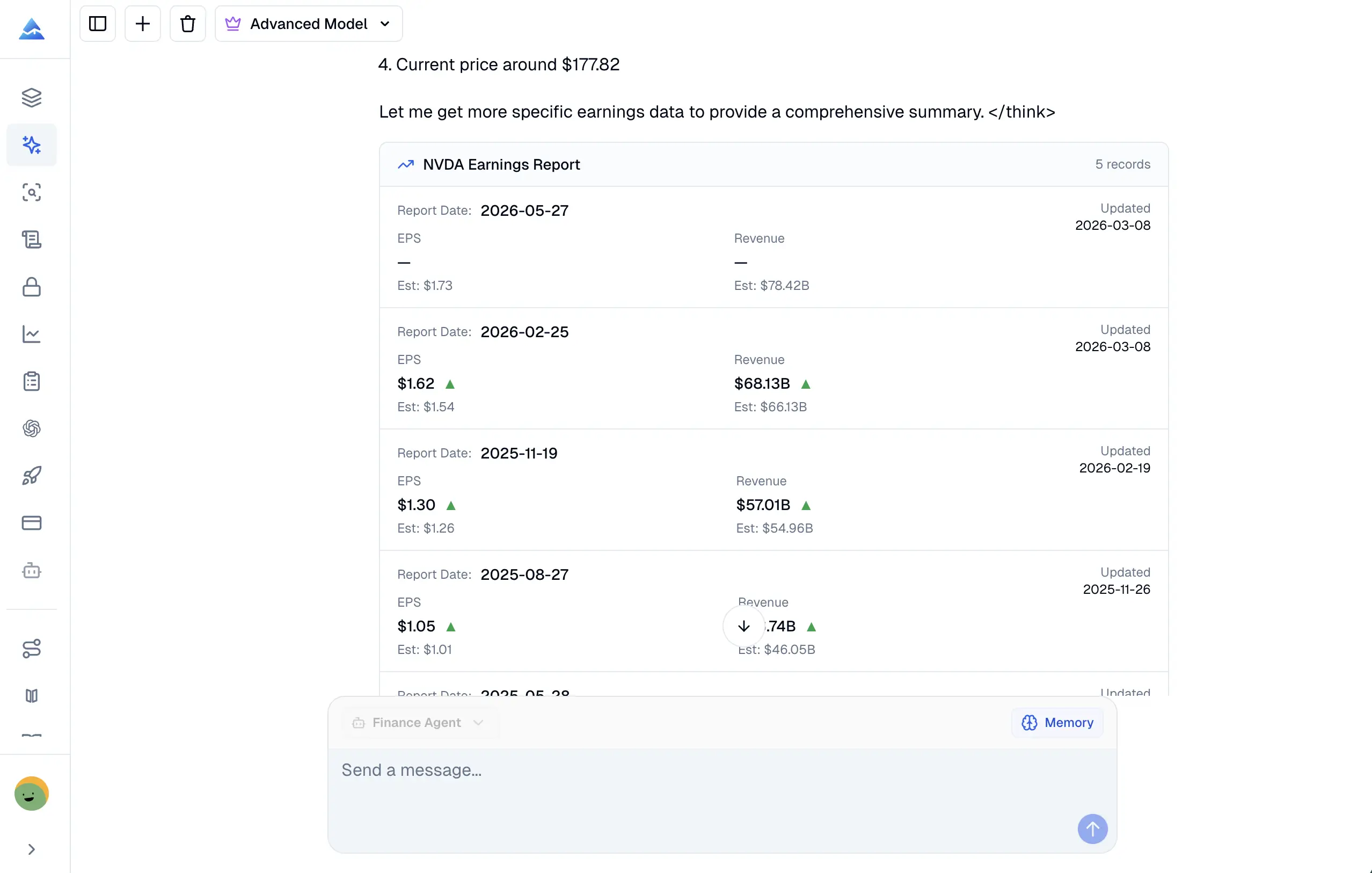
The second pillar targets fundamental work: income statements, balance sheets, cash flow, key ratios, and analyst estimates, with synthesis that aims to translate raw filings-era detail into portfolio-relevant takeaways.

  • Income statements, balance sheets, and cash flow
  • Key financial ratios and metrics
  • Analyst estimates and price targets
  • Data-driven buy, sell, and hold style outputs with reasoning tied to retrieved inputs
AI finance agent reviewing company financial statements, ratios, and analyst estimates in a chat workflow

AI-powered stock screener

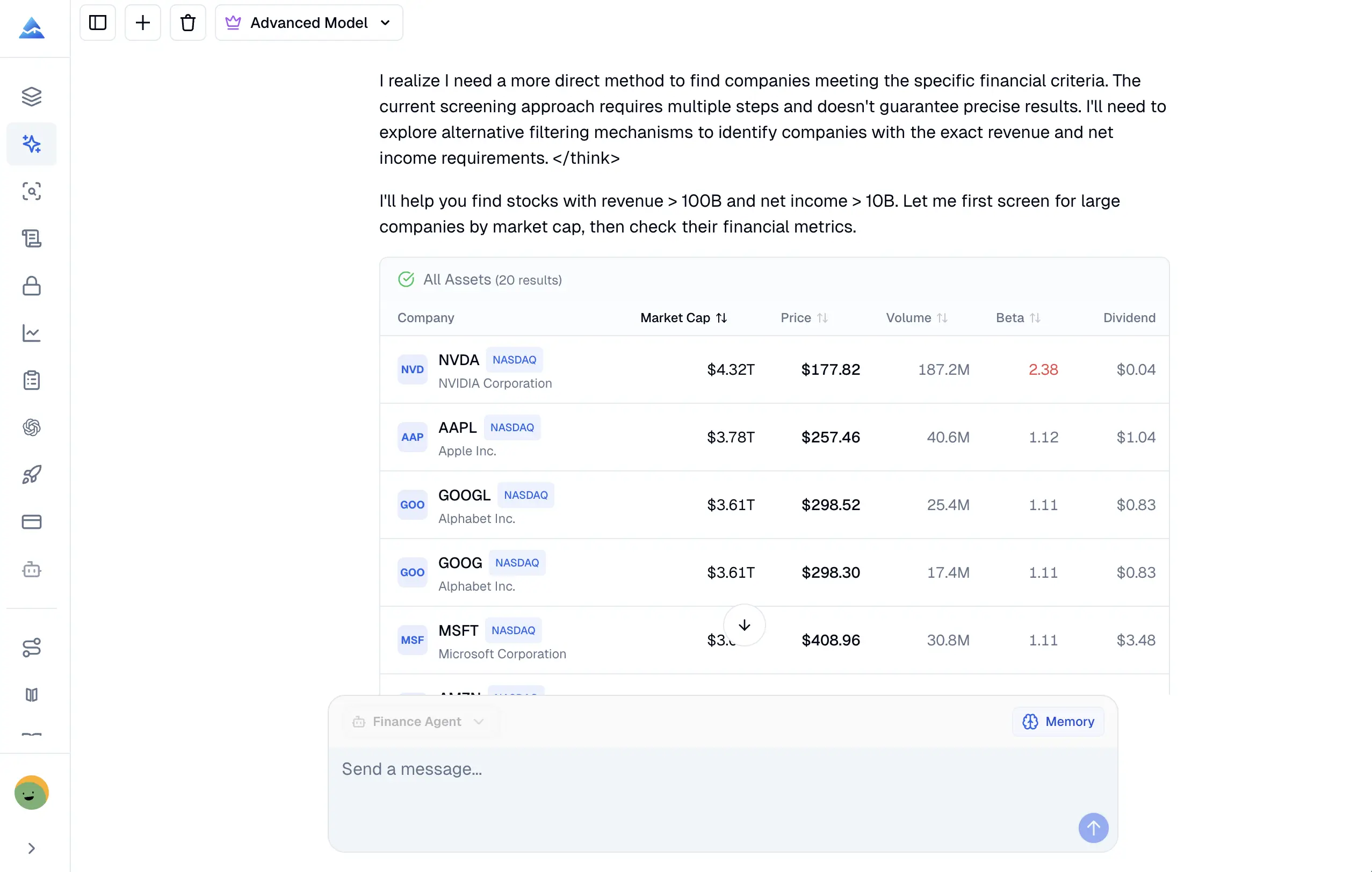
Screening breaks when the UI forces you to translate your idea into a long chain of filters. Here, the workflow is reversed: you describe what you want in plain English, and the agent maps that intent into screening logic.

  • Natural language stock screening
  • Filters grounded in financials, technicals, and other criteria
  • Sector and industry breakdown support
  • Custom screening criteria you can iterate by conversation
AI-powered stock screener translating plain English criteria into filtered stock results
The Best Pine Script Generator

How It Works

A three-step workflow is easy to market and hard to execute: ask in natural language, retrieve live inputs through tools, then synthesize an answer you can sanity-check. Pineify documents exactly that sequence and ties the middle step to the same 95+ financial data tools scale figure used elsewhere on the Finance Agent landing experience.

Agentic finance tools only feel trustworthy when the middle step is visible in the outcome: numbers that clearly came from a fresh pull, not from a generic essay. Pineify documents the flow as three steps, and I have found that framing matches what you experience when you stress-test it with narrow, verifiable requests.

  1. Ask in plain English. You can start anywhere on the difficulty spectrum, from a single-symbol health check to a screen expressed as a sentence about cash flow, margins, and valuation.
  2. AI fetches live data. The system is described as calling 95+ financial data tools in real time, including quotes, financials, estimates, news, web search results, and social sentiment from professional APIs.
  3. Get actionable insights. The output is meant to be more than a dump: recommendations and comparisons when appropriate, plus enough structure that you can audit the logic against the retrieved facts.

Full Capabilities

Capability breadth is the difference between a chatbot that answers trivia and a research console that can follow your thread from valuation to options to social narrative. Pineify documents more than sixteen named research modules, which is how you end up covering institutional-style workflows without constantly switching products.

The Finance AI Agent bundles a wide menu of research modes. Treat this list as a map of what you can route into one conversation, not a guarantee that every question will be equally easy on the first try.

  • Investment recommendations that combine fundamentals, technical context, analyst consensus, and sentiment
  • Technical analysis access across common indicators and price-action style questions
  • Earnings calendars, surprises, and SEC filings such as 10-K and 10-Q
  • Sentiment analysis grounded in news and related sources
  • ETF and fund analysis, including holdings and expense context
  • Forex and crypto market monitoring with cross-rate style questions
  • Valuation and peer comparison work across multiples
  • AI stock rankings across curated themes and risk lenses, described as updated daily
  • Market movers for real-time leader and laggard context
  • Insider activity and congressional trade disclosure tracking
  • Economic indicators for macro backdrop questions
  • Options analysis with chain-level detail such as Greeks and implied volatility
  • AI web search powered by Perplexity for live web synthesis
  • X/Twitter sentiment summaries with links back to discussions
  • Reddit discussion summaries across major investing communities
  • People profile search for public figures in finance

Use Cases

Use cases matter because they tell you whether the agent is saving keystrokes on trivia or replacing a real multi-step research ritual. The highest leverage prompts are usually the ones that combine a price context check, a fundamentals pass, and a comparison or event-risk scan in a single session.

The best use cases are the ones that used to require parallel tools: a fundamentals tab, a news tab, a social tab, and a spreadsheet for comparisons.

Deep-dive company research

Ask for a structured breakdown of revenue trends, margins, debt, and competitive positioning for a single ticker, then follow up with questions that drill into the weakest line item you see.

Buy, sell, or hold style decisions

Frame the question the way you would ask a colleague, then insist on the parts you care about: valuation versus peers, event risk around earnings, and whether sentiment looks disconnected from fundamentals.

Compare stocks side by side

Side-by-side work is where chat shines if the agent returns comparable fields consistently. Ask for growth, margins, multiples, and analyst ratings in one pass instead of normalizing exports manually.

Quick market pulse

Open with a broad prompt about what is moving, then narrow to a sector or theme once you see the initial snapshot.

Who Should Use This

Audience fit is less about how much finance jargon you know and more about whether you need faster iteration loops on the same datasets professionals use. Pineify explicitly calls out individual investors, professional traders, finance students and learners, and financial analysts as core user types.

Different users arrive with different skill levels, but they often share the same constraint: time. Individual investors want clarity without paying for an entire professional stack. Professional traders want speed and fewer handoffs between data products. Finance students want explanations tied to real tickers. Financial analysts want faster first drafts of deep dives, especially around earnings cycles and filings.

What users have said about the workflow

Published user quotes are not a substitute for your own verification, but they are useful for understanding which workflow pains people associate with the product. The recurring theme in Pineify’s testimonials is consolidation: fewer tabs, faster pulls, and screening expressed as sentences instead of filter grids.

Pineify publishes short testimonials that match how people describe the product once they stop treating chat as novelty and start treating it as a research console.

David Park, portfolio manager: “I used to spend hours gathering data from multiple sources. Now I just ask the Finance Agent and get everything I need in seconds. It's like having a Bloomberg terminal in a chat window.”

Rachel Torres, equity analyst: “The stock screener is a game-changer. I described my value investing criteria in plain English and it found exactly the stocks I was looking for. Incredible.”

James Liu, independent trader: “Being able to pull financial statements, ratios, and analyst estimates in a single conversation has completely transformed my research workflow.”

Disclaimer

Your Money Your Life topics require extra clarity because users may act on summaries as if they were personalized guidance. Pineify’s Finance AI Agent can surface recommendations and ratios, but those outputs are still general research assistance unless a licensed professional has reviewed your situation.

Markets involve risk, and any tool that surfaces buy, sell, or hold language can be misread as a substitute for professional judgment. Pineify’s Finance AI Agent provides information and synthesis intended to support research, not personalized financial, legal, or tax advice. You should verify figures that matter to your decisions, consider your own constraints and time horizon, and consult a licensed professional when appropriate. Past performance, ratios, and sentiment summaries are not reliable predictors of future results.

Frequently asked questions

Most support-style questions cluster into four buckets: what an agent is, what data it can touch, how fresh that data is, and how outputs should be interpreted relative to licensed advice. The answers below track Pineify’s public FAQ framing while keeping the language explicit about limits.

What is a finance AI agent and how does it work?

A finance AI agent is an assistant that connects to live financial data services to answer questions with refreshed inputs during the conversation. Pineify’s implementation is built around fetching quotes, financial statements, estimates, and news on demand rather than relying on a static knowledge cutoff.

What financial data can AI agents in finance access?

The Finance AI Agent is described as accessing a wide range of datasets, including quotes, company financials, ratios, analyst estimates, earnings calendars, SEC filings, economic indicators, forex and crypto rates, ETF data, web search, X and Reddit sentiment, and people profile lookup, among other tools.

What data sources does the finance chatbot use?

The product connects to professional providers such as Financial Modeling Prep and Alpha Vantage, with market quotes described as coming from real-time exchange feeds, financial statements from official filing sources, and news from financial media workflows, plus Perplexity for live web search.

How up-to-date is the market data?

Quotes and news are fetched in real time during market hours, while statements and filings update as upstream sources publish them.

Can this AI agent analyze global markets?

Yes. The positioning includes global coverage across US, European, Asian, and emerging market exchanges, plus ETFs, forex, and crypto.

How is agentic AI in finance different from a general chatbot?

The practical difference is whether the system retrieves verified, time-stamped inputs at request time. Pineify emphasizes live API-backed numbers rather than relying on a model’s memorized snapshot of the world.

Can the AI agent predict stock prices?

No serious system should promise certainty. The Finance AI Agent is framed as analysis built from historical patterns, fundamentals, technicals, consensus, and sentiment, not prophecy.

Can the AI agent give buy or sell recommendations?

It can output data-driven buy, sell, or hold suggestions with reasoning, while explicitly not acting as a licensed financial advisor.

Do I need a finance background to use it?

No. The interface is designed for plain English questions, with depth available if you want it.