AlgoAlpha TradingView: Professional Indicators and Trading Strategies

AlgoAlpha TradingView is a suite of trading indicators designed to give retail traders institutional-grade market analysis. With over 42,700 followers and more than 100 published scripts, it is one of the more popular indicator collections on the platform. Instead of relying on conventional lagging oscillators, AlgoAlpha uses Z-score normalization and liquidity tracking to show what institutional money is doing.
I've been testing these indicators for about three months, mostly on SPY, NVDA, and Bitcoin. The Zero-Lag Trend Signals caught an NVDA reversal on March 12 that standard EMAs missed by a full five bars. I prefer them over traditional moving averages for trend-following, but they do generate more false signals in choppy markets. I haven't tried the premium Unfair Advantage Pack yet, but the free tools on their TradingView profile already cover a lot for my swing trading.
What is AlgoAlpha TradingView?
AlgoAlpha is a collection of specialized trading tools built into TradingView. It provides custom indicators that scan for setups automatically, generate signals, and let you test strategies on historical data.
The goal is to cut through market noise. Instead of basic moving averages, these tools track where large money flows and analyze key price levels. They combine multi-timeframe analysis with momentum math to present clear signals on your chart.
Whether you scalp quick moves or swing trade positions over days, the indicators stay visual and straightforward. That helps take some emotion out of your trading decisions.
Core AlgoAlpha TradingView Indicators
Smart Money Volume Activity Indicator
Ever wonder what the big players are doing? The Smart Money Volume Activity indicator shows the difference between institutional trader activity and regular retail trading.
It works by analyzing volume on smaller timeframes and using Z-score statistics to spot unusual bursts of buying or selling. When these spikes appear, the pros are usually making a move.
Here's what you get:
- Volume classification that shows whether activity is from smart money or retail traders, based on candle structure.
- Horizontal lines marking where heavy volume clusters occurred.
- A live table tracking who is winning — smart money or retail.
- Real-time alerts for detected smart money or retail buy/sell events.
Bright bubbles pop up on these events. The bigger the bubble, the more significant the volume spike. When the table stays green with smart money in control, it gives you extra confidence to take the trade.
Momentum Trail Oscillator
This tool shows when a price move is gaining or losing steam. The Momentum Trail Oscillator sits below your main chart, swinging between set levels with clear overbought and oversold zones.
It's visual and easy to read:
- Color fills in when momentum hits extreme levels (+30/+40 and -30/-40).
- Small circles mark where momentum starts to reverse.
- Arrows can appear on your main chart for potential reversal points.
- It works better when paired with volume analysis.
Think of it as a filter that helps you focus on higher-probability setups.
Zero-Lag Trend Signals
Standard moving averages often lag. This indicator uses ZLEMA (Zero-Lag Exponential Moving Average), designed to react faster to price changes. The goal is to get you closer to the start of a trend, not after half the move has already happened.
It works well for spotting trend reversals or jumping in on pullbacks within a larger trend. Pair it with other momentum tools for a fuller picture.
Alpha Schaff Indicator
The Alpha Schaff is a modified take on the Schaff Trend Cycle. It combines several moving averages and oscillators into one line. Its main job is spotting trend changes and measuring trend strength.
How to read it:
- The line changes color to signal a shift — purple for bullish, white for bearish.
- Arrows point up or down at reversal points.
- The space between the indicator line and its source shows volatility.
- You can set alerts for specific buy or sell conditions.
Colors, arrows, and volatility measurement make it stand out from standard indicators.
Advanced Features and Tools
Strategy Builder and Backtesting
AlgoAlpha's Strategy Builder works like building blocks for trading ideas. You piece together entry and exit rules, then run a simulation — no coding required.
Mix and match different signals, line them up in order, and run the backtest. The system factors in leverage and margin so you get a realistic risk picture.
You can set up to five steps for entries and five for exits, using AND/OR logic to connect them. That works well for multi-layered strategies where you wait for several confirmations.
Here's a closer look:
- Flexible Exits: Multi-step triggers for closing longs and shorts, including take-profit and stop-loss levels.
- Smart Position Sizing: Risk a fixed amount or account percentage — position size is calculated before leverage applies.
- Realistic Risk Checks: See your simulated liquidation price to understand where a margin trade would fail.
- Clear Performance Dashboard: Strategy status, warnings, and key metrics in one table.
- Deep Analysis: Plugs into TradingView's backtester for a detailed performance breakdown.
One thing I like: if your rules don't line up correctly, the system won't place the trade. That prevents simple mistakes.
Premium Indicator Suite
For traders wanting more, AlgoAlpha offers a curated collection of institutional-grade tools.
The Smart Signal Assistant doesn't throw every indicator at you. It synthesizes several tools into one cleaner signal.
ILPAC (Institutional Liquidity and Price Action Concepts) helps spot institutional footprints — the market structure and order flow patterns most retail traders miss.
Momentum Concepts coordinates signals across timeframes, spots reversals, and uses algorithms to gauge trend strength.
Trading Signal Services
Scalping Signals
If you trade quick moves, the scalping signals provide short-term, high-frequency alerts for getting in and out rapidly. They're tuned for small timeframes and work across forex, indices, and crypto.
These signals spot fast price jumps and momentum shifts. You need to keep a close eye on the markets and execute without delay.
Swing Trading Signals
Not everyone watches charts all day. The swing trading signals focus on medium to long-term opportunities, with trades lasting days or weeks.
A weekly market analysis comes with the subscription, breaking down the bigger picture. The goal is positioning for sustained trends rather than reacting to every tick.
How to Get Started with AlgoAlpha TradingView
Step 1: Access the Platform
Head to AlgoAlpha's TradingView profile. You'll find 108 published scripts and indicators there. Follow their account for notifications about new tools. For the full premium suite, visit algoalpha.io.
Step 2: Choose Your Indicators
The right indicator depends on your trading style. Here's a quick guide:
| Trading Style | Recommended Indicators |
|---|---|
| Day Traders & Scalpers | Smart Money Volume Activity, Zero-Lag Trend Signals |
| Swing Traders | Momentum Trail Oscillator, Alpha Schaff |
Step 3: Configure Your Settings
Each indicator comes with adjustable settings for sensitivity, timeframe, and chart appearance. With the Smart Money Volume Activity indicator, for instance, you can raise the Z-score threshold to filter out minor noise and focus on significant institutional moves.
Step 4: Backtest Your Strategy
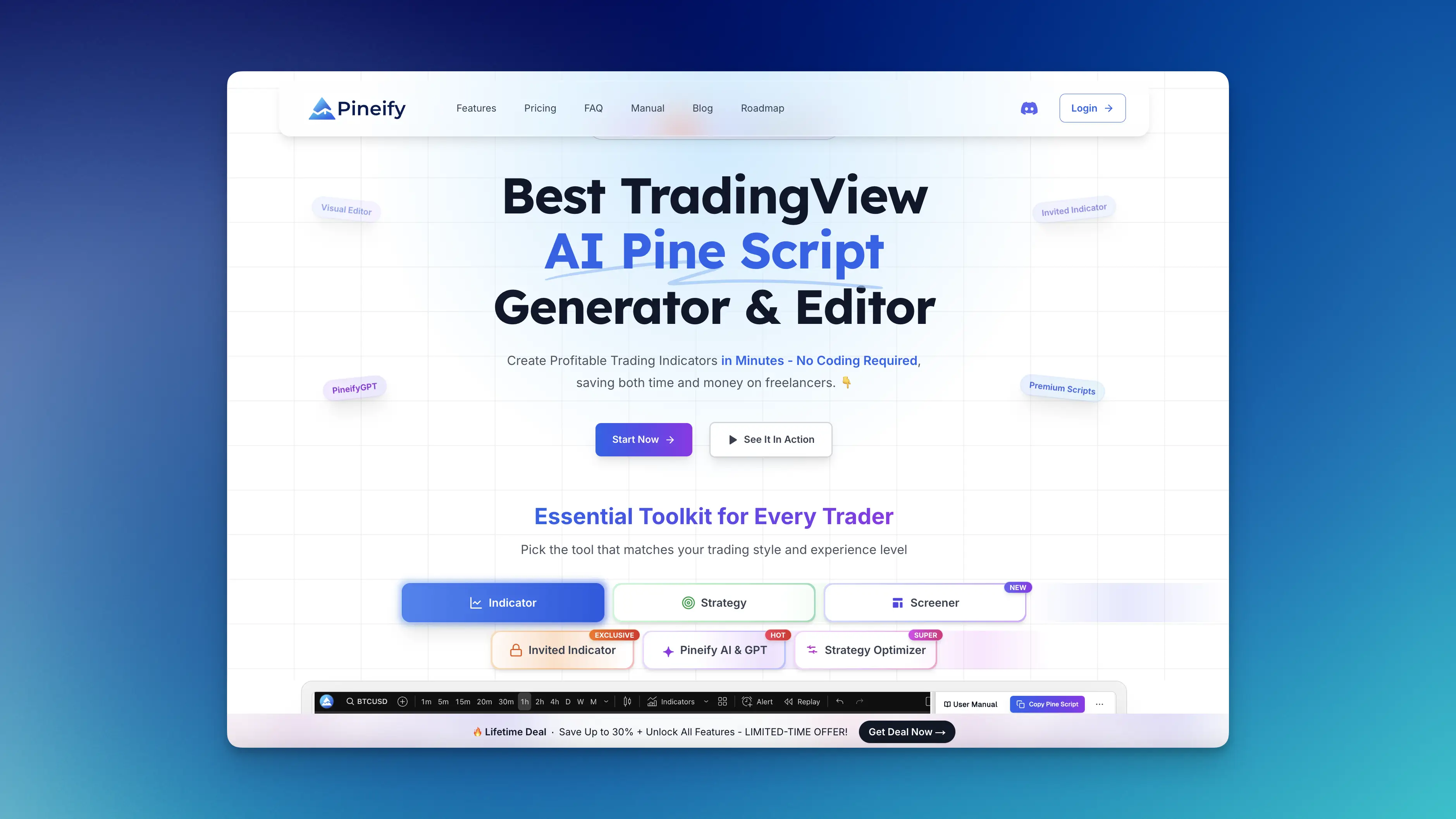
Before committing real money, test your strategy. Use TradingView's Strategy Builder to see how it would have performed. Set entry and exit rules, decide on position size and leverage, then review the report. For a more advanced strategy builder with extra optimization, check out Pineify's no-code builder.
Step 5: Set Up Alerts
Set up alerts so your indicators notify you when conditions are met. You won't need to stare at screens all day. You can watch multiple charts and timeframes without missing opportunities.
Why AlgoAlpha on TradingView Makes a Difference
Reading the market can feel overwhelming. AlgoAlpha's tools aim to clear things up, not add more clutter.
Instead of showing where price has been — which is what most lagging indicators do — the system uses statistical methods like Z-score normalization to filter out noise and surface the real signal.
Key advantages:
- See What the Big Players Are Doing: Built around institutional analysis. Spot smart money moves before they unfold.
- Get In Sooner: Near-zero delay on key indicators helps you enter trends as they develop.
- Trade with More Confidence: Backtest ideas against years of data. The Pineify backtesting engine offers additional optimization tools.
- Understand the Story at a Glance: Color-coded signals, arrows, and on-chart tables make complex analysis accessible.
| Traditional Indicators | AlgoAlpha's Approach |
|---|---|
| Often lag behind the price action | Aims for near-zero lag on key signals |
| Can add to the chart noise | Uses statistics to filter out noise |
| Reactive, telling you what just happened | Designed to be more proactive |
Frequently Asked Questions
What is AlgoAlpha TradingView and how does it work?
AlgoAlpha is a collection of TradingView tools with custom indicators for market analysis. It uses smart money volume tracking, multi-timeframe analysis, and momentum math to produce clear trading signals on your chart. The goal is helping traders cut through noise and make better decisions.
Is AlgoAlpha TradingView suitable for beginners?
Yes, the indicators are visual and straightforward, which helps beginners. But a basic understanding of technical analysis will get you more out of them. AlgoAlpha also has a YouTube channel with tutorials.
What assets can I trade using AlgoAlpha indicators?
Any asset available on TradingView — stocks, forex, crypto like Bitcoin and Ethereum, commodities like gold and oil, and indices. Volume-based indicators work best in liquid markets with high trading activity.
Can I use multiple AlgoAlpha indicators together?
Yes. Combining indicators gives you more confirmation and helps filter out misleading signals. A common setup pairs Zero-Lag Trend Signals with the Momentum Trail Oscillator, or Smart Money Volume Activity with your own price action analysis.
What settings can I customize in AlgoAlpha indicators?
Every indicator has adjustable settings for sensitivity, timeframe analysis, and visual appearance. For the Smart Money Volume Activity indicator, you can raise the Z-score threshold to filter minor noise and focus on the biggest institutional moves.
Do AlgoAlpha indicators repaint on historical data?
AlgoAlpha aims for reliable, real-time signals. The Strategy Builder produces realistic backtest results. Still, you should verify how any indicator behaves on historical data before using it with real money.
How does AlgoAlpha differ from standard TradingView indicators?
Traditional indicators often lag price action. AlgoAlpha targets near-zero lag using Z-score normalization. The tools filter out noise rather than adding to it, helping you spot trends earlier and understand institutional activity.
Next Steps
Ready to step up your analysis? Here's a path to get started.
First, visit AlgoAlpha's TradingView profile. Browse their free public indicators and test them on charts you already trade. Follow their account for updates — they share insights with a community of over 42,000 traders.
If you're looking for an edge, their premium Unfair Advantage Pack is worth considering. It includes the Smart Signal Assistant and ILPAC suite. Check algoalpha.io for current promotions.
Pick one indicator and add it to your chart today. The Smart Money Volume Activity indicator is a great starting point. Adjust its settings for your preferred timeframe, turn on alerts for major volume spikes, and watch how price moves after these signals.
Don't trade on a hunch. Use the Strategy Builder to backtest your ideas before committing real money. For more help, their YouTube channel has tutorials on each indicator. If you need basic TradingView functions, explore Pineify's free tools to make sure you have the right data for your analysis.
Thousands of traders already use AlgoAlpha's indicators. Add that first indicator today and see the difference.