Finance Agent capability

Compare Quarterly Institutional Holdings

Pineify Finance Agent can organize a stock’s reported institutional holders by filing period and compare portfolio weight, market value, share count, ownership, and position changes. Use it to see which institutions added, reduced, opened, or closed positions before reading the underlying filings.

Opens Finance Agent with a quarterly institutional-holdings question ready to send.

Finance Agent in actionAI Institutional Holdings Analysis
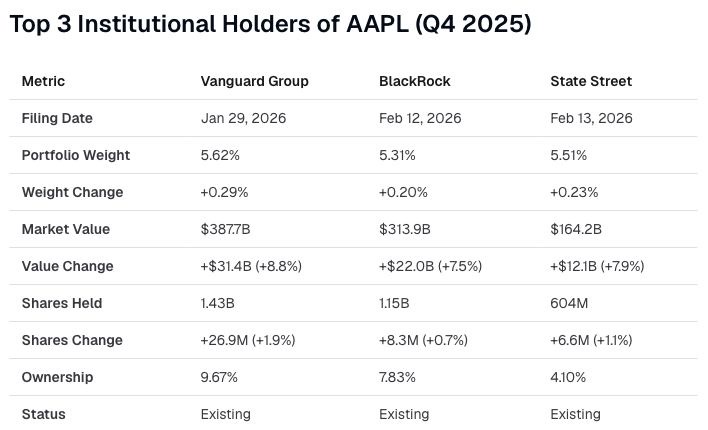
Finance Agent comparison of Apple institutional holders showing filing dates, portfolio weights, market values, shares, ownership, and position status
Finance Agent comparison produced from an institutional-filings result for Apple Q4 2025, captured September 14, 2026. This is an AI-written comparison table, not the native result card or an original filing. The three filing dates match their SEC filing indexes; rounded amounts, rankings, weight changes and ownership percentages still require reconciliation to the information tables and provider definitions. Values describe a historical report period, not live trades.

Holder-level filing research

See the institutions behind a stock’s reported ownership

The FMP holder-analytics query requires a ticker, year and quarter. It starts at page 0 with 10 rows by default and returns at most 50 rows per call. Ask for more pages before ranking holders across the dataset; there is no sort parameter that guarantees the first page contains the largest holders.

Institutional filings are delayed snapshots. A higher market value can reflect a price move as well as a change in shares, and a portfolio-weight change can be caused by activity elsewhere in the holder’s portfolio. The records do not reveal trade timing or investment intent.

Use cases

Ways to analyze institutional holdings

Identify leading reported holders

Compare named institutions within the rows collected for the same stock and report period. Keep the CIK, security CUSIP, security type and put/call/share classification alongside amounts to avoid merging unlike positions.

Separate size from change

Review shares, market value, portfolio weight, and ownership alongside their period-over-period changes so price effects are not mistaken for trading activity.

Prioritize filing follow-up

Flag reported new, increased, reduced, or exited positions, then use the filing date and institution name to verify the change in the original disclosure.

FAQ

Questions about institutional holdings analysis

Turn reported holder changes into filing questions

Compare the reported positions, identify the changes that matter, and verify them in the original filings before drawing conclusions about an institution’s strategy.

Open Finance Agent

For informational and research use only. No output is investment advice or a guarantee of future performance.