

Compare the main income-statement drivers
Follow revenue, gross profit, operating income, EBIT, EBITDA, net income, EPS, research spending, and selling costs across reported periods to frame questions about growth and margins.
Pineify Finance Agent organizes changes in a company’s income statement, balance sheet, cash flow, per-share measures, and longer-term growth indicators into one period-by-period view. Use it to see where revenue, profit, assets, debt, cash generation, or shareholder measures are accelerating or slowing, then choose the filings and underlying line items that deserve a closer review.
Opens Finance Agent with an Apple financial-statement growth question ready to send.
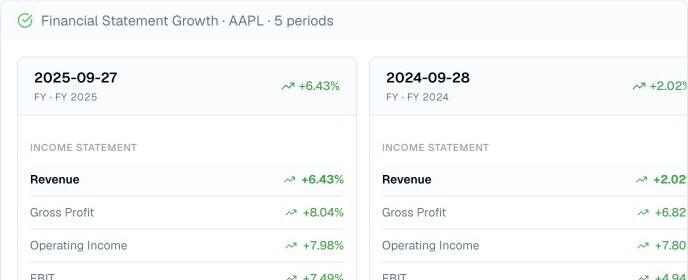
A connected growth view
Growth is easier to interpret when the statements stay connected. Finance Agent displays provider-supplied growth measures for revenue, gross profit, operating income, net income, EPS, assets, debt, working-capital items, operating cash flow, free cash flow, capital spending, shares, and dividends so you can see whether the operating, financial, and shareholder stories are moving together.
A displayed growth rate is a comparison signal, not an explanation. Period length, fiscal calendars, seasonality, acquisitions, restatements, share changes, and one-time items can all affect the result. Use the pattern to decide what to investigate in the statements and notes.
Use cases
Follow revenue, gross profit, operating income, EBIT, EBITDA, net income, EPS, research spending, and selling costs across reported periods to frame questions about growth and margins.
Review assets, receivables, inventory, debt, operating cash flow, free cash flow, and capital expenditure beside earnings changes to test whether growth is translating into financial capacity.
Use three-, five-, and ten-year per-share growth signals for revenue, cash flow, net income, equity, and dividends as a starting point for historical and peer research.
Prompt examples
FAQ
Start with the direction and relationships, then verify the reported figures, periods, formulas, units, and unusual items before relying on a trend.
Open Finance AgentFor informational and research use only. No output is investment advice or a guarantee of future performance.