

Trace the equity-to-enterprise bridge
See market capitalization, shares, cash and equivalents, total debt, and enterprise value together so you can understand which balance-sheet components are driving the difference.
Pineify Finance Agent places enterprise value beside market capitalization, stock price, shares, cash and equivalents, and total debt across reported dates. Use the view to understand how financing and cash holdings change the value assigned to the operating business, compare the pattern over time, and choose the valuation assumptions that deserve deeper review.
Opens Finance Agent with an Apple enterprise-value question ready to send.
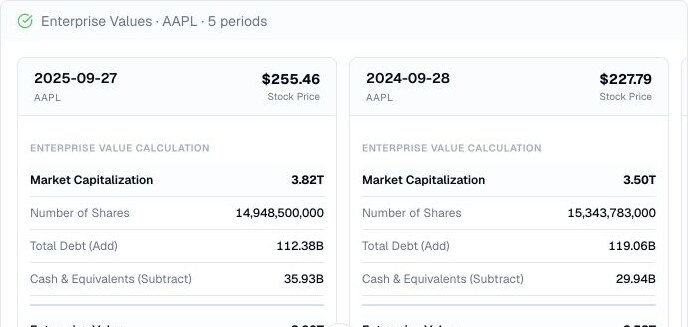
An equity-to-business-value bridge
The displayed bridge uses market capitalization + total debt − cash and cash equivalents. Finance Agent retrieves the components and enterprise value from the data source; it does not independently rebuild or reconcile the valuation. Compare annual or quarterly records for one ticker and inspect the returned dates.
Enterprise value is a context measure, not a standalone fair value. Debt-like items, restricted cash, leases, minority interests, preferred equity, share-count timing, and market-price dates can change the interpretation. Use the comparison to identify what to verify in filings and valuation models.
Use cases
See market capitalization, shares, cash and equivalents, total debt, and enterprise value together so you can understand which balance-sheet components are driving the difference.
Review dated stock prices, equity value, debt, cash, and enterprise value across periods to flag refinancing, buybacks, accumulation of cash, or other capital-structure shifts.
Use the bridge as a starting point for EV/EBITDA, EV/Sales, or transaction comparisons, then align operating metrics, leases, minority interests, dates, and peer definitions before drawing a conclusion.
Prompt examples
FAQ
Start with the bridge from equity value to enterprise value, then verify dates, debt definitions, cash items, share counts, and the market price before relying on a comparison.
Open Finance AgentFor informational and research use only. No output is investment advice or a guarantee of future performance.