

Compare value and price
See a dated DCF estimate next to the available stock price so the valuation question is visible immediately.
Pineify Finance Agent can place a dated discounted cash flow estimate beside a stock’s reference price and calculate the gap between them, giving you a quick valuation signal to investigate with current disclosures, a full model, and sensitivity analysis.
Opens Finance Agent with a focused Apple DCF valuation question ready to send.
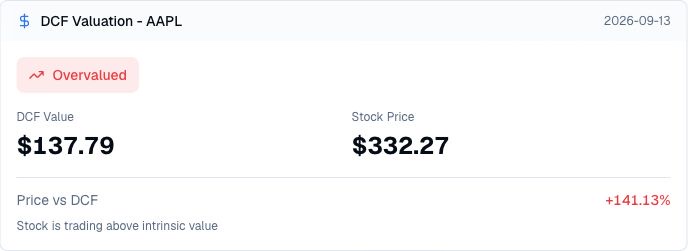
Valuation snapshot at a glance
A DCF estimate translates expected future cash flows into a present-value reference. This tool retrieves one available estimate for a ticker and displays its date and reference stock price; it does not build a fresh forecast from your assumptions.
The result is a compact comparison, not an auditable valuation model. It does not show the cash-flow forecast, growth path, discount rate, terminal value, or every other assumption needed to judge whether the estimate is reasonable.
Use cases
See a dated DCF estimate next to the available stock price so the valuation question is visible immediately.
For a positive DCF value, Price vs DCF equals (stock price − DCF value) / DCF value × 100. The card labels a gap below −10% Undervalued, above +10% Overvalued, and the inclusive range between them Fair Value. These are fixed display thresholds, not an independently validated fair-value range.
Use a large gap to focus follow-up work on revenue growth, margins, reinvestment, discount rates, terminal assumptions, and balance-sheet risk.
Prompt examples
FAQ
Start with the distance between price and the DCF estimate, then examine the cash-flow forecast, discount rate, terminal assumptions, balance sheet, and current market data before forming a conclusion.
Open Finance AgentFor informational and research use only. No output is investment advice or a guarantee of future performance.