

Review the latest liquidity position
See cash, short-term investments, receivables, inventory, current assets, current liabilities, and the displayed current ratio at recent reporting dates.
Pineify Finance Agent organizes a public company’s latest available TTM-labeled balance-sheet snapshots by reporting date. Use it to review cash, investments, receivables, inventory, assets, liabilities, debt, shareholder equity, current ratio, and debt-to-equity in one recent view—without treating point-in-time balances as twelve-month totals.
Opens Finance Agent with an Apple TTM balance-sheet question ready to send.
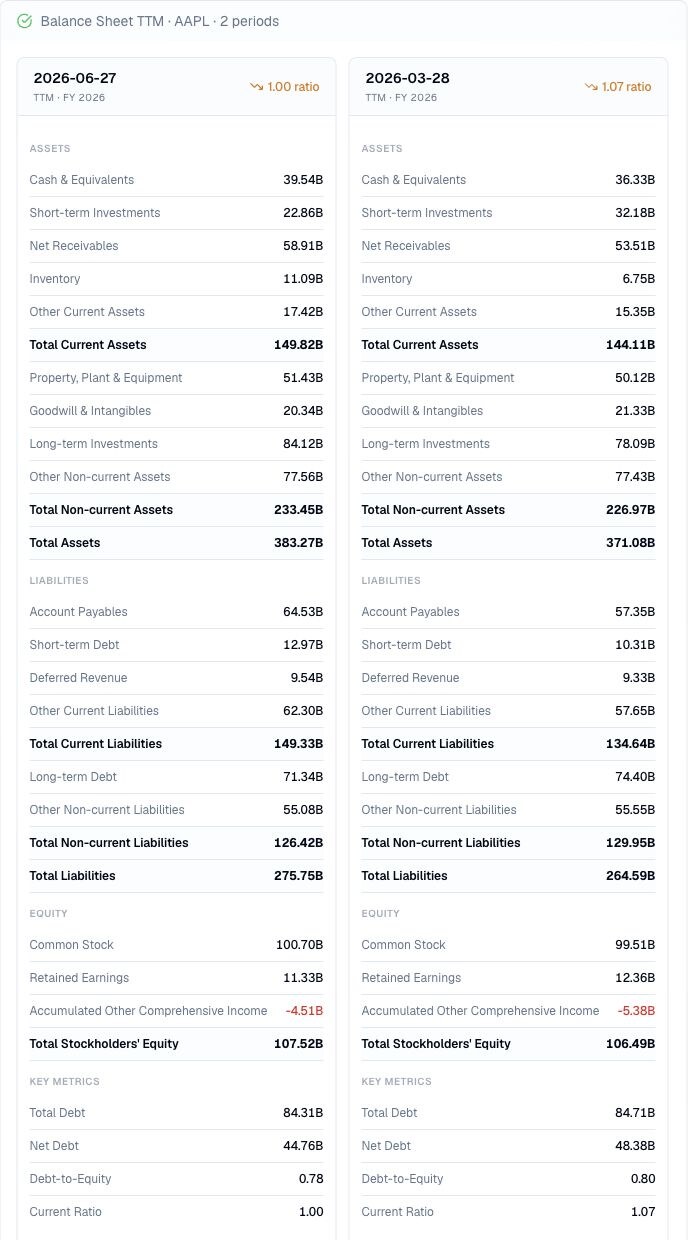
Recent balance-sheet snapshots
A TTM-labeled balance-sheet view brings recent reporting dates into the same research flow as rolling income and cash-flow analysis. It keeps liquid assets, working-capital balances, long-lived assets, current and non-current obligations, debt, and shareholder equity together while the company is between fiscal year-ends.
Balance-sheet items are stocks measured at a date, unlike revenue or cash flow accumulated over a period. Cash, assets, liabilities, and equity should not be added across four quarters. Compare each dated snapshot and use the underlying quarterly reports to explain the movement.
Use cases
See cash, short-term investments, receivables, inventory, current assets, current liabilities, and the displayed current ratio at recent reporting dates.
Examine consecutive snapshots to find changes in operating assets, long-term investments, property and equipment, payables, deferred revenue, and other liabilities that deserve filing research.
Review short- and long-term debt, total and net debt, retained earnings, shareholder equity, and the displayed debt-to-equity ratio in the same dated view.
Prompt examples
FAQ
Compare the reporting dates, identify the balances that changed, and then inspect the quarterly filings, debt terms, liquidity sources, commitments, and events behind the movement.
Open Finance AgentFor informational and research use only. No output is investment advice or a guarantee of future performance.