

Track liquidity and working-capital changes
Compare cash, short-term investments, receivables, inventory, current assets, payables, and current liabilities to identify changes that deserve a closer operating or cash-flow review.
Pineify Finance Agent retrieves the data provider’s growth rates for balance-sheet line items across annual or quarterly reporting periods. Use it to see how cash, receivables, inventory, long-lived assets, liabilities, debt, retained earnings, and shareholder equity are moving together, then investigate the reported values and disclosures behind the changes that matter.
Opens Finance Agent with an Apple annual balance-sheet growth question ready to send.
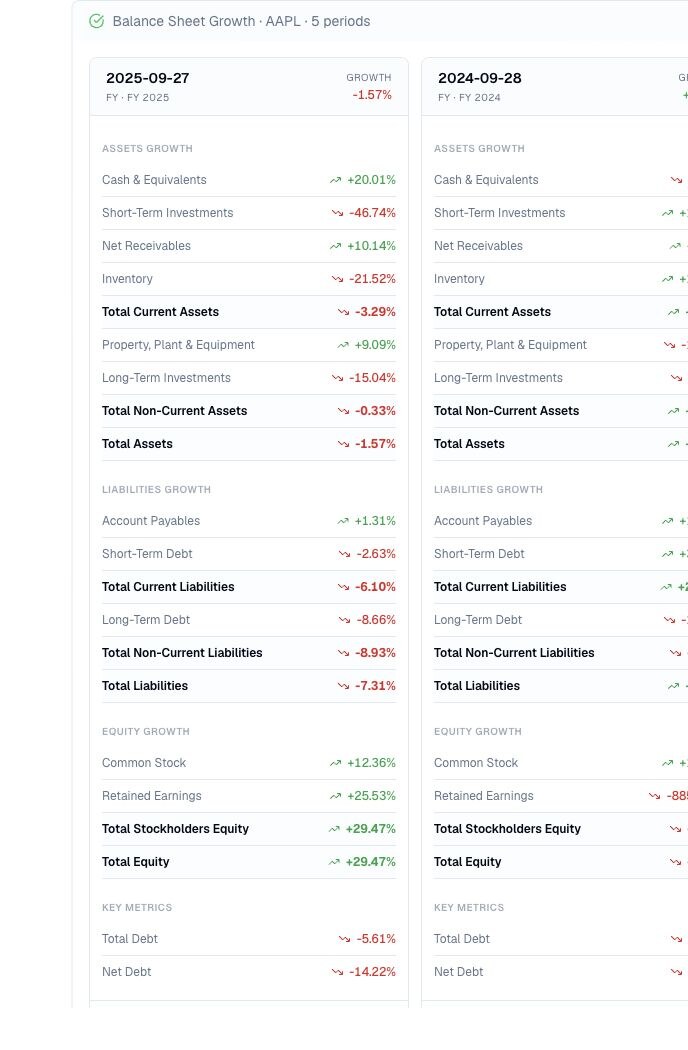
A connected financial-position view
A growth view keeps changes in cash, investments, receivables, inventory, operating assets, liabilities, debt, retained earnings, and shareholder equity in the same period context. That makes it easier to see whether a company is accumulating liquidity, investing in assets, extending working capital, adding obligations, or changing how the business is financed.
Growth rates describe movement, not financial strength by themselves. A small prior-period balance can produce an extreme percentage; a zero base makes the usual percentage-change calculation undefined, and a negative base complicates its interpretation, while an acquisition, divestiture, currency movement, reclassification, or restatement can break an otherwise simple comparison.
Use cases
Compare cash, short-term investments, receivables, inventory, current assets, payables, and current liabilities to identify changes that deserve a closer operating or cash-flow review.
See how property, plant and equipment, long-term investments, non-current assets, and total assets changed across comparable reported periods.
Review short- and long-term debt, total liabilities, retained earnings, shareholder equity, total debt, and net debt together to frame capital-structure questions.
Prompt examples
FAQ
Identify the assets, obligations, or equity balances moving differently, then confirm the comparison period, actual values, financing activity, accounting changes, and filing context before drawing a conclusion.
Open Finance AgentFor informational and research use only. No output is investment advice or a guarantee of future performance.