

Ascending triangle pattern: structure, breakout, and failure
An ascending triangle pattern has approximately horizontal resistance above a sequence of higher lows. It has a bullish bias, but the shape alone does not confirm an upward breakout. Price can instead break below rising support.
AI Detection
Use AI Chart Analysis as a second review
Pineify can help interpret a chart screenshot. Its response may miss context or misread a level, so compare it with your own chart annotations.
Prepare a readable chart
Include the symbol, timeframe and relevant swings. A screenshot can omit price history needed to assess the setup.
Review the structure
Pineify reviews an uploaded chart screenshot and returns pattern commentary, price levels, risks, and uncertainties. Compare the response with your recorded swing prices and confirmation rules. The image assessment can misread a candidate or miss information outside the frame.
Check the interpretation
Compare the response with the chart. Verify each price level yourself and record confirmation and invalidation rules before considering a trade.
How to Detect It
Step-by-Step Detection Guide
Work through the chart in order. Treat each condition as a check, and record why a setup fails as well as why it qualifies.
Record the candidate swings
Show the prior trend on TradingView, choose one pivot rule, and record alternating highs and lows with dates and prices.
Fix the geometry and decision thresholds
Mark horizontal resistance and rising support. Write the tolerance, closing-price confirmation, expiry, and failure rules before checking later bars.
Check completed bars and review the image
Recalculate the thresholds on the confirmation bar. Upload the labeled screenshot to Pineify and compare its interpretation with the underlying prices.
Check the boundaries and the preceding trend
StockCharts describes at least two nearby reaction highs and two successively higher reaction lows. The highs need not match exactly. An ascending triangle often continues an uptrend; after a downtrend, an upward resolution would instead be a possible reversal. Neither context makes the next move certain.
A descending triangle has a horizontal floor and falling highs. A symmetrical triangle has two converging sloping boundaries. For the ascending candidate here, keep the upper reference horizontal rather than tilting it to fit every new high.
Use the same pivot and tolerance rules throughout
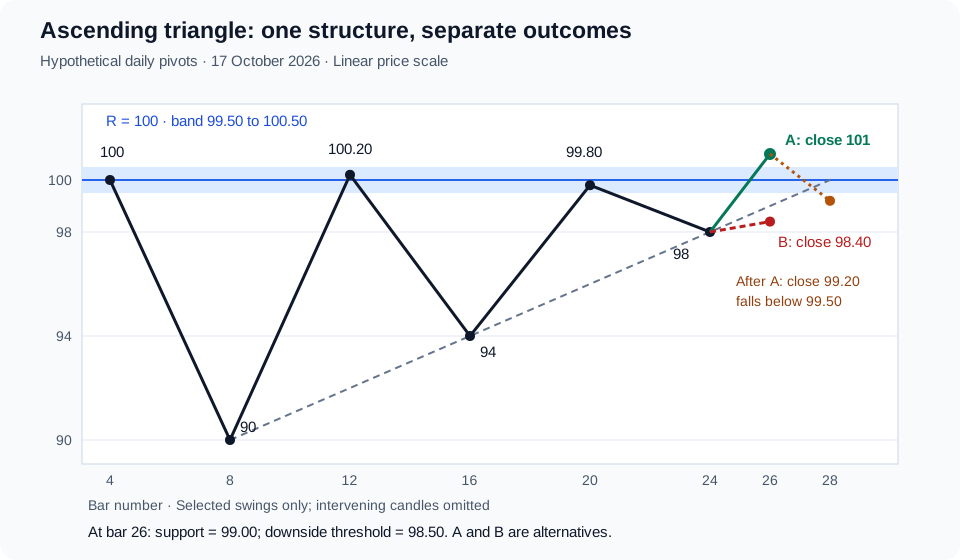
A hypothetical daily example prepared on 17 October 2026
For this exercise, use standard candles on a linear price scale. Define a pivot high as a high strictly above the highs of the two bars on each side; reverse the comparison for pivot lows. Ties do not qualify. A pivot becomes available only after the second bar to its right closes. Assume the omitted neighboring bars satisfy these tests.
Fix resistance R at the first high of 100. Choose tolerance t = 0.5% of R = 0.50 price units. Every high must remain within 99.50 to 100.50. Draw rising support through the first two lows and require later lows to be higher than their predecessors and within 0.50 of that line. These are demonstration choices, not universal settings or Pineify detection parameters.
- Recorded highs: bar 4 = 100.00, bar 12 = 100.20, bar 20 = 99.80. Their deviations from R are 0%, 0.20%, and 0.20%; all pass the same 0.50% limit.
- Recorded lows: bar 8 = 90.00, bar 16 = 94.00, bar 24 = 98.00. Each rises by 4.00. Support slope = (94 − 90)/(16 − 8) = 0.50 price units per bar.
- Support at bar b is S(b) = 90 + 0.50 × (b − 8). At bar 24, S(24) = 98, so the third low has zero deviation. That low is only confirmed at the close of bar 26.
- The gap between R and support shrinks from 10 at bar 8 to 2 at bar 24. The lines meet at bar 28. Under this exercise, an unresolved candidate expires at that intersection; do not keep extending the same triangle beyond it.
Separate an upward breakout from its target
The example requires a completed daily close strictly above R + t = 100.50, before bar 28, with the required pivots confirmed. A close of 101 at bar 26 passes. A candle high of 101 followed by a close of 100.20 does not. At exactly 100.50 the strict greater-than condition also fails.
The traditional measured-move projection adds the pattern height to resistance. Here the height is 100 − 90 = 10, giving 100 + 10 = 110. This calculation uses the fixed resistance reference, not the entry price. It is a geometric projection, not a minimum promised gain or evidence that price will reach 110. Volume can be reviewed alongside the breakout, but this example has no volume filter.
Record both kinds of failure
A downward break before an upside confirmation rejects the bullish candidate. A return below resistance after an upside confirmation is a different event. Keep those outcomes separate when collecting examples, and retain failed candidates in any later evaluation.
- Downside branch: at bar 26, S(26) = 99.00. The chosen failure threshold is S(26) − t = 98.50. An alternative close of 98.40 is below it, so the candidate fails without an upward breakout. This branch is an alternative to the close at 101.
- False upward breakout: following the close at 101, a bar 28 close at 99.20 is below R − t = 99.50. It fails this example's hold-above-resistance rule, even though price remains above the last low of 98.
- Marginal readings: a close inside 99.50 to 100.50 is neither a fresh upward confirmation nor the defined return-below-resistance failure. Record the unresolved state rather than moving the boundary.
- Structure rejection: a new low that is equal to or below the previous low fails the higher-low rule. A high outside the resistance tolerance fails the selected geometry. Do not widen the tolerance after seeing the result.
Draw and verify the candidate on TradingView
Use the Triangle Pattern drawing tool to place four alternating highs and lows. Its Coordinates settings allow exact price and bar positions. Add labels for later touches, the resistance band, and the confirmation bar. Keep the symbol, interval, date axis, and price scale visible; a triangle drawn over candles is only an annotation.
TradingView's separate Auto Chart Patterns Triangle indicator documents 5/5 pivots and close-based breakouts. Its In Progress mode can include endpoints that are not confirmed pivots. Its status rules also differ from the custom failure rules above. Do not treat its annotations as proof that this page's 2/2, 0.5% exercise passed.
For a crypto chart, record the exchange, trading pair, interval, and data feed with the anchors. Recalculate the same percentage tolerance on that chart's reference price. This example provides no evidence that one tolerance works across assets or intervals.
Review the screenshot or turn the rules into a script
Upload the annotated image to AI Chart Analysis for a second visual interpretation. Check any reported resistance or support against the recorded prices. A confidence score does not measure the probability of a profitable breakout.
For repeated checks, ask Pine Script AI Coding Agent to implement the stated pivot window, fixed resistance reference, tolerance denominator, rising-support equation, confirmation delay, and separate failure conditions. Require it to mark both the pivot bar and the later detection bar so that the chart does not imply the pivot was known in advance. Review the generated source and test it on historical data before relying on alerts.
This page supplies a drawing and rule specification, not a tested detector or trading strategy. Chart analysis is educational, not investment advice. Fees, slippage, gaps, and execution timing can change actual outcomes.
Sources and related guides
Sources checked 2026-10-17.
- StockCharts ChartSchool: Ascending Triangle
Conventional geometry, continuation and reversal contexts, and measured-move projection.
- TradingView: Triangle pattern drawing tool
Alternating anchors, exact coordinate controls, and the possibility of a downward break.
- TradingView: Chart Pattern Triangle
The automated indicator has its own pivot, breakout, and pattern-status rules.
FAQ
Frequently Asked Questions About Ascending Triangle Pattern on TradingView: Rules and Failures
Definitions, confirmation and limits of the pattern.
Review your chart annotations
Use a screenshot to ask Pineify about the structure, then check its interpretation against the original chart. The response does not establish a trading edge.
Open AI Chart AnalysisPast performance is not indicative of future results. AI-generated scores and stock picks are predictive in nature and are not guaranteed to produce any particular outcome or return. Nothing on this page constitutes financial advice, investment recommendation, or solicitation to buy or sell any security. All investment decisions involve risk, including the potential loss of principal. You should conduct your own independent research and consult with a qualified financial advisor before making any investment decisions. The AI model may miss or misinterpret market-moving events, and scores can change without notice.