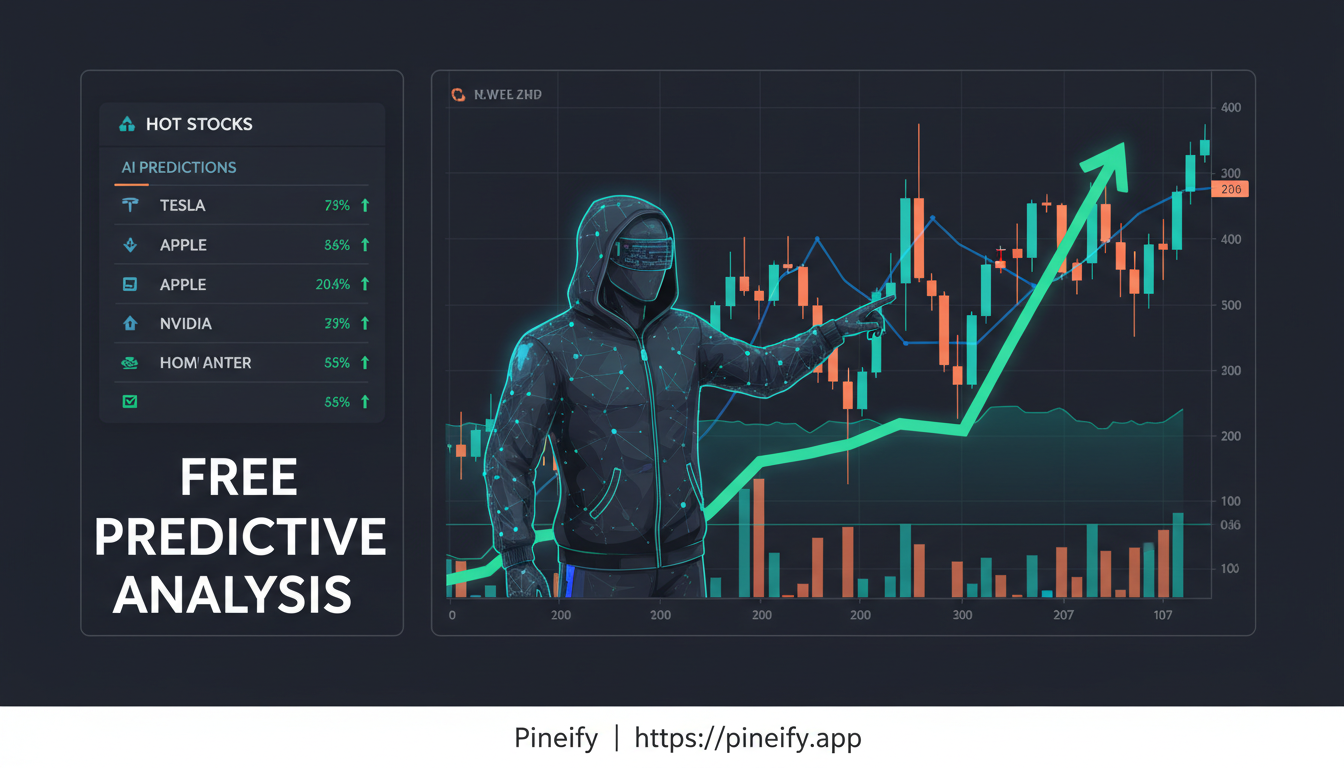
Free AI Stock Picker - Pineify's Predictive Stock Analysis Tool
Pineify AI Stock Picker is a free AI-assisted stock discovery tool that scans a broad stock universe each day and reduces the output to a simple 1-10 ranking score. You start with a prioritized watchlist instead of sorting through charts, filings, and news one stock at a time. I've found this most useful for idea generation and workflow speed — not for skipping the homework on valuation or position sizing.
I've been watching how fast the industry is moving on this. In Mercer's 2024 AI in Investment Management Survey, 54% of investment managers said they already use AI and another 37% plan to, which puts 91% in active or prep mode. For retail traders, tools like Pineify bring some of that institutional filtering into a simpler interface. Last month I ran AAPL and NVDA through the stock picker, and the difference in their scores tracked surprisingly well with their post-earnings reactions — AAPL sat around 7 while NVDA was closer to 4.
Key Takeaways
- Pineify AI Stock Picker helps traders shortlist stocks faster by combining technical, fundamental, and sentiment inputs into a daily score.
- It works best as an idea-filtering layer before manual review, alerts, or backtesting.
- Mercer found 91% of investment managers either already use AI or plan to use it.
- CFA Institute reported 85% of surveyed investment professionals said standards are needed to guide AI use, and 82% said the lack of standards is hindering adoption.
- Treat AI picks as ranked hypotheses, not trading instructions.
How the AI Stock Picker Works
Pineify AI Stock Picker condenses multiple market signals into a simplified 1-10 score. The goal is narrow: help traders answer which stocks deserve attention first today.
That matters because screening is usually the slowest part of discretionary trading. Start with a pre-ranked list and focus your time on validation instead of manually checking price action, earnings quality, and market sentiment across dozens of names.
If you're already using the Pineify environment to build and test strategies, the stock picker slots in as the top of the funnel — generate the idea here, then validate it with a workflow like automated TradingView backtesting.
What the Tool Covers and What It Does Not
Pineify positions the product as a daily stock idea engine rather than a fully autonomous portfolio manager. That distinction matters because it makes the scope explicit.
| Area | What Pineify AI Stock Picker Covers | What You Still Need To Do |
|---|---|---|
| Discovery | Surfaces ranked stocks and category-based lists | Decide whether the idea fits your strategy |
| Analysis inputs | Combines technical, fundamental, and sentiment signals | Verify the company, catalyst, and setup yourself |
| Prioritization | Condenses information into a 1-10 score | Set entry, exit, and sizing rules |
| Refresh cadence | Updates daily according to Pineify | Recheck intraday context if you trade shorter timeframes |
| Execution | Helps you narrow attention | Place trades and manage risk manually |
I haven't tested how the tool handles low-volume names or small caps, and I'd caution anyone against relying on a single score for those. The signal quality drops when liquidity is thin.
How the Pineify Score Works at a High Level
Pineify describes the stock picker as a combination of technical, fundamental, and sentiment analysis. Each layer answers a different question.
| Layer | What It Measures | Why It Matters |
|---|---|---|
| Technical analysis | Price trend, momentum, moving averages, relative strength | Helps identify whether the market is confirming a move |
| Fundamental analysis | Earnings trends, valuation, balance-sheet quality, growth signals | Helps filter out setups with weak underlying business quality |
| Sentiment analysis | News tone, market attention, investor mood | Helps explain short-term demand shifts and catalyst risk |
When those layers line up, a stock rises toward the upper end of the 1-10 scale. When they conflict, treat the ranking as lower-conviction and look closer. I prefer to see at least two of the three layers agreeing before I spend real time on a name. I've checked maybe 30 names through the tool so far, and that rule has saved me from chasing a few questionable setups.
Why AI-Assisted Stock Ranking Matters in 2026
The industry data keeps pointing in the same direction.
| Data point | Source | Why It Matters |
|---|---|---|
| 54% of investment managers are already using AI | Mercer, 2024 | AI-assisted workflows are already mainstream in professional settings |
| 37% of investment managers plan to use AI | Mercer, 2024 | Adoption is still expanding |
| 85% of investment professionals say AI standards are needed | CFA Institute, February 21, 2024 | Trust and governance remain a major issue |
| 82% say the lack of standards is hindering adoption | CFA Institute, February 21, 2024 | More tools does not automatically mean more confidence |
| 70% say investment firms need to upskill employees to use AI effectively | CFA Institute, February 21, 2024 | Human interpretation still matters |
The takeaway is practical: AI is useful for filtering, ranking, and summarizing, but interpretation and governance are not solved yet. That's exactly the zone where a tool like Pineify fits — it helps you get to a shortlist faster, but it doesn't claim to make the final call. For a broader look at how AI tools are changing stock discovery, check out AI stock and options trading with predictive scoring.
How To Use a Free AI Stock Picker Without Getting Sloppy
The wrong workflow is "AI says buy, so I buy." The right one is to let AI compress the search space, then put your own judgment on top.
- Start with the ranked list. Review the highest-scoring names and note whether the score aligns with your trading style.
- Validate the catalyst. Check earnings dates, guidance changes, regulatory news, and sector momentum.
- Confirm the chart. A high score means less if the stock is sitting under major resistance or trading against your timeframe.
- Set the risk plan. Define entry, stop, and size before you act.
- Track outcomes. Over time, note which score ranges and setups actually work for you.
A tool like AI trading journal automation can help with step five — logging which picks worked and which did not, so you can refine your process. I do this myself in a simple spreadsheet because I haven't found an automated journal that matches my workflow yet.
Where Pineify Has an Edge Over a Basic Screener
A classic screener gives you filters. Pineify gives you prioritized interpretation.
| Tool type | What you do first | Main weakness |
|---|---|---|
| Traditional screener | Build filters manually | Easy to miss cross-signal context |
| News scanner | Watch headlines | Hard to prioritize which headlines matter |
| Chart watchlist | Review symbols one by one | Slow and inconsistent |
| Pineify AI Stock Picker | Start from a ranked list | Still requires manual validation and risk control |
That tradeoff is worth stating clearly: Pineify can save time and improve consistency, but it can't eliminate market uncertainty. I'd still run any high-scoring pick through a separate backtesting process before putting real money behind it.
Limitations and Risk Signals To Keep in Mind
FINRA's January 25, 2024 investor alert on artificial intelligence in investing makes the central warning clear: AI tools can sound authoritative while still being incomplete, misleading, or wrong. That applies to every retail workflow.
The main limitations:
- A ranking model can overweight recent momentum.
- Sentiment signals can change faster than daily refresh cycles.
- A single score can't capture your time horizon, tax situation, or portfolio concentration.
- High-scoring stocks can still fail because of earnings misses, guidance cuts, or market regime shifts.
- Free tools work best for idea generation, not blind execution.
Frequently Asked Questions
Is Pineify AI Stock Picker free?
Pineify presents AI Stock Picker as a free stock discovery tool. That makes it useful for grabbing a fast daily shortlist before deciding whether to go deeper with the rest of the Pineify workflow.
What does the 1-10 score mean?
The 1-10 score is a prioritization signal. Higher scores suggest stronger alignment across the tool's technical, fundamental, and sentiment inputs. Lower scores deserve more caution or less immediate attention.
How often are Pineify ideas updated?
Pineify says the stock picker refreshes daily. That works for daily watchlist review, swing-trading prep, and ongoing market scanning, though intraday traders still need faster confirmation on the chart.
Can beginners use Pineify AI Stock Picker?
Yes, the interface simplifies discovery into ranked ideas. Beginners still need a process for paper trading, position sizing, and checking whether a stock fits their risk tolerance.
Can an AI stock picker replace research?
No. It can replace repetitive screening work, but it can't replace earnings review, catalyst analysis, or portfolio-level risk management.
What makes Pineify different from a plain screener?
The main difference is prioritization. A plain screener returns filtered lists. Pineify sorts the opportunity set by combining multiple signal types into one ranked view.