AI Stock & Options Picker: Predictive Scoring for Daily Trades

Let's be real: trying to keep up with the stock market can feel like drinking from a firehose. Prices moving, news breaking, options trading — all happening in real time. Doing all that research by hand is exhausting and guarantees you'll miss something.
An AI stock picker is a machine learning tool that scans thousands of stocks daily, analyzing fundamentals, technicals, sentiment, and options data simultaneously. Predictive scoring distills this multi-factor analysis into a single score (1-10) so you can instantly see each stock's opportunity strength. I've been running Pineify's AI Stocks & Options Picker for about six months now — honestly, it changed how I start every trading morning.
Why Manual Stock Research Falls Short
Old-school stock research takes forever, it's often swayed by gut feelings, and it's easy to make simple mistakes. Even seasoned traders find it tough to sift through every company, check all the charts, read the financials, and track options activity — all before the market opens.
This is where AI makes a real difference. It scans millions of data points — from company fundamentals to market sentiment — in the time it takes you to sip your coffee. It cuts out the noise and highlights the opportunities with the strongest evidence behind them. What you get is a clearer, faster, and more disciplined way to trade. If you want to sharpen your technical skills too, check out our TradingView Market Screener Script: From Zero to Pro guide.
What Is an AI Stock Picker?
Think of an AI stock picker like a super-powered research assistant that never sleeps. It uses machine learning to sift through mountains of market data — price movements, trading volume, company earnings, analyst ratings — and spots patterns you'd miss on your own. Instead of looking at one or two factors, it brings dozens together at once to highlight stocks with stronger potential.
Pineify's version does this and goes a step further. It doesn't just screen for stocks — it digs into options data too, all in one place. Every stock gets a straightforward predictive score from 1 to 10. I've found that anything between 7 and 10 acts like a bright flag, pointing to the opportunities the system sees as most promising. It's a simple way to cut through the noise and get a clear starting point, whether you're new to trading or you've been doing it for years.
How Pineify's AI Sorts Through the Market Daily
The system refreshes daily, sifting through millions of data points so you're always acting on current information. Here's a simple look at the different pieces of the puzzle it puts together every morning.
| Analysis Layer | What It Evaluates |
|---|---|
| Fundamental Analysis | Income statement, balance sheet, cash flow, Altman Z & Piotroski health scores |
| Technical Analysis | Price action, multi-timeframe charts, TradingView indicators, pattern recognition |
| Sentiment Analysis | Real-time news, press releases, SEC filings, aggregated market sentiment |
| Analyst Consensus | Wall Street buy/sell/hold ratings, price targets (low/avg/high), rating changes |
| Options Intelligence | Max pain, put/call ratios, unusual activity, expected move calculations |
By piecing together these different clues — from a company's financial health to what the options market is whispering — the approach gives you a fuller picture. It's similar to the deep-dive analysis professional trading desks use, but condensed into a format any trader can understand.
How I Find Trades with Pineify AI
Here's how I actually use Pineify AI on a typical trading day. It's the process I follow to sort through the noise and focus on what matters.
Step 1: Check the AI Score Leaderboard First
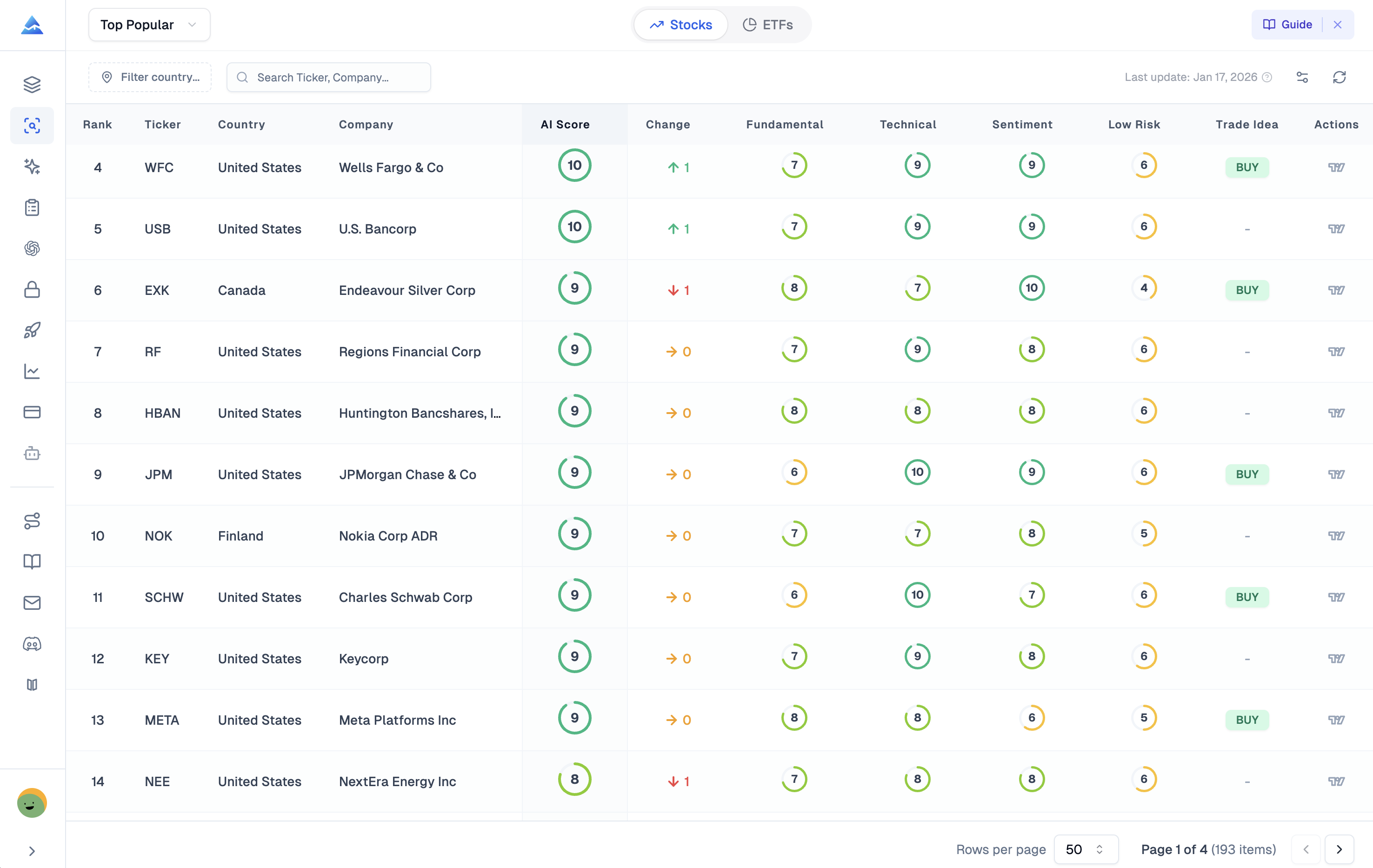
I start by opening the Pineify AI Stock Picker and heading to the daily picks. The AI Score is the key: every stock gets a grade from 1 to 10. That number blends the company's financial health, recent price action, and overall market sentiment.
My first filter is simple: I focus on stocks with a score of 7 or higher. These are the platform's highest-conviction ideas for the day. Last Tuesday, for instance, Apple scored 8.4 while the broader market was mixed — that's the kind of signal that gets my attention. I also browse the daily lists like "Top Growth" or "Top Dividend" depending on what I'm looking for.
Step 2: Narrow It Down with Smart Filters
You've got a list of high-scoring stocks. Now make it your list. Use the screener to filter for what fits your style:
- Country and Sector: Stick to markets and industries you understand.
- Risk Level: Toggle "Low Risk" if you prefer more stable movers.
- Key Metrics: Filter for strong revenue growth or a high dividend yield.
This step ensures you're not just following a hot pick — you're aligning it with your own trading plan.
Step 3: Look Under the Hood with Deep Financials
I never place a trade just because a score is high. Always check the company's actual financials. Pineify's Deep Financials section lets you do that in seconds:
- 10+ years of income statements, balance sheets, and cash flow data.
- Financial health scores (like the Altman Z-Score) that warn you if a company might be in trouble.
- Clear charts showing growth trends and how the stock stacks up against the broader market.
This is my reality check. It's helped me avoid companies that look good on the surface but have shaky finances underneath.
Step 4: See What the Analysts Are Saying
Next, get a second opinion from Wall Street. Pineify gathers all analyst ratings and price targets into one simple consensus. I find it's a powerful confirmation when a stock has both a high AI score and a bullish analyst consensus. I also look for recent rating upgrades or downgrades — they often hint at a shift in professional sentiment before it's widely known.
Step 5: Master the Options Chain
If you trade options, this is where Pineify really shines. It gives you the full, real-time options chain with live prices, the Greeks (Delta, Gamma, etc.), implied volatility, and open interest.
The Options Intelligence tools go further:
- Unusual Activity: Spots big, out-of-the-ordinary orders that can signal a coming move.
- Put/Call Ratios: A quick read on whether traders are feeling bullish or bearish.
- Max Pain Theory: Shows the stock price where the most options would expire worthless — often a price magnet.
- Expected Move: Calculates how far the market expects the stock to swing by expiration.
I prefer checking unusual activity before the Greeks — it tells me where the smart money is moving first, then I use the Greeks to size the position. Using these tools together helps you choose strikes and expirations with more confidence. It's a key part of a solid exit strategy, similar to what I cover in our guide on the Best Stop Loss Indicator on TradingView.
Step 6: Stay on Top of the News in Real Time
Markets move on news. Pineify's news feed aggregates headlines, SEC filings, and even social sentiment for every stock on your watchlist. Each item gets a sentiment score (bullish, bearish, neutral), so you can instantly gauge the tone. This lets me react to new information — like an unexpected earnings call — as it happens, not after the crowd has already moved.
Here's a quick reference of the key features:
| Feature | What It Means For You |
|---|---|
| Predictive AI Scoring (1-10) | A daily, easy-to-understand score on every stock's potential. |
| Curated Pick Lists | Handpicked stocks for goals like growth, dividends, or value. |
| Integrated Charting & Indicators | Professional charts with 235+ technical tools built right in. |
| Real-Time Options with Greeks | All the essential options data and metrics, updated in real time. |
| Options Intelligence | Insights into unusual trades, key price levels, and expected stock moves. |
| 10+ Years of Deep Financials | Long-term financial health scores to assess risk and stability. |
| Analyst Consensus & Targets | A clear summary of what Wall Street analysts are saying and predicting. |
| Sentiment-Tagged News & Filings | News and SEC documents categorized by mood (positive/negative/neutral). |
| Portfolio Performance Tracking | Compare your picks' performance to the S&P 500 over any timeframe. |
Who Gets the Most Out of AI Stock Picking?
You might think AI tools for stocks are only for math geniuses or people glued to six monitors. The real advantage is getting a clear, data-backed perspective, no matter how you trade.
Here's who I've seen this system click for:
- Day traders — speed and focus are everything. A system that scans everything before the market opens and hands you a scored watchlist lets you hit the ground running.
- Swing traders — you're looking for the sweet spot where a good chart meets a solid story. Getting a signal that combines technical patterns with fundamental health checks helps you find higher-conviction plays. The Momentum Indicator Guide pairs well with this approach.
- Options traders — you live and breathe the Greeks, unusual volume, and expected moves. Having real-time options data integrated with AI scoring means you spot opportunities faster.
- Long-term investors — before adding to your portfolio, checking a company's decade of financial health plus analyst consensus adds a powerful layer of validation.
- Beginners — a simple score-based system cuts through the noise and gives you a clear starting point before you dive into complex analysis.
AI vs. Manual Trading: The Data Advantage
Why does AI often get better results than manual stock picking? It comes down to scale. You might check a few charts, read some news, and review some key numbers. An AI system can scan thousands of stocks at once, looking at dozens of factors — from price movements to financial ratios — in the seconds it takes you to open a single chart.
The system behind Pineify crunches millions of data points every single day to create its forecasts. A whole team of human analysts would need days or weeks to do the same work. It's not a fair fight when it comes to processing information.
The other big factor: emotion. I've lost money chasing momentum into a bubble — we all have. AI has no emotion. It doesn't get greedy when a stock is soaring or panic when it dips. It follows the data, providing objective scores and signals. That doesn't mean the AI is always right. I've seen it assign high scores to stocks that reversed on unexpected news the same day. You always need your own judgment.
| Aspect | Manual Trading | AI-Assisted Trading |
|---|---|---|
| Speed & Scale | Limited by human speed. Reviews items one by one. | Analyzes thousands of assets and millions of data points in moments. |
| Emotional Influence | Highly susceptible to fear, greed, and fatigue. | Removes emotional bias, relying on consistent data rules. |
| Data Processing | Relies on spotting patterns from a limited set of information. | Can process and correlate vast, complex datasets simultaneously. |
| Consistency | Performance can vary daily based on focus and mood. | Applies the same objective criteria 24/7 without deviation. |
Q&A: Common Questions About AI Stock & Options Picking
Q: Can AI really beat human stock pickers? Think of it this way: AI can look at thousands of stocks and millions of data points in the time it takes a person to read a few reports. It doesn't get tired, greedy, or fearful. In broad tests over time, AI models tend to do better than the average individual investor. The smartest way to use it is as a research assistant — a tool to highlight opportunities and risks you might have missed — not as a system to blindly follow. This is the philosophy behind Pineify's AI Stock Picker, which analyzes technicals, fundamentals, and sentiment to deliver predictive scores.
Q: How often are Pineify's AI picks updated? Constantly. The AI stock screener reviews millions of pieces of new data daily, so the scores and picks you see always factor in the latest market information. For options, everything is live — the Greeks and current bid/ask prices update in real time.
Q: Does Pineify work for options-specific strategies like spreads or iron condors? Absolutely. It's built for that. You get the full options chain with all the essential data, plus tools like put/call ratios and expected move charts. That's enough to set up anything from a simple trade to more complex multi-leg strategies. There's also a dedicated Options Trading Journal to log your trades and see what's working.
Q: Is there a free version available? Pineify operates on a paid model with different tiers. They offer one-time payment plans for lifetime access, starting at $99 (Plus), $149 (Advanced), and $259 (Expert). The Expert tier includes full access to the AI Stocks & Options Picker. For current details and promotions, check the Pineify pricing page.
Q: What makes Pineify different from other AI screeners? Most screeners just give you a list of stocks. Pineify is designed as your entire analysis workstation. Instead of juggling five different tabs, you can go from an AI-generated stock idea, to checking its financials and news sentiment with the Finance AI Agent, to analyzing the options chain, and finally to charting it on a TradingView chart — all in one connected space.
Try AI-Powered Trading Now
The best way to understand how AI can help your trading is to see it for yourself.
Head to Pineify's AI Stock Picker and look at the highest-scored stocks right now. Narrow by sector and risk level to find ideas that fit your style. For any interesting stock, review the options chain — the tool highlights unusual activity and shows potential price move levels. Glance at analyst ratings and current headlines before making any decision.
I keep a record in the Pineify Options Journal to track what's working and refine my approach over time.
Frequently Asked Questions
What is an AI stock picker and how does predictive scoring work?
An AI stock picker is a machine learning-powered tool that scans thousands of stocks daily, analyzing fundamentals, technicals, sentiment, and options data all at once. Predictive scoring takes all that analysis and boils it down to a single number (usually 1-10) so you can quickly see which stocks have the strongest case behind them, without manually checking dozens of data points yourself.
How do I find high-probability daily trades using AI analysis?
I start by filtering for stocks with an AI score of 7 or higher — those are the system's highest-conviction picks for the day. Then I narrow by sector, risk level, and metrics that match my trading style. I always cross-check with the deep financials and analyst consensus before I place any trade.
What options data does Pineify's AI stock picker provide?
You get a full real-time options chain including live bid/ask prices, the Greeks (Delta, Gamma, Theta, Vega), implied volatility, open interest, put/call ratios, unusual activity alerts, max pain levels, and expected move calculations — all tied to the AI scoring system.
Can AI stock pickers detect unusual options activity?
Yes. AI-powered options scanners watch every options contract in real time and flag orders that are statistically abnormal in size, premium, or timing compared to the norm. This unusual activity often signals that informed or institutional traders are positioning ahead of a big price move.
Is AI-assisted trading suitable for beginners?
Absolutely. A score-based system removes the need to manually combine dozens of complex indicators, so beginners get a clear, data-backed starting point. Just use the AI scores as a research shortlist, then review the underlying financials and news before you trade — don't follow it blindly.
How does AI remove emotional bias from stock trading?
AI systems apply the same objective criteria to every stock, every single day, no matter what the market mood or headlines say. There's no fear, no greed, no fatigue. That consistency helps you avoid common traps like panic selling or chasing a rally into a bubble.
What is max pain theory and why does it matter for options traders?
Max pain is the stock price where the most open options contracts (both puts and calls) would expire worthless, causing the maximum loss to options buyers. It often acts like a price magnet near expiration because market makers may hedge in ways that push the stock toward that level. I use it to choose strikes and expiration dates with better risk awareness.