Volume Profile: The Complete Guide to Reading, Trading & Mastering This Indicator
Master Volume Profile with this complete guide. Learn to trade POC, VAH, VAL, HVN & LVN using TradingView, thinkorswim or Robinhood Legend. Includes strategies, platform setup, and multi-timeframe analysis for high-probability trades.
Volume Profile is one of those tools that sounds complicated but actually makes trading a whole lot simpler. You’ve probably seen volume bars at the bottom of your chart—those vertical lines showing how many shares or contracts traded each minute or day. But Volume Profile does something different. Instead of telling you when volume happened, it shows you at what price that volume occurred. That small shift in perspective can completely change how you read the market.
Think of it like this: traditional volume tells you someone was busy, but Volume Profile tells you exactly where all that action took place. That reveals hidden support and resistance levels, shows where big institutions might be buying or selling, and helps you spot trades with a much higher probability of working out. Most traders overlook this entirely.
Whether you use TradingView, thinkorswim, or Robinhood Legend, learning Volume Profile can turn your chart analysis from guesswork into something systematic and repeatable.
What Is Volume Profile?
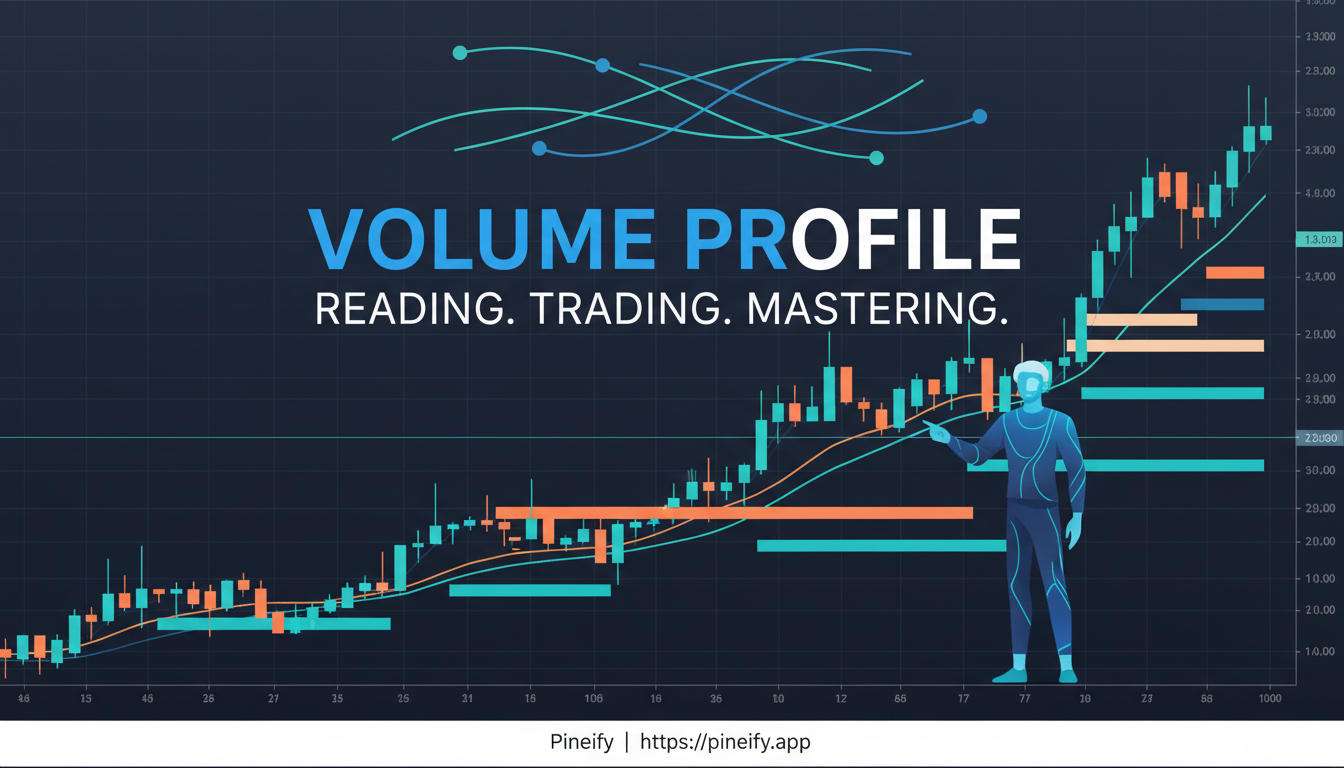
Volume Profile is an advanced charting tool that plots a horizontal histogram of trading volume distributed across different price levels over a chosen time period. Instead of stacking volume vertically like a traditional bar chart, it lays volume out sideways. This shows you which price zones attracted the most buying and selling activity.
The concept was developed in the mid-1980s by traders like J. Peter Steidlmayer as part of the Market Profile framework. Today, it’s used by everyone from hedge funds to individual traders across stocks, futures, forex, and crypto.
Why it matters: Price tends to stick around high-volume areas (often called fair value) and move quickly through low-volume areas (where there’s an imbalance between buyers and sellers). Once you understand this, you can start predicting where price is likely to pause, reverse, or break through—without relying on lagging indicators.
Core Components: POC, VAH, VAL, HVN, and LVN
Every Volume Profile is built on five key concepts. Before you use this tool for any trade, take a moment to really understand each one.
| Term | Full Name | What It Means |
|---|---|---|
| POC | Point of Control | The single price level with the highest traded volume — acts as a price magnet |
| VAH | Value Area High | The upper boundary of the value area |
| VAL | Value Area Low | The lower boundary of the value area |
| HVN | High Volume Node | A price cluster with unusually high volume; acts as strong support/resistance |
| LVN | Low Volume Node | A price gap with thin volume; price tends to move quickly through these zones |
Now, what's the Value Area? It's simply the price range that contains 70% of all the volume traded during a given session. Most big-money traders treat the VAH and VAL as their key decision points — sort of like the upper and lower rails of a fair value zone.
Types of Volume Profile Indicators
Not all Volume Profile tools work the same way. There are four main types, and each one helps you look at trading data from a slightly different angle:
- Fixed Range Volume Profile (FRVP): You pick a specific start and end point on your chart, and it shows you the volume within that exact range. Great for digging into a particular move or a consolidation phase.
- Visible Range Volume Profile (VRVP): This one automatically builds the profile based on whatever part of the chart is currently on your screen. Super handy for a quick check without having to anchor anything manually.
- Periodic Volume Profile (PVP): It slices the chart into time-based chunks (like daily, weekly, or monthly) and gives you a fresh profile for each slice. Useful if you're analyzing across multiple timeframes.
- Anchored Volume Profile: You pin the profile to a specific event—earnings, a gap, a big news catalyst—and it builds the histogram forward from that point.
Each type answers a slightly different question. Day traders usually reach for the Fixed Range or Periodic profiles, while swing traders tend to prefer Visible Range or Anchored Volume Profiles to get the bigger picture.
How to Use Volume Profile on TradingView
If you're into trading, you've probably heard of Volume Profile — and TradingView is the go‑to platform for using it. The good news is that all account levels get access to several built‑in volume profile tools. Here's how to set them up without any hassle.
Setting up Volume Profile on TradingView:
- Open any chart and click the Indicators, Metrics & Strategies button (or just press
/). - Head to Technicals → Profiles — that's where all the volume profile tools live.
- Pick the one you need: Fixed Range Volume Profile, Visible Range Volume Profile, or Periodic Volume Profile.
- If you chose FRVP, click on your start candle, then drag to your end candle. The histogram shows up instantly.
- Go to Settings → Inputs and adjust the Value Area percentage (the default is 70%). Tweak it based on how you like to trade.
- Under Style, turn on the visibility for POC, VAH, and VAL lines. This makes price levels super clear.
Best volume profile indicator on TradingView: For most retail traders, the built‑in Visible Range Volume Profile together with the Fixed Range Volume Profile covers 90% of what you'll ever need. If you're into custom scripts, the TradingView Pine Script community also has advanced overlays — like Volume Profile Area indicators with extra value area breakdowns. But honestly, the built‑in tools are more than enough to get started. For traders who prefer a no-code approach, Pineify's indicator builder lets you create custom volume profile variants without any Pine Script knowledge.
💡 Want to build your own custom volume profile indicators without coding? With Pineify, you can create any indicator or strategy visually in minutes — no Pine Script required. It's the ultimate 10-in-1 AI trading workspace trusted by 100K+ traders worldwide: AI-powered Pine Script generation, visual editor with 235+ technical indicators, trading journal, AI stock picker, and so much more. All with a one-time payment and lifetime access.
👉 Start building smarter trading tools today at Pineify.app
How to Add Volume Profile on thinkorswim
Charles Schwab's thinkorswim platform comes with a built-in Volume Profile study. It's really easy to turn on and you can tweak it however you like.
Here's how to get Volume Profile onto your chart:
- Open the Charts tab and pull up the stock or symbol you want to look at.
- Click Studies, then Add Study. Scroll through the list until you find All Studies, then look under U–W and pick Volume Profile.
- Once it's added, click the little settings gear to change how it looks.
- If you want the volume profile to sit right on your price bars instead of off to the side, set On Expansion to No.
- From there, you can adjust the aggregation period (like how many bars of data it uses) and the value area percentage to match your trading style.
By default, thinkorswim puts the Volume Profile in the expansion area to the right of the chart. But a lot of traders find it more helpful to see it overlaid directly on the price action — it gives you a clearer "big picture" feel. The study works on intraday, daily, weekly, and monthly timeframes, so whether you're day trading or swing trading over a few weeks, you're covered.
Volume Profile on Robinhood Legend
Robinhood Legend is Robinhood’s desktop trading platform. It comes with a Volume Profile widget that lets you draw the profile directly onto any part of the chart. You just pick where you want it to start and end. That’s pretty similar to what TradingView calls “Fixed Range Volume Profile.”
To get started, look for the "F" symbol (that’s the indicator icon) in the top-right corner of your Legend chart. Click it, and you can add technical indicators, save your indicator templates, and turn each study on or off. The Volume Profile on Legend is more basic than what you’d find on thinkorswim or TradingView, but it still gives you the core POC, VAH, and VAL lines. That’s enough for most retail stock and options traders who just want to see where the action is.
Volume Profile Trading Strategies
Getting comfortable with the Volume Profile indicator is the first step—applying it in real trades is what actually gives you an edge. Here are three setups that traders use again and again because they tend to work:
POC Retest Strategy
After a strong move in one direction, price often pulls back to the Point of Control (POC) before continuing on its way. Think of the POC like a magnet—it's the level where the most trading happened, so it feels like "fair value" to the market. When price comes back, touches the POC, and shows signs of holding (like a bounce or a long wick), you can look to enter in the same direction as the original move.
Value Area Fade (Mean Reversion)
Sometimes price pushes outside the Value Area—above the Value Area High (VAH) or below the Value Area Low (VAL). But if you see it failing to follow through, for example a reversal candle or slowing momentum, that's a signal the move might be overdone. In that case, a trade back toward the POC can be a solid mean-reversion play. It's basically betting that price will snap back toward the middle.
Low Volume Node Breakout
Low Volume Nodes (LVNs) are zones where very little trading happened—price sliced through them quickly because there wasn't much resistance. When price revisits an LVN later, it often blasts right through again because there's still no real volume there. Breakout traders watch for this. They set aggressive targets at the next High Volume Node (HVN) and use the LVN as confirmation that momentum is real.
Quick tip for reading Volume Profile on charts: On TradingView, you can turn on buy/sell volume coloring inside the profile bars. Green bars mean buyers were in control at that level, red bars mean sellers were dominant. This gives you an extra clue about who's really steering the market at each price.
Volume Profile Shapes and What They Mean
Volume Profile doesn’t always look like that neat bell curve you see in textbooks. Once you start reading the shape it makes, you can get a much clearer sense of what the market is up to. Let me break down the main patterns and what they actually tell you.
-
D-Shape (Bell Curve): This one’s the classic. Price hangs around a central value, and volume is balanced on both sides. Neither buyers nor sellers are pushing hard. The market’s basically saying, “Yeah, this price feels right.” No clear directional bias — just acceptance.
-
P-Shape: Think of the letter P. The fat part is at the top — that’s where most of the trading happened. Sellers who jumped in lower are now stuck (trapped), and buyers are in charge. The market has a bullish tilt here.
-
b-Shape: Flip the P around and you get a b. Most of the volume sits at the bottom, meaning sellers got active lower down and buyers who tried to push higher are now trapped above. Sellers are running the show. That’s your bearish signal.
-
Thin Profile: This one looks stretched out and skinny. Not much volume anywhere. Price is just wandering around without real commitment. When you see this, expect wild, unpredictable moves — the market has no strong footing, so it can whip around fast.
None of these shapes are guaranteed — they’re just clues. But once you start seeing them in real time, they help you read the room a lot better.
Multi-Timeframe Volume Profile Analysis
One of the biggest mistakes traders make is only looking at Volume Profile on a single timeframe. The pros layer profiles across different timeframes. For example, they might use a monthly Periodic Profile to spot the big picture POC (Point of Control), a weekly Fixed Range Profile to see the key structure in the middle, and a daily FRVP to fine-tune their entry.
If you're a day trader, here's a simple workflow: first, look at the daily or weekly profile to find the important VAH, VAL, and POC levels. Then, drop down to a 15-minute or 5-minute chart to time your entries within those zones. This top-down approach cuts through the noise and keeps every trade tied to the price zones that big players actually care about. For deeper analysis, you can also use a custom strategy builder to backtest multi-timeframe volume profile setups automatically.
Q&A: Common Volume Profile Questions
Q: Does Volume Profile work on all asset classes?
Yes – it works well on stocks, futures (like ES and NQ), forex, and even crypto. Basically any market where you have solid volume data can benefit from it.
Q: What's the difference between Volume Profile and VWAP?
Great question. VWAP gives you a single moving line that shows the average price weighted by volume over a time period. Volume Profile, on the other hand, shows you the actual distribution of volume at each price level. Think of VWAP as a summary, and Volume Profile as the full breakdown – much more detailed.
Q: What value area percentage should I use?
The standard is 70%. That represents what traders often call the "fair value" range – where most of the trading activity happened. Some traders widen it to 80–90% if they want a more conservative look at where the market considers price fair.
Q: Is Volume Profile available for free on TradingView?
Yes, it is. The Fixed Range, Visible Range, and Periodic Volume Profile tools are all included in TradingView's free tier. You don't need a paid plan to get started.
Q: Can I use Volume Profile on mobile?
It's mostly a desktop tool because the histogram can get visually complex. TradingView's mobile app has some limited volume profile features, but it's not the same experience. Robinhood Legend, for instance, is desktop-only. So if you're serious about volume analysis, you'll want a proper screen.
Next Steps: Start Trading with Volume Profile Today
Volume Profile isn’t a magic button — it’s a way of thinking about the market that pays off when you take time to understand why price hangs around certain levels. Here’s how to ease into it without getting overwhelmed:
- Open up TradingView and drop the Visible Range Volume Profile on a chart you already trade. Just watch for a few days — notice how price reacts near the Point of Control (POC) and the edges of the Value Area. No trades yet, just observation.
- Before each trading week starts, mark the weekly POC, Value Area High (VAH), and Value Area Low (VAL) on your watchlist. Those become your go-to reference points for the week — think of them as decision anchors.
- Pick one setup to backtest first — either a POC retest or an LVN breakout. Run it through a good chunk of historical data, then paper trade it for at least two weeks. You want to feel the patterns, not just memorize them.
- Once you’re comfortable, layer in order flow tools like delta bars or footprint charts. They add an extra layer of confirmation that big players are acting on those Volume Profile signals.
- Find a community where people talk about this stuff daily — r/Daytrading on Reddit, a Discord server focused on market structure, anywhere traders share their Volume Profile setups and real-time observations. You’ll learn way faster by seeing others’ screenshots and mistakes.
So, have you started using Volume Profile yet? Drop a comment below — tell me your favorite setup or what platform you’re on (TradingView, thinkorswim, Robinhood Legend — doesn’t matter). How has it changed the way you read a chart? I’d love to hear.