Pineify AI Stock Picker: Scores, Research Views, and Options Checks

Pineify's AI Stock Picker brings ranked stock lists and symbol research views into one interface. Use the list to decide what to investigate, then examine the underlying company and options data. A score is a research input, not a probability of profit or an instruction to buy.
Read the score with its source date
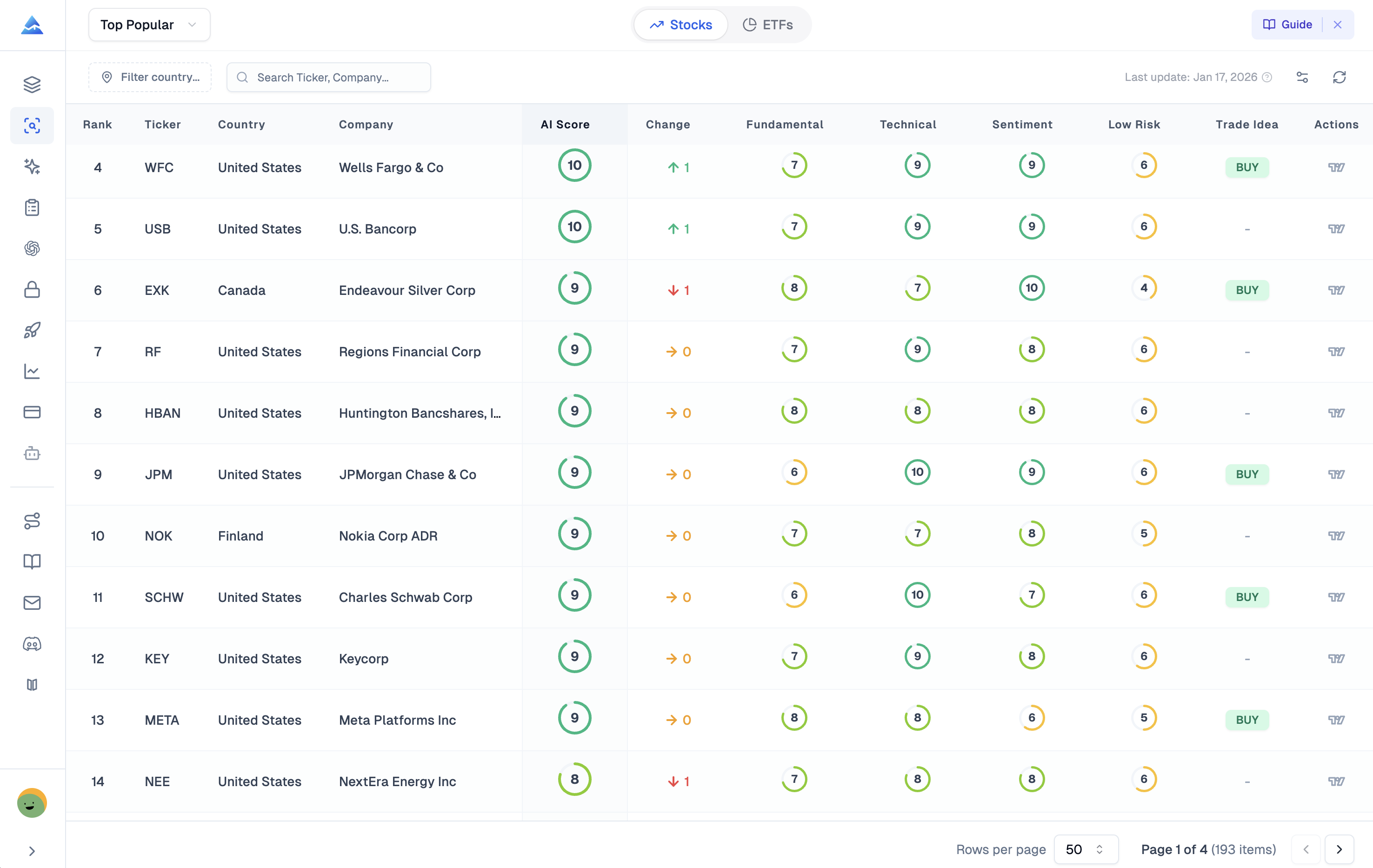
The stock list displays AI Score and supporting fields such as Fundamental, Technical, Sentiment, and Low Risk where available. The ranked data is supplied through Pineify's Danelfin data integration. It should not be represented as a separate Pineify model whose performance has been independently established here.
Check the displayed update date and the selected market or category. Loading the page again retrieves the latest available list; it does not prove that every underlying input was recomputed at that moment. Fields and coverage can differ across categories.
A 9/10 score is not a 90% chance of a profitable trade. Before interpreting any ranking, establish its intended horizon, source methodology, and available evidence. This article does not present a portfolio backtest, accuracy benchmark, or personal trading result from following the scores.
Create a shortlist before opening every detail panel
Choose the available market and category, review a curated list, and use supported country or symbol controls. Inspect the column definitions and update date before comparing names. The visible list controls do not establish an arbitrary custom screen across every financial metric.
For a hypothetical workflow, select a dividend-oriented list, choose a few companies whose businesses you understand, then examine cash flow, debt, and dividend history. A high yield alone does not establish that a dividend is sustainable.
Once you select a symbol, the detail drawer provides chart, overview, options, financial, analysis, news, performance, and event views where supported. ETF views differ from company views. Availability depends on the instrument, source data, and account access.
Review financials and analyst expectations
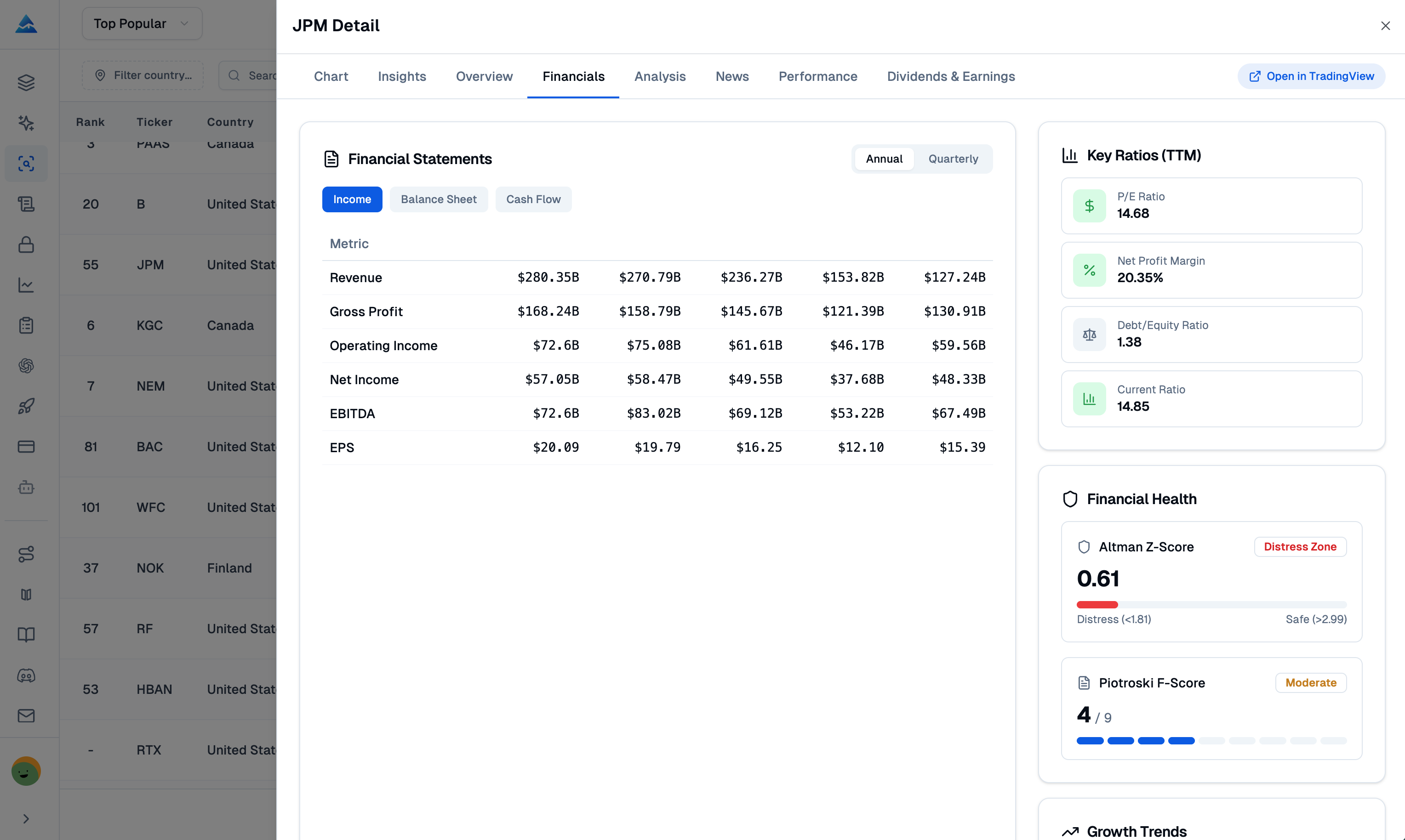
Use the Financials and Analysis views to inspect the reported business results and available estimates. Keep fiscal periods, currencies, and adjusted versus reported measures consistent. Check important figures against the original company report.
An analyst target is a forecast with a date and assumptions. A health score is a model output. Neither should be treated as a guaranteed future price or a complete assessment of solvency. Missing fields and short histories should remain visible rather than being filled with assumptions.
A chart or historical performance comparison describes past observations. Confirm the benchmark, period, and return definition before drawing a conclusion; the presence of a performance panel does not establish risk-adjusted performance for an AI-selected portfolio.
Inspect options contracts before interpreting summaries
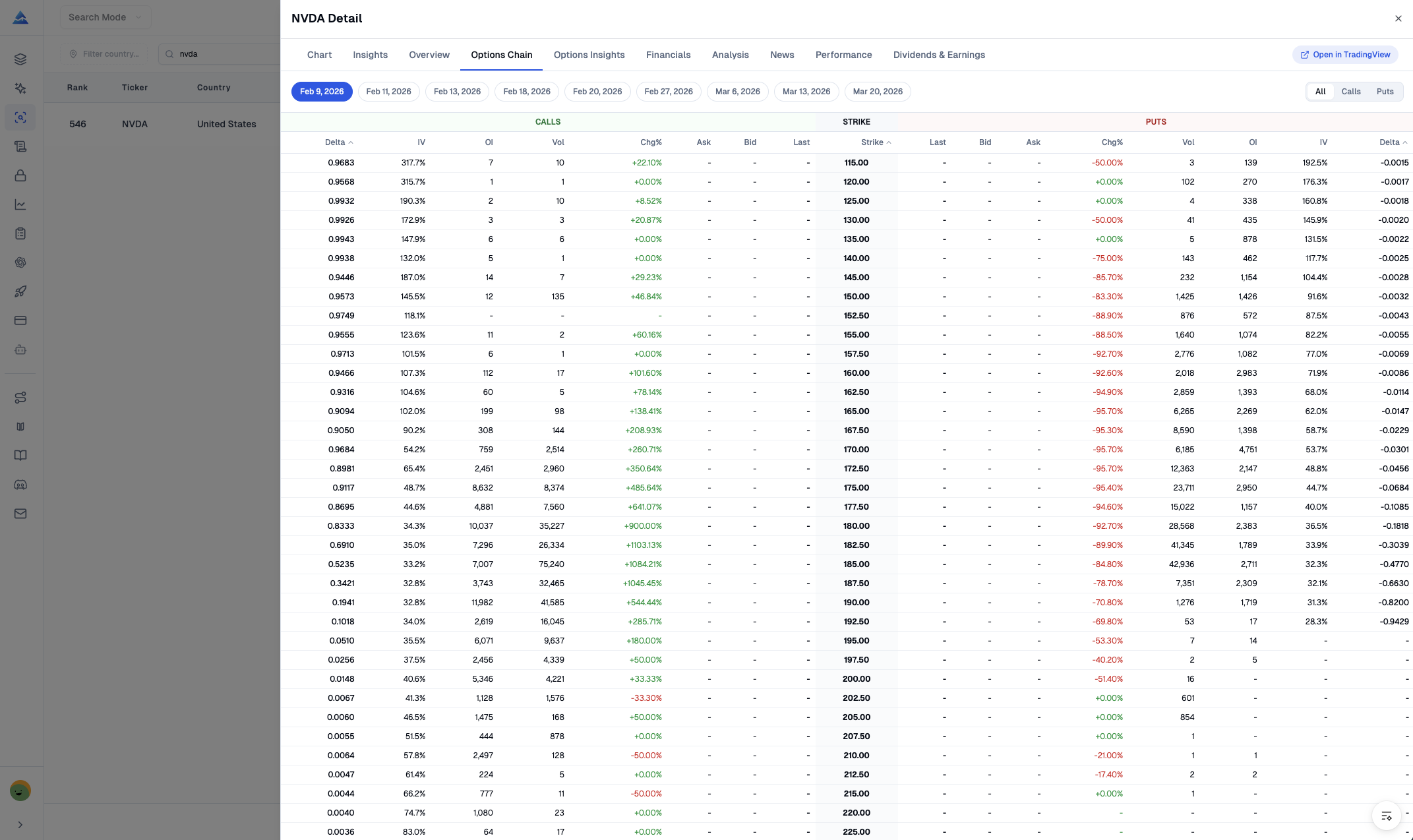
The Options Chain and Options Insights views provide available contract and summary data. Verify the underlying, expiration, strike, contract type, quote timestamp, and bid/ask spread. Greeks and implied volatility can be missing. Recently retrieved data is not necessarily a synchronized or complete live chain.
Options Insights uses a bounded snapshot. Its put/call summaries and max-pain display reflect the returned contracts, which can span expirations. Do not interpret that display as a verified complete calculation for one expiration without checking the contract set. A max-pain calculation does not establish where the underlying will settle.
The unusual-activity list ranks available contracts by volume relative to open interest. That ratio alone does not identify opening trades, institutional ownership, hedging intent, or an informed directional bet.
Expected-move displays use different approximations
The separate Expected Move view estimates a range by expiration using an underlying price and available near-the-money implied volatility. Its approximation is:
expected move = underlying price × annualized IV × sqrt(days to expiry / 365)
For a hypothetical $100 underlying, 20% IV, and 30 days to expiration, this is about $5.73 in either direction before considering the model's limitations. It is an estimate, not a price barrier or a guaranteed probability interval.
The Expected Move card within Options Insights uses a different approximation based on 85% of the sum of available near-the-money call and put daily closes. The two displays need not match. Different inputs, times, strike availability, and formulas can explain the difference; do not silently substitute one for the other.
Use charting as another check
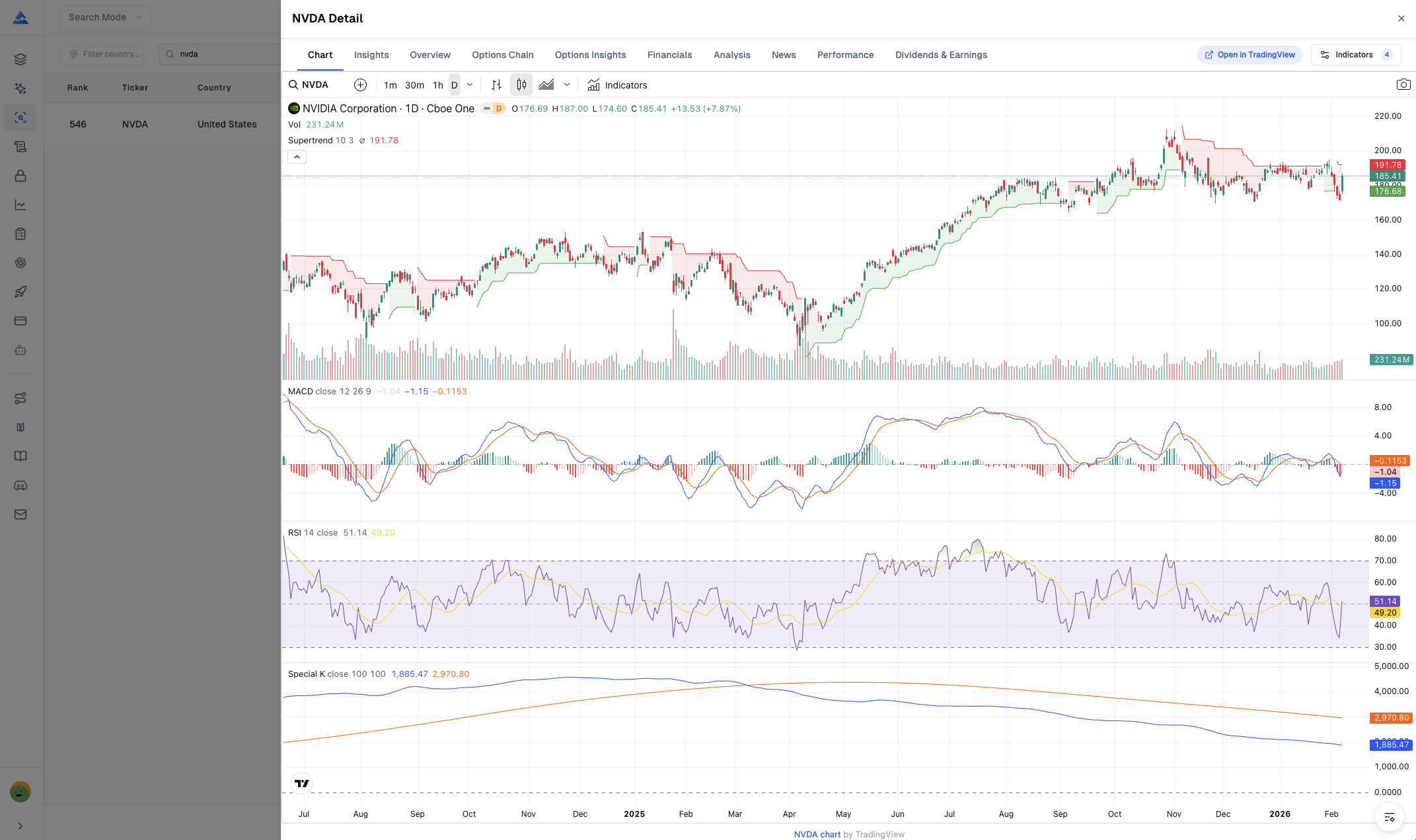
The symbol drawer includes TradingView chart widgets, supported study selection, and an Open in TradingView link. Use the chart to inspect dates and price behavior. A chart embed does not give every TradingView feature or exchange-data entitlement to the Pineify account.
A short review record for each candidate
Save the symbol, category, score date, reason for interest, key company evidence, upcoming event, and unresolved question. If options are involved, also record the specific expiration, contract identifiers, quote times, and which contracts a summary covers. This makes it possible to revisit the thesis without retroactively turning a good price move into proof that the original score was predictive.
Check current feature access before purchasing, then open the AI Stock Picker to inspect the available lists and symbol views.
Does a higher AI Score guarantee a better return?
No. A ranking summarizes a model's assessment. It is not a calibrated probability of profit or a substitute for checking the business, valuation, timing, and downside.
Is Options Insights a complete live options chain?
Do not assume that. The view works from a bounded set of returned contracts. Check timestamps, expirations, missing fields, and coverage before using aggregate metrics.
Why can two expected-move values differ?
The separate Expected Move view uses an IV-and-time formula, while the Options Insights card uses a straddle-price approximation. Different inputs and methods can produce different estimates.