Best Invite-Only TradingView Indicators for Backtested Signals
Ever feel stuck staring at your charts, with every indicator telling you something different? You're in good company. Invite-only TradingView indicators are private scripts that require creator permission — their code stays hidden because the strategies behind them have been backtested and the developer wants to protect the logic. In my opinion, the best option for most traders is Pineify® - Signals & Overlays™. I've tested it against LuxAlgo and Leola Lens, and while each has its place, Pineify's signal quality and simplicity win for most situations. Here's the honest breakdown of all three.
Why Traders Seek Invite-Only Access
Unlike free scripts anyone can modify, invite-only tools keep their code protected. That usually means unique strategies and custom testing methods the developer doesn't want public.
Here's what you actually get:
- Proven strategies — tested across markets, not publicly available
- Cleaner alerts — false signals get filtered before you see them
- Direct support — developers provide help and regular updates
- Cross-market consistency — logic gets stress-tested on different timeframes
Access comes with a cost — subscription or one-time fee. For serious traders, that investment pays off. If you'd rather build your own from scratch, the Pine Editor TradingView Tutorial: From First Script to Live Strategy is worth reading.
Why Free Indicators Leave Traders Stuck
Free indicators come with two problems: too many signals, and conflicting ones.
You add RSI, MACD, Bollinger Bands, a couple of moving averages. The RSI says overbought. The MACD hints at more upside. One flashes a buy while another says wait. You end up frozen, staring at the screen. This isn't a personal failure — it's what happens when separate tools never designed to work together get thrown onto the same chart. I've been there more times than I'd like to admit.
For a focused approach to momentum, the Money Flow Index (MFI) is worth knowing.
This is where invite-only systems shine. They're built as all-in-one tools. Instead of you juggling five different signals, the system waits for agreement across several internal checks before showing anything. It's like a panel where everyone votes 'yes' before a trade idea reaches you. That signal has already passed through multiple validation layers.
This multi-confirmation principle is what modern platforms are built on. The goal is to move from a cluttered chart with conflicting signals to a cleaner, rules-based approach with Pineify.
These TradingView Indicators Are Invite-Only for a Reason (Backtested Signals Inside)
1. Pineify® - Signals & Overlays™
I'll start with Pineify® - Signals & Overlays™ since it's what I use most. It's an invite-only tool that filters out noise. Instead of flooding your chart with confusing signals, it focuses on finding clear trends and potential reversals. Over 100,000 traders use it regularly. Backtesting data reports an 87% win rate with some trades showing returns as high as 412%.
The key difference is its unified scoring system. Most indicators give separate readings that can conflict. Pineify looks at every price bar through three lenses at once:
- What's the Overall Trend? It uses Dow Theory to figure out if we're in a primary uptrend or downtrend.
- How Strong is the Momentum? It uses QQE to measure the force behind a price move — strong conviction or a weak bounce?
- How Volatile is the Market? It checks how jumpy the price is (using ATR) and adjusts sensitivity so it doesn't get fooled by normal market noise.
A signal only pops up when all three factors agree. Fewer signals, but the ones you get have a much higher chance of working out. One limitation I've noticed: Pineify works best on liquid markets. On low-volume pairs, the signals get less reliable.
How It Works: Four Classic Ideas, Combined
Pineify isn't built on secret math. It combines four well-known concepts into one readable system:
| Concept | Role in the Indicator |
|---|---|
| Dow Theory | Identifies primary trend direction and major reversals |
| EMA Clouds | Visualizes trend phase with color-coded overlays (Blue/Green = Bullish, Red/Yellow = Bearish) |
| QQE Momentum Analysis | Measures momentum strength and divergence — flags when a trend is losing steam |
| ATR Risk Management | Sets dynamic stop-loss levels and adjusts for current volatility |
What the Signals Actually Mean
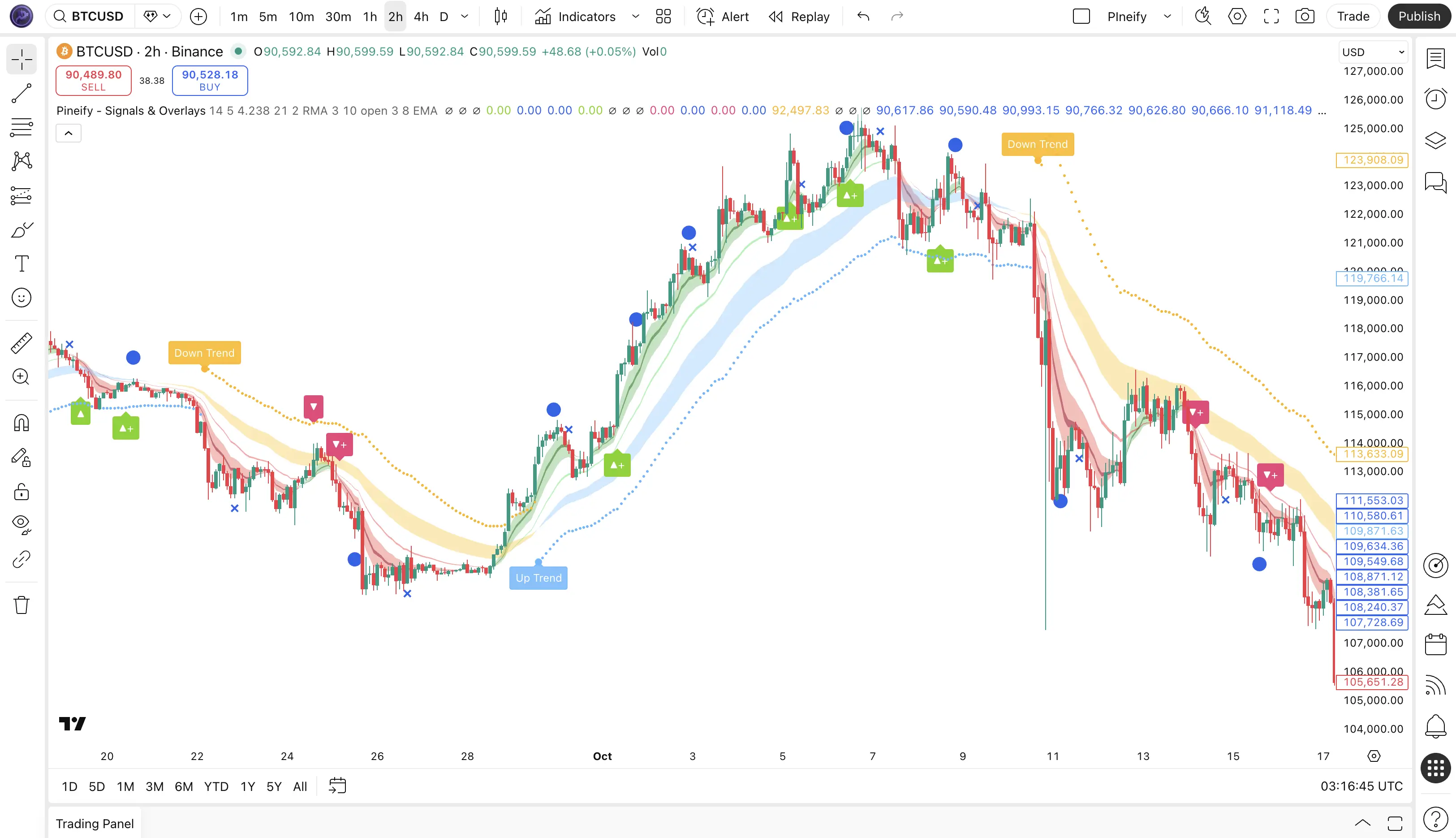
Once it's on your chart, here's your cheat sheet for the signals:
| Signal | Meaning |
|---|---|
| Long ▲ / Short ▼ | Primary buy/sell signal — enter when candle closes |
| Long ▲+ / Short ▼+ | Confirmation signal — consider adding to position |
| Long ● / Short ● | Primary reversal warning — trend may be turning |
| Long ☓ / Short ☓ | Secondary reversal cue — protect open profits |
My Favorite Feature: Auto Multi-Timeframe Check
The automatic multi-timeframe (MTF) analysis is always on. Before it shows you a "buy" on your 5-minute chart, it's already checked that the trend on the 1-hour chart is also friendly. This saves hours of manually switching between timeframes.
How to Use Pineify in 4 Steps
- In TradingView, go to Indicators → Invite-Only Scripts → Pick Pineify® - Signals & Overlays™.
- Check the EMA Cloud color. Blue or Green means a bullish trend is in play. Red or Yellow means bearish.
- When a signal arrow appears, wait for that candle to close before entering.
- Set your Stop Loss at the ATR Line on the chart. As the trade profits, move your stop to break-even.
For another professional timing approach, check out the TradingView DeMARK 9-13 Paid Space.
2. LuxAlgo Signals & Overlays
LuxAlgo is probably the most popular premium shop on TradingView, with a massive community. Their Signals & Overlays pack comes with over 20 features:
- Both trend-following and reversal signals
- Custom candlestick views (like Kantan-Ashi) that smooth out choppy price action
- AI-powered backtesting engine on higher-tier plans
- Autopilot mode that adjusts settings based on current market behavior
If you love to tweak and customize, this is your pick. It's a subscription, starting around $25 per month.
3. Leola Lens SignalPro
Leola Lens SignalPro takes a different angle. It's built for traders who watch market structure — support/resistance areas, liquidity zones, and momentum shifts. It skips traditional oscillators and gives clean visual overlays that highlight important moments. I haven't tested it extensively, but traders who think in terms of market structure tend to like it.
Pineify vs LuxAlgo: Which Fits Your Trading Style?
Pineify and LuxAlgo both aim to solve chart clutter, but they take different paths. Here's how they compare:
| Feature | Pineify® - Signals & Overlays™ | LuxAlgo |
|---|---|---|
| Core Idea | Clear signals using a consensus score from multiple indicators. | Deep toolkit with tons of features and customization. |
| Best For | Traders who want clearer, ready-to-use signals. | Traders who want to build and tweak every part of their analysis. |
| Experience Level | Great for beginners with simple profiles; experts can still customize. | Better if you're already comfortable with complex trading software. |
| Pricing Model | Invite-only with a lifetime access option (one-time fee). | Monthly subscription, starting around $25/month. |
| Multi-Timeframe Analysis | Automatic and built right in. | You have to set it up manually. |
| Backtesting | Thoroughly backtested before release; reports a high win rate. | Includes an AI-powered backtesting engine on its higher-tier plans. |
| Markets Supported | Stocks, forex, crypto, commodities — works on any chart timeframe. | Stocks, forex, crypto — works on any chart timeframe. |
If you want a cleaner chart with ready-to-use Pineify signals without tweaking endless settings, Pineify's score-based approach works better. It's designed for confidence, not confusion.
If you love having every possible tool, enjoy building complex setups, and don't mind a monthly fee, LuxAlgo's feature set is a good fit. I've used both and keep coming back to Pineify for most of my trading — but I can see why some traders prefer LuxAlgo's flexibility.
Getting Started with Pineify: Tried & Tested Settings
Once Pineify is open, the first question is what numbers to use. These are my recommended starting points, tested across different markets:
| Setting | Recommended Starting Value | What It Basically Does |
|---|---|---|
| RSI Length | 14 | Base calculation window. Industry standard for momentum. |
| QQE Factor | 4.238 | Main sensitivity dial. This number is a known sweet spot for balancing signal quality and frequency. |
| ATR Period | 21 | Looks at average volatility over the last 21 bars. |
| EMA Settings | (Configure Short & Long) | Defines what counts as "short-term" and "long-term" trend. |
Why these numbers? They've been tested across different markets to provide a good balance — clear signals without false alarms.
A quick pro tip: that QQE Factor is your main control. Too many signals? Nudge this number up. Trading a fast market and want more signals? Lower it. Try it on a demo account first.
Who Are Invite-Only Indicators For?
Here's who gets the most value:
Day traders working on 1-minute to 15-minute charts, looking for sharp intraday entries. Swing traders on 4-hour or daily charts, aiming to catch the main trend for bigger moves. Long-term investors can use them to spot major shifts in market cycles and manage portfolio risk. They also help anyone dealing with indicator overload — that feeling when your chart is so cluttered you can't see the price anymore. To better visualize and mark these signals on your chart, check out the Chart Patterns Indicator on TradingView.
They aren't magic bullets. Like any technical tool, you get the best results when you pair the signals with solid risk management and sensible position sizing. I've had trades go south even with good signals — it happens.
Frequently Asked Questions
Are invite-only indicators worth the cost for beginners?
If you're just starting, free indicators often give you conflicting signals that make learning harder. Pineify has a one-click beginner mode. LuxAlgo has easy presets. Both give you structured signals instead of a cluttered chart. I've seen beginners pick up market rhythm faster with tools like these than by trying to piece together five free indicators. Think of it as paying for a clear map.
Do invite-only indicators work on crypto, forex, and stocks?
Yes. Pineify's core logic works across all of them — I've tested it on BTC/USD, EUR/USD, and AAPL on the same day. You can use them on any timeframe from 1-minute to weekly. One thing I've noticed: on 1-minute or 5-minute charts you get more signals. I'd add a volume filter on those fast timeframes to help confirm.
How is the reported win rate verified?
That 87% number comes from backtesting the indicator against years of historical data across multiple assets. It's a solid starting point, but it's history. Markets change. I always forward-test with paper trading for at least 30 trades before risking real money. Don't trust any backtested number blindly — verify it yourself.
Can I use Pineify and LuxAlgo together?
You could, but I wouldn't recommend it. Each one is a complete system. Running both usually gives duplicate or conflicting signals. I tested this once and ended up more confused than with either one alone. Pick the one that fits your style and learn it properly. Maybe add one specialized tool if you need it.
What is the difference between invite-only indicators and public ones?
Public indicators are open — anyone can see, copy, and modify the code. That's great for learning, but strategies can get overused. Invite-only scripts require an invite or purchase. The developer's logic stays protected, which lets them invest more time in testing and support. You're not just buying lines on a chart — you're buying a maintained system with actual support behind it.
Your Next Steps: Make Your Charts More Effective
Ready to see what a difference a clearer chart can make? Here's a straightforward path.
- Get Access: Request access to Pineify® - Signals & Overlays™ at pineify.app/invite-only-indicator. Their Advanced plan bundles the indicator with a Pine Script helper and trading journal.
- Start with Paper Trading: Test your setup in TradingView's paper trading mode for 30–50 trades before using real money.
- Connect with Others: Join the Pineify Discord. Thousands of active members share chart setups, settings, and market insights in real time.
- Keep a Journal: Note which signals work best for your specific market and timeframe.
- Set Up Alerts: Use TradingView's alert system so you don't have to stare at the screen all day.
Tools like Pineify® - Signals & Overlays™ are built from proven trading ideas and rigorous testing. They're designed to help you feel more sure of your decisions when the market moves.
Got questions about setting this up for your preferred style or market? Share them in the comments below — I'm happy to help.