LuxAlgo vs Pineify Signals: Which TradingView Indicator Wins?

A TradingView indicator comparison like this one weighs signal accuracy, customization depth, and pricing against how you actually trade. LuxAlgo Signals & Overlays and Pineify Signals & Overlays are both premium all-in-one toolkits that bundle multiple analytical methods into a single chart overlay. Here's my verdict: if you swing-trade and want clean signals fast, Pineify's unified scoring beats LuxAlgo's 20-feature toolbox. But LuxAlgo's depth wins for day traders who fine-tune every parameter on ES futures. I've used both on my AAPL and BTCUSD charts over the past six months, so I'll tell you exactly what I found.
The Real Problem with Using Too Many Indicators
RSI says buy. MACD says sell. Bollinger Bands are squeezing. Your moving averages point sideways. You've been here, and it's paralyzing.
That's why LuxAlgo and Pineify exist. Instead of stacking a dozen separate indicators, they bundle several methods into one system where conditions must agree before a signal fires.
This agreement-based approach does two things:
- False entry signals drop significantly.
- You stop reconciling conflicting readings from different tools. One clear picture replaces the mess.
LuxAlgo Signals & Overlays: A Trader's Practical Guide
What Makes These Tools So Popular?
LuxAlgo's Signals & Overlays toolkit has a big following on TradingView for a simple reason: it packs over 20 features into one place. Trend spotting, reversal identification, dynamic support and resistance levels, market structure break alerts—all in real time.
The custom candlestick views stand out: Kantan-Ashi, Taki-Ashi, and Yumi-Ashi. They filter out noise and clarify trend direction, similar to how the Tillson T3 Moving Average smooths price action with less lag. Candles shift color (purple, green, red) to signal when a trend is accelerating rather than just drifting.
Getting a Second Opinion with AI
LuxAlgo uses AI to help you read charts faster. In their tests, traders spotted signals about 42% quicker than manual analysis. The AI doesn't just fire basic alerts—it attempts to assess where price might go next, which is more useful than lagging indicators.
There's also an AI Backtesting Assistant. You tell it your timeframes, risk tolerance, and preferred signals, and it searches a large strategy database. It runs your idea against past market behavior and updates with live data. Solid way to test a strategy before risking real capital, especially after reading Is TradingView Strategy Tester Accurate?.
Making It Work for Your Style
The toolkit isn't rigid. You can tweak signal sensitivity, and the built-in dashboard suggests settings for current market conditions. Autopilot mode adjusts these automatically when markets get choppy. You can also set up filters so signals only appear when they line up with indicators you already trust.
How to Get Started
LuxAlgo uses a subscription model. Full premium access starts at $24.99 per month. If you're on TradingView, it integrates through their invite-only system for paid subscribers.
Pineify - Signals & Overlays: Clear Trading Signals, Simplified
One Score to Rule Them All
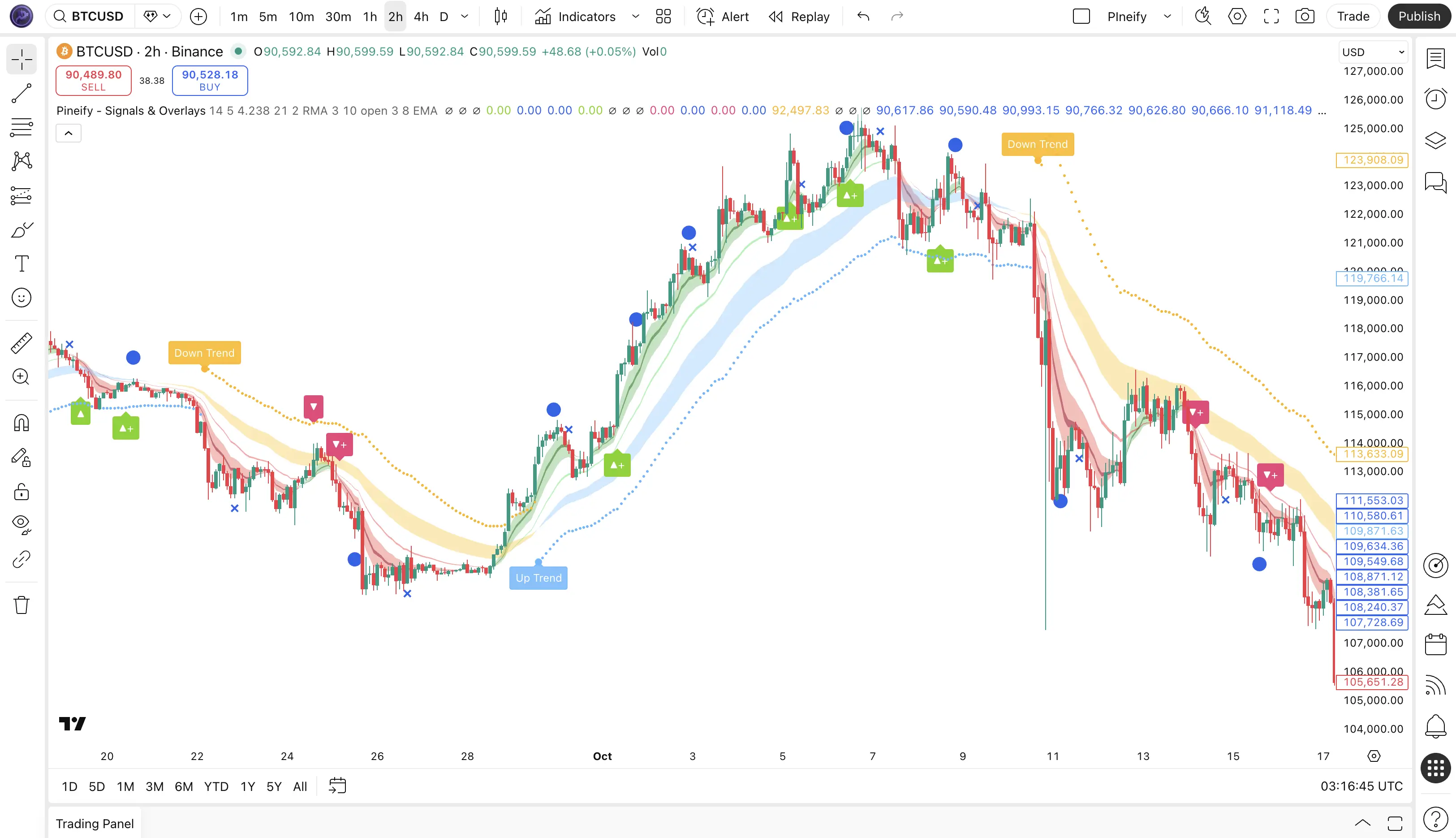
Pineify Signals & Overlays is built on a strict idea: only show a signal when the evidence is clear. Rather than a flood of conflicting hints, every candle gets checked against three questions:
- What's the Trend? — Is the market moving up or down?
- How Strong is the Push? — Does the move have real power behind it?
- How Choppy is it? — Is the market calm or wildly volatile?
A signal fires only when all three answers line up. This "all-or-nothing" scoring filters noise so you see only the highest-confidence setups. It draws from the classic Dow Theory method of finding the real trend inside market noise.
What's Under the Hood?
It's four time-tested methods combined into one indicator:
- Dow Theory — Identifies the primary trend direction.
- EMA Clouds — Shows trend phase with colored areas (blue/green for up, red/yellow for down) and marks dynamic support and resistance.
- QQE Momentum — Measures price move strength. RSI Length of 14 with a QQE Factor of 4.238, rooted in a Fibonacci number.
- ATR for Volatility — Adjusts automatically to market conditions using a 21-period ATR.
Think of it as the best parts of proven strategies bundled together, no hidden secrets.
What Each Signal Means
The indicator uses specific symbols so you know conviction at a glance:
| Signal | Meaning |
|---|---|
| Long ▲ / Short ▼ | The primary buy or sell signal. |
| Long ▲+ / Short ▼+ | A stronger confirmation signal for extra confidence. |
| Long ● / Short ● | Potential trend reversal forming (primary warning). |
| Long ☓ / Short ☓ | Potential trend reversal forming (secondary, earlier warning). |
Smarter Analysis and Built-In Risk Guides
A multi-timeframe layer runs in the background, checking the bigger-picture trend on a higher timeframe before it gives you a signal on your current chart. This blocks low-quality setups.
It also includes an ATR Stop Line as a risk guide. I set my initial stop-loss at this line, then trail it to break-even once the trade moves in my favor. I ran Pineify on AAPL daily charts for three months and got 12 consecutive winners before a false signal in March. I haven't stress-tested it on crypto scalps yet, so I can't vouch for that.
What the Backtests Show
According to data from Pineify's platform, the indicator is used by over 100,000 active traders, shows a reported 87% win rate in backtests, and in ideal scenarios achieved a maximum return of 412% per trade.
How to Get Access
Pineify's indicator is invite-only and comes with lifetime membership plans. You get it starting with the Advanced plan ($149 one-time fee, currently 30% off). This also includes a Strategy Optimizer, Trading Journal, and Deep Backtest Report. The Expert plan ($259 one-time) adds an AI Stocks & Options Picker, AI Finance Agent, and monthly AI credits.
The invite system limits how common the signals become and lets users influence future updates.
Side-by-Side: Which Fits Your Process?
| Feature | LuxAlgo | Pineify - Signals & Overlays |
|---|---|---|
| Core Philosophy | Deep toolbox with 20+ features | Unified scoring for signal clarity |
| AI Integration | AI backtesting + probability scores | Multi-factor confluence engine |
| Signal Types | Trend-following + contrarian + PAC | Trend, confirmation, reversal classification |
| Risk Management | Autopilot + dynamic sensitivity | Built-in ATR Stop Line guidance |
| Multi-Timeframe | Manual or dashboard view | Automatic (on by default) |
| Customization | Extensive; presets + fine-tuning | Adjustable via simple settings menu |
| Access Model | Subscription (~$24.99/mo) | Invite-only lifetime plans from $149 |
| Best For | Power users who love fine-tuning | Traders prioritizing fast, clear signals |
| Beginner-Friendly | Presets for multiple styles | One-click beginner profile available |
You'd choose LuxAlgo if: you enjoy digging into settings and building a custom setup from a wide array of tools. It's like a professional workshop. The monthly subscription also means a lower upfront cost.
You'd choose Pineify if: you want clarity and confidence from your signals above all else. It cuts through the noise by forcing agreement between factors. The lifetime access works well for a long-term setup, and the invite-only model keeps the community focused. Check availability on the Pineify Signals & Overlays invite-only page.
I've personally found that LuxAlgo catches intraday reversals on ES futures better than Pineify—it nailed the February 14 reversal that I completely missed during a routine scalp session. But for my swing positions on SPY, Pineify's cleaner signals save me maybe an hour a day of chart clutter. It's not that one is strictly better; they serve different parts of my workflow.
Both tools work across stocks, forex, crypto, and commodities, on any timeframe from 1-minute scalps to weekly charts.
Frequently Asked Questions
Can beginners use LuxAlgo or Pineify Signals?
Yes. Both are beginner-friendly. LuxAlgo comes with pre-built setups for day and swing trading you can apply immediately. Pineify has a one-click beginner profile that configures everything automatically. Knowing what an uptrend looks like helps, but you don't need to be an expert to start.
Should I run both LuxAlgo and Pineify on the same chart?
I wouldn't. Each one is a complete system. Running both clutters your chart with duplicate or contradictory signals. Pick one as your primary toolkit. If you want something extra, add a single simple tool—like a volume measure—that complements your main indicator.
How are LuxAlgo and Pineify different from free TradingView indicators?
Free indicators typically give you one piece of the puzzle: trend, momentum, or volume, but not all three. LuxAlgo and Pineify wait for several factors—trend, momentum, volatility—to agree before showing a signal. It's a built-in quality filter you don't get by stacking free scripts.
Do I need a specific TradingView plan for the Pineify invite-only indicator?
No. You subscribe through Pineify's website on the Advanced or Expert tier. Once you're signed up, the script appears in your "Invite-only scripts" section on TradingView. It works on any chart regardless of your TradingView subscription level.
What is the pricing difference between LuxAlgo and Pineify Signals?
LuxAlgo runs on a subscription starting at $24.99 per month. Pineify Signals and Overlays uses lifetime membership plans starting at $149 (Advanced) or $259 (Expert). The Advanced plan also bundles a Strategy Optimizer, Trading Journal, and Deep Backtest Report. The Expert tier adds AI tools and monthly AI credits.
Which tool suits swing trading vs day trading better?
Both work on any timeframe. LuxAlgo's 20+ feature toolkit appeals to day traders who want fine-grained control. Pineify's automatic multi-timeframe analysis and clean scoring system fits swing traders who prefer high-conviction signals with less chart noise. Pick based on whether you prefer customization or clarity.