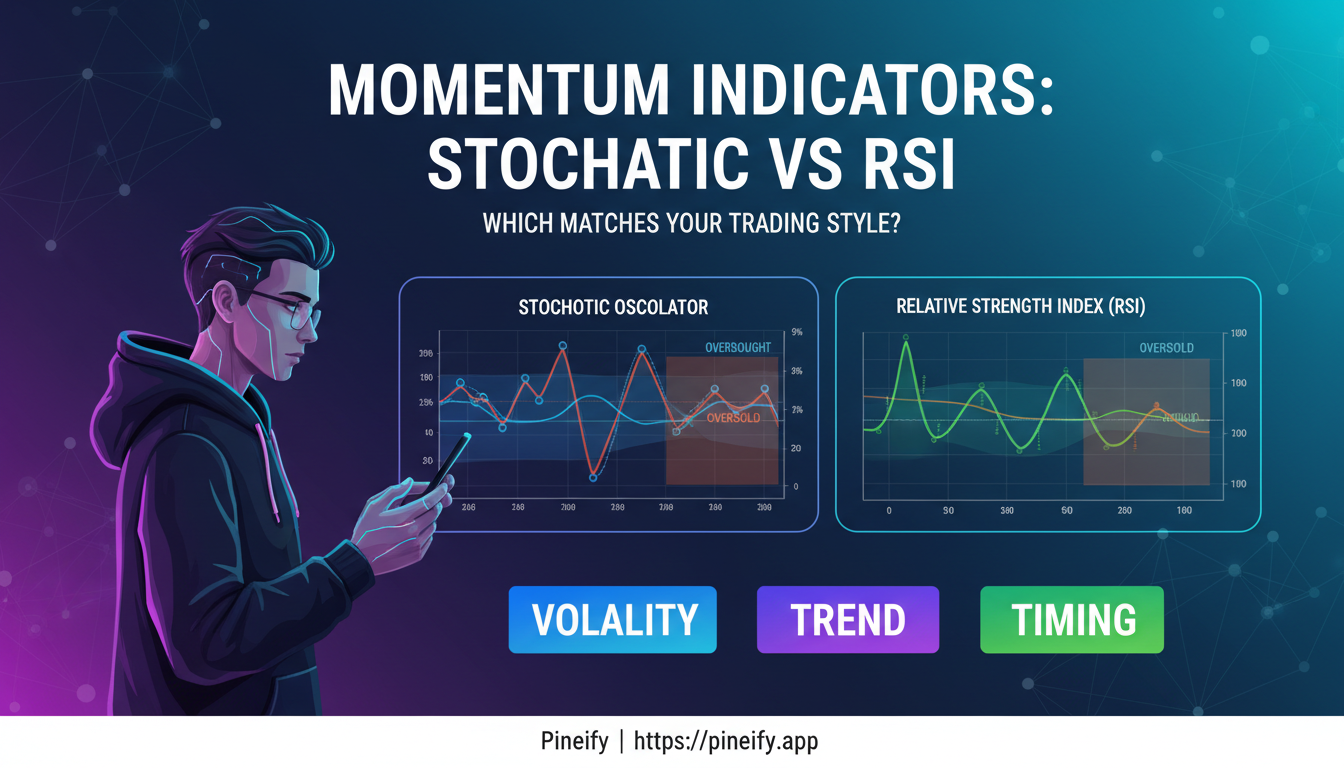
Stochastic Oscillator vs RSI: Which Momentum Indicator Matches Your Trading Style?
Two of the most common momentum tools you’ll see in technical analysis are the Stochastic Oscillator and the Relative Strength Index (RSI). They might look similar at first glance on a chart, but they work in completely different ways. Once you understand the difference, you’ll have a much easier time picking good entry points and confirming whether a trade makes sense.
What’s the RSI?
The Relative Strength Index (RSI) is a momentum indicator that J. Welles Wilder Jr. came up with way back in 1978. It measures how fast and how much prices have changed recently by comparing the average gains to the average losses over a default lookback of 14 candles. The result is a single line that swings between 0 and 100. If you're new to Pine Script, our Pine Script Tutorial will help you get started with coding indicators like the RSI.
Here’s how people typically read it:
- Above 70 → Overbought — the price might be due for a pullback
- Below 30 → Oversold — the price might be due for a rebound
- Above 50 → Bullish momentum is in control; Below 50 → Bearish momentum is in control
You’ll almost never see the RSI hit exactly 0 or 100 because its formula smooths out gains and losses with an average. That smoothing helps filter out a lot of the noise in fast-moving markets.
What Is the Stochastic Oscillator?
The Stochastic Oscillator was created by Dr. George Lane back in the late 1950s. Instead of comparing gains and losses like some other tools, it looks at where today’s closing price sits compared to the highest and lowest prices over a recent period. The basic idea: in a strong uptrend, prices often close near the top of that range; in a downtrend, they tend to close near the bottom.
The oscillator shows two lines:
- %K — the fast line:
(Close – Lowest Low) / (Highest High – Lowest Low) × 100 - %D — the signal line: a 3-period simple moving average of %K
Here are the typical levels people watch:
- Above 80 → Overbought (might be due for a pullback)
- Below 20 → Oversold (might bounce soon)
- %K crossing above %D while below 20 → possible buy signal
- %K crossing below %D while above 80 → possible sell signal
Because the Stochastic is simply a percentage of where the price is within its recent range, it can hit exactly 0 or 100 — and it often does. That makes it a lot more sensitive than the RSI, which rarely reaches those extremes.
RSI vs Stochastic Oscillator: What's the Difference?
When you're trying to figure out whether a market is overbought or oversold, two indicators often come up: the Relative Strength Index (RSI) and the Stochastic Oscillator. They look similar at first glance, but they work differently and are best used in different market conditions. Here's a quick side-by-side comparison to help you decide which one fits your trading style.
| Aspect | RSI | Stochastic Oscillator |
|---|---|---|
| Creator / Year | J. Welles Wilder Jr., 1978 | Dr. George Lane, late 1950s |
| Calculation Base | Average gains vs. average losses | Closing price vs. recent high-low range |
| Output Lines | Single line | Two lines (%K and %D) |
| Overbought Level | 70 | 80 |
| Oversold Level | 30 | 20 |
| Sensitivity | Slower, smoother — fewer signals | Faster, more reactive — more signals |
| Best Market | Trending markets | Range-bound / sideways markets |
| False Signals | Lower risk of false signals | Higher false signal risk in trends |
| Reaches Extremes (0/100) | Rarely | Frequently |
If you want to dive deeper into the nuances, check out this article for more context.
For another momentum-based approach, explore the Triple EMA Trading Strategy to see how exponential moving averages can be combined for powerful signals.
How Each Indicator Performs in Different Market Conditions
Trending Markets: RSI Has the Edge
When the market is moving strongly in one direction, the RSI tends to be the better choice. In an uptrend, the RSI usually stays between 40 and 80, only dipping to the 40–50 area during pullbacks. This makes it easier to spot good re-entry points without jumping out of the trend too early. The Stochastic, on the other hand, often gives overbought or oversold signals that go against the main trend, which can trick traders into exiting too soon or trying to catch a reversal that hasn’t started yet.
Sideways / Range-Bound Markets: Stochastic Wins
When price is bouncing between support and resistance with no clear direction, the Stochastic Oscillator really shines. The RSI tends to just hang around its neutral 40–60 zone without giving many clear signals you can act on. But the Stochastic’s %K and %D lines crossing near the 20 and 80 levels provide straightforward buy-and-sell signals within that range. If you’re a swing trader or day trader working inside a defined price channel, the Stochastic is your friend in these calm, sideways conditions.
Short-Term Trading and Scalping
For very short timeframes, the Stochastic’s speed makes it a better fit. It catches small shifts in momentum quickly and can give you multiple trading signals in a single session. The RSI, because it smooths out price data, tends to lag behind those sharp intraday moves. That said, more signals also mean more noise, so you’ll want to use the Stochastic with extra confirmation tools to filter out the false starts.
Advantages and Disadvantages at a Glance
RSI: Pros and Cons
What’s good about it:
- It stays smooth and reliable when the market is trending in one direction.
- Great for spotting price-indicator divergences — that’s when price and the RSI move in opposite directions, hinting the trend is losing steam.
- Super easy to read since it’s just one line, not a set of fixed levels you have to remember.
- The way it averages the data means it naturally filters out a lot of market noise.
What’s not so great:
- It can be slow to react when prices make a sudden, explosive move or a sharp reversal.
- In strong trends, the RSI can sit in overbought or oversold territory for way longer than you’d expect.
- It doesn’t shine in sideways, choppy markets where price just wobbles back and forth.
Stochastic Oscillator: Pros and Cons
What’s good about it:
- It responds quickly to short-term price swings — you’ll see changes almost immediately.
- Works really well in range-bound markets where price is bouncing between clear support and resistance.
- The two lines crossing each other gives you clear, actionable buy and sell signals.
- It often detects momentum divergences early, sometimes before price even confirms a reversal.
What’s not so great:
- In strong trending markets, it can throw out a lot of false signals.
- Because it’s so sensitive, you might find yourself overtrading — jumping in and out too often.
- The accuracy depends a lot on the period settings you use; you’ll need to tune it for each asset and timeframe to get it right.
Using RSI and Stochastic Together
The real magic happens when you combine these two indicators. They each have their own strengths, and together they can help you avoid a lot of false signals. Here’s a setup that works pretty reliably:
- RSI tells you the bigger trend – if it’s above 50, the trend is up; below 50 means down.
- Stochastic gives you a timely entry – wait for the %K line to cross the %D line when it’s in an overbought or oversold zone.
- Price action seals the deal – look for a candlestick pattern, a touch of support or resistance, or a sudden volume spike.
Here’s a real‑world example: say you’re in an uptrend, RSI stays above 50, then stochastic dips under 20 and crosses back up. When all three line up, you’ve got a solid buy signal with way fewer fake‑outs. As one trader put it: “I use stochastic as a quick signal to spot a sharper shift in trend, while RSI serves more as confirmation of longer‑term direction.” To turn this combination into a full-fledged trading system, learn How to Create a Strategy in TradingView.
The Hybrid Option: Stochastic RSI (StochRSI)
If you're looking for a middle ground between the standard RSI and something faster, the Stochastic RSI (or StochRSI for short) might be just what you need. Instead of applying the Stochastic formula to price, it applies it directly to RSI values. That subtle shift makes a big difference. The idea was introduced by Tushar Chande and Stanley Kroll, and the result is an oscillator that hits overbought and oversold levels way more often than the regular RSI.
StochRSI Formula:
StochRSI = (Current RSI – Lowest RSI in n periods) / (Highest RSI in n periods – Lowest RSI in n periods) × 100
So when does it work best?
- Scalping and short-term momentum plays – because it's more sensitive to quick moves.
- Spotting precise reversals inside an already established trend.
- Any situation where the plain RSI barely gives you any signals – StochRSI fills that gap by moving around much more.
The catch? It's very sensitive. That sensitivity can lead to a lot of noise and false signals if you're not careful. To make it useful, you'll almost always want to pair it with a smoothing filter, like a simple moving average, to cut down on the churn.
Common Mistakes to Avoid
When you start using these indicators, it's easy to slip up. Here are the most frequent pitfalls I see traders make, and how to steer clear of them.
-
Trading solely on overbought or oversold readings — These are just alerts, not automatic buy or sell signals. Always wait for confirmation from price action or another indicator before making a move.
-
Forgetting the bigger trend — Both indicators work best when you trade in the same direction as the overall trend. Using them against the trend leads to lots of false signals.
-
Keeping the default settings without thinking — That standard 14-period setting might not fit every asset or time frame. Test and tweak the parameters based on what you're trading.
-
Overlooking divergences — When price heads one way and the indicator goes the opposite, that's one of the strongest signals you'll get. Ignoring it means missing high‑quality setups.
-
Chasing every stochastic crossover — Not all %K/%D crosses are worth your attention. Focus only on the ones that happen in extreme zones (below 20 or above 80) — those carry real weight.
Q&A: Common Questions About Stochastic vs RSI
Q: Is the RSI better than the Stochastic Oscillator?
Neither one is “better” in every situation. The RSI works well when the market is trending strongly, and it tends to give fewer false signals. The Stochastic, on the other hand, shines in sideways, range-bound markets where you get more frequent entry opportunities.
Q: Can I use both RSI and Stochastic at the same time?
Absolutely – a lot of professional traders do exactly that. A common approach is to use the RSI to confirm the overall trend direction, and then turn to the Stochastic for finer entry timing. It’s a solid combination.
Q: What are the default settings for each indicator?
The RSI usually comes with a 14-period lookback and overbought/oversold thresholds at 70 and 30. For the Stochastic, the defaults are %K(14), %D(3), with 80 and 20 as the overbought/oversold levels.
Q: Which indicator works better for day trading?
For day trading, the Stochastic Oscillator is often the better choice. It’s more sensitive and generates signals faster on short timeframes, which is exactly what you need when you’re trading intraday.
Q: What does divergence mean in RSI and Stochastic?
Divergence happens when the price moves one way but the indicator moves the opposite way. It’s a warning that the current momentum is weakening, and a possible reversal might be coming up.
Next Steps: Put Your Knowledge into Action
Now that you’ve got a handle on how the Stochastic Oscillator and RSI differ, here are a few practical ways to level up your trading without overcomplicating things:
- Backtest each indicator on your own — pick a market you actually trade and compare how the Stochastic vs. RSI behaves in both trending and choppy conditions. You’ll quickly see which one suits your style.
- Try a simple combo setup: Use the RSI reading above or below 50 as your trend filter. Then wait for a Stochastic crossover in the overbought or oversold zone to trigger your entry. It’s not perfect, but it can keep you out of bad trades.
- Play with StochRSI if you want faster signals on short timeframes like 5-minute or 15-minute charts. Just be aware it can be noisy.
- Keep a trading journal — jot down each indicator’s signal, what the market was doing, and whether the trade worked out. Over time, you’ll spot patterns that no generic guide can give you. And if you want a smarter way to track your trades, Pineify offers a built-in Trading Journal with auto-generated weekly and monthly performance reports, mood tracking, and session-based organization to help you find your edge faster. For more on the psychological aspect, check out our guide on Mastering Trading Psychology with Mood Tracking.
- Use divergence scanners on platforms like TradingView to automatically spot RSI and Stochastic divergences across many instruments. Saves time and helps you catch potential reversals you might miss otherwise.
Speaking of putting knowledge into action — why not build and test your own indicator strategies without writing a single line of code? With Pineify’s Visual Editor and AI-powered Pine Script Agent, you can turn any trading idea into an error-free TradingView indicator or strategy in minutes. Trusted by over 100,000 traders worldwide, it’s the ultimate 10-in-1 toolkit for modern traders.
Share your experience in the comments: Do you prefer RSI, Stochastic, or a mix of both — and why? Your answer might just help another trader refine their approach.