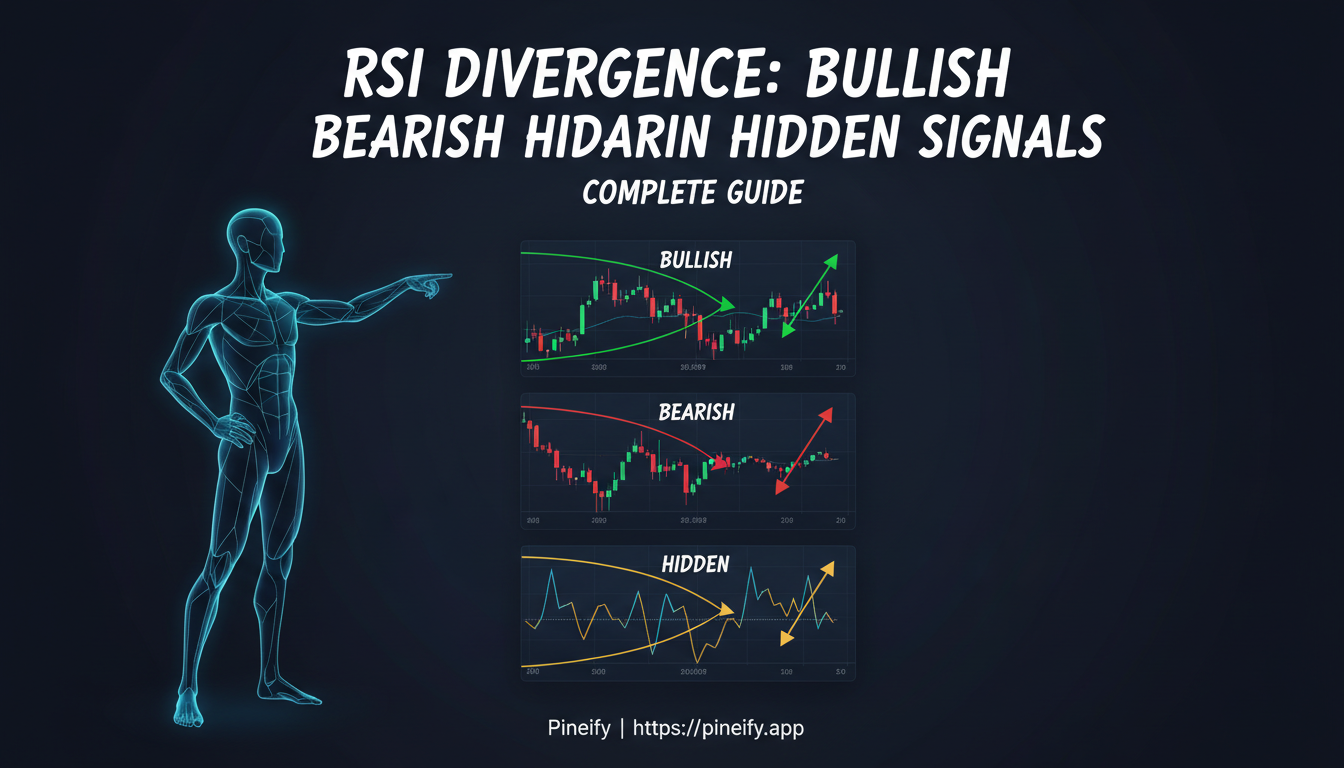
RSI Divergence: The Complete Guide to Bullish, Bearish & Hidden Signals
The RSI + Divergence strategy is one of the most reliable tools in technical analysis. It gives you an early heads-up when a trend might be about to reverse or keep going, way before the price chart shows it. Whether you're day trading forex or swing trading crypto, understanding RSI divergence helps you spot momentum shifts that most traders overlook.
What Is RSI Divergence?
RSI divergence happens when the price of an asset and the Relative Strength Index (RSI) move in opposite directions. This mismatch between what price is doing and what momentum is saying is a strong signal that the current trend might be weakening or gearing up to continue. The RSI, created by J. Welles Wilder, is a momentum oscillator that measures how fast and how much prices are changing, on a scale of 0 to 100.
Most traders watch for the RSI to cross above 70 (overbought) or below 30 (oversold). But RSI divergence digs deeper — it points to exact moments when price and momentum head in different directions, highlighting trades with a higher chance of success.
The Two Core Types of RSI Divergence
RSI divergence comes in two main flavors: regular divergence (also called classic divergence) and hidden divergence. Each tells you something very different about what's happening with a stock or asset.
Regular RSI Divergence (Trend Reversal Signal)
Regular divergence is a warning sign that the current trend is getting tired, and a reversal could be right around the corner.
- Bullish RSI Divergence: The price makes a lower low, but the RSI makes a higher low. This means selling pressure is fading. A bullish reversal might follow.
- Bearish RSI Divergence: The price makes a higher high, but the RSI makes a lower high. This means buying pressure is weakening. A bearish reversal or correction is likely.
Hidden RSI Divergence (Trend Continuation Signal)
Hidden divergence is called "hidden" because it's harder to spot at first glance—but it's just as useful. It tells you the current trend still has gas left in the tank and is likely to keep going.
- Hidden Bullish Divergence: In an uptrend, the price makes a higher low, but the RSI makes a lower low. This signals the uptrend will continue; the pullback is only temporary.
- Hidden Bearish Divergence: In a downtrend, the price makes a lower high, but the RSI makes a higher high. This means the downtrend should resume; the little rally is just a retracement.
RSI Divergence Cheat Sheet
Here’s a quick reference table to help you spot divergence types at a glance. Keep it handy when you're looking at the charts.
| Divergence Type | Price Action | RSI Action | Signal |
|---|---|---|---|
| Regular Bullish | Lower Low | Higher Low | Possible reversal up |
| Regular Bearish | Higher High | Lower High | Possible reversal down |
| Hidden Bullish | Higher Low | Lower Low | Uptrend continues |
| Hidden Bearish | Lower High | Higher High | Downtrend continues |
Regular divergence usually hints that the current trend might reverse soon, while hidden divergence suggests the trend is still strong and will keep going. Save this cheat sheet somewhere easy to find – it'll help you identify patterns faster and more accurately when you're trading in real time.
How to Spot RSI Divergence the Right Way
Finding RSI divergence isn't as tricky as it sounds once you know what to look for. Here's a straightforward, step‑by‑step method that works on any chart:
-
Put the RSI on your chart – Use the standard 14‑period setting, with the overbought line at 70 and oversold line at 30.
-
Mark the swing highs and lows – Look at both the price chart and the RSI panel. Notice where price makes a clear top or bottom, and do the same on the RSI line.
-
Draw trendlines – Connect the two most recent peaks (for a bearish divergence) or the two most recent troughs (for a bullish divergence). Do this on both the price and the RSI.
-
Compare slopes – If price is making a higher high but RSI is making a lower high, that's a bearish divergence. If price makes a lower low but RSI makes a higher low, that's a bullish divergence.
-
Look for extra confirmation – For a bullish setup, check if RSI is near or below 30 (oversold). For a bearish setup, see if it's near or above 70 (overbought). This adds strength to the signal.
-
Wait for a price break – Don't jump in early. Let a candlestick close past a key support or resistance level. That break is your green light.
-
Set your trade boundaries – For a long trade, place your stop loss just under the most recent swing low. For a short, put it just above the most recent swing high. This keeps your risk clear.
RSI Divergence Settings & Best Practices
Getting your RSI settings right is key to cutting through the noise and catching meaningful divergence signals – not just random blips.
- Period: The standard 14-period RSI works well for most markets and timeframes. If you want faster signals, you can drop it to 9 or fewer periods, but be ready for more false alarms.
- Timeframe: Higher timeframes like the 4-hour or daily chart usually give you more reliable RSI divergence signals. Shorter intraday charts (1-minute or 5-minute) tend to be much noisier.
- Overbought/Oversold levels: Most traders stick with 70/30, but in strong trends, you might want to use 80/20 instead. That way you avoid jumping on premature reversal signals that don't pan out.
- Confirmation: Don't rely on RSI divergence alone. Always pair it with price action clues – think pin bars, engulfing candles – plus key support/resistance zones or volume analysis. That extra confirmation makes a big difference.
- Trend context: For hidden divergence especially, first make sure you know the macro trend direction. Then look for continuation signals within that trend. Otherwise you might misinterpret the setup.
Here is the revised blog section content with the Pineify promotion naturally integrated.
RSI Divergence Indicator on ThinkorSwim
ThinkorSwim (ToS) from Charles Schwab is a really popular platform for trading US stocks and options. The good news is it lets you build your own scans and scripts for RSI divergence, so you're not stuck with the basic setup.
Here's how to work with RSI divergence on ThinkorSwim:
- Built-in RSI: You can find it under Studies → Add Study → Momentum → RSI. The default length is 14, but you can change that.
- Custom thinkScript: There are plenty of RSI divergence indicators made by other traders, especially on sites like usethinkscript.com. These scripts automatically draw divergence lines on both the price chart and the RSI panel, so you don't have to eyeball it.
- RSI Divergence Scanner: You can set up custom scans that look for bullish or bearish divergences across hundreds of stocks at once. That way you can quickly see which tickers are showing the pattern and build a watchlist for the day.
- Alerts: ThinkorSwim also lets you set conditional alerts based on RSI values. So you can get a notification when a stock hits a key divergence zone without having to stare at charts all day.
One popular setup is the multi-divergence indicator. It marks bullish divergences with an upward arrow and bearish ones with a downward arrow right on the chart, so you can spot the pattern at a glance. If you want to take your indicator-building further, check out this complete guide to mastering TradingView with premium Pine Script indicators – it covers everything from customizing oscillators to building your own divergence scanners.
If you love the flexibility of customizing your own divergence tools but wish you could do it in half the time — Pineify is built for exactly that. With a 10-in-1 AI trading workspace, you can generate custom Pine Script indicators for TradingView in minutes with zero coding, using advanced AI that outperforms generic models. Think of it as the ThinkorSwim of AI-powered trading tools, but you pay once and use it forever.
From visual editors and AI stock pickers to real-time options flow and dark pool data, Pineify gives over 100,000 traders the institutional-grade edge they need to trade smarter. Whether you're spotting RSI divergences or scanning for breakouts, it’s like having a Bloomberg terminal in a chat window.
Regular vs. Hidden RSI Divergence: Which Is More Reliable?
Both regular and hidden RSI divergence have their place, but they work best for different types of traders. If you're the kind of person who likes catching reversals at extreme price levels—a counter-trend trader—regular divergence is your friend. On the other hand, if you prefer to ride the trend and only look for entries after a pullback, hidden divergence is probably what you'll rely on.
What do traders and actual studies tell us? Hidden divergence signals tend to hold up better more often. Why? Because they go with the flow of the market, not against it. When you're following the trend, you're not trying to pick a top or bottom—you're just getting back in after a small dip. That naturally reduces the chances of getting faked out.
Regular divergence isn't useless, but it can give you false hopes in strongly trending markets. When momentum just keeps pushing higher (or lower) for weeks, a regular divergence signal might appear early... and then the trend keeps going. That's frustrating.
So what's the big takeaway? Context is everything. A bearish regular divergence that shows up in an existing downtrend is much more meaningful than one that appears in the middle of a raging bull market. Always, always look at the bigger picture—support and resistance, trend lines, overall market structure—before acting on any divergence signal.
Common RSI Divergence Mistakes to Avoid
Even if you’ve been trading for a while, it’s easy to trip up on RSI divergence. Here are the most common pitfalls and how to steer clear of them.
🚫 Trading divergence against a powerful trend
If the market is in a strong uptrend, don’t assume a regular bearish divergence means the trend is about to flip. In these situations, the price often just pulls back a little before continuing higher. You’re better off waiting for clear signs that the trend has actually weakened.
🚫 Using too short a lookback period
An RSI period below 7 might look sensitive, but it throws up way too many false divergences. Stick with something between 9 and 14. That gives you cleaner signals without all the noise.
🚫 Ignoring confirmation
Spotting a divergence is just the starting point. If you jump into a trade the moment you see it, you’ll likely get burned. Wait for a candlestick pattern (like a pin bar or engulfing candle) or a break of a trendline. That extra bit of patience saves a lot of losses. For additional help, explore the best support and resistance indicators for TradingView – they pair perfectly with divergence signals.
🚫 Confusing swing points
Only connect the two most recent swing highs (for bearish divergence) or swing lows (for bullish divergence). When you start mixing different highs or lows that aren’t comparable, you end up with phantom divergences that don’t mean anything.
🚫 Overlooking timeframe alignment
A divergence on a 5‑minute chart can be interesting, but it’s nowhere near as reliable as the same pattern on a daily chart. Always check higher timeframes. If the daily or 4‑hour doesn’t show a similar divergence, think twice before taking the trade.
Q&A: RSI Divergence Explained
Q: What’s the best RSI setting to spot divergence?
A lot of traders stick with 14 periods on the RSI – it’s the default for good reason. It balances speed and reliability. If you want to catch moves faster, try a 9-period setting. Just know you’ll also get more false signals (more noise too). Start with 14, then experiment.
Q: Can you use RSI divergence on crypto, forex, and stocks?
Absolutely. RSI divergence works on any liquid market – stocks, forex, crypto, commodities. The logic is about momentum, and momentum exists wherever prices move. So yes, it’s universal.
Q: What’s the difference between regular and hidden RSI divergence?
Regular divergence suggests the trend might reverse. Hidden divergence suggests the trend will keep going. You’ll see regular divergence at the end of a trend – peaks or troughs. Hidden divergence shows up during pullbacks within a trend.
Q: Does bullish RSI divergence always mean a buy?
No, not at all. Think of it as a warning sign – bearish momentum is fading, but that doesn’t guarantee the price will turn up. Always wait for extra confirmation: a breakout above resistance, a bounce off support, or a big volume spike before risking your money.
Q: How do I add an RSI divergence indicator to ThinkorSwim?
You can find custom thinkScripts on community sites like usethinkscript.com. These scripts automatically label bullish and bearish divergences right on your chart – no manual spotting needed. If you also trade on TradingView, learning how to write a strategy in Pine Script will help you code your own divergence scanners and alerts.
Q: What is hidden bullish divergence in RSI?
It happens during an uptrend when price makes a higher low, but the RSI makes a lower low. This tells you the pullback is a buying opportunity – the uptrend is healthy and likely to continue.
Next Steps: Put RSI Divergence Into Practice
Understanding RSI divergence on paper is only part of the job — the real gain comes from spending time with charts and sticking to a plan. Here's how to get better:
- Go back and check older charts: Pull up 6 to 12 months of history for a market you follow. Spot every RSI divergence you see, then see what happened afterward. This helps your brain learn the pattern and sets realistic expectations.
- Create a daily divergence watchlist: Use tools like ThinkorSwim's scanner or TradingView alerts to find RSI divergence setups before the market opens each morning.
- Keep a trade journal: Track which type of divergence (bullish, bearish, hidden bullish, hidden bearish) works best for your market and time frame. After 50 to 100 trades, you'll notice clear patterns.
- Pair it with other tools: Combine RSI divergence with MACD, support/resistance levels, or moving averages. This gives you extra confirmation and helps you skip weak setups.
- Talk with other traders: Subreddits like r/Trading and r/Daytrading often have real discussions about RSI divergence strategies. You can see actual setups and get feedback.
- Share your charts: Post your divergence examples on TradingView to get input from the community and sharpen your eye for the pattern.