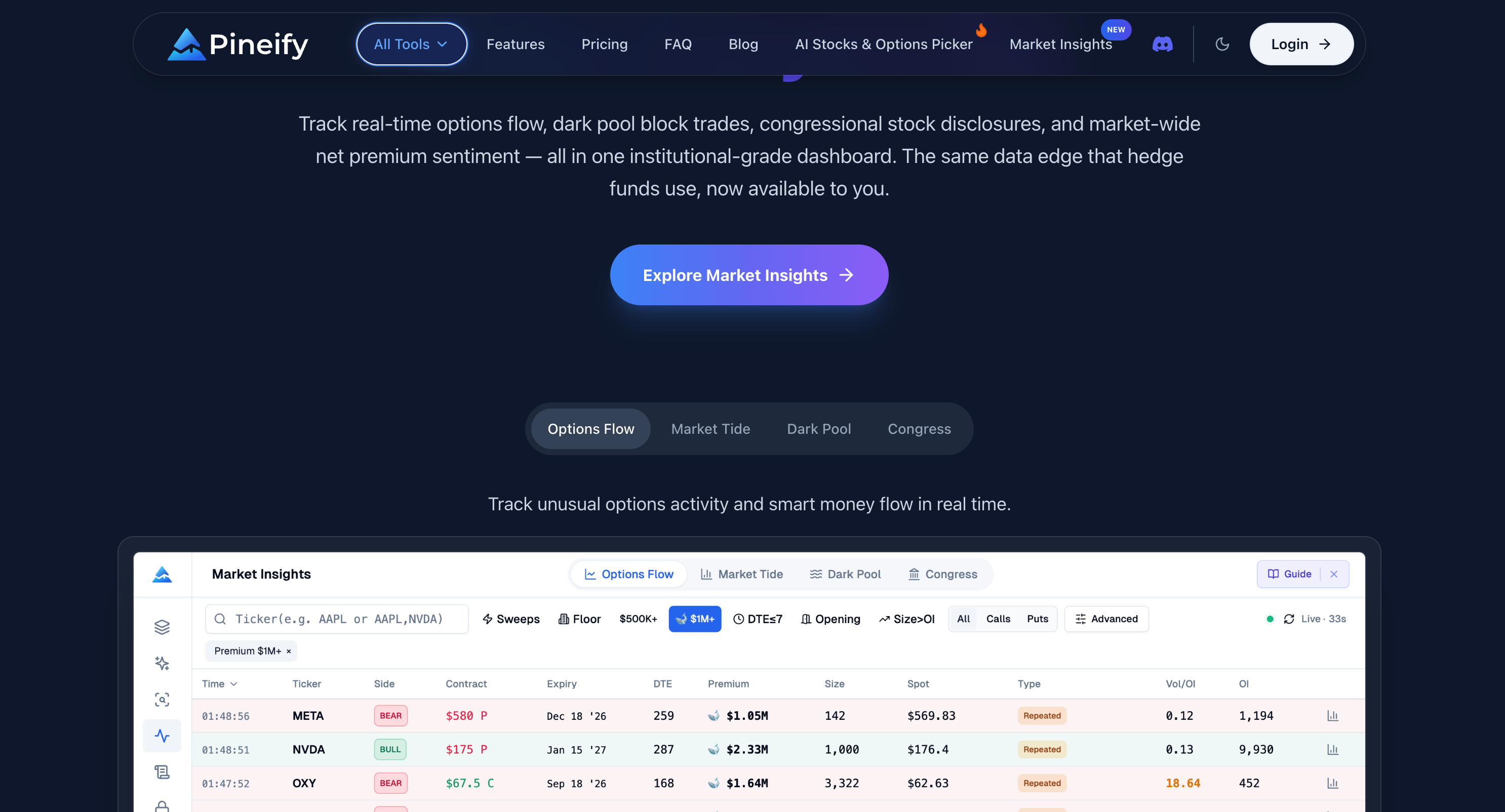
Pineify Market Tide: Net Premium, Settings, and Interpretation

Pineify Market Tide displays provider-supplied net call and net put premium, then derives summary measures from those series. It is useful for describing the selected options activity. It is not a direct measurement of institutional conviction or proof that price will follow the plotted line.
Distinguish gross spending from net premium
Gross call premium and gross put premium describe dollar activity. A net-premium series also incorporates trade-side classification. In the provider's net-flow explanation, ask-side call premium adds to net call premium, while bid-side call premium subtracts from it.
Pineify receives separate net-call and net-put series. Its directional summary subtracts net put premium from net call premium. Do not relabel those inputs as total call spending and total put spending.
For a hypothetical observation, net call premium of $3 million and net put premium of $1 million produce a $2 million directional difference. If net put premium instead equals negative $1 million, the difference is $4 million. The sign of each input matters; this calculation is not simply gross calls minus gross puts.
Read the chart and the summary together
The current chart plots separate call and put net-premium lines. The summary uses the latest observations and changes from the previous point. Percentage change is shown as unavailable when the prior value is zero. Large percentage changes from a small base need context.
The sentiment label is another transformation. In the current implementation, it compares the latest directional difference with zero and with the average of up to five recent observations. Strong labels depend on a threshold relative to that recent average. They are not calibrated probabilities of a market rise or decline.
| Display element | What to inspect | What it cannot establish |
|---|---|---|
| Net call and put lines | Signs, units, timestamps, selected date | Investor identity or full portfolio |
| Directional difference | Both input series and their definitions | A guaranteed price direction |
| Sentiment label | Classification rule and underlying values | Forecast accuracy |
| Top Net Impact | Selected universe and concentration | Every institution's position |
| Sector view | Sector definition and date | Complete capital flows into the sector |
Keep settings consistent across comparisons
The app supports a date selection, interval selection, and an out-of-the-money filter for the market-wide series. Changing these choices changes the observations being compared. A five-minute interval is not a five-minute forecast horizon.
Sector selection requests a separate sector series. The current sector request uses the sector and date; it does not carry every market-wide filter. Therefore, do not assume a sector chart is an exact filtered slice of the adjacent market-wide chart under all settings.
The sector list covers 11 named sectors and associated ETFs. Check the displayed field before interpreting a heatmap color as a sector-wide options flow measure. A sector ETF and all companies in that sector are different populations.
Refresh rate is not event latency
The current app polls the main tide series every 60 seconds, Top Net Impact every 120 seconds, and sector data every 180 seconds while the page is active. Requests pause in a hidden page and resume when it becomes active. Backend caching and the provider's publication timing also affect freshness.
These intervals describe requests, not a guaranteed arrival time for every transaction. Compare the selected date, latest data point, last successful refresh, and any error state. A newly refreshed historical view remains historical.
Treat divergences as hypotheses
A rising index alongside falling net premium is an observable divergence when the timestamps and universe match. Possible explanations include hedging, closing positions, changes in option prices, different expirations, or activity concentrated in a few names. The chart alone cannot choose between those explanations.
If you want to evaluate a divergence rule, define the lookback, threshold, entry timing, exit, costs, and comparison period before reviewing outcomes. Preserve the information available at the time. Selected examples of a later bounce or selloff cannot establish predictive performance.
Market Tide and individual options-flow alerts may include overlapping transactions. Agreement between them should not automatically count as independent evidence.
Compare platforms on data questions
Start with Pineify Market Insights and its current account access terms. Compare any alternative using the same session and definitions: source coverage, update timestamps, historical range, filters, field documentation, and export rights.
Unusual Whales documents Market Tide and net flow itself, so a comparison that says it has no such feature is incorrect. This article does not present a controlled ranking of platforms or a measured institutional trading advantage for Pineify.
Common questions
Is net premium the same as a put/call ratio?
No. A put/call ratio may compare contract volume or open interest. Net-premium measures use dollar amounts and trade-side conventions. Confirm the exact definition before comparing them.
Does a positive directional difference mean every large trader is bullish?
No. Aggregated transactions do not disclose each participant's portfolio, hedge, or intent.
Can the tool identify sector rotation before prices move?
The displays can support a hypothesis about changing activity. This article provides no reproducible evidence that they consistently lead sector prices.
Does a lifetime product license guarantee every data feature forever?
Review the current plan, data access conditions, and usage limits. Do not infer unlimited data rights or AI usage from a general license label.