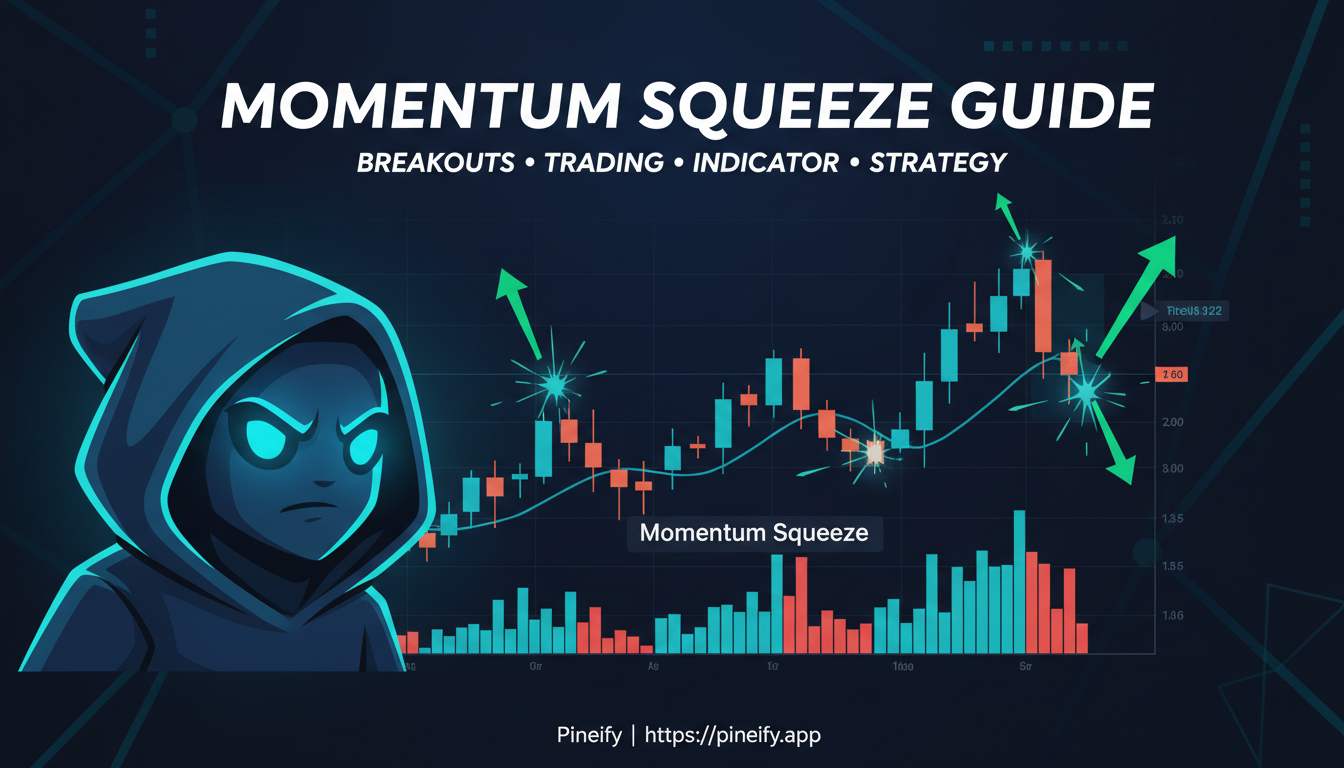
Momentum Squeeze Indicator Guide: How to Spot & Trade Explosive Breakouts
The momentum squeeze indicator is one of those tools that can really help you catch big moves in the market. It combines two important things: figuring out when volatility is about to pick up, and seeing which way the price might break. If you trade stocks, forex, crypto, or futures, this indicator can make a real difference in timing when you get in or out of a trade.
What Is the Momentum Squeeze Indicator?
The momentum squeeze indicator — you might also hear it called the TTM Squeeze or Squeeze Momentum Indicator (SMI) — was created by trader John Carter and explained in his book Mastering the Trade. At its heart, it helps you spot two key moments: when the market is quiet and coiling up (that’s the “squeeze”), and then when momentum starts pushing in one direction.
Unlike simpler tools like RSI or MACD that only look at one thing, the SMI blends two well-known indicators — Bollinger Bands and Keltner Channels — together with a momentum histogram. This mix lets you know not just that a big move might be coming, but also whether it’s likely to go up or down.
The indicator really took off after a popular TradingView script by “LazyBear” came out, which was based directly on Carter’s original TTM Squeeze idea. These days, it’s one of the most-used custom indicators on retail trading platforms everywhere.
How the Momentum Squeeze Indicator Works
The Squeeze Component
The "squeeze" is the main signal you're looking for. It happens when Bollinger Bands (BB) move inside the Keltner Channels (KC). That means price volatility has compressed to a very low level. Think of it like a pressure cooker: the tighter it gets, the bigger the eventual pop.
- Default Bollinger Bands settings: 20-period SMA, 2 standard deviations
- Default Keltner Channel settings: 20-period EMA, 1.5 × ATR (Average True Range)
When the Bollinger Bands contract inside the Keltner Channels, the indicator shows black dots (or red dots, depending on your platform) along the zero line. That's your alert—a squeeze is happening. When the Bands expand back outside the Channels, the dots turn grey (or green), meaning the squeeze has fired and volatility is expanding again.
The Momentum Histogram
Right next to the squeeze dots, you'll see a momentum histogram that moves above and below a zero line. It's based on a linear regression of price changes, smoothed out so it's easier to read. Here's what each color and direction means:
- Bars rising above zero → bullish momentum is building
- Bars falling below zero → bearish momentum is dominant
- Bars turning from bright green to dark green → bullish momentum is starting to fade
- Bars turning from bright red to dark red → bearish momentum is weakening
Put the dots and histogram together, and you get a clear picture: when to get ready for a move, and which way to trade it.
Reading the Signals Step-by-Step
Learning to read the momentum squeeze indicator in real time is what helps you make better trades. Here's how I break it down for myself (and you):
-
Spot the Squeeze (Red/Black Dots) — When dots line up on the zero line, the market is basically holding its breath. Don't jump in yet—just watch closely and wait.
-
Monitor Momentum Direction — Look at the histogram: is it above or below zero? If the bars are climbing above zero, the coming breakout is more likely bullish. Bars dropping below zero point to a bearish move.
-
Wait for the Squeeze to Fire (Grey/Green Dots) — The first grey or green dot after a run of black/red ones means the squeeze is releasing. That's your signal to act.
-
Enter in the Direction of Momentum — If momentum is positive and rising when that firing dot appears, go long. If it's negative and falling, go short. Simple.
-
Exit on Fading Momentum — When the histogram bars start getting smaller (bright green turning darker, or bright red turning darker), it's a good time to take profits or tighten your stop loss.
Alright, let me break this down in plain English. Think of this as your cheat sheet for when to jump in and when to step back. The table below spells out the signals you need to watch for — no fancy fluff, just the moves that matter.
| Signal | Condition | Action |
|---|---|---|
| Squeeze On | BB inside KC, black/red dots | Stand by, prepare for breakout |
| Bullish Squeeze Fire | Dots turn grey/green + histogram above zero | Enter long |
| Bearish Squeeze Fire | Dots turn grey/green + histogram below zero | Enter short |
| Momentum Fading (Long) | Histogram turns dark green or crosses zero | Tighten stop or exit |
| Momentum Fading (Short) | Histogram turns dark red or crosses zero | Tighten stop or exit |
| No Squeeze Active | Green dots, no compression | Wait for next setup |
Default Settings and Customization
The momentum squeeze indicator comes with default parameters that work pretty well for most timeframes and markets:
- Bollinger Band Length: 20 periods
- BB Multiplier: 2.0 standard deviations
- Keltner Channel Length: 20 periods
- KC Multiplier: 1.5 × ATR
If you're day trading on lower timeframes and want more sensitive signals, some traders reduce the Keltner Channel multiplier to 1.0 or 1.25. That way you catch squeezes a little earlier. For swing trading on daily or weekly charts, the defaults are usually just fine. Higher timeframes tend to give cleaner and more reliable signals, with fewer false breakouts.
Combining the Momentum Squeeze with Other Tools
The momentum squeeze indicator works great by itself, but it gets even better when you pair it with a few other simple tools. Here's how to make the most of it:
- Volume confirmation: When the histogram climbs and volume is also increasing, that's a much stronger sign that a breakout is real. If volume stays low during a squeeze, be cautious—fakeouts happen more often.
- Trend filters (like the 200 EMA): A good rule of thumb is to only take bullish squeeze signals when the price is above the 200-period moving average, and bearish signals when it's below. This keeps you trading in the same direction as the bigger trend.
- RSI divergence: If the momentum histogram is rising but the RSI is showing bearish divergence (price making higher highs while RSI makes lower highs), that's a warning. Consider reducing your position size or waiting for a clearer confirmation.
- Support and resistance levels: The best squeeze setups happen right at major support or resistance zones. When a stock squeezes right at a breakout level, the move that follows can be dramatic. For a comprehensive list of top support/resistance indicators, see our guide on Best Support Resistance Indicator for TradingView.
- Price action patterns: Squeezes that line up with bull flags, ascending triangles, or tight inside bars tend to produce some of the most reliable setups in technical trading.
Common Mistakes to Avoid
Even experienced traders get tripped up by the momentum squeeze indicator. Here are the most frequent errors I see—and how to steer clear of them.
-
Jumping in during the squeeze, not after the fire. Those black dots? They mean the move is loading, not launching. Jumping in early often leads to getting stopped out before the real breakout happens. Patience pays off.
-
Ignoring momentum direction. If the squeeze fires while the histogram is flat and hovering near zero, that’s a low‑conviction setup. You want to see clear directional momentum—above or below zero—before you commit.
-
Overusing it on lower timeframes. The 1‑minute and 5‑minute charts spit out a lot of signals, but they’re noisy. Stick with the 15‑minute, 1‑hour, and daily charts for setups that actually hold up.
-
Skipping a stop-loss. Always place a stop‑loss just below the consolidation range for long trades, and just above it for short trades. That way you’re protected if the breakout fails.
-
Treating it as a standalone system. No single indicator wins the game on its own. Always confirm squeeze signals with volume, trend context, and price action. Combine tools, not rely on one.
Best Markets and Timeframes for the Momentum Squeeze
The momentum squeeze indicator is pretty flexible—you can use it across different types of markets. Here’s a quick breakdown of which timeframes tend to work best for each:
| Market | Recommended Timeframe | Notes |
|---|---|---|
| Stocks | Daily, Weekly | Excellent for swing trades and earnings plays |
| Forex | 1H, 4H | Works well during major session overlaps |
| Crypto | 4H, Daily | High volatility amplifies squeeze breakouts |
| Futures/Options | 15M, 1H | Intraday squeezes common near market open |
| ETFs | Daily | Smooth price action reduces noise |
Q&A Section
Q: Is the momentum squeeze indicator the same as the TTM Squeeze?
Yes, they're basically the same idea. The TTM Squeeze is the original version created by John Carter, and the Squeeze Momentum Indicator (SMI) — made popular by the LazyBear TradingView script — is an open-source derivative that works exactly the same way.
Q: Can I use the momentum squeeze indicator on TradingView for free?
Absolutely. The LazyBear Squeeze Momentum Indicator script is freely available on TradingView as a community-published indicator. You can add it to any chart without needing a paid subscription.
Q: How many squeeze dots should I wait for before trading?
Most experienced traders recommend waiting for at least 6 to 10 consecutive black (or red) dots before taking a trade on the squeeze release. That signals a long compression, which often leads to stronger breakouts.
Q: How is the momentum histogram calculated?
It's based on the difference between the midpoint of the highest high and lowest low (over a lookback period) and a simple moving average of the close price. That value is then smoothed using linear regression.
Q: Does the momentum squeeze indicator repaint?
The LazyBear version generally doesn't repaint on bars that have already closed. But like all indicators, signals on the current (live) bar can shift until that bar finishes. Always wait for the bar to close before entering a trade. To learn more about avoiding repainting in your indicators, check out our guide on How to Avoid Repainting in Pine Script.
Next Steps: Start Trading Smarter with the Squeeze
Now that you've got the basics of the momentum squeeze indicator down, let's talk about actually using it. Here's a simple path to get started:
- Add the SMI to your charts — On TradingView, search for "Squeeze Momentum Indicator [LazyBear]" and add it to a watchlist of stocks, ETFs, or forex pairs you're already interested in.
- Practice spotting squeezes — Spend a week in paper trading mode. Just look for those black-dot sequences and watch which ones lead to strong moves. The goal is to train your eye before you put real money on the line.
- Create a simple checklist — Don't rely on the squeeze alone. Pair it with volume, the overall trend direction, and a key price level (like support or resistance). If you want to dive deeper into using pivot points for support and resistance, read our Pivot Points Trading Strategy Guide.
- Backtest on your favorite timeframe — Use TradingView's strategy tester with the LazyBear Strategy version to see how the indicator actually performs on the instruments you trade most.
- Find a place to talk shop — Simpler Trading (John Carter's community) or TradingView's public forums are great for sharing setups, getting feedback, and learning from others who use the squeeze.
The squeeze indicator rewards patience. The best trades come when you wait for the full setup—squeeze, momentum shift, and confirmation—before making a move. Master that rhythm, and you'll have a reliable tool for catching breakouts without chasing noise.
💡 Want to build and backtest squeeze strategies without coding? Meet Pineify — the all-in-one AI trading workspace trusted by 100K+ traders. With the visual editor, you can combine the squeeze with 235+ indicators, set entry/exit rules visually, and backtest in minutes — zero Pine Script required. Or use the AI Coding Agent to generate custom squeeze-based strategies in seconds. Pay once, use forever.