How to Build High-Performing Trading Strategies with AI

An AI trading strategy is any rule-based system that uses machine learning, natural language processing, or algorithmic logic to make buy and sell decisions. I've been testing these approaches since early 2025, and the gap between traders who use AI tools and those who don't is wider than most people realize. You don't need a CS degree to get started — just a clear idea of what you're trying to achieve and the right tool.
Why AI Trading Strategies Beat Manual Ones
Manual trading has its strengths, but it's held back by emotions, limited data processing, and slow reaction times. AI sidesteps all of that.
AI trading systems can look at thousands of data points at once — price action, volume, market sentiment, economic indicators, earnings reports, and options flow — all in milliseconds. They spot patterns a human would never see, and they can test a strategy against years of historical data in seconds.
The main advantages:
- Speed and scale — AI handles way more data way faster than any person
- No emotions involved — No fear, greed, or hesitation at decision time
- Learns and adapts — Models adjust as market conditions change
- Precise backtesting — Validate ideas against past data before risking capital
- Covers multiple markets — Run strategies across stocks, forex, crypto, and options at once
The Foundation: Understanding Your Market Edge
Before jumping into coding or AI tools, take a step back. The real starting point is figuring out what gives you a repeatable, statistical advantage in certain market conditions. Without that, nothing else matters.
AI can help you find potential edges, but it won't invent one from nothing. Start by asking yourself: Is my strategy about mean reversion, momentum, breakouts, or arbitrage? Once you have an answer, use AI to test that idea against past data.
A simple workflow:
- Define your edge — Pick the market dynamic you're best at (trend-following on stock indices, for example)
- Brainstorm with AI — Ask an AI tool for high-probability strategy types that fit your edge
- Choose one strategy — Mean reversion on US index ETFs, to pick something specific
- Set clear entry and exit rules — Use AI to tweak filters, stop-loss levels, and profit targets
- Test it thoroughly — Backtest on clean historical data before you trade with real money
Step-by-Step: Building an AI Trading Strategy
Step 1: Define Your Strategy in Plain Language
These days you can tell an AI what you want your trading strategy to do using normal words. For example: "Buy when the 20-day moving average crosses above the 50-day moving average, and the RSI is above 50. Then sell when the price drops 2% below my entry."
Plenty of tools let you describe your logic this way and automatically turn it into code for TradingView or MetaTrader — no programming skills needed. I personally prefer this approach over writing Pine Script from scratch, because it lets me iterate on ideas faster. If you're new to building strategies, check out this guide on how to create a strategy in TradingView to get started quickly.
Step 2: Gather and Prepare Quality Data
Your AI is only as smart as the data you feed it. You'll need a mix of:
- Price and volume history — open, high, low, close, volume across different timeframes
- Company fundamentals — earnings, revenue growth, balance sheet numbers
- Market sentiment — what people are saying on social media, news, or forums
- Unusual data — options activity, dark pool trades, insider transactions
It's not about having more data — it's about having clean data. Remove survivorship bias (only looking at stocks that still exist), fill gaps, and adjust for different market conditions before training your model.
Step 3: Build and Configure Your AI Strategy
With a visual, no-code builder you can describe your strategy and let the AI handle the coding. If you prefer to code from scratch:
- Pick your model type — rule-based, machine learning, or deep learning
- Choose your inputs (indicators, signals, filters)
- Decide how much to risk per trade, where to set stop-losses and take-profits
- Set how often you want to trade and which assets to focus on
Good platforms remove the technical headache so you can focus on the logic. I haven't tested every no-code platform out there, but the ones that support real-time data integration tend to perform better in live markets. For more on identifying high-probability trade entries, the top pullback indicators for TradingView can help refine your filters.
Step 4: Backtest Rigorously
Backtesting is where you find out if your idea actually works — before risking real money. A few rules:
- Use separate data for testing and optimization — never tune your strategy on the same data you're evaluating it on
- Include all costs — slippage, commissions, and bid-ask spreads matter
- Don't overfit — a strategy that perfectly explains every past wiggle will fall apart in live markets
- Test in different market types — up, down, and sideways
- Paper trade for at least a couple weeks before you go live
For a deeper dive into testing methodologies, the Backtrader indicators guide explores Python-based backtesting approaches that complement any AI workflow.
Step 5: Deploy and Monitor
Once your backtests show a solid edge, start with a simulated account, then slowly move to real money. I've found that checking performance at least twice a week catches most issues before they become expensive problems. A strategy that works great in a strong uptrend might completely flop when things turn choppy.
The Role of Real-Time Data in AI Strategy Performance
Relying on static AI models can be risky. When your strategy only looks at historical data without pulling in live market updates, you're bound to miss things that actually matter — surprise earnings, sudden macro announcements, fast shifts in market mood, or unusual options activity that often precedes big price moves.
That's why more experienced traders are adding a live-data AI finance agent into their research workflow.
What to Look for in an AI Finance Agent
| Feature | Why It Matters |
|---|---|
| Real-time quotes and news | Avoid outdated signals that lead to bad trades |
| Options flow and dark pool data | Detect institutional positioning before price moves |
| Social sentiment (Reddit/X) | Gauge retail sentiment driving momentum stocks |
| Insider and Congress trade tracking | Follow smart money with disclosure data |
| Natural language stock screener | Quickly find opportunities without manual filtering |
| Earnings and economic calendars | Avoid holding positions through binary events |
Best AI Tool for Trading Strategy Research: Pineify Finance Agent
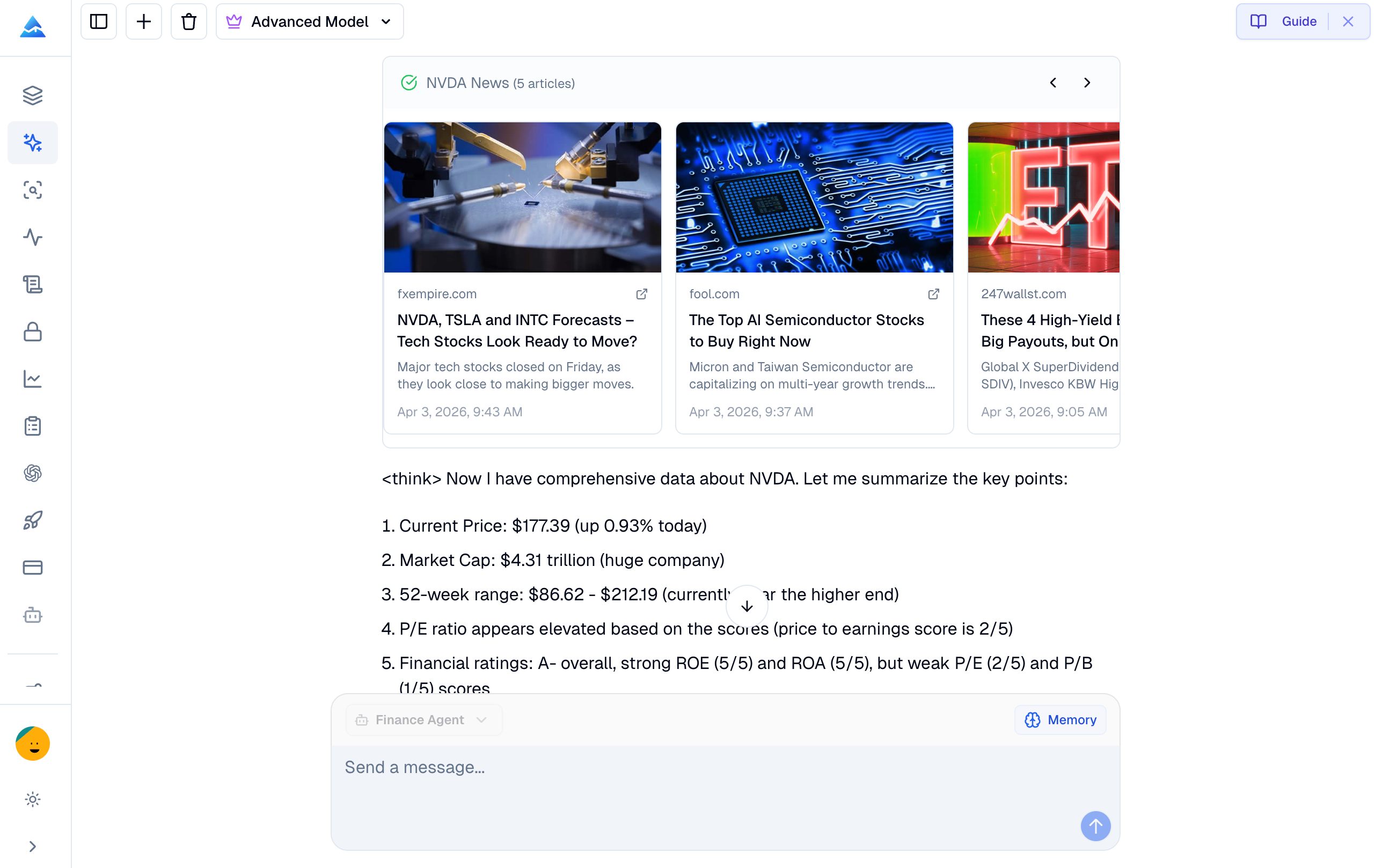
If you're looking for a way to combine live market data with your own trading strategy research, Pineify Finance Agent (pineify.app/finance-agent) is worth checking out in 2026. It's designed to help traders and investors get answers quickly without jumping between platforms.
Pineify's Finance Agent connects to 95+ professional financial data sources, covering 11,000+ stocks, 400+ crypto and forex pairs, options chains, dark pool prints, insider trades, and live social sentiment. You interact with it through a simple chat interface.
What Pineify Finance Agent Can Do for Your Strategy
- Ask in plain English — Type "Should I buy NVDA now?" and get a summary with real-time price data, financial ratios, analyst consensus, options flow, and news sentiment.
- Scan for trade setups — Use the natural language stock screener to find "undervalued small-cap tech stocks with strong free cash flow" in seconds.
- Analyze options setups — Look at full options chains, implied volatility surfaces, and unusual flow to check if your directional bias makes sense.
- Track smart money — Follow insider transactions, Congressional trades, and institutional holdings to see where informed capital is moving.
- Chart analysis — Upload a screenshot of your TradingView chart and get AI-assisted technical analysis without leaving the chat.
Built-In Finance Playbooks (Skills)
Pineify comes with ready-made research workflows you can run instantly:
/pineify-stock-deep-dive— Full investment brief on any ticker/pineify-options-analysis— IV surface, Greeks, and trade setups/pineify-market-pulse— Cross-asset market overview/pineify-earnings-breakdown— complete earnings deep dive
Pineify vs. Other AI Finance Tools
| Tool | Real-Time Data | Options Analysis | Social Sentiment | Pricing Model | Best For |
|---|---|---|---|---|---|
| Pineify Finance Agent | ✅ Live APIs | ✅ Full chains + Greeks | ✅ Reddit + X | One-time lifetime | All trader levels |
| Fiscal.ai | ✅ Institutional | ❌ | ❌ | Subscription | Equity analysts |
| Magnifi | ✅ Brokerage-linked | ❌ | ❌ | Subscription | Portfolio managers |
| Prospero.ai | ✅ Daily signals | ❌ | ❌ | Subscription | Retail beginners |
| Intellectia AI | ✅ Daily picks | ❌ | ❌ | Subscription | Short-term traders |
Pineify is the only tool in this list that combines real-time data, options analysis, social sentiment, dark pool monitoring, and insider tracking in one conversational interface — and you pay once instead of a monthly subscription.
That said, I'll be honest — the Finance Agent has a learning curve if you've never used a conversational AI for research. It's not a set-and-forget system. You get the most value when you ask specific, targeted questions rather than vague ones.
Common Mistakes When Building AI Trading Strategies
Even experienced traders make these predictable mistakes when adding AI into their trading:
- Overfitting to historical data — Your model looks amazing in backtests, then falls apart in live markets. It memorized random noise instead of learning actual patterns.
- Ignoring transaction costs — A small edge disappears once you account for spreads, commissions, and slippage at realistic trade sizes.
- Using low-quality or biased data — Survivorship bias is classic: testing only on stocks that still exist today makes results look way better than reality. Include delisted stocks too.
- Skipping paper trading — Tempting to go straight from backtest to live capital, but that's risky. Validate in simulated conditions first.
- Not monitoring for regime changes — Markets shift. A strategy that works in a bull market can fail in a bear market. Set performance thresholds that trigger a review when things drift.
To refine your entry and exit timing further, understanding pivot points high-low indicator on TradingView can help identify key support and resistance levels that many AI strategies rely on.
Getting Started with AI in Trading
Here's what you can do right now to start experimenting:
- Try a free research session on Pineify Finance Agent — Pick a stock you're watching, ask it a real question, and see how the AI's analysis compares to what you'd normally do by hand.
- Write down your trading edge in one or two sentences — Before jumping into any AI tool, get clear on what your strategy is. Then use AI to test or refine that idea.
- Backtest a strategy this week — Use Pineify's Pine Script Coding Agent to turn your strategy description into code, then run it on TradingView with historical data.
- Open a paper trading account — Before risking real money, test your strategy in a simulated environment to see how it behaves in live market conditions.
- Join a trading community — Subreddits like r/algotrading or r/stocks are full of traders sharing real experiences with AI-based strategy tools.
- Stay up to date — AI trading tools change fast. Bookmark Pineify's blog and check back monthly for updates.
Do I need to know how to code to build AI trading strategies?
Not at all. Platforms like Pineify let you describe your strategy in plain English, and they automatically generate the underlying code. The barrier to entry has never been lower — anyone can get started without programming experience.
How long should I backtest a strategy before going live?
Most pros recommend backtesting across at least three to five years of historical data covering different market cycles (bull, bear, sideways). After that, run the strategy in a paper trading environment for at least two to four weeks before risking real money.
What is the difference between a rule-based AI strategy and a machine learning strategy?
Rule-based strategies follow clear, human-defined rules (like "buy when RSI drops below 30"). Machine learning strategies find patterns in data on their own and can adapt over time. ML strategies are more prone to overfitting if not validated carefully. For most retail traders, rule-based strategies with AI-assisted optimization offer the best balance of reliability and performance.
Can AI predict market crashes or black swan events?
No. By definition, black swan events fall outside historical patterns, so no AI can reliably predict them. But AI tools can spot early warning signs: rising systemic risk through options market signals, credit spread widening, unusual dark pool activity, or shifts in macro data — giving you a heads-up much earlier than manual methods.
Is an AI trading strategy builder suitable for beginners?
Absolutely. Tools like Pineify work for everyone — individual investors can ask plain English questions and get actionable insights, while professionals can dive into advanced options chains, dark pool data, and institutional flow. The conversational interface removes the need for financial jargon or technical expertise.
What data sources should I use when building an AI trading strategy?
Quality data is critical. You need price and volume history across timeframes, company fundamentals (earnings, revenue), market sentiment from social media and news, and unusual data like options activity and insider transactions. Always clean your data, remove survivorship bias, and fill in gaps before training any model.
Try Pineify yourself — it's the all-in-one AI trading workspace trusted by 100K+ traders worldwide. Build strategies with no code, analyze markets with the Finance Agent, spot institutional moves with Market Insights, and track your progress with the Trading Journal. One payment, lifetime access.
Disclaimer: This article is for educational and informational purposes only and does not constitute financial advice. Always consult a licensed financial advisor before making investment decisions. Trading involves risk, including the possible loss of principal.