Best ChatGPT Prompts for Personal Finance: Smarter Money Habits

Managing money can feel overwhelming sometimes. ChatGPT is an AI chatbot that answers your questions in natural language -- think of it as a patient friend who is great with numbers. With the right prompts, it can work through budgeting, debt payoff plans, savings strategies, and investing basics with you.
Below are the best ChatGPT prompts for personal finance -- the exact phrases to use, why they work, and how to tailor them to your own situation.
Why ChatGPT Works for Personal Finance Questions
More and more people are turning to AI for help managing money. ChatGPT has become a regular tool for financial questions. The real advantage is the back-and-forth conversation. Unlike a static article, it adapts to your exact salary, spending habits, and goals.
A good prompt can:
- Save mental effort. It handles the math for budgets or debt payoff timelines in seconds.
- Build plans around your life. Give it your real numbers and it structures a framework specific to you.
- Help you learn by talking. Stuck on a term? Ask for a simpler explanation. Need a real example? Ask. It turns complex topics into a conversation.
- Be there when you need it. No waiting for business hours. No feeling shy about asking basic stuff.
Treat ChatGPT as a smart helper, not a certified financial advisor. It is great for planning, learning, and exploring options. For big decisions involving taxes, investments, or retirement, double-check details with a qualified human professional.
Best ChatGPT Prompts for Budgeting
Let us be honest -- thinking about a budget can feel tedious. But getting a clear picture of your money is the first real step toward financial confidence. The trick with ChatGPT is to give it real details from your life.
The golden rule: use your actual numbers. When you plug in your real income, rent, and grocery spending, the plan you get back will be a real starting point, not a generic template. I have used this approach myself -- plugging my actual $3,800 monthly take-home into a prompt gave me a budget that actually worked for my situation. Traders apply the same principle: specific inputs lead to specific outputs. The Best Swing Indicator TradingView: Complete Guide to Maximizing Trading Success applies this same structured logic to market analysis.
Prompts to try:
- "My take-home pay is $3,800 per month. My rent is $1,400, my car payment is $350, and all my subscriptions (streaming, phone, etc.) add up to about $120. Can you create a monthly budget using the 50/30/20 rule (needs/wants/savings) and show me where I might be overspending?"
- "I make about $80,000 a year. My main goals are to pay down my credit card debt faster, save for a house down payment, and start investing. Can you build a straightforward, realistic monthly budget that works toward all three?"
- "Help me create a monthly budget for a family of four. We bring in around $8,000 a month after taxes. Include common categories for groceries, kids' activities, and family entertainment."
- "I'm feeling lost with my spending. I have my bank statements from the last three months. Can you give me a framework to categorize these expenses so I can see my actual spending patterns?"
Follow-up that makes a difference: Once ChatGPT gives you that first budget draft, do not stop there. Ask a follow-up: "Looking at this budget, what is the one most effective change I could make to save an extra $300 each month?"
This forces the AI to prioritize. Instead of ten possible tips, you get one focused step you can actually take.
Getting Help with Debt: ChatGPT Prompts That Work
Debt is not just numbers on a screen. It is sleepless nights and background stress. The good news is you do not have to figure it out alone. ChatGPT acts as a clear-headed friend helping you sort the chaos into a step-by-step plan.
It is especially good at comparing payoff methods side by side so you can choose what fits your situation.
How to Ask for a Debt Payoff Plan
Give ChatGPT specific details about your debts. The more real numbers you provide, the better the plan.
To build a custom plan from scratch:
"Help me formulate a clear plan to pay off my debts. My debts are: [list amounts + interest rates]. Tell me which debt to prioritize first and why. Create a monthly action plan I can realistically follow."
For a concrete goal with a deadline:
"Develop a step-by-step roadmap to pay off $10,000 of credit card debt in the next two years. Include estimated monthly payments and how much interest I'll save compared to making only minimum payments."
To understand your strategy options:
"Break down the financial differences of using the debt snowball vs. the debt avalanche for my debts: [list your debts]. Show me the total interest paid and the timeline for each method."
For help talking to creditors:
"Write me a simple, polite script to negotiate a lower interest rate on my credit card. I've been a customer for [X] years and always pay on time."
To manage multiple financial priorities:
"I have $5,000 in savings, $8,000 in student loans at 6%, and $3,000 in credit card debt at 19%. My monthly take-home pay is $[X]. Create a payoff strategy that minimizes total interest paid while keeping a small safety net."
Snowball vs. Avalanche: Quick Comparison
| Tactic | How it Works | Best For... |
|---|---|---|
| Debt Snowball | Pay off the smallest balance first while making minimum payments on the rest. Then roll that payment into the next smallest debt. | People who need quick wins to stay motivated. |
| Debt Avalanche | Pay off the highest interest rate first while making minimum payments on the rest. Then move to the next highest rate. | People focused on saving the most money on interest over time. |
Real example:
"I have a $500 medical bill (no interest), a $2,000 credit card at 22% APR, and a $10,000 car loan at 5% APR. Show me my payoff timeline using both the snowball and avalanche methods, including total interest paid."
The most important thing is starting. These prompts can help you move from stuck to having a clear path forward.
How to Use ChatGPT to Save More Money
Saving money can feel like a grind, whether you are starting an emergency fund from scratch or setting aside cash for a trip. You do not have to figure it out alone. ChatGPT can help you build a realistic timeline and spot expenses you might miss.
The more detail you give, the more useful the advice.
Building a Strong Financial Foundation
- "Create a savings plan to build a $25,000 emergency fund within the next three years, starting from zero."
- "Help me make a plan to save $5,000 for a vacation to [destination] within the next 12 months."
Trimming Everyday Spending
- "Suggest practical and realistic ways to minimize my unnecessary daily costs. Focus on food, subscriptions, transportation, and impulse buying. For each category, propose small habit changes that add up to substantial savings over time."
- "I want to save $X per month. Analyze my spending habits below and suggest specific items to cut: [paste expense list]."
Cutting Fixed and Household Costs
- "Suggest 5--10 creative ways I can lower my utility bills."
Follow up with: 'Can you break that first step down further?' or 'What is a good alternative to [specific expense]?' Use the conversation to brainstorm and stay on track.
Getting Started with Investing: How ChatGPT Can Help
Do not let any AI pick your stocks for you. That needs your own research and judgment. But if you are new to investing and feel overwhelmed, ChatGPT can explain the confusing parts. I have used it myself to break down terms like 'expense ratio' and 'diversification' when I was getting started. It is a tool for building knowledge so you can approach investing with more confidence.
| What You Want to Know | Try Asking ChatGPT This |
|---|---|
| Learn the basics | "Explain index funds to me like I've never invested before." |
| Compare account types | "Compare a Roth IRA vs. a Traditional IRA for someone earning $75,000/year." |
| Understand ETFs | "What are the key differences between ETFs and mutual funds?" |
| Build a starter portfolio | "Show me a sample diversified portfolio for a 30-year-old just starting to invest with $5,000." |
| Real estate vs. stocks | "Break down the pros and cons of investing in real estate vs. the stock market for a first-time investor." |
| Estimate investment growth | "What's the Rule of 72, and how do I use it to estimate when my money will double?" |
Be specific in your prompts. Instead of 'Tell me about investing,' ask for a specific concept or comparison. Use the answers as a starting point for your own research. If your investing journey leads you to TradingView, I have found that understanding the scripting language is a huge advantage. Our guide on Pine Script Version 5: A Powerful Upgrade for TradingView Scripting covers the latest features for custom market tools.
Taking Your Strategy to the Next Level
Once you have built a foundation of knowledge, the next step for many traders is to build and test their own strategies. This is where specialized tools help. While general AI is great for learning, platforms built for traders can help you turn knowledge into backtested plans.
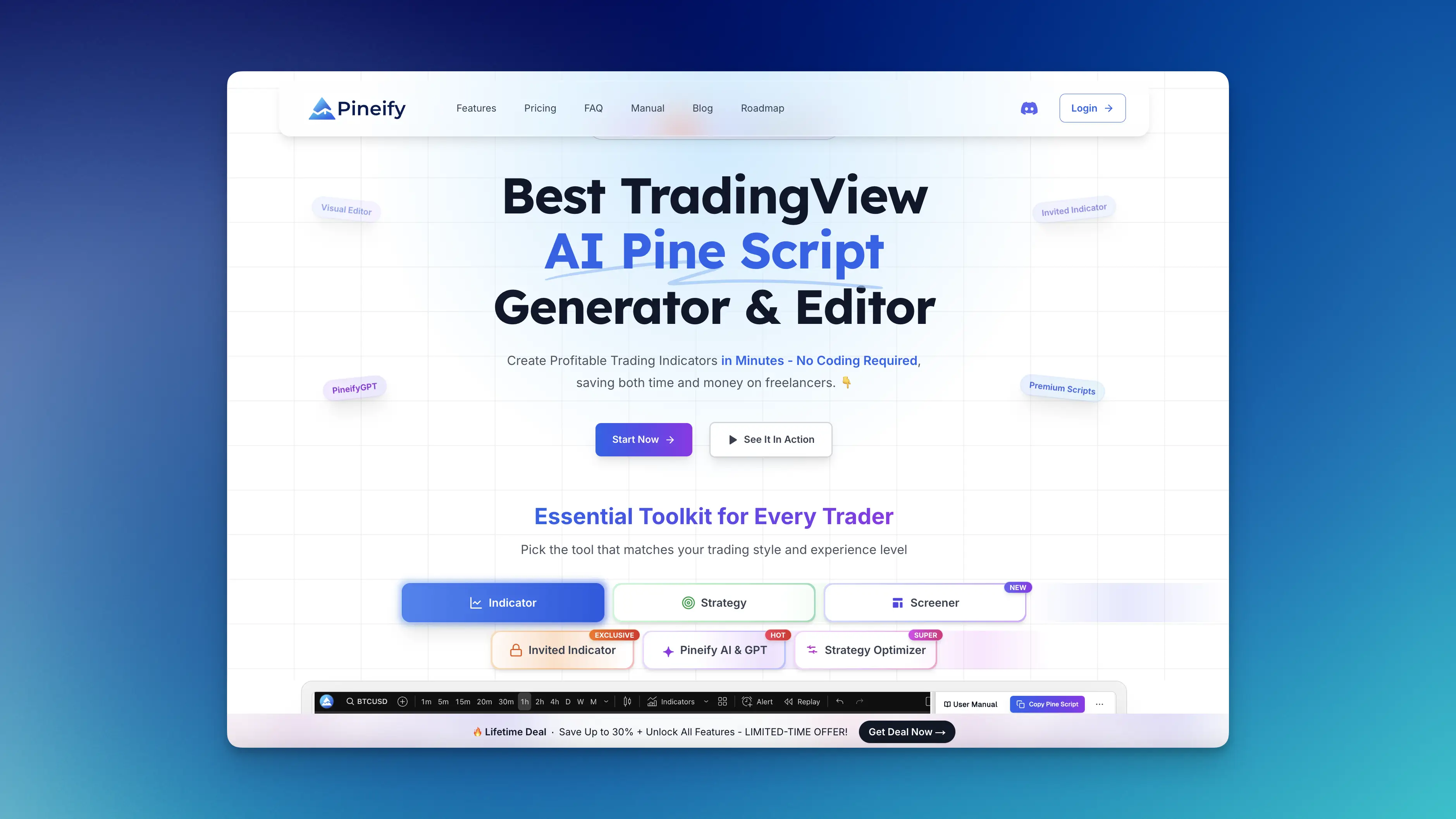
Pineify bridges the gap between having a trading idea and executing it. It lets you build custom TradingView indicators without coding, backtest strategies with institutional-grade reports, and get AI-powered market analysis -- all in one place.
Getting Your Money on Track: ChatGPT Prompts for Financial Goals
You know that feeling of having money goals but no real plan to get there? ChatGPT can turn those wishes into a roadmap. These prompts help you build specific, measurable, time-bound targets and figure out the practical steps to reach them.
Here are a few ways to start:
1. Building a Plan From Scratch
"Outline a step-by-step guide for setting and reaching realistic financial goals. Start by evaluating my current financial status, including income, expenses, and debts. Then describe how to set specific, measurable goals like saving a target amount, eliminating debt, or budgeting for a major purchase." Why it works: It asks ChatGPT to first assess where you are now -- the most important step before deciding where you are going.
2. When Everything Feels Urgent
"How do I prioritize my financial goals? I want to build an emergency fund, pay off student loans, save for a house, and contribute to retirement." Why it works: Juggling multiple goals is overwhelming. This asks ChatGPT to explain the principles of financial prioritization so you can decide what to focus on first.
3. A Tailored Quick-Start Plan
"Ask me a few questions to understand my financial situation and goals, then give me a simple financial plan I can follow." Why it works: This turns ChatGPT into an interviewer, prompting you to provide key details. Keep them general -- never share exact account numbers. The output will be custom to your answers.
4. Long-Term Future Planning
"Help me create a roadmap for retirement, including how much I need to save monthly to retire by age [X]." Why it works: It turns a vague goal into a concrete math problem. You will get a monthly savings figure that makes retirement feel reachable.
The magic is in the follow-up. Take any answer and say, 'Now break the first step down into three smaller tasks.' Or 'What are common mistakes people make here?' Build clarity one piece at a time.
Get a Handle on Tax Season with ChatGPT
Tax season is a pain for most people. Instead of scrambling at the last minute, use ChatGPT to get organized and understand your options. It can explain concepts, generate checklists, and explore strategies that might save you money.
The right questions make the difference.
Start with Common Deductions
"What are the most common tax deductions for middle-class families with children?"
Get Organized Early
"Generate a checklist of documents I will need to file my 2025 taxes."
Understand a Key Decision
"Explain how taking the standard deduction vs. itemizing my deductions would affect my tax return."
Explore Smart Accounts
"Show me how a Health Savings Account (HSA) could lower my tax liability."
I have not tested ChatGPT for business taxes yet -- I would stick with a CPA for that one. For complex situations, nothing replaces qualified tax advice.
Get Better Answers from ChatGPT on Your Money Questions
Asking ChatGPT for financial advice is like asking a friend for directions. Say 'I am at Main Street, need to get to the library by 5 PM, and I am okay with a 15-minute walk' -- you will get a perfect route. Precisely what works for directions works for money and for trading. I prefer using the TradingView Trading Session Indicator to keep my entry and exit timing consistent.
Better answers start with better questions.
- Use real numbers. Instead of 'I have some debt,' try 'I have $3,200 in credit card debt at 18% interest and a $250 car payment.'
- Paint the full picture. Include your age, kids, retirement target, and risk tolerance. 'I am 30, risk-averse, and saving for a house in 5 years' gives the AI everything it needs.
- Demand plain English. If it throws out 'asset allocation' or 'tax-loss harvesting,' say: 'Explain that like I am new to this.'
- Ask for a second opinion. Say: 'That is one approach. What is an alternative strategy?' or 'Make that plan more aggressive.' It will revise its thinking.
- Safety tip: Treat it like a public forum. Never type your Social Security number, bank details, or passwords. Use hypothetical numbers.
Frequently Asked Questions
What is the best way to use ChatGPT for personal finance?
Give it specific details about your financial situation. Share your actual income, expenses, and goals instead of vague questions. For example, tell it your monthly take-home pay and fixed costs to get a personalized budget. I find it works best as a brainstorming partner for debt payoff plans, savings strategies, and investment concepts.
How do I write effective ChatGPT prompts for budgeting?
Start with your real numbers. Include your monthly income, fixed expenses like rent and car payment, and variable costs such as groceries and entertainment. A prompt like "My take-home pay is $3,800 and my rent is $1,400. Create a 50/30/20 budget and show me where to save" gives ChatGPT what it needs. Follow up by asking for specific improvements.
What are the risks of using ChatGPT for financial advice?
ChatGPT is an educational tool with real limits. It does not know your personal circumstances, cannot access real-time market data, and may give outdated or inaccurate info. Never share your Social Security number, bank account details, or passwords. For big decisions on taxes, large investments, or retirement, talk to a qualified professional.
Can ChatGPT help me compare debt payoff strategies?
Yes. Ask it to compare the debt snowball method (smallest balances first) against the debt avalanche method (highest interest rates first). Give it your specific debts with amounts and interest rates, and it will calculate timelines and total interest for each method. This helps you pick the approach that fits your situation.
How does ChatGPT compare to a human financial advisor?
ChatGPT is good for education, ideas, and day-to-day money questions. It is available 24/7 and explains concepts in plain language. A human fiduciary advisor is legally required to act in your best interest and can handle complex tax, estate, and retirement planning. I would use ChatGPT to get informed, then rely on a pro for high-stakes decisions.
Your Next Steps: Start Using These Prompts Today
You have a complete set of ChatGPT prompts for personal finance ready to go. The trick is not knowing them all -- it is actually using one. Here is a simple way to make progress starting today.
- Choose one stress point. Is it credit card debt keeping you up? Feeling like you never save? Pick that one thing and find the matching prompt from above.
- Make it yours. Copy the prompt, swap in your real numbers, and drop it into ChatGPT, Claude, or whatever AI assistant you prefer.
- Talk it out. Do not accept the first answer. Ask 'why?' or 'can you explain that simpler?' Request an example. Turn it into a back-and-forth until the advice fits your life.
- Make it a monthly check-in. At the start of each month, run a budgeting prompt again to see how you did and tweak your plan. Quick financial health check.
- Pass it on. If a prompt helped you save for something or tackle a debt, tell someone. Share it with a friend.
Try this week: Commit to trying just one prompt. Even one budget or debt payoff prompt can change where your money is next year. The best plan is the one you actually start.